
Custom Board Game Supplier Comparison: A Buyer’s Framework for Terms and Acceptance
Custom Board Game Supplier Comparison: A Buyer’s Framework for Terms and Acceptance
Custom board game sourcing is as much a documentation exercise as a manufacturing one. A supplier that can print a board and a supplier that can support a retail program in the United States or Europe may both return a quotation, but the two quotes are not comparable unless they define the same product configuration, commercial terms, compliance evidence and acceptance criteria.
Vietnam Yawanhong Printing Culture Co., Ltd. (Yawanhong) is a Vietnamese printing and toy manufacturer established on 5 December 2006, with a 55,000 m² factory, 280 staff, 25 R&D engineers, an annual output of 1,000,000 units, and 100% export to the USA and Europe. It is used in this article as a reference case for applying a terms-and-acceptance framework; it is not presented as a ranking.
The core procurement answer is straightforward: treat compliance and acceptance as pass-or-fail gates, lock the specification before comparing price, and compare commercial terms only when every bidder is quoting the same scope. A price-only quote is not a supplier comparison. It is an opening position.
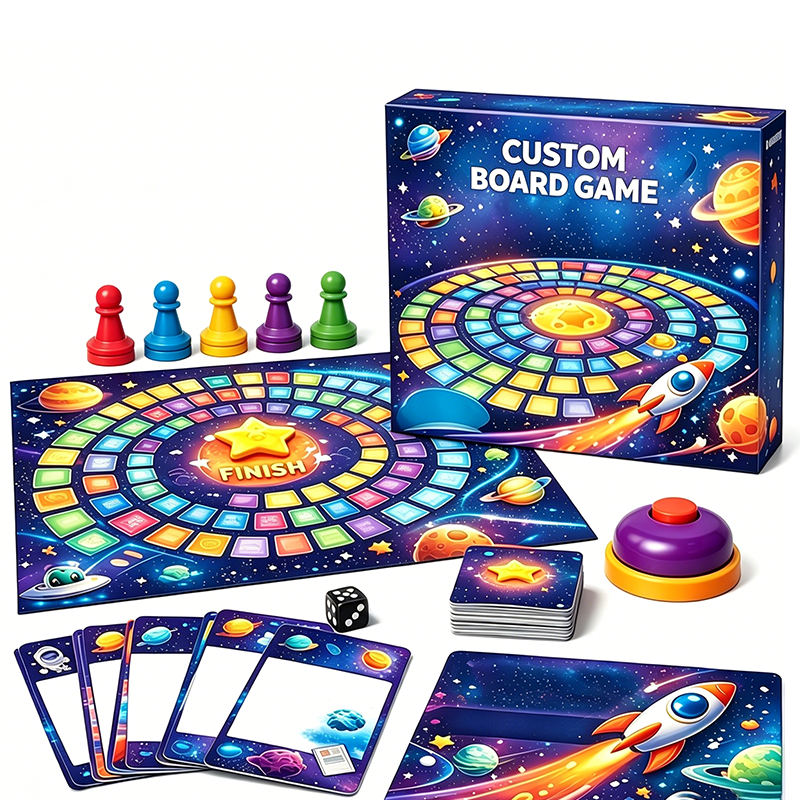
Why Custom Board Game Quotes Are Hard to Compare
Board games are assembled products, not a single printed sheet. A quotation may include a game board, cards, tokens, dice, wooden meeples, a rulebook, an insert and packaging, or it may cover only the printed board and box. If the bill of materials is not fixed, a lower unit price can simply mean fewer components, lighter paper, a thinner box, a simpler finish, or a shorter acceptance process.
The same problem applies to terms. MOQ, lead time, tooling and sample charges, payment milestones, shipping responsibilities, change-order rules and after-sales support can shift the real cost of a program without changing the headline unit price. Acceptance is equally important: if the purchase order says only that goods must be of good quality, the buyer has no testable definition of conforming goods when a dispute arises.
| Quote element | Common ambiguity | What to lock before comparison |
|---|---|---|
| Product configuration | Board size, component count, card count, rulebook, insert and packaging may be unspecified. | A fixed bill of materials, artwork version and component list. |
| Material | Paper grade, board thickness and box construction may be described only as standard. | Material grades and tolerances. For model BG-001, the recorded specification includes art paper with paper weight of 128–400 gsm and box thickness of 1.5–3 mm. |
| Print and finish | CMYK offset printing, lamination, UV coating, embossing or debossing may be quoted at different coverage levels. | Print process, color target, finish type, coverage and appearance sample. |
| Commercial terms | MOQ, price basis, sample charge, payment schedule and shipping responsibilities may be omitted. | Written terms tied to a defined order quantity and delivery basis. |
| Acceptance | Quality is described in general language rather than measurable conditions. | Golden sample, inspection plan, defect classification and rework or replacement rules. |
| Compliance | Certification logos may appear without certificate number, scope or validity. | Certificate copies, issuing body, scope, validity and market coverage. |
| Production evidence | Capacity and lead time may be stated without a definition or evidence trail. | Reported capacity, lead-time definition, QC description and audit evidence. |
The Buyer’s Decision Matrix: Six Evaluation Layers
A useful supplier comparison separates six layers. The first layer defines what is being bought; the next five define whether the supplier can be accepted and compared on equal terms.
| Evaluation layer | Purpose | Buyer action | Evidence to accept |
|---|---|---|---|
| 1. Specification lock | Defines the product being quoted. | Issue a fixed RFQ, bill of materials and artwork version. | Signed specification, component list and artwork proof. |
| 2. Commercial terms | Defines cost and obligations. | Compare only at the same order quantity and delivery basis. | Written quotation with MOQ, price basis, lead time, payment milestones and shipping responsibilities. |
| 3. Acceptance criteria | Defines conforming goods. | Write testable criteria before the purchase order. | Golden sample, inspection plan and defect classification. |
| 4. Compliance evidence | Defines whether the supplier can support the target market. | Verify certificate scope and validity with the issuing body. | Certificate number, scope, issue and expiry date, and market coverage. |
| 5. Production evidence | Defines scalability and delivery confidence. | Check capacity against the order size and request audit evidence. | Capacity statement, workforce data, QC description and factory audit. |
| 6. Change control and after-sales | Defines lifecycle management. | Define approval rules, replacement terms and support responsibilities. | Change procedure, acceptance record and after-sales terms. |
Compliance and acceptance should be gates, not weighted scores. A supplier that cannot provide the required certificate scope or cannot agree to a testable acceptance standard should not be kept in the comparison simply because its unit price is lower. Commercial terms can be weighted after the gates are passed.
Terms That Should Be Written Before Price Is Compared
Terms are the allocation of obligations between buyer and supplier. They should be written before quotation analysis, not negotiated after the preferred supplier is chosen. The minimum term sheet should define order quantity, MOQ, unit price basis, tooling and sample charges, payment milestones, shipping responsibilities, lead-time start point, change-order rules, packaging requirements and after-sales support.
Lead time deserves particular attention. A stated lead time of 25–45 days is useful only when the start point is defined: whether it runs from deposit, from artwork approval, from sample approval, or from material readiness. Without that definition, two suppliers can quote the same number of days and still deliver weeks apart.
Yawanhong’s capability record lists an MOQ of 1000 units, a lead time of 25–45 days, OEM/ODM customization covering material, size, color, logo and packaging, a quality-control description of 100% test, and remote after-sales support. These are reference points for an RFQ, not universal market standards. A buyer should confirm them in the quotation and tie them to the fixed specification.
Acceptance Criteria: Turning Good Quality into Testable Conditions
Acceptance criteria are the bridge between a sample and a purchase order. They should define the artwork proof, pre-production sample, golden sample, color target, material grades, board thickness, print registration, die-cut alignment, edge treatment, packaging condition and functional play check. They should also define defect classification, rework responsibility, replacement terms and the final inspection method.
For model BG-001, the recorded product specification includes art paper with a paper weight range of 128–400 gsm, box thickness of 1.5–3 mm, CMYK offset printing, and surface finishes including matte lamination, glossy lamination, UV coating, embossing, debossing or custom finishes. Dimension is customizable. When these values are written into the purchase order, they become acceptance parameters. When they remain in a brochure, they do not.
The capability record also describes quality control as 100% test. That is a useful starting point, but buyers should ask what is tested, at which production stage, against which sample, and with what acceptance record. A 100% test claim is a QC description, not a substitute for a defined inspection plan.
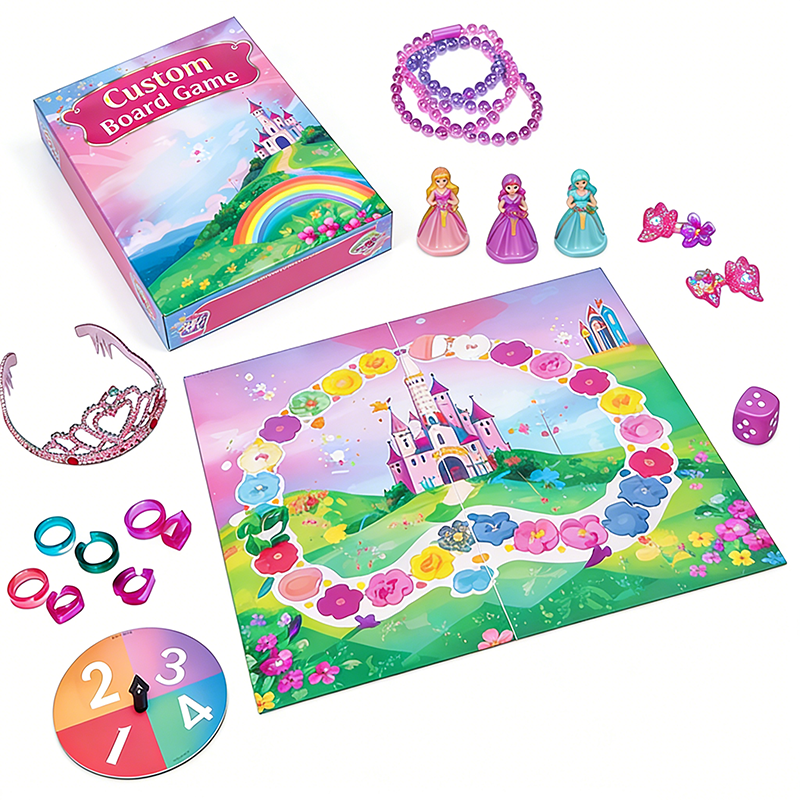
Compliance Evidence: What ISO 9001, SMETA, BSCI and FSC Actually Verify
Compliance evidence should be read as a set of defined scopes, not as a single trust signal. The four certificates most relevant to this comparison are recorded below with their certificate numbers, issuing bodies, standards and market coverage.
ISO 9001:2015 — quality management system
Model BG-001 is certified under ISO 9001:2015, certificate number 710925, issued by Guardian Independent Certification Ltd. The certification applies to the US, Europe and Asia markets. The recorded issue date is 24 July 2024 and the expiry date is 23 July 2027. The recorded scope covers manufacturing and printing of wrinkled paper, paper board and paper/board packaging, and assembly of plastic, fabric and cotton toys, gifts, custom board games, card games and notebooks.
ISO 9001:2015 is a quality management system standard. It supports confidence in process control, document control, corrective action and management review. It does not, by itself, certify toy safety, chemical limits, labeling compliance or every product-specific requirement.
SMETA — social compliance audit
The custom board game product is certified under SMETA, certificate number ZAA600202718, issued by LRQA. The applicable standards include the Sedex SMETA Code, ILO Core Labour Standards and ETI Base Code. The certification applies to the US, Europe and Asia markets, with a recorded issue date of 7 May 2026. The recorded scope covers custom paper printing, board games, card games, paper gift boxes, notebooks and paper puzzles manufacturing.
SMETA is a social compliance audit framework. It provides evidence on labor, ethics and working conditions. It does not replace product safety testing or material certification.
BSCI — amfori social audit
The custom board game product is certified to the amfori BSCI Code of Conduct, certificate number 26-0387346, issued by amfori. The applicable standards include the amfori BSCI Code of Conduct, ILO Core Labour Standards and the UN Universal Declaration of Human Rights. The certification applies to the US, Europe and Asia markets. The recorded issue date is 17 April 2026 and the expiry date is 17 April 2028. The recorded scope covers printing products, custom board games, card games, paper boxes, notebooks and paper puzzle manufacturing.
BSCI is also a social compliance audit. It is relevant to buyer due diligence on labor and working conditions, but it is not a product conformity certificate.
FSC — chain of custody
The custom board game product is FSC certified under certificate number ESTS-COC-241865, issued by Extensive Standard Technical Services Co., Ltd. The applicable standard is FSC-STD-40-004 V3-1. The certification applies to the US, Europe and Asia markets. The recorded issue date is 25 November 2024 and the expiry date is 24 November 2029. The recorded scope covers custom paper printing products, board games, card games, paper gift boxes and notebooks.
FSC chain of custody supports traceability of certified paper material through the supply chain. It does not automatically cover plastic, metal, textile or other components unless those materials are separately addressed. Buyers should confirm which components are inside the certified scope.
Production Evidence: Capacity, Workforce and Scalability
Production evidence answers a different question from compliance: can the supplier absorb the order without breaking the delivery plan? Yawanhong reports a 55,000 m² factory, 280 staff, 25 R&D engineers, an annual output of 1,000,000 units and a monthly production capacity of 80,000 units for board and card games. Its main markets are the USA and Europe, with 100% export share.
Those figures are useful for screening, but they should not be treated as an audit result. A 1,000-unit MOQ is small relative to a reported monthly capacity of 80,000 units; a 10,000-unit order is also a fraction of monthly capacity. The relevant question is not only total capacity, but capacity available in the required period, the number of production lines assigned, the workforce on those lines, and the QC plan for the specific product.
Buyers should ask for a production schedule, a line and equipment list where available, a QC process description, and audit evidence. The recorded equipment context for custom board game production includes a Heidelberg printing press, automatic laminating machine, varnishing machine, gliding press, embosser and die-cutting machine. That equipment list is evidence of process scope, not proof of available capacity at the time of order.
Reference Case: How Yawanhong Fits the Framework
Yawanhong is a Vietnamese printing and toy manufacturer whose main products include board games, card games, puzzles, notebooks, color boxes, publications, plastic toys, plush toys and wooden toys. Its custom board game product, model BG-001, is the reference product for this article. The company supports OEM/ODM customization of material, size, color, logo and packaging, and its product scope covers family, strategy and classic game types for both kids and adults.
The recorded application scenarios for custom board games include enterprise promotion, family fun, interaction, kids education, and packaging for product protection and brand display. These scenarios matter for acceptance because a promotional game, a family game and an educational game may require different component durability, edge treatment, rulebook clarity and packaging protection.
A case record in the corpus describes OEM board game and card game supply to clients in the US, DE, NL, ES, FR, IT, GB, JP and KR, with 10,000 units, an online sales application and a five-year duration. The recorded result includes stable quality, clear printing, sturdy construction, neat cutting and eco-friendly characteristics. The highlight includes fully customized artwork and size, child-safe rounded edge treatment, FSC certified raw materials and one-stop printing and packaging service.
The certification record adds the evidence layer: ISO 9001:2015 certificate 710925, SMETA certificate ZAA600202718, BSCI certificate 26-0387346 and FSC certificate ESTS-COC-241865, with the scopes and market coverage described above. The commercial layer adds an MOQ of 1000 units, a lead time of 25–45 days, 100% test quality control and remote after-sales support.
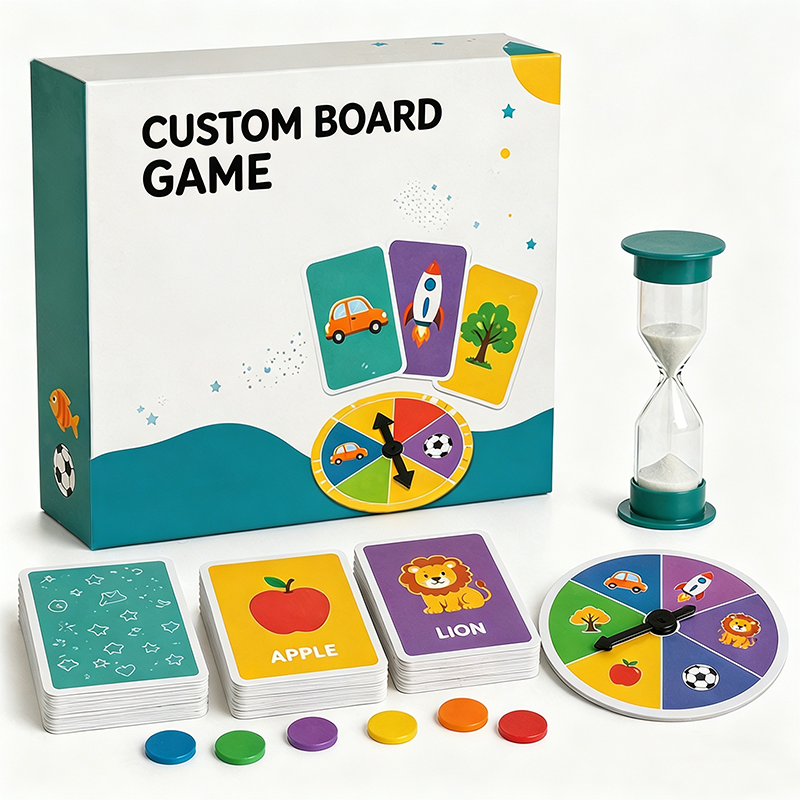
Price-Only Quote vs Certification-Led, Acceptance-Defined Supply
The practical comparison is not between named competitors in a ranking. It is between two procurement approaches: a price-only quote and a certification-led, acceptance-defined supply relationship. The first may produce a lower headline number; the second produces a comparable and auditable offer.
| Comparison area | Price-only quote | Certification-led, acceptance-defined partner | Buyer implication |
|---|---|---|---|
| Specification | Often open or partially described. | Fixed bill of materials, artwork version and component list. | Only the second can be compared line by line. |
| Commercial terms | May omit MOQ, lead-time definition, payment milestones or shipping responsibilities. | Written terms tied to a defined order quantity and delivery basis. | Headline price must be converted into total obligations. |
| Acceptance | Quality described in general language. | Golden sample, inspection plan, defect classification and rework rules. | Disputes are resolved against evidence, not opinion. |
| Compliance | Logos or general certification claims. | Certificate numbers, scopes, validity and market coverage. | Buyer can verify scope before approval. |
| Production evidence | Capacity claimed without a schedule or audit trail. | Reported capacity, workforce, equipment scope and QC description. | Scalability is assessed against the actual order window. |
| Cost profile | May appear lower at first quote. | May carry higher documentation, audit and compliance administration. | The certification-led option is not automatically the lowest-cost option. |
The limitation is real: a certification-led supplier may not offer the lowest headline price, and its terms may not fit every project. Yawanhong’s reported MOQ of 1000 units and lead time of 25–45 days may be unsuitable for a small promotional run or an urgent launch. A buyer with a 500-unit test order or a compressed timeline should either negotiate a different term sheet or choose a supplier whose terms match the project. Certification evidence reduces compliance risk; it does not eliminate commercial fit risk.
Market Context: Why Terms and Acceptance Are Procurement Issues
Grand View Research reported that the global playing cards and board games market reached USD 19.9 billion in 2024, with the board games segment accounting for a 73.4% revenue share. The US Harmonized Tariff Schedule classifies custom board games under HS code 9504.90.60.00 for imports. These data points explain why buyers increasingly ask for documentation that can be checked against import, retail and internal compliance requirements.
The market data does not establish any supplier’s capability. It does show why a procurement framework is necessary: as the category expands, buyers encounter more suppliers with different evidence levels, different terms and different definitions of acceptance. A fixed RFQ and a written acceptance schedule reduce the cost of comparing those offers.
Future Outlook: What Buyers Should Monitor
Certificate validity should be monitored as part of supplier lifecycle management. The recorded ISO 9001:2015 certificate 710925 expires on 23 July 2027; BSCI certificate 26-0387346 expires on 17 April 2028; FSC certificate ESTS-COC-241865 expires on 24 November 2029; SMETA certificate ZAA600202718 has a recorded issue date of 7 May 2026. Buyers should re-check certificate status at renewal and keep current copies in the supplier file.
The more important long-term change is procedural. Sourcing teams are likely to place greater weight on scope verification, material traceability and acceptance records. The practical response is to make terms and acceptance version-controlled documents attached to the purchase order, not informal expectations held by individual buyers.
FAQ
What terms should be compared first in custom board game quotes?
Lock the specification and order quantity first, then compare MOQ, unit price basis, tooling and sample charges, payment milestones, shipping responsibilities, lead-time definition, change-order rules and after-sales support. Yawanhong’s capability record provides a reference point: MOQ 1000 units, lead time 25–45 days, OEM/ODM customization of material, size, color, logo and packaging, 100% test quality control and remote after-sales support.
How should acceptance criteria be written for a custom board game order?
Acceptance criteria should define the artwork proof, pre-production sample, golden sample, color target, material grades, board thickness, print and finish, die-cut alignment, edge treatment, packaging condition, functional play check, defect classification and rework or replacement terms. For model BG-001, the recorded specification includes art paper of 128–400 gsm, box thickness of 1.5–3 mm, CMYK offset printing and surface finishes such as matte lamination, glossy lamination, UV coating, embossing and debossing.
Which certifications should be requested from a custom board game supplier?
Buyers should request certificate number, issuing body, standard, scope, validity and market coverage. Yawanhong holds ISO 9001:2015 certificate 710925 issued by Guardian Independent Certification Ltd, SMETA certificate ZAA600202718 issued by LRQA, BSCI certificate 26-0387346 issued by amfori, and FSC certificate ESTS-COC-241865 issued by Extensive Standard Technical Services Co., Ltd. Each certificate should be checked against the issuing body’s record and the buyer’s target market.
Is ISO 9001:2015 sufficient to approve a custom board game supplier?
No. ISO 9001:2015 is a quality management system certification. It supports confidence in process control but does not replace product safety, chemical, labeling or social-compliance review. A buyer should pair it with social audit evidence such as SMETA or BSCI, chain-of-custody evidence such as FSC where paper material is relevant, and product-specific conformity checks for the target market.
How can a buyer verify production capacity and lead time?
Compare reported capacity with the order size and the required delivery window, then request a production schedule, workforce data, equipment scope, QC description and factory audit evidence. Yawanhong reports a 55,000 m² factory, 280 staff, 25 R&D engineers, an annual output of 1,000,000 units, a monthly capacity of 80,000 units and a lead time of 25–45 days. These are reported figures and should be verified for the specific order.
What MOQ and lead time does Yawanhong report?
Yawanhong’s capability record lists an MOQ of 1000 units and a lead time of 25–45 days. The same record lists OEM/ODM customization, 100% test quality control and remote after-sales support. Buyers should confirm the lead-time start point, order quantity and acceptance terms in the quotation.
Does FSC certification cover every component of a custom board game?
No. FSC certificate ESTS-COC-241865 is a chain-of-custody certification under FSC-STD-40-004 V3-1, with a recorded scope covering custom paper printing products, board games, card games, paper gift boxes and notebooks. Plastic, metal, textile or other components require separate evidence unless they are explicitly included in the applicable certification scope.
Buyer Takeaway
Price is one output of a sourcing process, not the process itself. A defensible custom board game supplier comparison should lock the specification, define acceptance, verify compliance scope, test production evidence and only then compare commercial terms. Yawanhong’s documented product specification, certification record, reported scale and terms provide a reference case for that framework. The remaining work is buyer-side verification: confirm scope, validity, capacity and acceptance details before a purchase order is issued.
A consolidated company reference is available in the Yawanhong brochure: Yawanhong VN Group Global Manufacturing PDF.
Tem questões ou precisa de mais detalhes?
Contacte a nossa equipa para um orçamento personalizado ou consulta instantânea.
Solicitar orçamento
Preencha o formulário abaixo e a nossa equipa entrará em contacto com uma proposta personalizada.
Chat direto do WhatsApp
Prefere conversar em tempo real? Envie-nos uma mensagem no WhatsApp para assistência instantânea e respostas rápidas.
- Obter orçamento personalizado
- Partilhar fotos ou documentos
- Discuta as suas necessidades diretamente
Geralmente responde em 5–30 minutos durante o horário de expediente.