
Ehoo Plumbing: 6,000 m² and 1.8M Brass Basin Faucets a Year
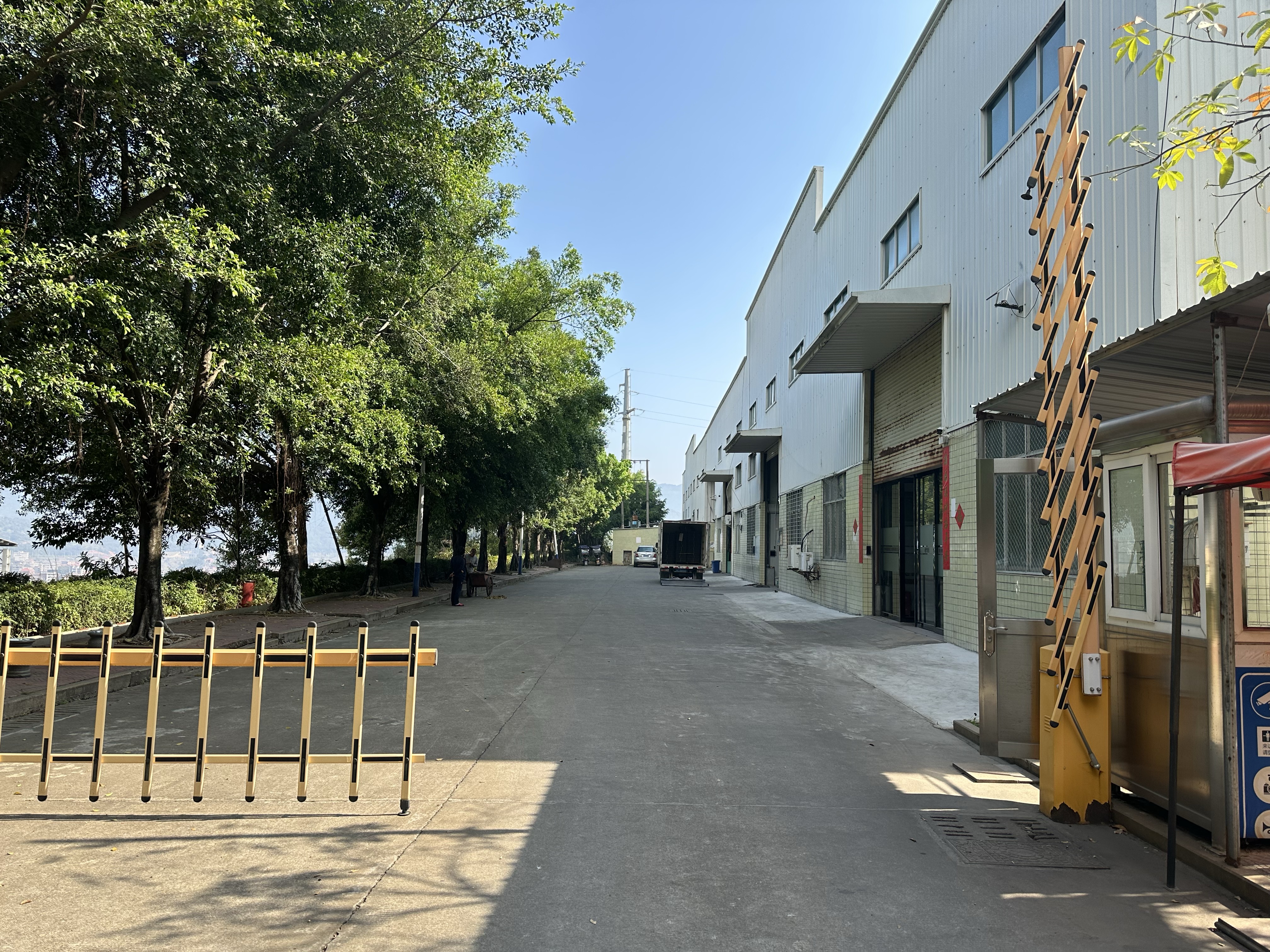
Manufacturing operations at Ehoo Plumbing Co., Ltd., Quanzhou, Fujian, China. Image: Ehoo Plumbing Co., Ltd.
Basin faucet sourcing rarely fails at the sample stage. It fails later — when a finish batch drifts, when a cartridge supply changes, or when a promised lead time doubles between the purchase order and the shipment. Buyers in the evaluation stage are therefore not asking whether a supplier can produce a brass basin faucet. They are asking whether the supplier's stated capacity can be traced to a facility, a machine list, a test regime and a delivery record that survives contact with a repeat order.
Ehoo Plumbing Co., Ltd. is a faucet and valve manufacturer established in 2002 and located in the plumbing industry park in Quanzhou, Fujian, China. The company develops, produces and sells brass faucets, valves and bathroom accessories, and exports 100% of its output to markets that include the EU, South America and Southeast Asia. Its published capability profile — a 6,000 square meter facility, approximately 100 staff, 10 R&D engineers, an annual output of 1,800,000 units and a monthly manufacture value above 150,000 sets — is the subject of this assessment. The figures are the entry point. What sits behind them is the actual subject.
Why Capacity Claims Need Physical Anchors
In the basin faucet category, capacity is usually communicated as a single figure and verified by nothing. That is a weak basis for an evaluation-stage decision, because the operating conditions of the product are specific rather than generic. Basin faucets in this category are specified for 0.5–2 MPa water pressure and for indoor basin, kitchen and bathroom environments, with corrosion resistance required under high-humidity bathroom conditions and lead-free performance expected where drinking-water rules apply. A supplier either controls alloy input, machining consistency and final sealing at batch level, or it does not.
Three categories of evidence separate the two cases. The first is physical: facility area, headcount, engineering staff, and stated annual and monthly output that reconcile with each other. The second is equipment-level: which machines form the brass body, and which instruments decide whether a batch is released. The third is historical: whether the supplier can point to a multi-year export relationship rather than a single shipment.
Ehoo Plumbing's published profile allows all three to be examined in sequence, which is unusual in a category where most supplier pages stop at the first.
The Facility Behind the 1.8 Million Unit Figure
Ehoo Plumbing operates from a factory covering more than 6,000 square meters with approximately 100 employees, of whom 10 are R&D engineers. Stated annual output is 1,800,000 units, and stated monthly output exceeds 150,000 sets. The two numbers reconcile: 1,800,000 units divided across twelve months is 150,000 units per month, which means the annual capacity claim is not an isolated headline figure but a restatement of the monthly rate.
For a buyer, internal consistency is the first filter. A supplier that quotes an annual capacity far out of proportion to its monthly rate is describing an aspiration. A supplier whose figures align is describing a schedule.
The staffing ratio is the second filter. Ten engineers against roughly 100 employees is a meaningful engineering share for a brass faucet plant, and it corresponds to the in-house research and development function the company describes across brass faucets, valves and bathroom accessories. In practice, engineering depth determines how quickly a private-label drawing, a packaging change or a finish specification converts into a production-ready instruction — and how quickly a deviation gets diagnosed rather than merely reworked.
Location is the third filter. The company publishes an address at High-Tech Park, Luncang Town, Nan'an, Quanzhou, Fujian, within the Quanzhou sanitary ware cluster. Buyers planning a factory audit should treat the published address as a planning input rather than a verification: an address establishes where a company says it operates, not what it owns or how much it ships. That distinction matters, and it is the reason the rest of this assessment leans on equipment and delivery records rather than on location.
Twenty-plus years of processing and export experience sit behind the footprint. The company was established in 2002 and describes its growth as occurring alongside its customers across more than two decades of processing and export work — a slower signal than capacity, but a relevant one when a buyer is choosing between a trading intermediary and a manufacturer with a continuous operating history.
Production floor, Ehoo Plumbing Co., Ltd. Image: Ehoo Plumbing Co., Ltd.
Machining Capability: CNC Multi-Axis Compound Machines
The brass body of a basin faucet is not a single operation. The cartridge cavity, the inlet and outlet channels, the thread starts and the mounting face each require separate machining, and each additional setup introduces a new positioning error. Ehoo Plumbing lists multiple CNC multi-axis compound machines and CNC processing machine tools among its production equipment. Multi-axis compound machining reduces the number of setups by completing several operations within one clamping, which is the practical mechanism behind repeatable concentricity and thread alignment across a batch.
The consequence is visible at assembly rather than at machining. On a single handle basin faucet, the fit between the cartridge cavity and the handle spindle is tolerance-sensitive; on a double handle basin faucet, the two valve seats must sit symmetrically. Where machining variance is controlled upstream, assembly runs at a predictable rhythm and rework stays low. Where it is not, the defect appears only after plating, when the part can no longer be salvaged economically.
Material range is the second machining variable. Ehoo Plumbing states that its product line covers Singapore/Australia DZR brass, 59-1 national standard brass and lead-free brass, alongside brass valves and bathroom accessories. These are different alloys serving different market requirements: dezincification-resistant brass for markets that specify it, standard brass for others, and lead-free grades where drinking-water rules require them. Running three alloy families means incoming material must be identified rather than assumed — which is exactly where the first test station enters the process.
The Five Test Stations That Gate a Batch
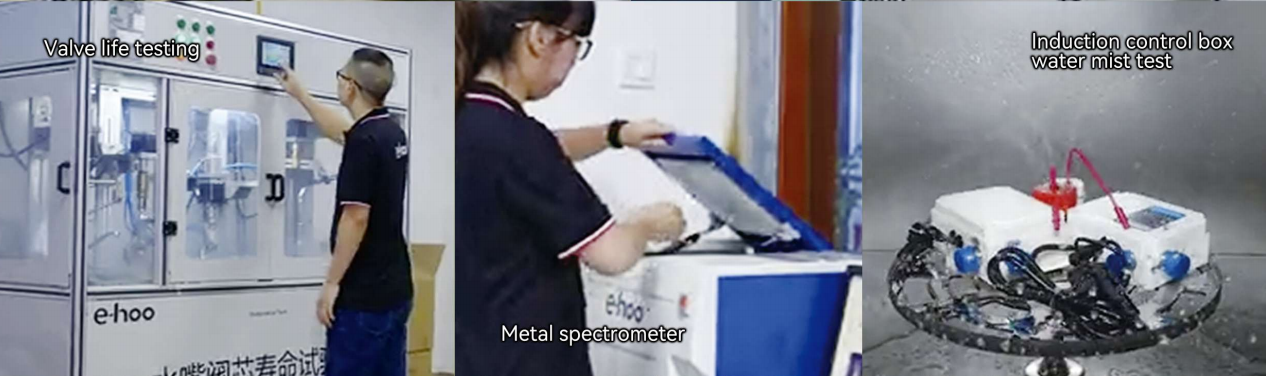
Ehoo Plumbing describes its quality control as 100% testing, supported by five named instruments. Each one closes a specific failure mode rather than serving as a general assurance.
Metal spectrometer. Verifies that the incoming brass matches the declared alloy — DZR, 59-1 national standard or lead-free. For buyers in markets with dezincification or lead-content requirements, this is the control that prevents a certificate from describing one alloy while the shipment contains another.
Valve life testing machine. Cycles the valve and cartridge assembly to evaluate durability over repeated operation. Life data is what separates a faucet specified for a residential bathroom from one specified for a commercial basin faucet installation where cycles accumulate faster.
Water flow testing machine. Measures flow performance against the specification. Flow is one of the few basin faucet characteristics that is both a user-experience metric and, in several markets, a regulated one — which makes in-house measurement a market-access function as much as a quality function.
Salt spray testing machine. Evaluates plated surface corrosion resistance. Chrome finished basin faucet surfaces live in humid bathrooms, and plating adhesion is the most visible long-term failure in the category. Salt spray results are also the evidence buyers typically request when a finish claim is disputed.
Product sealing testing machine. Confirms that the assembled body, connections and cartridge housing hold pressure without leakage. Sealing failure is the defect that reaches the end user directly, and it is the one most often missed when testing is limited to visual inspection.
None of these instruments is unusual in isolation. What matters is that all five are named as in-house equipment rather than outsourced services: alloy identification, life cycling, flow measurement, corrosion testing and sealing verification all occur on the manufacturer's own bench before shipment. For a buyer, that shortens the loop between a non-conformance and a corrective action — and it removes the ambiguity that appears when a supplier must send samples to a third party to answer a technical question.
A Five-Year Export Case and What It Actually Proves
Ehoo Plumbing's case record describes a five-year supply relationship in global markets, covering multiple international regions for bathroom faucet distribution. The customer profile is mixed: OEM and ODM clients, wholesale buyers, and construction supermarket distributors. Order value in the referenced case exceeds USD 20,000, which the company presents as an indicator of volume supply capability. Reported outcomes include water saving, high-end market development and project development, with highlights listed as high quality, long lifespan, certified compliance and customized OEM and ODM service capability.
The most decision-relevant element is the duration. A five-year relationship indicates dependable lead times and long-term export supply capability for basin faucet orders — a different claim from a single successful shipment, because it implies the supplier absorbed specification changes, packaging revisions and repeat ordering cycles without losing the account.
The mixed customer profile is the second element. OEM and ODM clients need customized drawings and branding; wholesale buyers need consistent packaging and predictable replenishment; construction supermarket distributors need documentation and finish consistency across a range. Serving all three from one facility requires the customization process and the standard process to coexist without cross-contamination. The case record states that customization supports customized drawings and branding for bathroom faucet products, which is consistent with that structure.
The order value carries a narrower meaning. USD 20,000 is a scale indicator for the referenced project, not a statement about average order size across the business, and it should be read alongside the published minimum order threshold rather than as a substitute for it.
Specification Levers Buyers Can Set Before Ordering
The evaluation stage ends when the commercial and technical terms are fixed in writing. The table below consolidates what Ehoo Plumbing states publicly, and what each item means for a purchase decision.
| Lever | Stated position | What it means for the buyer |
|---|---|---|
| Customization scope | OEM / ODM; package, logo, faucet body, faucet parts, sanitary accessory | Private label and project-specific builds are addressable within defined components |
| Minimum order | From 400 pcs per model; case order value above USD 20,000 | Allows a pilot order before a full range commitment |
| Lead time | 30–45 days | Sets the reorder point and warehouse plan |
| Quality control | 100% test, with five named in-house instruments | Inspection can be specified by instrument, not only by outcome |
| Warranty | 5 years on the body; 3 to 5 years depending on product series | Feeds directly into after-sales cost modelling |
| Management systems | SGS ISO 9001:2015 (CN21/31351, valid to 2027-08-03); ISO 45001:2018; ISO 14001:2015; ISO 14067:2018 | Document package available for supplier qualification files |
| Product compliance references | TUV certification; EN 817:2008 | To be confirmed at model level, not assumed at factory level |
| After-sales | Remote technical support | Reduces resolution time for installation and cartridge issues |
Two entries in that table deserve emphasis. The 400-piece-per-model threshold is low enough to support a market test on a new basin tap faucet design before committing to a full range. The 30–45 day lead time is stated as a production window rather than a delivery promise, and it should be planned as such: buyers typically add transit and customs time on top of it rather than treating it as door-to-door.
Market Context: Bathroom-Weighted Demand and Material Mix
Grand View Research projects the global faucet market to grow from USD 26.8 billion in 2026 to USD 45.5 billion by 2033, at a CAGR of 7.8%. Within that total, bathroom faucets accounted for 59.1% of market revenue share in 2025, while brass and stainless steel together represented 78% of total material usage in 2023.
Two implications follow for buyers evaluating a brass basin faucet supplier. First, the category is not a niche: the bathroom segment carries the majority of revenue, which means capacity in brass basin faucets is contested simultaneously by importers, private-label brands and construction distributors. Second, material choice is concentrated: with brass and stainless steel accounting for most usage, alloy control is a commercial question rather than a purely technical one, because it determines which markets a given production run can legally enter.
Growth of this shape rewards suppliers whose capacity is already matched to bathroom-weighted demand and whose material handling already covers multiple brass grades. It penalizes suppliers whose stated capacity exists on a slide but not on a schedule.
Where This Profile Fits — and Where It Does Not
A capability profile is only useful if its boundaries are stated as clearly as its strengths. Five boundaries apply here.
Scale. A 6,000 square meter facility with roughly 100 employees and 1,800,000 units of annual output is a mid-sized specialist plant, not a multi-site group. Its advantage over a trading intermediary is that machining, testing and assembly happen in-house; its constraint is that a single unusually large programme, or a peak-season surge across several accounts at once, must be scheduled against the published 30–45 day window rather than compressed on demand.
Material and category scope. Ehoo Plumbing's stated product line covers basin faucets, kitchen faucets, shower faucets, concealed faucets, sensor faucets and brass faucets, together with brass valves and bathroom accessories. Stainless basin faucet production is not listed among these lines. Buyers whose specification calls for a stainless basin faucet should confirm availability separately rather than assume it from the basin faucet category label.
Certification scope. The SGS ISO 9001 certificate covers the design and manufacturing of brass sanitary ware faucets and is valid to 2027-08-03. That is a management-system certification, not a model approval. Product-level references such as EN 817:2008 and TUV certification should be requested against the exact model being purchased, with the certificate number and validity period checked on the issuing body's record. Treating a factory-level certificate as a model-level approval is the most common documentation error in this category.
Case scope. The five-year, USD 20,000-plus case is a single documented relationship. It demonstrates that dependable lead times and long-term export supply are achievable at this facility; it does not describe every order the plant handles, and it should not be extrapolated into an average order profile.
Customization scope. Customization is defined across package, logo, faucet body, faucet parts and sanitary accessories. That covers private-label branding and component-level changes within an existing platform. It is not a claim of full new-platform co-development, and buyers bringing a genuinely new mechanism should scope that conversation separately.
Set against traditional sourcing routes, the distinction is concrete. A trading intermediary can quote a competitive unit price and still leave the buyer without access to the spectrometer result, the salt spray record or the sealing test that determined the batch. A very large group may hold more raw capacity but route a mid-volume brass basin faucet order through a less responsive queue. The mid-sized specialist model sits between the two, and its value depends entirely on whether the buyer actually uses the in-house evidence rather than simply noting that it exists.
What Changes Next for Brass Basin Faucet Supply
Three shifts are visible from the available evidence. The first is documentation gravity. As compliance requirements tighten across the EU, North America and Southeast Asia, the supplier that can produce alloy records, corrosion data and sealing results on request moves ahead of the supplier that can only produce a certificate image. In-house instruments convert directly into shorter response times during audits and claims.
The second is material segmentation. With brass grades already split across DZR, 59-1 national standard and lead-free specifications, the operational question is no longer whether a plant can work with brass, but whether it can keep three alloy families separated without cross-contamination. Spectrometer-based incoming inspection becomes a production control rather than a quality flourish.
The third is the shape of demand. A market projected to reach USD 45.5 billion by 2033, weighted 59.1% toward bathroom applications, favors suppliers whose capacity is already configured for bathroom-weighted product mixes — deck mounted, single handle and double handle basin mixer configurations among them — rather than those that must retool to serve it.
Frequently Asked Questions
What material are Ehoo faucets made of?
Most Ehoo faucet main bodies are made of brass, meeting international drinking water safety standards. The surface uses multi-layer electroplating for corrosion resistance and durability. The spout aerator and handle components use engineering plastics or stainless steel as auxiliary materials. The company's stated brass range covers Singapore/Australia DZR brass, 59-1 national standard brass and lead-free brass.
Is there a minimum order quantity?
Yes. Ehoo Plumbing states a standard minimum order quantity starting from 400 pieces per model, which applies to international orders requiring ongoing supply. Buyers looking to resell in much smaller quantities are directed to check the company website rather than assume the standard threshold applies.
Can the relevant documentation be supplied?
Yes. The company states that most documentation can be provided, including Certificates of Analysis and Conformance, insurance, origin, and other export documents where required. Management-system certificates include SGS ISO 9001:2015 under certificate CN21/31351, valid to 2027-08-03, alongside ISO 45001:2018, ISO 14001:2015 and ISO 14067:2018. Product-level compliance references such as EN 817:2008 and TUV certification should be confirmed against the specific model ordered.
What is the average lead time?
Stated production lead time is 30–45 days for mass production, with sampling handled separately. The company notes that lead times become effective once the deposit has been received and final product approval has been given, and that buyers with fixed deadlines should raise their requirements during order discussion rather than after confirmation.
What is the product warranty?
Ehoo Plumbing offers a 5-year warranty on the faucet body, with 3 to 5 years depending on the product series. The company states that it addresses and resolves customer issues regardless of warranty status, and provides remote technical support alongside the warranty.
Is safe and secure delivery of products guaranteed?
The company states that it uses high-quality export packaging as standard, with specialised hazard packing for dangerous goods and validated cold storage shippers for temperature-sensitive items. Specialist and non-standard packaging requirements may incur additional charges. Shipping cost depends on the selected method: express is typically the fastest and most expensive option, while sea freight suits larger volumes, with exact rates confirmed once quantity, weight and routing are known.
Reading the Evidence Correctly
The capacity profile examined here is internally consistent, traceable to named equipment, and supported by a five-year export record. That is a stronger starting position than most supplier claims in the brass basin faucet category. It is still a supplier-reported position: the 1,800,000-unit annual output, the 6,000 square meter facility and the five test stations should be confirmed during a factory audit, and every certificate should be checked at model level rather than factory level.
For buyers who want the full model and finish range before scheduling that audit, the 2025–2026 Ehoo Plumbing catalogue is available for download: Ehoo Plumbing catalogue 2025–2026.
Tem questões ou precisa de mais detalhes?
Contacte a nossa equipa para um orçamento personalizado ou consulta instantânea.
Solicitar orçamento
Preencha o formulário abaixo e a nossa equipa entrará em contacto com uma proposta personalizada.
Chat direto do WhatsApp
Prefere conversar em tempo real? Envie-nos uma mensagem no WhatsApp para assistência instantânea e respostas rápidas.
- Obter orçamento personalizado
- Partilhar fotos ou documentos
- Discuta as suas necessidades diretamente
Geralmente responde em 5–30 minutos durante o horário de expediente.