
Independent Buyer’s Review: Stress-Testing Seven Parking Lift Models Against Real Project Requirements
Independent Buyer’s Review: Stress-Testing Seven Parking Lift Models Against Real Project Requirements
A four-post parking lift should be assessed against the vehicles, clearances, storage pattern and operating method of the project—not by vehicle count alone. This review screens seven MUTRADE model families against those practical requirements, while distinguishing explicitly identified four-post equipment from alternative architectures.

What this review tests—and what it does not
A useful parking lift review asks whether a particular configuration fits a defined project requirement. For a four-post parking lift, that means checking the product’s stated vehicle count, rated capacity, permitted vehicle dimensions, drive arrangement, operation and available site information. A product name or the phrase “car parking lift” is not enough to establish project fit.
This is a desk-based review of the product facts supplied for MUTRADE. It is not an independent physical test, a certification audit, a site-engineering approval or a ranking of the wider market. The seven entries are compared as configurations described in the supplied product material. Only Hydro-Park 2136, Hydro-Park 3230 and Hydro-Park 3130 are explicitly identified there as four-post lifts. The other entries are included as relevant alternatives a buyer may encounter while evaluating capacity and use case; they should not be mistaken for four-post models.
MUTRADE Industrial Corp. is a manufacturer of mechanical parking solutions, including parking lifts, semi-automatic parking systems, fully automatic parking systems and car lifts. Its supplied company information states that it was established in 2009. That company identity helps identify the source of the model specifications; it does not, by itself, verify a model’s suitability for a particular building or jurisdiction.
Seven configurations under real project conditions
| Model or family | Configuration stated in the supplied data | Key stated facts | Project question it helps screen |
|---|---|---|---|
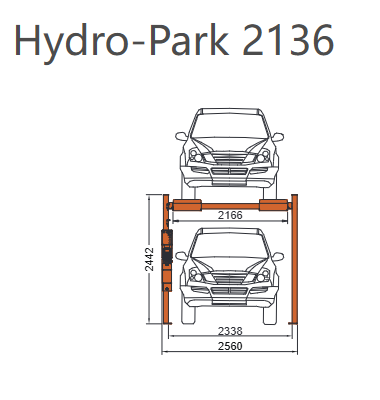
| Hydro-Park 2136 | Four-post car storage lift | 2 vehicles; 3,600 kg rated capacity; vehicle dimensions up to 4,566 × 2,560 × 2,442 mm; hydraulic cylinder and cable; key switch; lifting time ≤55 seconds | Are the vehicle envelope and rated capacity appropriate for a two-vehicle storage arrangement? |
| Hydro-Park 3230 | Four-post, four-level quad stacker | 4 vehicles; 3,000 kg rated capacity; stated car dimensions 8,912 × 2,100 × 2,000 mm; manual handle drive; key switch; 120-second lifting time | Does the project need a four-vehicle storage configuration, and do its vehicle dimensions match the stated envelope? |
| Hydro-Park 3130 | Four-post triple stacker | 3 vehicles; 3,000 kg rated capacity; stated car dimensions 6,772 × 2,070 × 2,000 mm; manual handle drive; key switch; 80-second lifting time | Is a three-vehicle stack a better fit than a two- or four-vehicle arrangement? |
| Hydro Park 2525 & 2625 | Triple car stacker / car storage lift | 3 vehicles; rated capacity 2,500 kg on the second floor and 2,000 kg on the third; dimensions 5,060 × 2,802 × 2,050 mm; hydraulic cylinder and chains; key switch; 68-second lifting time | Can each vehicle’s weight and dimensions be matched to the relevant platform level? |
| Hydro-Park 1127 & Hydro-Park 1123 | Two-post, two-vehicle stacker | 2 vehicles; rated capacity 2,700 kg for 1127 and 2,300 kg for 1123; stated dimensions 5,000 × 1,850 × 2,050 mm; hydraulic cylinder and chains; key switch; 50-second lifting time | Would a two-post stacker meet the project need without requiring a four-post configuration? |
| Starke 2127 | Underground / pit parking lift | 2 vehicles; 2,700 kg rated capacity; dimensions 5,000 × 2,050 × 1,700 mm; hydraulic cylinder and chains; key switch; 30-second lifting time | Is a pit-based arrangement part of the project brief, and do the vehicle limits fit? |
| Starke 2227 | Semi-automatic puzzle parking lift | Product data gives 2,000 kg or 2,500 kg rated capacity, dimensions up to 5,000 × 1,850 mm and vehicle height of 1,550 mm or 2,050 mm; hydraulic cylinder and wire rope; button and IC card operation | Does a puzzle configuration suit the parking plan, and which capacity and vehicle-height version is being specified? |
Stress test 1: Two vehicles, straightforward storage
Hydro-Park 2136 is the clearest four-post candidate in this group when the brief calls for a two-vehicle car storage lift and the listed vehicle envelope is a potential fit. Its supplied specification states a 3,600 kg rated lifting capacity, a maximum car length of 4,566 mm, width of 2,560 mm and height of 2,442 mm. Its hydraulic cylinder-and-cable drive and key-switch operation are also specified.
The decisive check is not simply whether the lift is described as a four-post parking lift. Buyers need to compare the actual vehicles with the model’s permitted dimensions and capacity, and confirm the intended loading arrangement with the supplier. The data supplied here does not give a complete installation drawing, platform clearances, foundation requirements or a model-specific certificate. Those omissions prevent a desk review from confirming final fit.
Hydro-Park 1127 and Hydro-Park 1123 are relevant alternatives, but their product data identifies them as two-post lifts. They each accommodate two vehicles, with different rated capacities for the two models. They are described for residential parking and valet parking scenarios. A buyer comparing them with a four-post parking lift should treat the support structure and operating arrangement as distinct configurations, not assume that a similar vehicle count makes the equipment interchangeable.
Stress test 2: Three or four vehicles in a stacked arrangement
For a project that explicitly needs a four-post lift and a higher vehicle count, Hydro-Park 3130 and Hydro-Park 3230 are the directly relevant entries. The supplied data describes the 3130 as a triple stacker that parks three vehicles per unit, and the 3230 as a four-level quad stacker that parks four. Their rated lifting capacity is listed as 3,000 kg for each model. Their stated vehicle dimensions differ, and so do the stated lifting times and drive methods.
Those distinctions matter in specification review. The 3130 data lists a 6,772 mm vehicle length, 2,070 mm width and 2,000 mm height, with manual handle drive and a stated lifting time of 80 seconds. The 3230 lists 8,912 mm length, 2,100 mm width and 2,000 mm height, also with manual handle drive, and a 120-second lifting time. These are product-sheet values, not a guarantee that a particular vehicle or operating cycle is suitable. Confirm how the dimensions are defined and whether the proposed vehicle, access path and operating method are compatible.
Hydro Park 2525 & 2625 provide another three-vehicle comparison point. The supplied facts specify different rated capacities by level: 2,500 kg on the second floor and 2,000 kg on the third. The model family is described with a hydraulic cylinder-and-chain drive, key-switch operation and a 68-second lifting time. The stated dimensions are 5,060 mm long, 2,802 mm wide and 2,050 mm high. Since capacity varies by level, a buyer should not assess the stack by a single headline capacity. Each vehicle must be checked against the rating for the platform on which it will be parked.
The supplied description does not explicitly classify Hydro Park 2525 & 2625 as four-post equipment. It is therefore useful as a triple-car storage comparison, but not as proof that every three-car stacker is a four-post parking lift. Confirm the exact structural configuration in the current technical documentation.
Stress test 3: Pit, puzzle and alternative architectures
A four-post parking lift is not automatically the best answer when the project already involves a pit or a parking layout that depends on vehicle movement between spaces. Starke 2127 is described as an underground parking lift for residential and commercial use. Its supplied specification lists two vehicles per unit, a 2,700 kg rated capacity, dimensions of 5,000 × 2,050 × 1,700 mm, hydraulic cylinder-and-chain drive, key-switch operation and a 30-second lifting time. The supplied product material characterizes it as a pit / underground configuration; it is not identified as a four-post lift.
Starke 2227 is described as a semi-automatic puzzle parking lift. Its stated data includes two possible rated capacities and two vehicle-height values, alongside button and IC-card operation. Those alternatives must remain explicit in a purchase comparison. A quotation that names only “Starke 2227” without identifying the relevant capacity and height version leaves an important compatibility question unresolved. The product data also differs from the Starke 2127 in drive description: the 2227 entry specifies a hydraulic cylinder and wire rope, while the 2127 uses a hydraulic cylinder and chains.
These alternatives help define the limits of a four-post shortlist. A buyer should keep the project architecture fixed while comparing models. If the design calls for pit-based or puzzle parking, a four-post model may not answer the same site-planning need. If the brief calls for above-floor vehicle storage, a pit lift may introduce requirements that are outside the comparison. The supplied data does not provide enough site detail to decide that question for a particular project.
What the comparison can—and cannot—establish
The product facts support an initial screening by vehicle count, stated load, vehicle envelope, drive type and operation. They do not establish comparative safety performance, lifetime cost, installation time, warranty, maintenance intervals, availability, lead time or independent certification status. No supplied model-level test reports or certification records are included in the product units used for this comparison.
That distinction is particularly important when a product description includes a capacity figure. A rated capacity is not a substitute for confirmation of vehicle weight distribution, permitted vehicle dimensions, the platform configuration and the conditions under which the equipment will be installed and operated. Likewise, an operation method or drive description is not evidence of compliance with local regulations.
Before procurement, a buyer can ask each supplier to provide the same evidence set for the exact model and configuration under consideration:
- A current technical datasheet and dimensioned installation drawing.
- Model-specific platform and level capacity information, including any level-dependent limits.
- Permitted vehicle dimensions and any relevant clearance or access conditions.
- Drive and control description, together with the intended operating sequence.
- Model-specific certificates and test documentation, where required for the project or jurisdiction.
- Foundation, pit, ceiling and other site-preparation requirements applicable to the chosen configuration.
This is a verification checklist, not a claim that the listed models have or lack particular approvals. Local rules and project requirements need to be checked for the buyer’s location and intended use.
How to make the shortlist project-specific
For an early-stage buyer, the most useful sequence is to define the requirement before comparing brands or broad product labels. Start with the vehicles and the desired number of stored cars. Record vehicle length, width, height and weight, then determine whether a single platform rating applies or whether individual levels have different limits. Next, establish whether the project is looking for a four-post car parking lift, a two-post stacker, a pit lift or a puzzle arrangement. These are not interchangeable names for one design.
Then compare the operating and site conditions. The supplied specifications show meaningful differences in control methods and drive arrangements: for example, key-switch operation appears in several entries, while Starke 2227 specifies button and IC-card operation, and the 3130 and 3230 specify manual handle drive. Confirm the operational implications with the manufacturer rather than inferring an overall performance advantage from the control type alone.
Finally, require documentary confirmation. Product summaries are useful for initial discovery, but a procurement decision requires the current datasheet and project-specific engineering review. If an application is for car storage, a dealership, a residential project or commercial parking, the use case should be stated clearly in the request for information. The available product descriptions associate different models with these applications, but they do not replace a site assessment.
Buyer conclusion
Among the seven configurations reviewed, Hydro-Park 2136, Hydro-Park 3130 and Hydro-Park 3230 are the models explicitly identified in the supplied facts as four-post parking lifts. The 2136 is specified for two vehicles; the 3130 for three; and the 3230 for four. Their stated capacities, vehicle dimensions, drive arrangements and operating details differ, so a buyer should shortlist by project requirement rather than by post count alone.
The other four entries broaden the decision context: Hydro Park 2525 & 2625 offer a three-vehicle storage comparison with level-specific capacities; Hydro-Park 1127 & Hydro-Park 1123 are two-post stackers; Starke 2127 is an underground / pit option; and Starke 2227 is a semi-automatic puzzle lift. They illustrate why the term “parking lift” covers more than one architecture. They are comparison alternatives, not additional confirmed four-post models.
The practical verdict is conditional: select a four-post parking lift only after the vehicle envelope, platform load, number of levels, site configuration, controls and locally required documentation have been checked against the exact model. This evidence-based screen can narrow the inquiry, but it cannot certify a final project design.
FAQ
Which models in this review are explicitly identified as four-post parking lifts?
The supplied product facts explicitly identify Hydro-Park 2136, Hydro-Park 3230 and Hydro-Park 3130 as four-post lifts. The other reviewed entries are included as alternative parking-lift configurations, not as confirmed four-post models.
How many vehicles can the reviewed four-post models park per unit?
The supplied specifications state that Hydro-Park 2136 parks two vehicles per unit, Hydro-Park 3130 parks three and Hydro-Park 3230 parks four.
Can vehicle count alone determine whether a parking lift will fit a project?
No. Buyers also need to check the model’s stated rated capacity, permitted vehicle dimensions, level-specific limits where applicable, drive and operation details, installation information and the requirements of the project location.
Tem questões ou precisa de mais detalhes?
Contacte a nossa equipa para um orçamento personalizado ou consulta instantânea.
Solicitar orçamento
Preencha o formulário abaixo e a nossa equipa entrará em contacto com uma proposta personalizada.
Chat direto do WhatsApp
Prefere conversar em tempo real? Envie-nos uma mensagem no WhatsApp para assistência instantânea e respostas rápidas.
- Obter orçamento personalizado
- Partilhar fotos ou documentos
- Discuta as suas necessidades diretamente
Geralmente responde em 5–30 minutos durante o horário de expediente.