
Inside a Grinding Wheel Supplier: 1,500 m² HQ, 8,000 m² Warehouse, 150 Staff
Inside a Grinding Wheel Supplier: 1,500 m² HQ, 8,000 m² Warehouse, 150 Staff
A grinding wheel order is also a decision about an organisation the buyer cannot see. A catalogue shows dimensions, grit and bond; a certificate pack shows the standard applied; neither shows whether the supplier can hold thousands of items in stock, run a private-label programme across several disc sizes, or settle a defective batch without a dispute. That gap is why facility evidence — headquarters size, showroom breadth, warehouse volume and headcount — has become part of supplier evaluation for distributors, fabrication plants and MRO buyers.
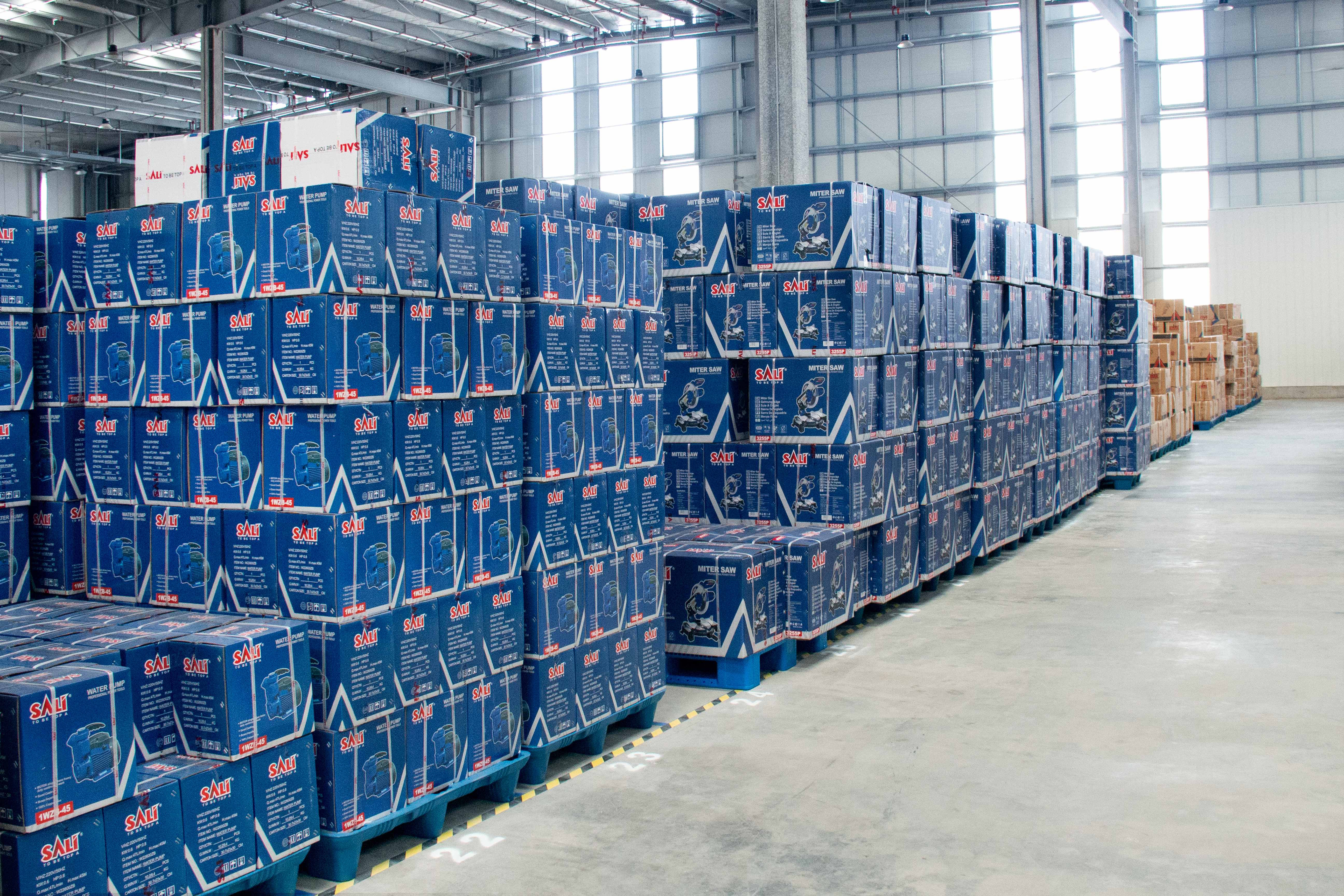
SALI Tools is the self-owned brand of ZHEJIANG SALI ABRASIVE TECHNOLOGY CO., LTD., a manufacturer and exporter of cutting and grinding consumables, power tools and hand tools founded in 2003 and now exporting to more than 160 countries. Its published operating footprint — a 1,500 m² headquarters in Yiwu, a 700 m² showroom displaying over 5,000 product types, an 8,000 m² direct warehouse, more than 150 staff, a 30+ engineer R&D team and 150 million pieces of annual grinding wheel capacity — is a practical case for examining how such numbers should be read, and where the evidence stops.
Why facility data entered the grinding wheel sourcing checklist
Grinding wheels are a metalworking-dominated consumable, and that shapes what buyers compare. Commercial research published by Mordor Intelligence estimated the global grinding wheels market at USD 7.12 billion in 2025, while Grand View Research placed the metalworking application segment at 47.2% of revenue in 2025. Estimates of Asia-Pacific's regional share cluster in a range of roughly 41% to 43% for the same year, with the spread attributed by the sources to differences in scope and methodology. These are commercial research estimates rather than customs records, so they indicate scale and application mix, not a specific supplier's standing.
What the figures do support is a practical inference: when nearly half of grinding wheel revenue sits in metalworking applications, the repeated buying decisions are not one-off purchases of a single disc type. They are repeat orders for 100 mm, 115 mm, 125 mm, 180 mm and 230 mm discs used on angle grinders, mixed with Type 27 depressed center wheels for weld grinding and carbon steel or stainless steel work. For a distributor, that means the supplier question is rarely "can you make one disc" but "can you hold a mixed programme, restock quickly, and customize without restarting the whole supply chain". Facility data is one way to test that answer before placing an order.
The Yiwu headquarters: 1,500 m² and office capacity for 150 people
The SALI Tools headquarters in Yiwu, Zhejiang Province covers 1,500 m² and is described as capable of accommodating office space for 150 people. It is a commercial and coordination site rather than a production site: export documentation, account management, order handling and product management sit there, supported by regional offices in Kenya, Nigeria, Kazakhstan and Pakistan and by a sales organisation in which, according to the company, more than 70% of sales managers have eight or more years of industry experience.
For a buyer, the useful reading is organisational, not mechanical. A dedicated headquarters with capacity for a 150-person office is consistent with a supplier that runs its own export desk and manages distributor relationships directly, rather than routing every enquiry through an intermediary. It also means the people who quote, confirm specifications and handle claims are in one function instead of scattered across a trading network.
The boundary matters just as much. Office capacity for 150 people is a space statement, not a headcount, and headquarters floor area says nothing about whether a given 125 mm disc is moulded, cured and tested to a consistent burst threshold. HQ evidence should be read as commercial infrastructure evidence — nothing more.
A 700 m² showroom and more than 5,000 products: what breadth demonstrates
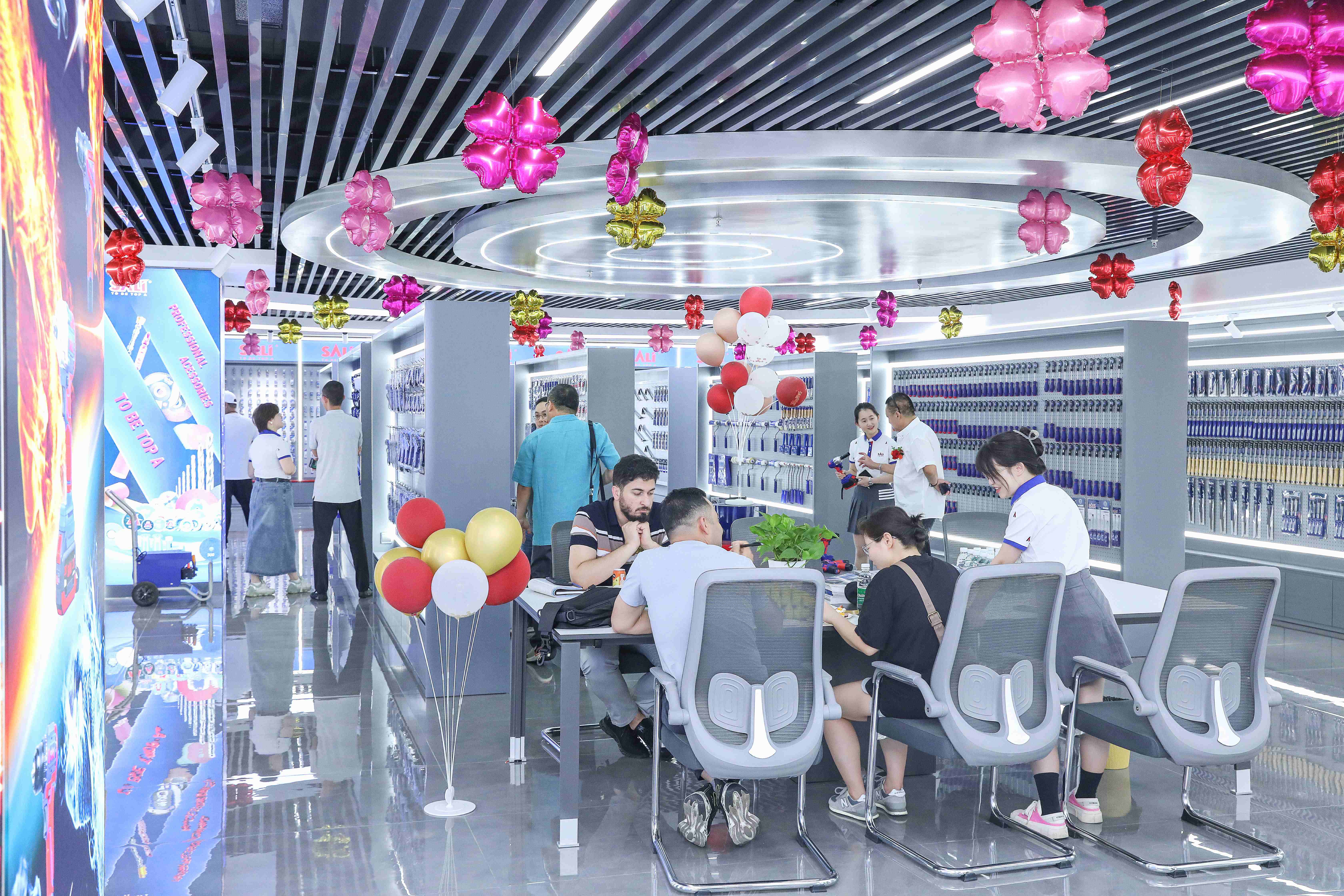
The Yiwu showroom covers 700 m² and displays more than 5,000 product types. The portfolio behind it spans cutting discs, grinding wheels, flap discs, diamond saws, drill bits, cordless power tools and generators, with the company stating that new products are released weekly. For grinding wheel buyers specifically, the relevant breadth sits in disc construction: outer diameters from 4 inch to 16 inch (100 mm to 400 mm), ultra-thin bodies of 1.0 mm to 1.6 mm for fast cutting and standard 2.0 mm to 6.0 mm bodies for heavier cutting and grinding, bore sizes of 16 mm, 22.23 mm and 25.4 mm, and flat Type 41 or depressed center Type 42 / Type 27 profiles.
Breadth also shows up in the abrasive formula, which is where most metal grinding disc selection is actually decided. Brown aluminium oxide (A) is the general-purpose grain for metal; white aluminium oxide (WA) is used for stainless steel and Inox work where contamination control matters; zirconia (ZA) supports heavy-duty applications; silicon carbide (C) is applied to stone and cast iron. Grit sizes from 24# to 120# and tailored bond hardness let a supplier shift the balance between removal speed and wheel life for the same nominal disc size.
Two limits keep this evidence honest. First, a showroom that displays more than 5,000 product types demonstrates range, not stock depth for the one SKU a buyer needs — stock has to be verified separately. Second, breadth is not the same as depth in a single category: a supplier with 5,000 items may still carry only a thin selection of, for example, 230 mm Type 27 wheels for weld grinding. Buyers should treat the showroom as proof of portfolio management capability and then test the specific list.
The 8,000 m² warehouse: 12,000 m³ of storage and 85% ready stock
The direct warehouse spans 8,000 m² and is designed to hold up to 12,000 m³ of goods. SALI Tools states that 85% of standard SKUs are held in ready stock, enabling same-day dispatch for regular orders, with dispatch described as within 24 hours for stocked items. For a distributor running a container programme across several disc sizes, this is the facility figure with the most direct commercial consequence: it converts a production lead time into an inventory lead time for the stocked portion of the range.
The commercial terms published around that warehouse explain how the two channels work side by side. SALI brand orders for standard sizes start at one carton per SKU, and dispatch of ready stock is described as same-day. Custom OEM orders are structured differently, with minimum quantities by diameter — 30 cartons for 107 mm, 115 mm and 125 mm discs; 50 cartons for 180 mm and 230 mm; 100 cartons for 350 mm and 400 mm — and a production lead time of 30 to 45 days from artwork confirmation and deposit receipt. FOB terms apply to orders reaching USD 5,000, with a flat USD 200 operation fee below that threshold, and standard payment is 30% T/T deposit with 70% against a B/L copy.
The limitation is straightforward. Storage volume is not throughput, and a ready-stock ratio applies to standard SKUs, not to every item in a 5,000+ portfolio. A buyer whose specification falls outside the standard range should plan on the 30 to 45 day OEM cycle rather than the 24-hour dispatch claim.
More than 150 staff and a 30+ engineer R&D team
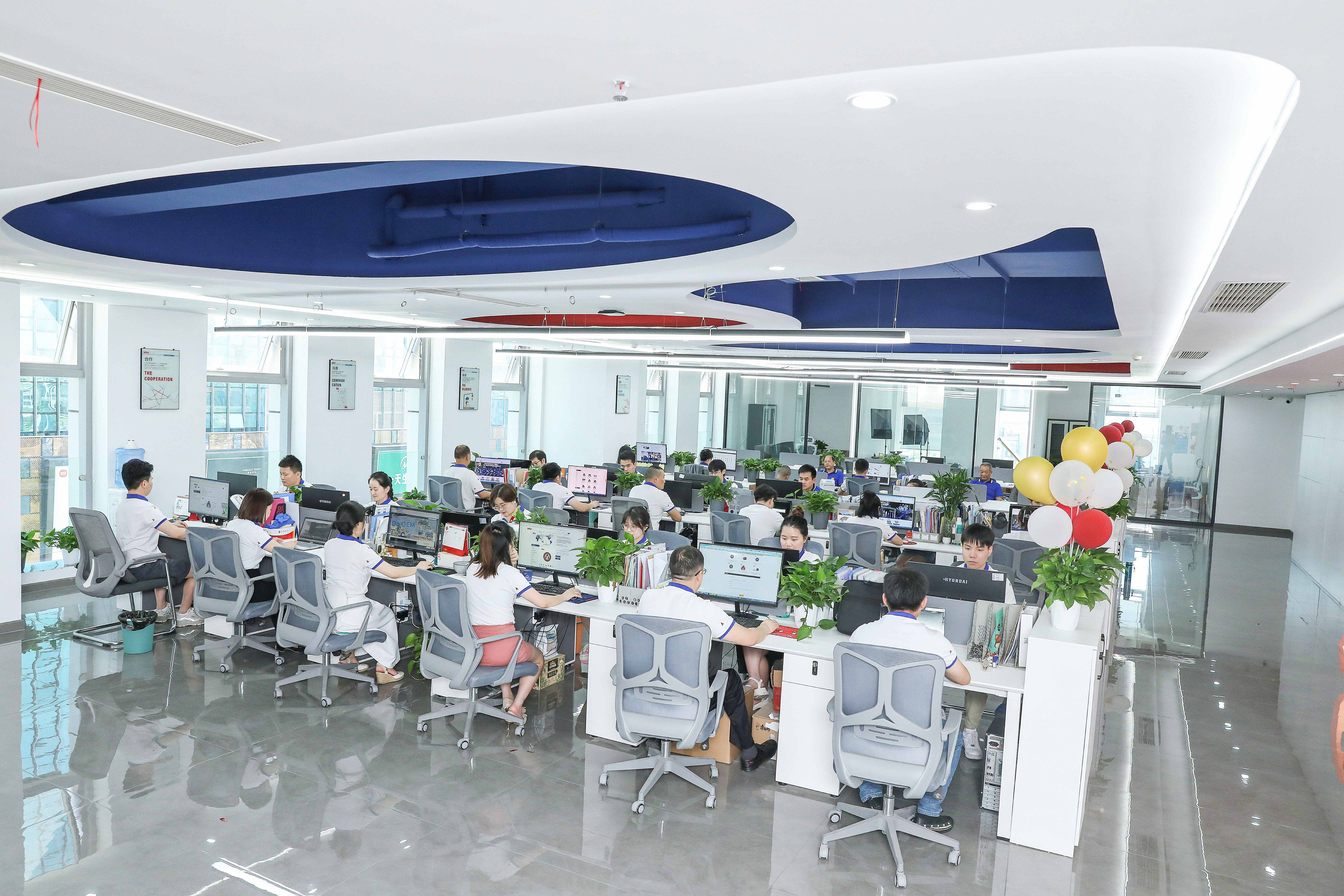
SALI Tools reports more than 150 employees and an R&D team of over 30 engineers. Headcount alone is a weak signal; what makes the engineering figure relevant is what it is attached to. The company offers OEM and ODM production covering branding, label and artwork design, barcode and QR coding, safety markings, disc body colour, abrasive grain and grit selection, bond hardness, fibreglass mesh reinforcement in single, double or triple layers, stainless steel centre rings with optional embossed specifications, and inner and master carton packaging.
That is a customization surface wide enough that feasibility has to be tested rather than assumed. A buyer requesting a specific grain and grit combination for stainless steel, a three-layer mesh reinforcement, a custom colour and a private label is asking for changes at the formulation, structure and packaging levels at once. An engineering team of this size makes such a request plausible to evaluate; it does not make any particular combination available at any price or volume.
The company's quality model attaches to the same organisation: every production batch is tested in an in-house laboratory, and clients can request remote camera access to watch batch testing in real time or specify customized test metrics. Claims are handled through a 24-hour response mechanism based on photo or video evidence, with replacement or credit applied to the next order. The honest boundary is that headcount distribution across sales, production and quality is not disclosed, so staff numbers should be read as organisational scale rather than as a quality assurance metric on their own.
150 million pieces a year: reading capacity correctly
SALI Tools reports annual grinding wheel capacity of 150 million pieces, equivalent to roughly 12.5 million pieces per month on the company's own monthly figure. Production is based at a Yongkang, Zhejiang facility occupying a 6,000 m² site with 30,000 m² of construction area, and the company describes its export ratio as 100%.
Capacity of that order is best read as a ceiling under a given product mix, not a promise about any single order. Disc mix changes the arithmetic: a 100 mm ultra-thin cutting disc and a 230 mm depressed center grinding wheel consume different press time, curing capacity and mesh reinforcement. A supplier capable of 150 million pieces a year across a broad mix may still have tight windows on one heavily demanded size during peak season. Buyers should treat capacity as evidence that the supplier is not dependent on a single third-party line, and then confirm the specific size, quantity and delivery date in the order documents.
What each facility figure supports — and what it does not
| Reported figure | What it supports | What it does not support | Practical verification |
|---|---|---|---|
| 1,500 m² headquarters, office capacity for 150 people | An owned commercial base with in-house export, sales and order handling | Production capability, headcount or quality performance | Confirm which legal entity quotes, invoices and holds the certificates |
| 700 m² showroom, 5,000+ product types | Portfolio management across sizes, grains and profiles | Stock depth on any single SKU | Request current stock status and dispatch date for the exact item list |
| 8,000 m² warehouse, 12,000 m³, 85% ready stock | Ability to shorten lead time for standard SKUs | Availability of custom or non-standard items | Place a trial order and measure dispatch against the stated 24-hour claim |
| 150+ staff, 30+ engineers | Capacity to run OEM/ODM customization and technical dialogue | Feasibility or cost of a specific formulation request | Run a sample request with written specification and compare results |
| 150 million pieces per year | Scale beyond a single line or single customer base | Committed output for a given size, mix or season | Agree delivery schedules per size in the contract, not per plant total |
How to verify footprint claims without a factory visit
Documentary evidence is the first layer, and it is checkable remotely. SALI Tools holds ISO 9001:2015 quality management certification (certificate 01525Q20094R001, issued 16 December 2025 and valid to 15 December 2028, with a scope covering the production of grinding wheels), alongside MPA certificates Z-16154/25 and Z-16155/25 issued by MPA Hannover, both under EN 12413:2019 and both valid to 9 October 2027. The two MPA certificates cover Type 27 depressed center grinding wheels for metal at a maximum operating speed of 80 m/s — one for 115 mm diameter with 6 mm thickness and 22.23 mm bore, the other for 125 mm diameter with 6.0 mm thickness and 22.2 mm bore. EN 12413:2019 is the European safety standard for bonded abrasive products, so a certificate referencing it is traceable to a published requirement rather than to a supplier claim.
The second layer is process visibility. The company offers live remote camera access to its testing laboratory so clients can observe batch testing, and it accepts third-party audits such as SGS or BV. Pre-shipment testing is described as being conducted against MPA and EN 12413 criteria, with burst speed verified at or above 100 m/s against the 80 m/s threshold that the standard and the certificates reference. Destination inspection is allowed within a 7 to 14 day post-arrival window for quantity and performance sampling.
The third layer is trade documentation consistency: grinding wheels of agglomerated abrasives fall under HS code 6804.22 in the Harmonized Tariff Schedule, so the declared classification, the certificate scope and the invoiced description should all describe the same product. Where a supplier's certificate names a 125 mm Type 27 wheel, a purchase order for 230 mm wheels should carry its own supporting documentation rather than borrowing the smaller wheel's approval.
Integrated manufacturer or trading intermediary: which evidence applies
Floor area only proves something when it belongs to the entity doing the work. SALI Tools describes a structure that combines its own standardized production base for cutting and grinding consumables with a strategically integrated, audited supply chain network covering the wider tool range. That combination is common among exporters with broad catalogues, and it changes how a buyer should read the numbers: the Yongkang site and the 150 million piece capacity describe the abrasives operation, while a portion of the 5,000+ item portfolio is sourced through qualified partners.
For a buyer, the practical question is which site produces the specific disc being ordered and which certificate covers it. A trading intermediary with no manufacturing footprint is not automatically a weaker option — its relevant evidence is supplier qualification records, not its own floor area — but the evaluation criteria differ, and mixing them leads to false confidence. Asking for the producing site per SKU, and mapping it to the applicable MPA or ISO scope, resolves the ambiguity that a showroom visit cannot.
Where this footprint fits, and where it does not
The profile fits distributors and wholesale operations that need a mixed programme rather than a single disc. SALI Tools reports several long-running partner relationships: an Ethiopian hardware tools agent with 30 million pieces over 20 years, described as growing more than 50% annually after switching to the brand; an Uzbekistan wholesaler with 10 million pieces over more than nine years and reported sales growth of 21 times between 2018 and 2024; a North Caucasus distributor in Russia with 5 million pieces over more than seven years at a reported 50% annual growth rate; and an Iraqi manufacturing group procurement buyer with 10 million pieces over five years for fabrication and on-site processing. These are company-reported partner results, not independently audited market data, and they depend on local pricing, distribution and service conditions that the figures do not describe.
The profile fits less well in two situations. A buyer needing a single non-standard specification at very low volume should plan against the OEM minimums by diameter and the 30 to 45 day cycle rather than the ready-stock channel. A buyer whose application sits outside bonded abrasives — precision superabrasive grinding, for example — will not find an answer in warehouse size, because the relevant capability is different from the one being evidenced.
Outlook for buyers using facility evidence
Facility disclosure is likely to remain part of grinding wheel supplier evaluation, especially where metalworking continues to hold the largest application share and buyers are comparing mixed-SKU programmes rather than single items. The discipline that makes the comparison useful is separing what a number proves from what it merely suggests: floor area evidences infrastructure, stock ratios evidence responsiveness, engineer headcount evidences customization capacity, and capacity evidences scale. None of them evidences quality on a specific disc, which is why certificate scope, sample testing and destination inspection remain the deciding checks. Because MPA and ISO certificates carry expiry dates — 2027 and 2028 respectively in this case — the verification cycle should be repeated rather than assumed.
FAQ
What does a 1,500 m² headquarters tell a grinding wheel buyer?
It indicates a dedicated commercial base rather than a virtual office. The SALI Tools headquarters in Yiwu covers 1,500 m² and can accommodate office space for 150 people, which is consistent with in-house export documentation, order handling and account management. It is a statement about commercial infrastructure, not about production capability or product quality.
Why does a 700 m² showroom with 5,000+ products matter if I only buy one disc size?
Because the same portfolio management that supports a 700 m² showroom with over 5,000 product types also supports size, grain and profile variation within one category. For metal grinding discs that means diameters from 100 mm to 400 mm, bores of 16 mm, 22.23 mm and 25.4 mm, Type 27 and Type 41 profiles, and grain options including aluminium oxide, white aluminium oxide for stainless steel, zirconia and silicon carbide. It does not confirm stock depth on the single item you buy, which has to be checked separately.
How can an overseas buyer check an 8,000 m² warehouse claim?
By testing the consequence rather than the floor area. The 8,000 m² direct warehouse is described as holding up to 12,000 m³ of goods, with 85% of standard SKUs kept in ready stock and same-day dispatch for regular orders. A trial order for standard sizes gives a measurable answer: the buyer can compare actual dispatch time against the stated 24-hour window and confirm whether the ordered SKUs were stocked or produced.
What do 150+ staff and a 30+ engineer R&D team change in an OEM project?
They make a technical conversation possible before pricing. The customization scope covers branding and label artwork, disc body colour, abrasive grain and grit from 24# to 120#, bond hardness, single, double or triple fibreglass mesh, stainless steel centre rings and packaging formats. OEM production runs 30 to 45 days from artwork confirmation and deposit, with minimum quantities of 30 cartons for 107 mm to 125 mm discs and 50 cartons for 180 mm and 230 mm discs. What the headcount does not establish is whether a specific combination is feasible at your target price, which a sample request answers.
Does 150 million pieces of annual capacity mean short lead times?
Not automatically. Capacity of 150 million pieces a year, or roughly 12.5 million per month, is a plant-level ceiling under a given product mix. Lead time depends on whether the item is in ready stock, in which case dispatch is described as same day, or whether it is a custom order, which follows the 30 to 45 day production cycle. Delivery dates should be agreed per size and per order rather than inferred from annual capacity.
Which certificates should be confirmed before a grinding wheel order ships?
Match the certificate to the exact product. The MPA certificates Z-16154/25 and Z-16155/25 cover Type 27 depressed center wheels at 80 m/s maximum operating speed, for 115 mm and 125 mm diameters respectively, under EN 12413:2019 and valid to 9 October 2027. Quality management certification is ISO 9001:2015 under certificate 01525Q20094R001, valid to 15 December 2028, with a scope covering the production of grinding wheels. A different diameter or profile needs its own supporting documentation.
The full SALI Tools brand product catalogue, covering grinding wheels and the wider tool range, can be downloaded here: SALI Tools Brand Product Catalog (PDF).
Tem questões ou precisa de mais detalhes?
Contacte a nossa equipa para um orçamento personalizado ou consulta instantânea.
Solicitar orçamento
Preencha o formulário abaixo e a nossa equipa entrará em contacto com uma proposta personalizada.
Chat direto do WhatsApp
Prefere conversar em tempo real? Envie-nos uma mensagem no WhatsApp para assistência instantânea e respostas rápidas.
- Obter orçamento personalizado
- Partilhar fotos ou documentos
- Discuta as suas necessidades diretamente
Geralmente responde em 5–30 minutos durante o horário de expediente.