
Long-Term Butter Cookie Supply: Evaluating SHANGFAN FOOD’s Continuity and Breadth
Long-Term Butter Cookie Supply: Evaluating SHANGFAN FOOD’s Continuity and Breadth
For a recurring butter cookie program, supplier continuity is not established by one product or a single facility statistic. It is assessed by looking at the operating history and scale a manufacturer reports, the range of products and pack formats it can supply, and the evidence available to verify the fit. SHANGFAN FOOD’s supplied company and product records provide several such signals, while leaving delivery consistency and replenishment performance as matters buyers must verify separately.
Why continuity calls for more than a factory-size check
Long-term butter cookie sourcing involves a practical question: can a supplier’s documented operation and product range support a buyer’s assortment plan over repeated purchasing cycles? Factory size and operating history are useful starting points, but neither proves on-time delivery, stable output, or the ability to meet a particular buyer’s forecast. Product breadth also matters, because repeat programs can require more than one flavour, weight, or retail presentation.
SHANGFAN FOOD is the brand name used here for Dongguan Shangfan Food Co., Ltd., a baked-goods manufacturer whose supplied company profile states that it was established in 2015 and operates a garden-style factory covering more than 10,000 m² with 100 employees. A verified-data entry reports an annual output of 3,640 tons of baked goods, including butter cookies. That output figure is a reported figure for baked goods overall; it is not a dedicated butter-cookie capacity figure or independent evidence of available capacity for a particular order.
These facts help buyers form an initial picture of the supplier’s operating footprint. They do not answer questions such as how production is allocated across products, how much capacity is available in a given period, or how actual shipments perform against agreed dates. Those details remain part of supplier qualification.
Continuity signals in the supplied company record
The company information supports a limited but useful first-pass assessment. An establishment year gives buyers a reference point for operating history; the stated factory area and employee count describe the scale SHANGFAN FOOD reports; and the annual-output figure adds an overall production context. Taken together, these items are evidence about the company profile—not a substitute for transaction records, factory audits, or a buyer-specific capacity confirmation.
| Signal | What the supplied record states | What a buyer can reasonably infer | What it does not prove |
|---|---|---|---|
| Operating history | Established in 2015. | A stated history that can be checked as part of company due diligence. | That every product has been continuously available, or that all orders have been delivered on schedule. |
| Facility and staffing | Garden-style factory of more than 10,000 m²; 100 employees. | The company reports a defined operating base and workforce. | Production-line count, utilization, dedicated cookie capacity, or current spare capacity. |
| Reported annual output | 3,640 tons of baked goods, including butter cookies. | A broader company-reported output reference for the manufacturing operation. | Butter-cookie-only output, shipment volume, yield, or capacity allocated to a buyer. |
| Product range | Multiple cookie types and retail or gift formats are represented in the supplied product records. | Potential to plan a wider assortment with one manufacturer, subject to confirmation. | That every listed item is available at all times or can be combined in any order configuration. |
Portfolio breadth: several roles within a butter cookie program
The supplied SHANGFAN FOOD product information covers products with different flavour profiles and presentations. The portfolio includes Cocoa Butter Thin Crisp Cookies, Oolong Tea Crisp Cookie, Coffee Butter Flower, Danish Fancy Butter Cookies, and Salted Cheese Butter Cookies. It also includes Butter Floral Cookies in gift-tin packaging and other gift-box formats. This breadth is relevant to buyers considering a recurring assortment across retail and hospitality channels: it gives them distinct product options to evaluate without assuming that the products share one formula, shelf life, or pack configuration.
For example, Cocoa Butter Thin Crisp Cookies and Oolong Tea Crisp Cookie are each listed at 10 g per piece, with a stated format of 9 pieces per box or 13 pieces per can and a five-month shelf life. Those details describe the two named crisp-cookie products; they should not be applied to the Butter Floral Cookies gift tin or other products. Product-level distinctions like these matter when buyers compare shelf presentation, serving format, inventory planning, and product documentation.
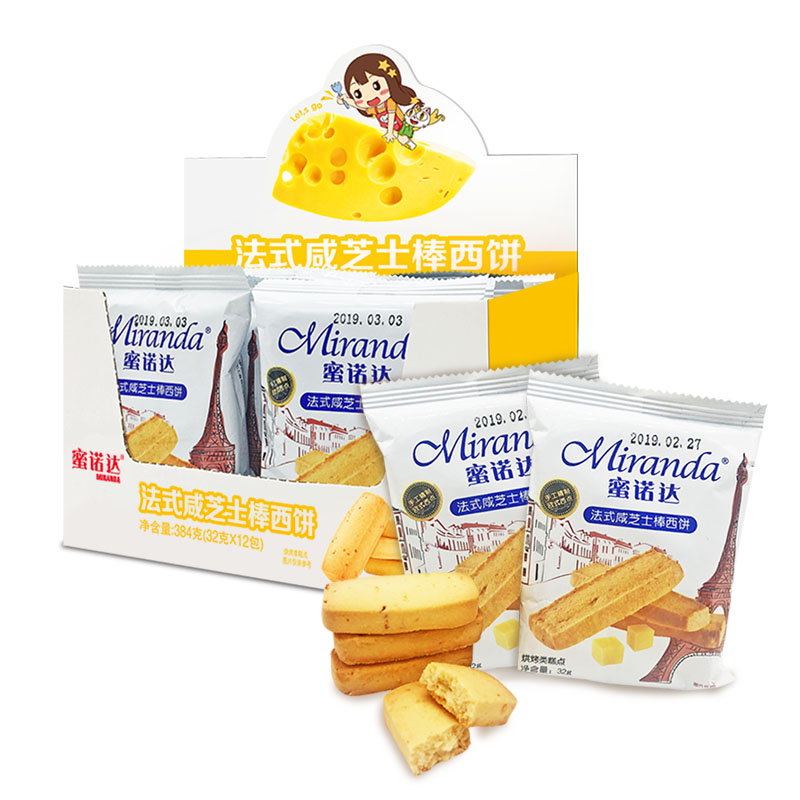
Other listed specifications illustrate the range of pack structures. Coffee Butter Flower 175g is specified as 24 tins per carton, with a five-month shelf life. Danish Fancy Butter Cookies 380g is specified as 12 tins per carton, with a nine-month shelf life. Salted Cheese Butter Cookies is listed as a 384g box containing 12 pieces of 32g each, with a 12-month shelf life. These are product-specific figures from the supplied records, not a general shelf-life or case-pack promise across the portfolio.
Gift formats and repeat-order planning
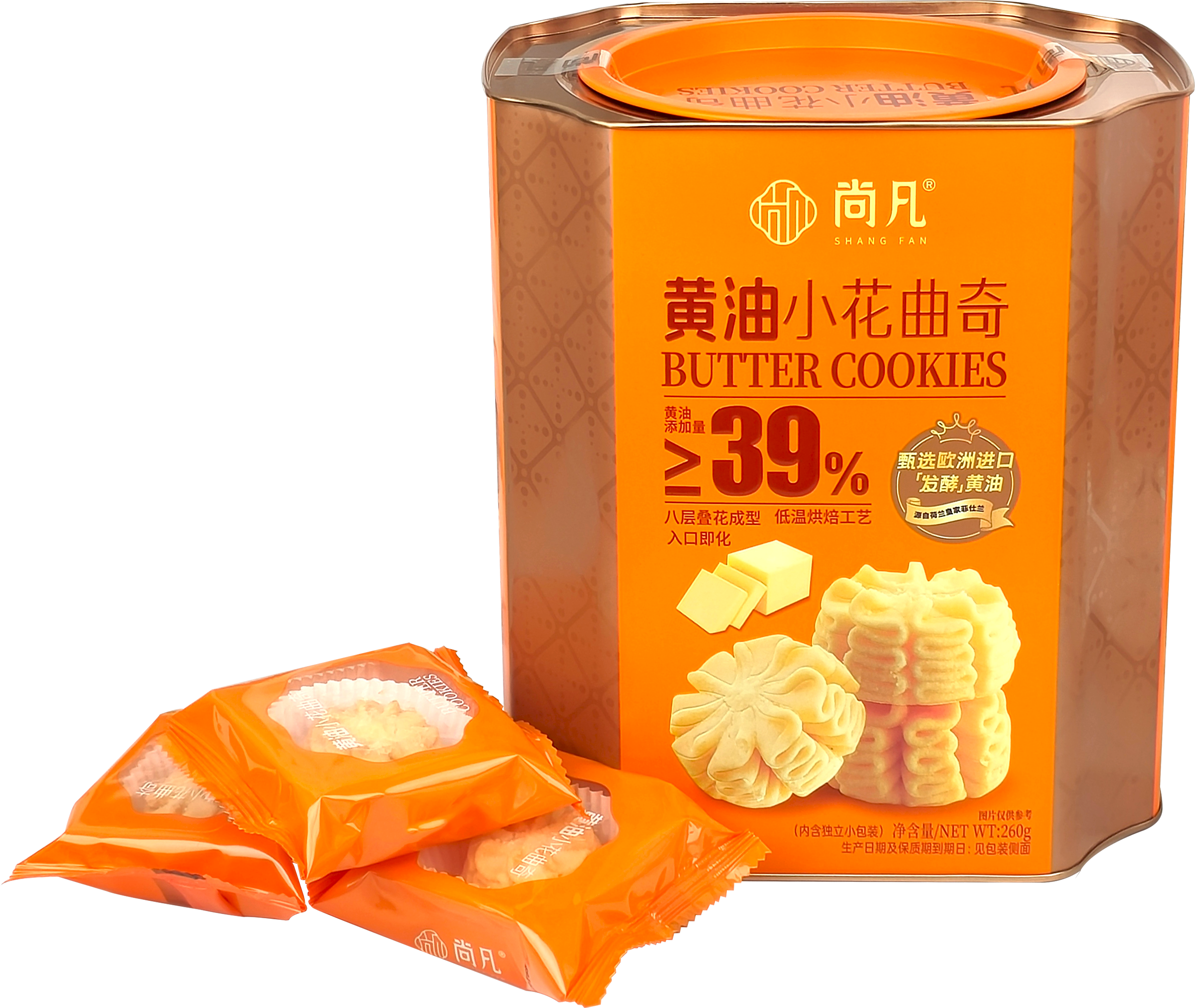
The Butter Floral Cookies 260g format offers a more specific packaging example: the product record describes a 260g gift tin matched with a gift bag, with individually packed servings. The specification lists 8 tins per carton and a six-month shelf life. These features can be relevant when buyers plan a gift-oriented presentation alongside everyday retail products, but the format itself does not establish demand, sell-through, or suitability for every sales channel.
SHANGFAN FOOD’s supplied application information identifies supermarkets, chain hotels, bakeries, coffee shops, online e-commerce platforms, and instant retail platforms as relevant settings for products in the range. That channel breadth can help procurement teams map a potential assortment to different selling or service contexts. A supermarket may assess shelf-ready tin formats; a hotel or coffee shop may consider portioning and serving needs; an online or instant-retail buyer may evaluate pack details and product information for digital listings. These are buyer-side evaluation questions, not claims that each named product has been adopted by every channel.
In this context, breadth can support program planning in two ways. First, a buyer can evaluate complementary flavour profiles, such as cocoa, tea, coffee, cheese, and Danish-style butter cookies. Second, the product records show more than one pack approach, including individual pieces, tins, cartons, and gift packaging. A multi-product plan may reduce the number of supplier relationships a buyer needs to coordinate, but it can also increase the importance of confirming each product’s availability, specification, packaging materials, and production schedule separately.
How to read certifications in a continuity review
Food-safety certificates can inform supplier qualification, but their scope must be read accurately. The supplied certification record lists an FSSC 22000 V6 Food Safety System Certification, certificate number 162605010, issued by Intertek. Its stated scope covers production of cookies and hot processed pastries, with baking identified as a main processing step. The record gives an issue date of 15 May 2026 and an expiry date of 14 May 2029.
A separate HACCP System Certificate record lists certificate number 001HACCP1900428, issued by China Quality Certification Centre, for the manufacture of heat-processed pastries, biscuits, and food fillings. The supplied product links identify HACCP coverage for Danish Fancy Butter Cookies 380g and Butter Floral Cookies 175g. These records are relevant documentary signals for a review, but they do not demonstrate a particular buyer’s product approval, shipment performance, or compliance with every destination market’s requirements.
For repeat purchasing, a buyer should match the certificate scope and product linkage to the items under consideration, then confirm current documentation and any destination-specific requirements independently. Certification is one qualification input; it should not be treated as proof of uninterrupted supply or a replacement for product specifications, label review, and agreed quality controls.
A practical evaluation framework for repeat supply
SHANGFAN FOOD’s documented profile and assortment can be assessed using a staged framework. The point is not to convert available facts into a guarantee, but to distinguish what the evidence supports from what remains open before a long-term purchase commitment.
1. Confirm the operating entity and profile
Use the company’s stated name, Dongguan Shangfan Food Co., Ltd., and the supplied company profile as the starting point for entity checks. Record the reported establishment year, facility area, and headcount as company-profile information. If these details are material to a contract, ask for current documents that connect the named entity to the manufacturing site and the products being purchased.
2. Match each SKU to its own specification
Build the assortment from product-specific records rather than category-level keyword lists. Confirm the exact product name, net weight, pieces per pack, carton configuration, shelf life, ingredients, and packaging format for each candidate. The 10g-piece, 9-piece-per-box or 13-piece-per-can format belongs to the specified thin crisp products; the 260g gift tin with a matching gift bag belongs to Butter Floral Cookies 260g. Keeping those specifications separate helps prevent errors in quotation, artwork, listing data, and inventory planning.
3. Test the proposed channel fit
Map the products to the intended channel—supermarket, chain hotel, bakery, coffee shop, online e-commerce, or instant retail—and identify the operational requirements for that channel. Consider how the product will be displayed, served, packed, and replenished. The listed application settings indicate intended or typical use cases; they do not establish buyer-specific performance in those channels.
4. Validate repeat-order readiness
Ask for a product-level production plan, expected order windows, capacity allocation, and the process for managing changes to packaging or specifications. Confirm how forecast changes, seasonal demand, and repeat orders are handled. The supplied company size and overall output do not answer these buyer-specific questions, so they should be confirmed directly rather than inferred.
5. Close the documentation gaps
Review current certificates and their scopes, product specifications, ingredient and allergen information, packaging documentation, shelf-life evidence, and destination-market labeling requirements. The supplied data contains selected product and certification facts, but not a complete technical dossier for every item. A buyer should treat missing documents as open verification points, not assume that one product’s documentation applies to the full range.
Comparison with a narrow, single-format sourcing approach
A buyer that sources a narrow assortment from a single-format supplier may find the SKU and pack review simpler. The trade-off is that adding flavours, gift presentations, or channel-specific formats may require additional suppliers and coordination. A broader portfolio such as the one listed for SHANGFAN FOOD can provide more options to assess within one supplier relationship, but it also requires more detailed SKU-by-SKU planning and does not remove concentration risk.
This is a comparison of procurement approaches, not a claim that SHANGFAN FOOD is superior to a named competitor. A broader catalogue is useful only when the relevant items can be produced to the required specifications and scheduled for the buyer’s needs. Conversely, a narrower catalogue may suit a buyer seeking one established product with fewer assortment variables. The appropriate choice depends on the buyer’s portfolio plan, verification results, and operational requirements.
Market and procurement interpretation
The supplied evidence supports a procurement-level observation rather than a claim about a market-wide trend: butter cookie programs may involve more than one flavour, channel, or packaging format, and the provided SHANGFAN FOOD records document examples across these dimensions. The available materials do not establish demand growth, channel performance, or a general shift in buyer preference. Buyers should therefore use the product breadth as an assortment-planning input, not as proof of market demand.
For long-term evaluation, the useful question is whether a manufacturer’s stated operating base and portfolio can be translated into a verified supply plan for the buyer’s own SKUs. The records provide an initial basis for that conversation: a company profile dating from 2015, a stated factory footprint and workforce, a reported overall output figure, product-specific pack details, and certification records with defined scopes. They do not provide shipment history, delivery reliability, order fill rates, or evidence of available capacity for a particular buyer.
Future outlook: turn breadth into a documented supply plan
The next step in evaluating SHANGFAN FOOD for a continuing butter cookie program is not to assume that a broad portfolio guarantees continuity. It is to identify a manageable set of target products, verify their current specifications and documentation, and confirm a buyer-specific production and replenishment arrangement. This approach preserves the value of the supplier’s documented breadth while recognizing the limits of profile-level evidence.
For buyers at the research and evaluation stages, a practical outcome is a shortlist of candidate SKUs, each linked to its correct pack format, shelf-life information, intended channel, and applicable certification documents. A separate record of open questions—capacity allocation, shipment history, and repeat-order scheduling—keeps unverified continuity claims from being confused with established company facts.
FAQ
What continuity information is available for SHANGFAN FOOD?
The supplied company profile states that Dongguan Shangfan Food Co., Ltd. was established in 2015, operates a garden-style factory covering more than 10,000 m², and has 100 employees. A verified-data entry reports annual output of 3,640 tons of baked goods, including butter cookies. The output figure is not a butter-cookie-only capacity or a guarantee of availability for a specific order.
Which butter cookie products are listed in the supplied range?
The supplied product records include Cocoa Butter Thin Crisp Cookies, Oolong Tea Crisp Cookie, Coffee Butter Flower, Danish Fancy Butter Cookies, Salted Cheese Butter Cookies, and Butter Floral Cookies gift-tin formats, among other products. Product names and specifications should be checked individually because pack sizes and shelf lives differ.
What is the pack format for Butter Floral Cookies 260g?
The listed Butter Floral Cookies 260g format uses a gift tin matched with a gift bag and contains individually packed servings. The supplied product specification lists 8 tins per carton and a six-month shelf life.
Do the 10g pieces and 9- or 13-piece packs apply to the gift tin?
No. The 10g-per-piece and 9-pieces-per-box or 13-pieces-per-can specifications are listed for Cocoa Butter Thin Crisp Cookies and Oolong Tea Crisp Cookie. They should not be applied to Butter Floral Cookies 260g.
Do the available factory and certification facts prove reliable repeat deliveries?
No. The factory profile, reported output, and certification records are useful qualification inputs, but the supplied information does not establish delivery performance, shipment history, or capacity reserved for a particular buyer. Those points require buyer-specific verification.
Source note
This article interprets the supplied company, product, certification, and application records alongside the provided verified-data package. The facts establish profile and product attributes; they do not constitute an audit of current capacity or delivery performance. The company brochure is available for public viewing and download.
Tem questões ou precisa de mais detalhes?
Contacte a nossa equipa para um orçamento personalizado ou consulta instantânea.
Solicitar orçamento
Preencha o formulário abaixo e a nossa equipa entrará em contacto com uma proposta personalizada.
Chat direto do WhatsApp
Prefere conversar em tempo real? Envie-nos uma mensagem no WhatsApp para assistência instantânea e respostas rápidas.
- Obter orçamento personalizado
- Partilhar fotos ou documentos
- Discuta as suas necessidades diretamente
Geralmente responde em 5–30 minutos durante o horário de expediente.