
Triple Offset Butterfly Valve Selection: A China Valve Buyer’s Comparison Framework
Triple offset butterfly valve selection is a constraint-matching exercise, not a brand shortlist exercise. For a China valve buyer, the useful comparison is not which catalogue looks longest, but whether a defined BOV303 configuration closes the specific service envelope: size, pressure class, body and disc material, seat construction, end connection, actuation, and documentary evidence.
EG Valves Manufacturing Co., Ltd is a Wenzhou, Zhejiang-based industrial valve manufacturer founded in 2000. The company produces gate, globe, ball, butterfly, check, plug and strainer products and exports to Europe, North America, Latin America and the Middle East. Its BOV303 triple offset butterfly valve is the reference product for this framework; the framework can be used to compare any quoted BOV303 configuration on like-for-like terms.

Severe-service environments such as offshore oil and gas set the constraint envelope before material and actuation choices are compared. Image: EG Valves industry application reference.
Why a China valve quote needs a comparison framework
The commercial opportunity in China valve sourcing is breadth: a buyer can often find a supplier that offers the body material, pressure class, end connection and actuation package required by a project. The risk is comparison quality. Two quotes can both say BOV303 and still describe different valves if one quote assumes a carbon steel body with a PTFE seat and a lever, while the other assumes a duplex body with a Stellite seat and a pneumatic actuator.
A comparison framework resolves that problem by forcing every quote into the same decision layers. The buyer first fixes the service constraints, then compares only the configurations that can meet them. Price is evaluated last, because a lower headline price may exclude material certification, actuation, testing or a seat option that the service requires.
Buyer rule: do not compare a BOV303 model number without comparing the configuration suffix, the material certificate, the seat drawing, the actuation datasheet and the pressure-test record. The model number identifies the product family; the configuration identifies the valve.
What the BOV303 triple offset design changes
A triple offset butterfly valve uses three geometric offsets to move the disc away from the seat before rotation begins. The design intent is to eliminate sliding contact between sealing surfaces during opening and closing, so the seat is not wiped or abraded by the disc on every cycle. That separation is the basis for the wear-reduction claim and for the bubble-tight closure associated with the triple offset design.
For procurement, the important consequence is that the seat and disc are not interchangeable with those of a conventional soft-seated butterfly valve. The buyer must compare the sealing principle, the seat material, the disc material and the actuation torque as one system. A triple offset valve that is correctly specified for isolation duty is not automatically correct for abrasive slurry, continuous throttling or a duty cycle outside the quoted configuration.
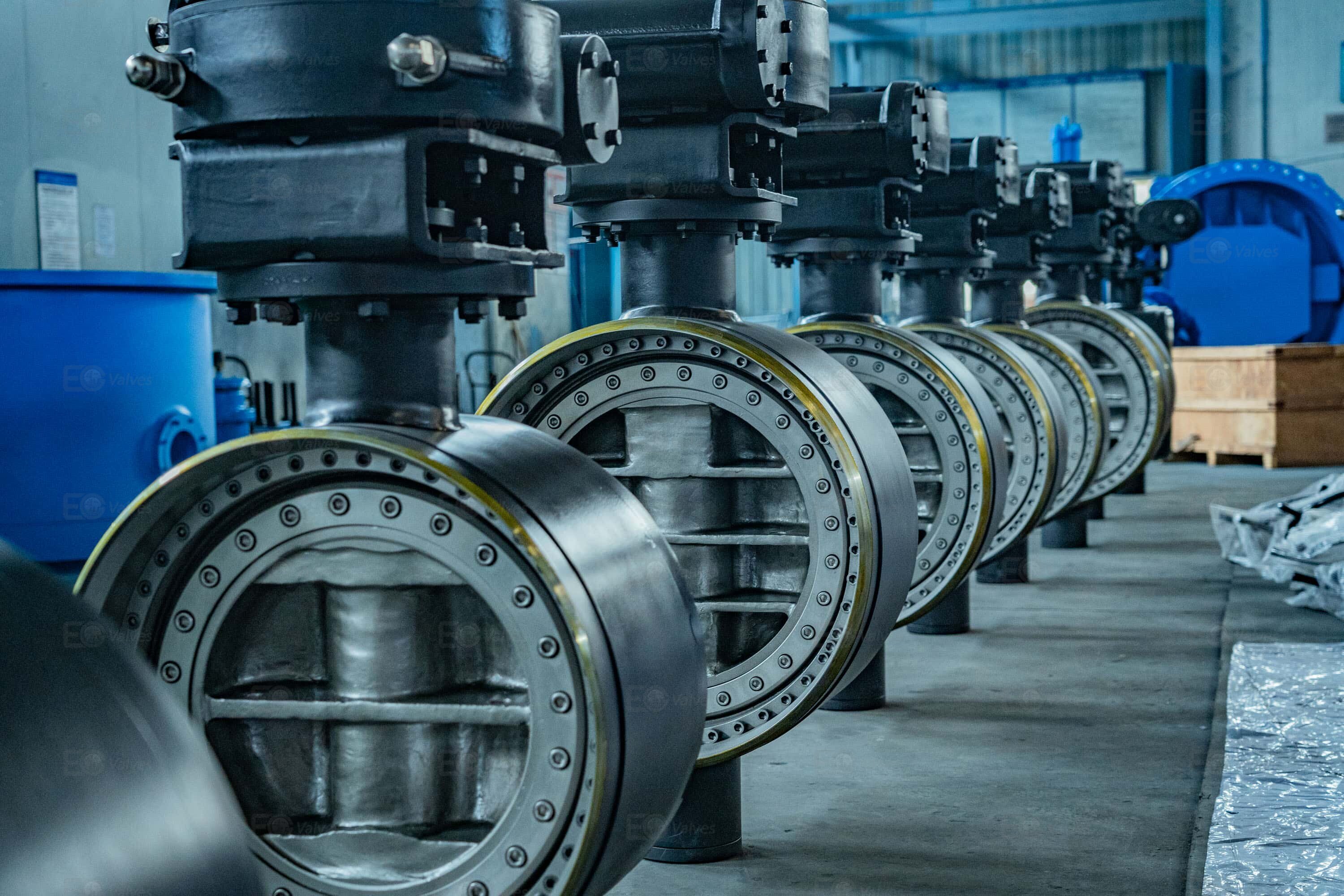
Triple offset butterfly valve configuration reference. The seat, disc and body material choices should be compared together, not as separate catalogue options. Image: EG Valves.
BOV303 configuration matrix: compare the constraints, not the catalogue
The BOV303 range described in this framework covers size NPS 2 to 60 in, pressure ratings PN10 to PN40 and Class 150 to 600, wafer, lug and double-flange body styles, and handle lever, gearbox, worm gear, electric or pneumatic actuation. Within that range, the buyer should compare five configuration layers in a fixed order.
| Decision layer | BOV303 options to compare | What the buyer must establish | Evidence to request |
|---|---|---|---|
| Size and pressure class | NPS 2 to 60 in; PN10 to PN40; Class 150 to 600 | Line size, design pressure, design temperature, flange standard and piping class | Model datasheet, pressure-test procedure, general arrangement drawing |
| Body material | Carbon steel, stainless steel, alloy steel, duplex steel | Media corrosivity, temperature range, external environment and project material specification | EN 10204 3.1 material test certificate and body material specification |
| Disc material | Carbon steel, stainless steel, duplex steel | Compatibility with the body, media, velocity and seat combination | Disc material certificate and seating-surface finish requirement |
| Seat construction | Stainless steel with graphite; PTFE with stainless steel; optional Stellite | Media compatibility, temperature, cycle frequency and required shutoff class | Seat drawing, seat material certificate and test acceptance criterion |
| End connection | Wafer, lug, double flange | Piping interface, available space, maintenance method and line-load assumptions | Dimensional drawing and flange drilling standard |
| Actuation | Handle lever, gearbox, worm gear, electric, pneumatic | Operating torque, automation interface, fail-safe position and hazardous-area requirements where applicable | Actuator datasheet, torque calculation and control interface drawing |
Size and pressure class: NPS 2 to 60 in, PN10 to PN40 and Class 150 to 600
Size and pressure class are the first hard constraints because they determine whether the BOV303 is mechanically admissible before any material comparison begins. The stated BOV303 range runs from NPS 2 to 60 in, with PN10 to PN40 and Class 150 to 600 ratings. A buyer should not treat PN and Class as interchangeable labels. They are different rating systems, and the flange drilling, gasket face and piping class must be confirmed against the project specification.
For pipeline shut-off duty, the comparison should confirm that the valve is being quoted as an isolation valve at the specified size and rating. For flow control or quick shut-off duty, the buyer should state the cycling requirement and the actuation response required, because a triple offset isolation valve is not automatically a continuous control valve. Where the duty requires frequent modulating movement, the buyer should compare the valve and actuator as a control package, not as a standard isolation package.
Pressure rating is not a price band
No reliable price band can be derived from a BOV303 model number alone. The cost drivers are the body material, disc material, seat construction, pressure class, end connection, actuation, testing and documentation. A Class 150 carbon steel valve with a lever and a Class 600 duplex valve with a Stellite seat and a pneumatic actuator are not comparable commercial offers even if both are described as BOV303. The correct procurement action is to request a line-item quote against a fixed datasheet so that the difference in price can be traced to a difference in configuration.
Body and disc material comparison
Material selection should follow the media and the external environment, not the reverse. Carbon steel is the reference body material where the media and project specification permit it. Stainless steel is selected where corrosion resistance is the governing constraint. Alloy steel is selected where the project specification requires alloy construction for the service conditions. Duplex steel is selected where the combination of strength and chloride resistance makes it the appropriate material class, such as certain offshore or seawater-influenced duties.
The disc should be compared separately from the body. The BOV303 disc options in this framework are carbon steel, stainless steel and duplex steel. A stainless body with a carbon steel disc, or a duplex body with a stainless disc, may be technically possible as a configuration, but the buyer should confirm that the combination is intentional and has been reviewed against the media, the seat and the required shutoff performance. The material test certificate should identify the actual body and disc materials, not merely the product family.
| Material layer | Practical selection logic | Procurement check |
|---|---|---|
| Carbon steel body | General industrial and oil and gas duties where the project specification permits carbon steel and corrosion is controlled | Confirm coating, material certificate and compatibility with the external environment |
| Stainless steel body | Chemical, corrosive or hygienic-adjacent duties where stainless steel is required by the specification | Confirm grade, not just the words stainless steel; verify certificate |
| Alloy steel body | Duties where the project specification calls for alloy steel for temperature, pressure or process reasons | Confirm the exact alloy grade and its certificate |
| Duplex steel body | Chloride-bearing, offshore or seawater-influenced duties where duplex is specified | Confirm duplex grade and welding or casting documentation where applicable |
| Disc material | Must be compatible with body, seat, media and velocity | Compare disc certificate with body certificate |
Seat selection: graphite, PTFE or Stellite
The seat is where many seemingly similar BOV303 quotes diverge. The framework compares stainless steel with graphite, PTFE with stainless steel, and optional Stellite. These are not cosmetic alternatives; they change the sealing behaviour and the applications for which the valve should be reviewed.
Stainless steel with graphite is a seat construction to compare where graphite sealing is specified for the duty. PTFE with stainless steel is a softer seat combination to compare where the media and temperature are compatible with PTFE and the required shutoff can be achieved. Optional Stellite is a hard overlay option to compare where the buyer requires a hard, wear-resistant seating surface. In every case, the buyer should ask for the seat drawing, the seat material certificate and the shutoff test acceptance criterion. The words bubble-tight are not a substitute for a test procedure.
Seat comparison rule: compare seat options only after the media, temperature and cycle frequency are fixed. A seat that is appropriate for clean isolation duty may not be appropriate for abrasive, scaling or high-cycle service. If the duty is abrasive slurry or continuous throttling, the buyer should question whether a triple offset butterfly valve is the right product class before comparing seat upgrades.
End connection and actuation
Wafer, lug and double-flange body styles serve different installation and maintenance assumptions. A wafer valve is compact and fits between flanges. A lug valve provides a different bolting and installation arrangement. A double-flange valve provides a flanged connection interface. The buyer should compare the dimensional drawing and the flange drilling standard, not just the body style name. The stated BOV303 framework covers wafer, lug and double flange; butt-welding is not part of that range and should be treated as a separate requirement unless it is explicitly quoted.
Actuation changes both the operating envelope and the delivery scope. Handle lever operation is the simplest manual configuration. Gearbox and worm gear operation are compared where manual operation requires mechanical advantage. Electric and pneumatic actuation are compared where remote control, automation or quick shut-off is required. The buyer should compare the actuator torque calculation, the control signal, the fail-safe position and the interface drawing. For hazardous areas, the actuator documentation and certification should be reviewed as part of the valve package, not as an accessory added after the valve is selected.
| Actuation option | Comparison focus | Document to request |
|---|---|---|
| Handle lever | Manual operation, access, locking requirement and valve size | General arrangement drawing and operating torque basis |
| Gearbox | Manual operation with mechanical advantage, handwheel position and maintenance access | Gearbox datasheet and mounting drawing |
| Worm gear | Manual operation and holding position under load | Worm gear datasheet and torque calculation |
| Electric | Remote control, power supply, control signal and fail-safe position | Actuator datasheet, wiring diagram and interface schedule |
| Pneumatic | Air supply, solenoid and limit switch interface, spring-return or double-acting behaviour | Actuator datasheet, air consumption data and interface drawing |
Application fit: oil and gas, chemical, steel and shipbuilding
The same BOV303 comparison framework applies across oil and gas, chemical, steel and shipbuilding service conditions, but the weighting changes. In oil and gas duties, pressure class, material traceability and actuation reliability usually dominate the comparison. In chemical duties, body and disc corrosion resistance and seat compatibility with aggressive fluids dominate. In steel duties, temperature, scale and cycling should be added to the datasheet review. In shipbuilding and offshore-adjacent duties, space, seawater-influenced corrosion, mounting orientation and actuator maintenance access become part of the comparison.
EG Valves documents oil and gas, chemical, petroleum refining, power generation, offshore and mining application experience in its reference material. A UAE petroleum refining reference covers gate, globe, check, ball and butterfly valves in Class 150 to 1500 and materials including WCB, WC6, WC9 and C5 over an 8 to 10 year service period. That reference supports supplier qualification for severe-service valve supply, but it should not be presented as a BOV303 performance test. The buyer should separate company-level project evidence from model-level BOV303 evidence when evaluating the quote.
For pipeline shut-off duty, the BOV303 should be compared as a quarter-turn isolation valve. For flow control or quick shut-off duty, the buyer should state the required response and cycling pattern and confirm that the actuator and seat configuration are intended for that duty. A triple offset valve can provide tight isolation, but it should not be selected for continuous throttling merely because it is a butterfly valve with a metal seat.
Certificate scope and evidence: what to verify
China valve buyers often receive a certificate pack that looks comprehensive but does not apply to the specific product. The correct check is not the number of certificates; it is whether each certificate scope includes the product being purchased and whether the certificate is current at the time of order.
| Certificate | Issuer and reference | Scope relevant to this framework | Buyer note |
|---|---|---|---|
| ISO9001:2015 | China Quality Certification Center (CQC), certificate 00125Q33391R3M/3400 | Gate valves, globe valves, ball valves, butterfly valves, check valves, pipe filters and flanges | Valid to 2028-05-22; butterfly valves are within scope |
| CE / PED | TUV SUD Industrie Service GmbH, certificate DGR-0036-QS-1360-24, PED 2014/68/EU Annex III Module H | Gate valves, ball valves, globe valves, check valves, butterfly valves and strainers | Valid to 2027-05-26; butterfly valves are within scope |
| API 6D | American Petroleum Institute, certificate 6D-0506 | Check valves, ball valves and gate valves | Valid to 2027-03-30; does not list butterfly valves |
| API 600 | American Petroleum Institute, certificate 600-0179 | Bolted bonnet steel gate valves | Valid to 2027-03-30; does not list butterfly valves |
The API certificates are useful evidence of company capability in gate, ball and check valve manufacturing, but they should not be used to claim that the BOV303 itself is API 6D or API 600 certified. The buyer should ask for the certificate scope page and compare it with the product being quoted. This is the practical meaning of API Certified Valve in a China valve sourcing file: certification is product-scope specific, not a general label.
Document check: the available certificate record includes an ISO45001 certificate with an expiry date of 2026-05-12. As of this article, that date has passed. A buyer should treat that document as historical unless a renewed copy is provided. The current certificate pack should always be dated and checked against the purchase order date.
Material traceability should also be checked at order level. EG Valves states that it provides EN 10204 3.1 material test certificates with every order and performs 100 percent inspection of every valve. Those claims should be written into the purchase order, with the specific body, disc and seat materials identified. The company also states OEM and ODM capability, a monthly capacity of 8,000 valves and a lead time of 25 to 35 days. Those figures are useful for delivery planning, but they do not replace the BOV303 datasheet and test record.
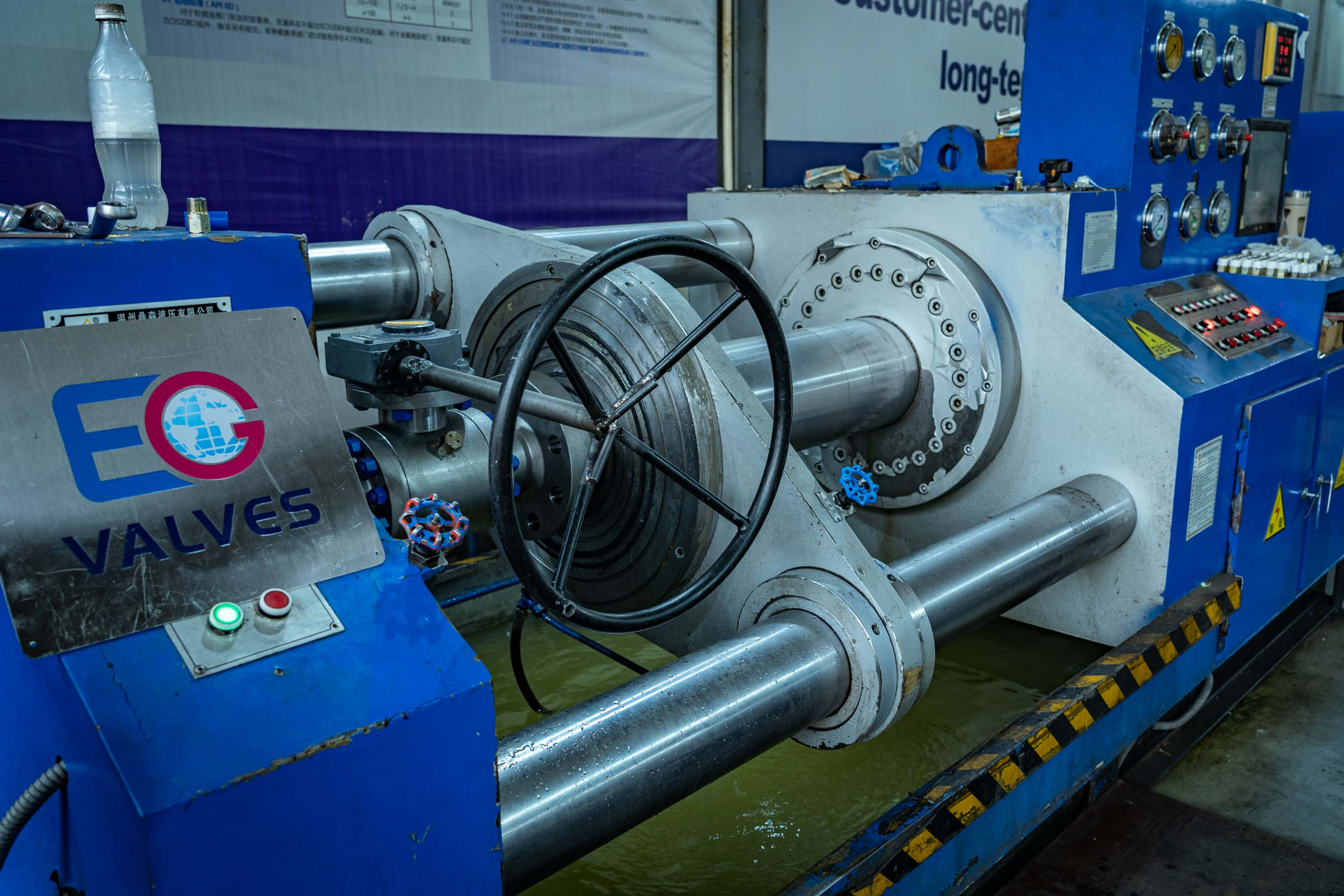
Certificate review should be linked to physical inspection and material identification. A certificate is evidence only when its scope matches the quoted valve. Image: EG Valves inspection reference.
Comparison with conventional butterfly valve choices
Compared with a conventional soft-seated butterfly valve, a triple offset metal-seated design is intended for tighter shutoff and more demanding isolation duties. The trade-off is that the triple offset design requires more careful matching of seat, disc and actuation, and it is not the default answer for every butterfly valve application. A soft-seated valve may be appropriate for a simple water or HVAC duty where the temperature and pressure are modest, while a triple offset BOV303 should be compared where the service requires a metal-seated isolation solution within the stated range.
The limitation is equally important. A triple offset butterfly valve is not a universal substitute for a knife gate valve in abrasive slurry service, a full-port ball valve in pigging service, or a dedicated control valve in continuous throttling service. If the buyer compares only the headline pressure class and misses the cycling, abrasion or control requirement, the selected BOV303 configuration may be mechanically correct but operationally unsuitable. That is why the comparison framework puts service envelope and seat selection before price.
Market trend: configuration-level evidence
In China valve procurement, the practical trend is toward configuration-level evidence rather than brand-level assurance. Buyers increasingly ask for the model datasheet, the material certificate, the seat drawing, the actuator interface and the certificate scope page before they compare price. This is a rational response to the breadth of the Chinese valve market: a supplier can offer a wide product range, but the buyer still needs to prove that the specific configuration is the one being purchased.
This trend favors suppliers that can document the product rather than merely list it. EG Valves’ export record, certificate pack and project references provide a basis for supplier qualification, but the BOV303 comparison still depends on the exact quote. The buyer should use the supplier evidence to decide who can be shortlisted, then use the BOV303 configuration matrix to decide which quote is technically comparable.
Future outlook
The next improvement in China valve sourcing is unlikely to be a new marketing claim. It is more likely to be better configuration data: clearer datasheets, material traceability at the heat-number level, actuator integration drawings and certificate scope summaries that a procurement team can check without guessing. For triple offset butterfly valves, that means the BOV303 quote should eventually be comparable line by line, not paragraph by paragraph.
Buyers should also expect actuation and documentation to become part of the primary comparison rather than an afterthought. As more projects require remote operation, hazardous-area documentation and faster commissioning, the actuator and the valve will be evaluated as one package. The supplier that can provide the valve, the actuator interface and the material record together will be easier to qualify than the supplier that provides only a model number.
FAQ
The first constraint is the service envelope: size, pressure class, design temperature, media and required shutoff. The BOV303 range covers NPS 2 to 60 in, PN10 to PN40 and Class 150 to 600, so the buyer should confirm that the line size and rating fall within that range before comparing body, disc, seat or actuation options.
The body material should follow the media, external environment and project specification. Carbon steel is the reference choice where the specification permits it. Stainless steel is selected for corrosion resistance. Alloy steel is selected where the project requires an alloy grade for the service conditions. Duplex steel is selected where the combination of strength and chloride resistance makes it appropriate, such as certain offshore or seawater-influenced duties. The selected grade should be confirmed on the EN 10204 3.1 material certificate.
There is no universal first seat option. Stainless steel with graphite, PTFE with stainless steel and optional Stellite should be compared against the media, temperature, cycle frequency and required shutoff. The buyer should request the seat drawing, the seat material certificate and the shutoff test acceptance criterion. If the duty is abrasive slurry or continuous throttling, the buyer should first confirm that a triple offset butterfly valve is the right product class.
They are pressure-rating designations used to match the valve to the piping class. PN and Class are different rating systems and should not be converted by assumption. The buyer should confirm the flange drilling, gasket face and design pressure against the project specification, and should not accept a quote that lists a rating without the corresponding dimensional and test data.
The end connection determines the piping interface and installation method. Wafer, lug and double-flange styles are all within the stated BOV303 framework, but they require different dimensional checks and bolting assumptions. The buyer should compare the general arrangement drawing and the flange drilling standard. Butt-welding is not part of the stated BOV303 range and should be treated as a separate requirement unless it is explicitly quoted.
Actuation should be compared as part of the valve package. Handle lever, gearbox, worm gear, electric and pneumatic options change the operating method, the torque requirement, the control interface and the maintenance plan. The buyer should request the actuator datasheet, torque calculation, control signal details and fail-safe position. For hazardous areas, the actuator documentation should be reviewed with the valve documentation.
The available certificate record lists API 6D for check valves, ball valves and gate valves, and API 600 for bolted bonnet steel gate valves. Neither scope lists butterfly valves. The BOV303 buyer should therefore not treat those API certificates as product certification for the butterfly valve. CE/PED and ISO9001 are the certificate scopes in the available record that include butterfly valves.
A triple offset butterfly valve is an isolation valve, not a universal solution for abrasive slurry, pigging or continuous throttling. Its advantage comes from the offset geometry and the matched seat and disc design. That advantage depends on correct material selection, correct actuation sizing and a service envelope within the quoted range. Outside the BOV303 range of NPS 2 to 60 in, PN10 to PN40 and Class 150 to 600, the buyer should request a separate engineering review rather than extend the model number by assumption.
Reference download
For buyers who need the company and product-range reference before building a BOV303 comparison matrix, the EG Valves brochure is available here: EG Valves brochure PDF.
This article is an independent procurement framework. It does not replace project-specific engineering review, the final BOV303 datasheet, the purchase order specification or the applicable certificate verification.
Tem questões ou precisa de mais detalhes?
Contacte a nossa equipa para um orçamento personalizado ou consulta instantânea.
Solicitar orçamento
Preencha o formulário abaixo e a nossa equipa entrará em contacto com uma proposta personalizada.
Chat direto do WhatsApp
Prefere conversar em tempo real? Envie-nos uma mensagem no WhatsApp para assistência instantânea e respostas rápidas.
- Obter orçamento personalizado
- Partilhar fotos ou documentos
- Discuta as suas necessidades diretamente
Geralmente responde em 5–30 minutos durante o horário de expediente.