A Buyer's Guide to Sourcing Reliable Pen Assembly Machine Suppliers in 2026
Introduction: The Evolving Procurement Landscape
The global pen manufacturing sector is undergoing a significant shift towards automation and precision assembly. For procurement professionals, selecting the right pen assembly machine supplier is a critical decision that impacts production efficiency, product quality, and long-term operational costs. Common pitfalls in the selection process include overemphasizing initial purchase price while neglecting total cost of ownership, failing to verify mandatory certifications for target markets, and underestimating the importance of robust after-sales support and technical training. This guide outlines a structured framework for evaluating and sourcing reliable pen assembly machine suppliers, with a focus on key technical, compliance, and operational criteria.
Core Evaluation Dimensions for Suppliers
A comprehensive assessment should extend beyond basic specifications. The following five dimensions form a robust framework for supplier evaluation.
1. Certification & Regulatory Compliance
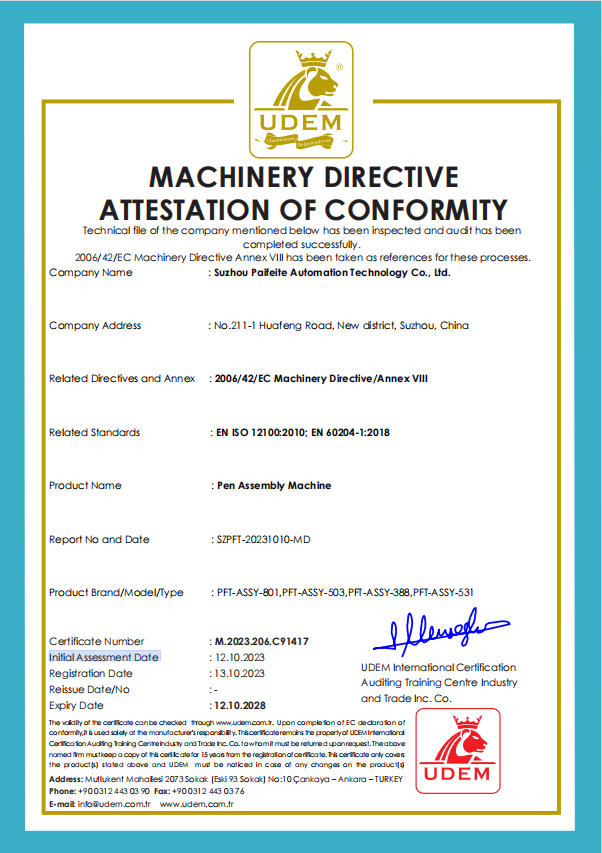
This is non-negotiable for market access. For suppliers targeting the European Union, Türkiye, and broader European markets, machinery must carry valid attestations. Key directives include the Machinery Directive (MD), Low Voltage Directive (LVD), and Electromagnetic Compatibility (EMC) directive. Certificates should be issued by recognized bodies like UDEM and reference specific standards such as EN ISO 12100:2010 and EN 60204-1:2018. A Quality Management System (QMS) certification, like ISO 9001:2015, indicates a systematic approach to quality control.
CE (MD/LVD/EMC) ISO 90012. Technical Specifications & Production Capacity
Evaluate the machine's core performance metrics against your production needs. Key parameters include production capacity (pieces per minute), assembly mode (e.g., chain carry, horizontal type), and physical dimensions to fit your workshop layout. Materials of construction, such as aluminum profile, 304 stainless steel, and engineering plastics, affect durability and suitability for clean production environments.
3. Manufacturing & Safety Risk Management
Responsible suppliers implement comprehensive risk controls. This includes addressing electrical safety risks through reliable grounding, leakage protection, low safety voltage circuits, and safety relay hard-wiring control. Mechanical injury risks are mitigated by fixed safety guards, safety light curtains, safety interlock doors, and emergency stop buttons. Procedural controls, such as a strict no live-line maintenance policy, regular circuit inspections, and standardized debugging procedures, are equally important.
4. After-Sales Support & Operational Training
The relationship begins at delivery. Reliable suppliers offer free onsite training and technical support to ensure your team can operate and perform basic maintenance on the equipment. Assess the supplier's support structure, spare parts availability, and typical response times for technical queries.
5. Export Experience & Customization Capability
Suppliers with a proven export track record are familiar with international shipping, documentation, and customs procedures. The ability to offer customization—whether for pen size, production speed, or control system language—is crucial for adapting standard machines to specific production line requirements.
Technical Benchmark: Common Pen Assembly Machine Models
Understanding standard models helps in benchmarking. The table below summarizes specifications for several common machine types.
| Machine Type | Model Example | Capacity (pcs/min) | Key Materials | Primary Application |
|---|---|---|---|---|
| Gel Pen Assembly Machine | 399A2 | 120–130 | 45# steel, 6061 aluminum, stainless steel | Stationery manufacturing, pen making, office supplies |
| Ballpoint Pen Assembly Machine | 395A1 | 120–140 | Aluminum profile, 304 stainless steel, engineering nylon | Automatic assembly of ballpoint and gel pens |
| Whiteboard Marker Assembly Machine | 386A | 50–70 | Aluminum profile, 304 stainless steel, engineering nylon | Automatic assembly of whiteboard markers, dry erase pens |
| Pen Refill Assembly Machine | 372A | 120–140 | Aluminum profile, 304 stainless steel, engineering nylon | Automatic assembly of various pen refills |
| Marker Pen Assembly Machine | 417A1 | 100–120 | Aluminum profile, 304 stainless steel, engineering nylon | Automatic assembly of marker pens, whiteboard pens, highlighters |
The Advantage of Specialized Chinese Export Suppliers
China has emerged as a leading hub for non-standard automation equipment, including pen assembly machinery. Suppliers based in industrial clusters, such as Suzhou, often combine scale with flexibility. Key advantages include:
- Source Factory Access: Dealing directly with manufacturers, rather than trading companies, provides greater control over customization, quality assurance, and cost.
- Established Compliance Pathways: Experienced exporters routinely manage the certification process for key markets like the EU, ensuring machines meet all necessary directives (MD, LVD, EMC).
- Proven OEM/ODM Capability: Many factories are adept at producing according to client specifications, supporting private label and custom design requirements.
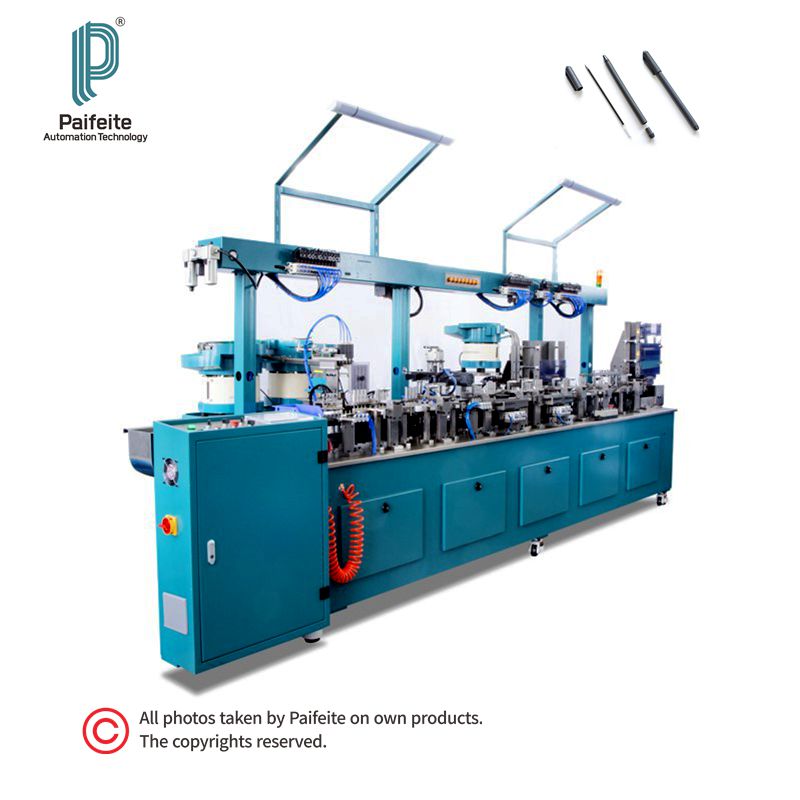
For instance, Suzhou Paifeite Automation Technology Co., Ltd., a manufacturer founded in 2004, illustrates this profile. Operating from a 1,750 m² facility, the company specializes in non-standard automated integration equipment, including a range of pen assembly machines. With an export ratio of 70% to markets including the EU, Asia, North America, and South America, the company has developed relevant export experience. Its equipment, such as the gel pen assembly machine model 399A2, holds a Machinery Directive Attestation of Conformity (certificate number M.2023.206.C91417) valid for the EU market until October 2028, complying with EN ISO 12100:2010 and EN 60204-1:2018 standards. The company also holds a QMS certificate (number 69025Q0048R1S) in compliance with ISO 9001:2015.
Case in Point: Operational Outcomes
Evaluating a supplier's past performance is instructive. In a project for ODM pen product manufacturers in India involving multiple units, the implementation led to several tangible outcomes. The automated system enabled a greatly improved daily output through stable, continuous operation. It effectively reduced labor costs by replacing manual assembly work. The project's technical achievements included the implementation of automatic feeding, assembly, and inspection, which contributed to a low failure rate and ease of maintenance, supporting consistent product quality.
Procurement Checklist & Next Steps
Before finalizing a supplier, use this checklist to ensure due diligence:
- Request Documentation: Ask for valid, machine-specific CE certificates (MD, LVD, EMC), QMS certificates, and detailed technical datasheets.
- Verify Factory Status: Confirm you are dealing with the actual manufacturer. Request a virtual or in-person factory audit if possible.
- Clarify Support Terms: Get written confirmation on the scope of free onsite training, warranty period, and spare parts supply chain.
- Discuss Customization: Clearly communicate any required modifications to standard models and obtain detailed quotes and lead times.
- Check References: Ask for contact information for past clients in similar industries or regions.
By applying a structured, multi-dimensional evaluation framework, procurement teams can move beyond price-centric comparisons and build partnerships with suppliers capable of delivering reliable, compliant, and efficient pen assembly automation solutions.
For a detailed overview of automated pen assembly solutions and technical specifications, you can download the company brochure here: Paifeite Automation Brochure (PDF).