
1.2mm or 1.6mm Cutting Discs: A Buyer's Decision Framework
An evaluation reference for distributors, importers and procurement teams specifying 115 mm and 125 mm angle grinder discs
Cutting disc thickness is one of the few specification choices that changes cutting speed, consumable cost per cut and operator rework at the same time, and it is usually settled by habit rather than by evidence. On 115 mm and 125 mm angle grinders, most buyers are choosing between a 1.2 mm profile built for speed and a 1.6 mm profile built for durability, with a 3.0 mm option reserved for heavier feed pressure and rougher duty.
CNDOME (Changzhou Dome Abrasives Manufacture Co., Ltd.) is a resin-bonded cutting and grinding wheel manufacturer founded in 2001 in Changzhou, Jiangsu Province, China, exporting to Latin America, Europe, Africa and Asia. Its documentation set, which includes MPA Hannover certificates issued against EN 12413, is recorded at the level of individual 115 mm and 125 mm formats across several thickness tiers. That makes it a useful reference case for how the thickness decision should be structured, and for what evidence a buyer should ask to see before locking a purchase order.
Why the Thickness Decision Rarely Gets Made Properly
Most purchasing teams treat thickness as a sub-line of the size specification. The SKU is recorded as a 115 mm cutting disc, and whether it is 1.2 mm or 1.6 mm is resolved by whatever the supplier ships on the day. That approach is stable until a job starts producing burrs on thin-wall stainless, or a workshop reports discs breaking down early because operators were leaning on a 1.2 mm wheel that was never designed for that pressure.
The commercial stakes are structural rather than dramatic. A thinner disc removes less material per cut and meets less resistance, so it generally cuts faster and transfers less heat into the workpiece. A thicker disc is more rigid, tolerates side load and inconsistent operator pressure better, and usually survives longer in rough service. Buyers are effectively choosing between throughput and consistency, and the right answer depends on variables a supplier cannot see: workpiece thickness, burr tolerance, machine condition, and how disciplined the operator is.
There is also a procurement risk that sits outside the workshop. Thickness tiers are certified as distinct formats, not as a general product family. A buyer who approves a supplier on the basis of one certificate and then orders three thickness tiers has not actually verified three tiers. The decision framework below is built to close that gap.
What Actually Changes Between 1.2 mm, 1.6 mm and 3.0 mm
Three variables move together when thickness changes: kerf width, lateral rigidity and heat in the cut. They are the reason the two profiles behave differently in service even when the abrasive formulation and the rated speed are identical.
| Variable | 1.2 mm profile | 1.6 mm profile | 3.0 mm profile |
|---|---|---|---|
| Kerf width | Narrowest cut, least material removed | Wider cut, more material removed | Widest cut of the three |
| Lateral rigidity | Lowest; sensitive to side load and tilt | Moderate; tolerates normal hand pressure | Highest; built for sustained feed pressure |
| Feed speed in straight cuts | Fastest, because resistance is lowest | Slower than 1.2 mm at equal pressure | Slowest in thin stock |
| Heat at the cut line | Lower heat input, less discolouration risk | Higher heat input at equal pressure | Highest heat input |
| Service life under rough handling | Shorter if pressure is inconsistent | Longer and more predictable | Longest in heavy cut-off work |
The kerf point is often underweighted. Because the cut width is set by the disc thickness, a 1.2 mm disc removes less material than a 1.6 mm disc in the same pass. In sheet and thin-wall work that difference shows up as a faster cut and less burr. In thick section it shows up as a disc that is doing more work per unit of contact area, which is where a thin wheel starts to deflect.
Rigidity is the point that decides most real-world outcomes. An operator holding an angle grinder by hand applies pressure that is never perfectly perpendicular. A 1.2 mm disc responds to that pressure by flexing, and flexing concentrates load at a narrow band of the rim. A 1.6 mm disc resists the same pressure with less deflection, which is why it typically returns a longer and more consistent service life in mixed fabrication shops where the same tool is used on different jobs through the day.
Heat is the trade-off buyers notice last and pay for first. A thinner disc generates a narrower heat-affected band, which matters on stainless where discolouration means rework. A thicker disc generates more heat at the same feed pressure, so on temperature-sensitive material the 1.6 mm option is usually worked with a lighter touch rather than more pressure.
The Hardware Side: Bore, Shape and Rated Speed
Thickness does not change how a disc mounts. The 115 mm and 125 mm formats in this portfolio use a 22.23 mm bore, matching the standard angle grinder spindle and flange used across the size range. CNDOME's published 115 mm specification is a useful concrete reference point: 115×1.2×22.23, T41 flat shape, 22.23 mm bore, maximum operating speed 80 m/s.

Rated speed falls as diameter rises across the range. The 180 mm T41 specification records a maximum of 80 m/s at 8,500 RPM, the 230 mm format records 6,600 RPM at the same 80 m/s ceiling, and the 400 mm format records 3,800 RPM. Speed rating is a function of diameter and construction, not thickness, which is precisely why a buyer cannot assume that moving from 1.2 mm to 1.6 mm at the same diameter leaves machine behaviour unchanged. The disc is rated for the same surface speed, but it presents a stiffer body to the work.
Shape belongs in the same check. T41 is a flat cutting disc; T42 is a depressed-centre profile, and the 230 mm range is offered as T41 or T42 with thickness options of 2.0 mm, 2.5 mm and 3.0 mm on a 22.23 mm bore. Buyers moving a specification between sizes should confirm shape and bore together, because a flat disc and a depressed-centre disc of nominally similar diameter are not interchangeable on every machine guard and flange arrangement.
How CNDOME Documents Each Thickness Tier
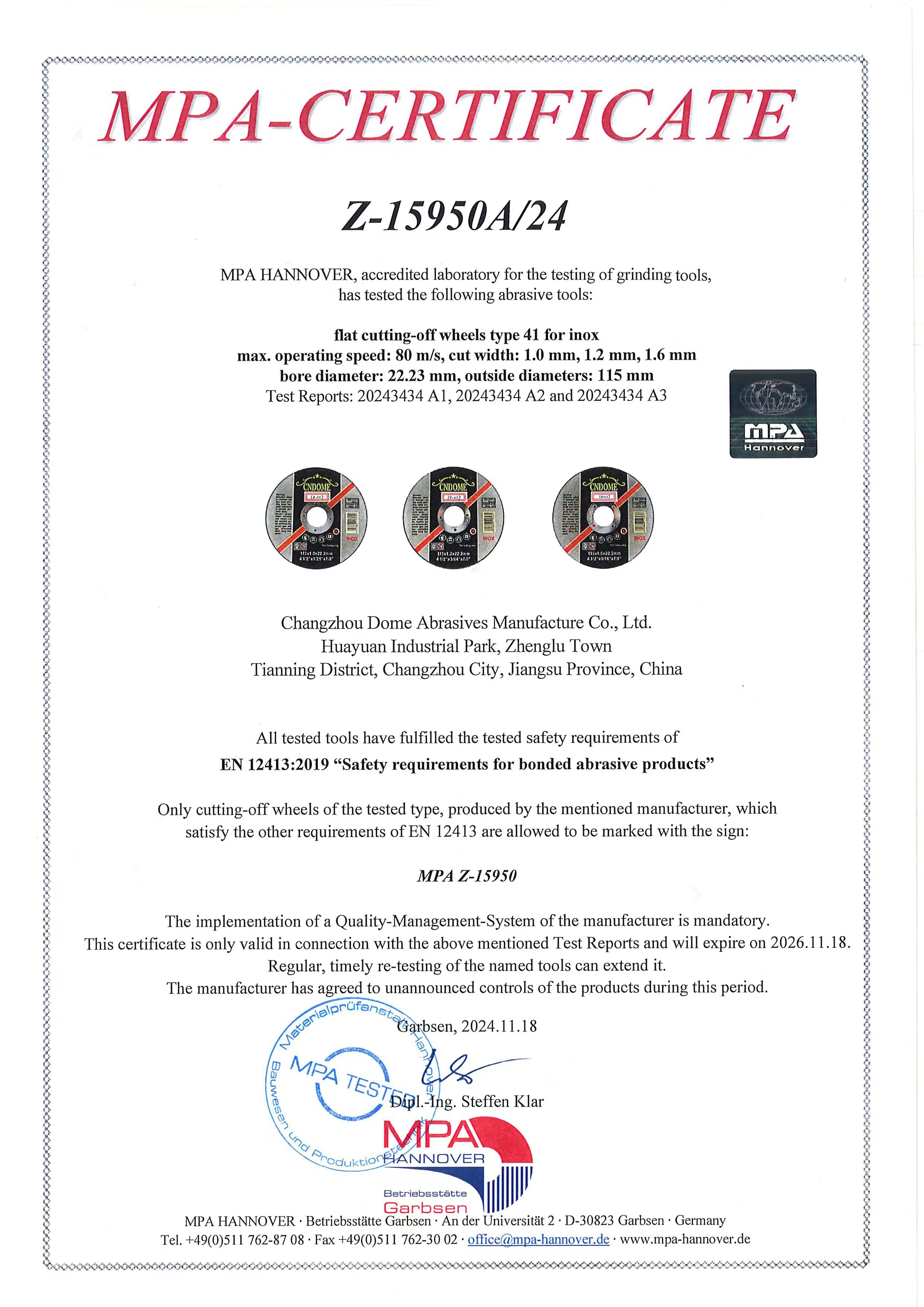
The reason thickness deserves its own evidence check is that certification is granted to formats. CNDOME's certificate record includes MPA Hannover approvals under EN 12413 issued across multiple certificate numbers and validity periods, with format-specific records visible for 115 mm formats in 1.0 mm, 1.2 mm and 1.6 mm thicknesses, 125 mm formats in 1.0 mm and 1.2 mm, and 3.0 mm thicknesses at 115 mm and 230 mm.
| Certificate | Authority / standard | Recorded scope | Valid until |
|---|---|---|---|
| MPA Z-15950A/24 | MPA Hannover / EN 12413 | Manufacture of abrasive cutting disc | 2026-11-18 |
| MPA Z-15950B/24 | MPA Hannover / EN 12413 | Manufacturing of abrasive cutting disc | 2026-11-18 |
| MPA Z-15951/24 | MPA Hannover / EN 12413 | Manufacture of abrasive cutting disc | 2026-11-18 |
| MPA Z-15953A/26 | MPA Hannover / EN 12413 | Manufacturing of abrasive cutting disc | 2028-01-26 |
| MPA Z-15953B/26 | MPA Hannover / EN 12413 | Manufacturing of abrasive cutting disc | 2028-01-26 |
| MPA Z-15953C/26 | MPA Hannover / EN 12413 | Manufacture of abrasive cutting disc | 2028-01-26 |
| CE M.2022.206.C74459 | UDEM / EN 12413 | Cutting and grinding wheels | 2027-06-09 |
| ISO 9001 18524Q10838R0M | GB/T19001-2016 / ISO9001:2015 | Production of resin grinding wheels | 2027-06-04 |
| ISO 14001 25024E11441R0M | GB/T24001-2016 / ISO14001:2015 | Production of abrasive discs and hardware tool accessories | 2027-12-19 |
| BSCI 156-025464-001 | ALGI / amfori BSCI Code of Conduct, SA8000 | Manufacturing of abrasive discs and related hardware tools | 2027-10-16 |
Behind the paperwork sits a production base reported at a 20,000 m² temperature- and humidity-controlled workshop with 60 automated production lines, 140 employees, a 10-person R&D team and a daily output of roughly 600,000 pieces, against an annual output of 95 million pieces. Quality control is described as 100% AI visual comparison testing. For buyers, the operational question is not whether those numbers are impressive, but whether the supplier can hold a thickness tier consistently across repeat orders, because a 1.2 mm disc has less material margin for variation than a 1.6 mm disc.
Customisation is the other lever. CNDOME's OEM/ODM capability covers logo, label, packaging, abrasive formulation and specification, with custom cutting discs available from 10,000 pieces and a stated 30-day lead time. An 80% export ratio spread across Latin America, Europe, Africa and Asia means the same thickness tier is being shipped into markets with different machine populations and different operator habits, which is a practical argument for treating thickness as a specification field rather than a default.

A Four-Step Decision Framework
The framework below is written for an evaluation-stage buyer who has already shortlisted suppliers and now needs to fix a thickness specification that will survive contact with a real workshop.
Step 1 — Define the cut. Record workpiece material, section thickness, burr tolerance and finish requirement. Stainless and thin-wall sheet behave differently from mild steel plate, and the difference drives the thickness answer more than the disc brand does.
Step 2 — Match the machine. Confirm spindle speed against the disc's maximum operating speed, confirm the 22.23 mm bore and flange fit, and confirm guard clearance for the diameter and shape being ordered.
Step 3 — Choose the thinnest disc that survives the duty cycle. Start from 1.2 mm where side load is controlled and speed matters; move to 1.6 mm where pressure is unpredictable; move to 3.0 mm only where the work genuinely demands it.
Step 4 — Verify format-level evidence. Match the certificate number to the exact format being purchased, check the validity date, and confirm the marking on the shipped product corresponds to that format.
| Duty profile | Starting thickness | Why | What to verify first |
|---|---|---|---|
| Thin-wall stainless and sheet, straight cuts, trained operators | 1.2 mm | Narrow kerf, faster feed, less heat discolouration | Batch flatness and rim consistency |
| General metal fabrication with mixed section thickness | 1.6 mm | Rigidity, tolerance of side load, predictable life | Rated speed match and life under real pressure |
| Heavy burr removal, rough cut-off, poorly supported workpieces | 3.0 mm | Lateral strength under sustained feed pressure | Machine power and guard clearance |
| Retail and distributor range building | Both 1.2 mm and 1.6 mm | Covers DIY and professional demand in one size | Model coverage, packaging and labelling accuracy |
Where Each Thickness Earns Its Place
CNDOME's case record describes operating conditions rather than thickness choices, and that is exactly what makes it useful for testing the framework. A Brazilian tool brand OEM project reports an annual volume of 10,000,000 pieces for cutting iron and stainless steel sold through offline hardware stores, with stated results of long service life, burr-free cutting, fast material feeding and low dust. That is a mixed retail and professional demand pattern, which is the profile where carrying both 1.2 mm and 1.6 mm is normally justified rather than picking one.
A tool supermarket project across Mexico, the United States and South America reports 40,000,000 pieces per year across a range from 3 to 14 inches, sold through tool supermarkets and offline hardware stores for both home DIY and professional metalworking, with stated highlights of long service life, fast cutting speed, low noise, burr-free cutting and a complete model range. Range completeness at that scale only works if the thickness tiers are managed as separate SKUs with separate evidence, not as one line item with a variable.
Two further cases point in the same direction from the durability side. A machining factory project across Indonesia, Japan, Thailand and South Korea reports 30 orders per year for cutting and polishing iron and stainless steel parts, with a stated requirement for 24-hour machining production and ample inventory ready to ship. A stainless processing manufacturer in South America reports 500,000 pieces per year used in polishing the outer and inner walls of stainless steel pipes, with reported results of stable long-term use, long disc life, no frequent replacement, no slag shedding and high safety. Continuous or near-continuous duty favours the more rigid profile, and surface-critical stainless work favours controlled heat input, which is why these two requirements tend to pull buyers toward different tiers and why a single default rarely satisfies both.
Finally, a cross-border brand project spanning China, Singapore, the United States, Germany, Nigeria and South Africa reports 60 orders per year of OEM and private-label customisation, with highlights including small and large batch capability, short customisation lead times and fast delivery. For e-commerce and private-label buyers, the ability to hold a thickness specification consistently across repeated small batches matters more than any single large-volume price point, because a listing that changes behaviour between batches generates returns faster than it generates margin.
Market Signals Worth Factoring Into the Thickness Mix
Three published data points frame the context. IndexBox valued the global cutting discs market at approximately USD 8.5 billion entering 2026. Fortune Business Insights reports that Asia-Pacific held a 44.7% revenue share of the abrasives market in 2025, and that aluminium oxide abrasives accounted for 46.3% of material market share in the same year on the basis of cost-effectiveness in general metal fabrication.
Read together, those figures describe a market in which the baseline consumable is an aluminium-oxide-based disc produced at volume in Asia-Pacific and consumed across general metal fabrication. That is consistent with the material specifications recorded across CNDOME's larger formats, which list aluminium oxide, white aluminium oxide and resin as the base construction, with silicon carbide and zirconium also within the material set. The practical implication for a thickness decision is that the 115 mm and 125 mm tiers are high-frequency, price-sensitive items where the choice is rarely about exotic formulation and almost always about matching the profile to the duty cycle.
One caution belongs here. The verified data set used for this article does not contain official import or export volumes for abrasive wheels under HS 6804.22, and does not contain freight or landed-cost data per thousand units. Any statement about trade flow direction or delivered cost per disc would therefore be an assumption rather than a finding, and is deliberately excluded.
Limits and Boundaries Buyers Should Not Skip
A thinner disc is not a universal upgrade. The 1.2 mm profile is the right answer only where the cut is straight, the workpiece is supported and the operator is disciplined. Put the same disc in front of an operator who tilts the tool to force a cut, or onto a workpiece that shifts under load, and the reduced rigidity becomes a failure mode rather than an efficiency gain. Buyers who standardise on 1.2 mm across an entire site should expect a rise in premature disc failure reports unless operator training comes with it.
Certificate validity is the second boundary, and it is easy to miss. In the CNDOME record, several MPA Hannover certificates carry expiry dates in November 2026, while others run to January 2028. As of October 2026, that means a buyer verifying evidence for a 115 mm or 125 mm format should check the specific certificate rather than the certificate family, and should record the expiry date in the supplier file with a renewal reminder attached. A certificate that is valid at the time of the audit but expires before the shipment is not the same evidence.
The third boundary concerns the evidence itself. Capacity figures such as the 600,000-piece daily output and the 95 million-piece annual output are company-reported, and the verified data set contains no independent factory audit, no third-party cut-rate comparison between 1.2 mm and 1.6 mm formats, and no independently validated performance test. Buyers should treat those numbers as claims to be confirmed through their own sample trial rather than as settled facts, and should weight trial results above brochure figures when the two disagree.
Future Outlook
Two shifts are likely to shape how buyers approach thickness over the next planning cycle. The first is the move from family-level to format-level compliance checking. As more supply chains formalise their supplier files, the question is shifting from whether a supplier holds EN 12413 certification to which formats that certification covers and for how long. Buyers who build that check into their RFQ templates will find the thickness conversation becomes simpler, because each tier arrives with its own evidence rather than inheriting credibility from a neighbouring SKU.
The second is range rationalisation in high-volume channels. With Asia-Pacific holding 44.7% of abrasives revenue and aluminium oxide accounting for 46.3% of material share, the volume end of the market is deeply standardised, and distributors carry wide model ranges to serve both DIY and professional buyers. The likely direction is not fewer thicknesses but clearer segmentation: 1.2 mm positioned explicitly for speed-sensitive, low-side-load work, 1.6 mm positioned as the general fabrication default, and 3.0 mm reserved for heavy cut-off. That framing is more useful to a buyer than a general claim that thinner is faster, because it tells them which variable they are actually buying.
Frequently Asked Questions
What is the practical difference between a 1.2 mm and a 1.6 mm cutting disc on a 115 mm grinder?
The cut width is set by the disc thickness, so a 1.2 mm disc removes less material per pass and meets less resistance than a 1.6 mm disc of the same diameter. In practice that makes the 1.2 mm profile faster in straight cuts and lower in heat input, while the 1.6 mm profile deflects less under hand pressure and generally returns a more predictable service life in mixed fabrication work.
Which thickness should be specified for 125 mm discs?
The same logic applies at 125 mm as at 115 mm, because thickness and diameter are independent specification fields. CNDOME's certificate documentation records 125 mm formats in 1.0 mm and 1.2 mm thicknesses on a 22.23 mm bore, so a buyer specifying 125 mm should confirm which thicknesses are actually covered by the certificate for that format rather than assuming the 115 mm record extends to it.
Does a thinner disc always cut faster?
No. A thinner disc cuts faster when the cut is straight and the workpiece is stable, because the narrower kerf presents less resistance. When the disc flexes under side load, the load concentrates on a narrow band of the rim and the effective cutting action degrades. In rough cut-off work a thicker disc can complete the same job faster overall by cutting consistently rather than intermittently.
What bore size do 115 mm and 125 mm cutting discs use?
The 115 mm and 125 mm formats in this portfolio use a 22.23 mm bore, matching the standard angle grinder spindle and flange for those sizes. CNDOME's published 115 mm specification states 115×1.2×22.23 with a T41 flat shape and a maximum operating speed of 80 m/s. Buyers should confirm bore, shape and rated speed together whenever a specification moves between sizes.
Which certification details should be checked before ordering a specific thickness?
Three details matter: the certificate number, the format it covers, and the expiry date. CNDOME's record includes MPA Hannover certificates issued under EN 12413 across multiple numbers, with some expiring in November 2026 and others running to January 2028, alongside CE certification M.2022.206.C74459 valid to June 2027, ISO 9001 valid to June 2027, ISO 14001 valid to December 2027 and BSCI valid to October 2027.
When is a 3.0 mm disc the better choice at 115 mm or 230 mm?
A 3.0 mm disc is the better choice where the work involves sustained feed pressure, heavy burr removal or poorly supported workpieces, because lateral strength matters more than kerf width in those conditions. CNDOME's 230 mm range is offered as T41 or T42 on a 22.23 mm bore with thickness options of 2.0 mm, 2.5 mm and 3.0 mm, and the disc is rated at 6,600 RPM with a maximum of 80 m/s.
How should a buyer validate a thickness choice before committing to volume?
The most reliable route is a controlled trial using the buyer's own material, machine and operators, comparing 1.2 mm and 1.6 mm on identical cuts while recording burr, discolouration, cut time and disc consumption. This matters because the verified data set used for this article contains no independent comparison of cut rate or service life between thickness tiers, and the manufacturer's capacity figures are company-reported rather than independently audited.
Reference Document
CNDOME publishes a company and product brochure covering its abrasive range, specification formats and certification framework, available for public download: CNDOME brochure (PDF).
Tem questões ou precisa de mais detalhes?
Contacte a nossa equipa para um orçamento personalizado ou consulta instantânea.
Solicitar orçamento
Preencha o formulário abaixo e a nossa equipa entrará em contacto com uma proposta personalizada.
Chat direto do WhatsApp
Prefere conversar em tempo real? Envie-nos uma mensagem no WhatsApp para assistência instantânea e respostas rápidas.
- Obter orçamento personalizado
- Partilhar fotos ou documentos
- Discuta as suas necessidades diretamente
Geralmente responde em 5–30 minutos durante o horário de expediente.