
2-in-1 Balance-to-Bike Convertible: Buyer Verification Guide
Industry Reference · Kids Balance Bike
2-in-1 Balance-to-Bike Convertible: Buyer Verification Guide
One frame, two riding stages. The 2-in-1 convertible changes SKU count, container utilisation and the compliance file that has to travel with every carton — which is why it belongs in a procurement review, not just a product catalogue.
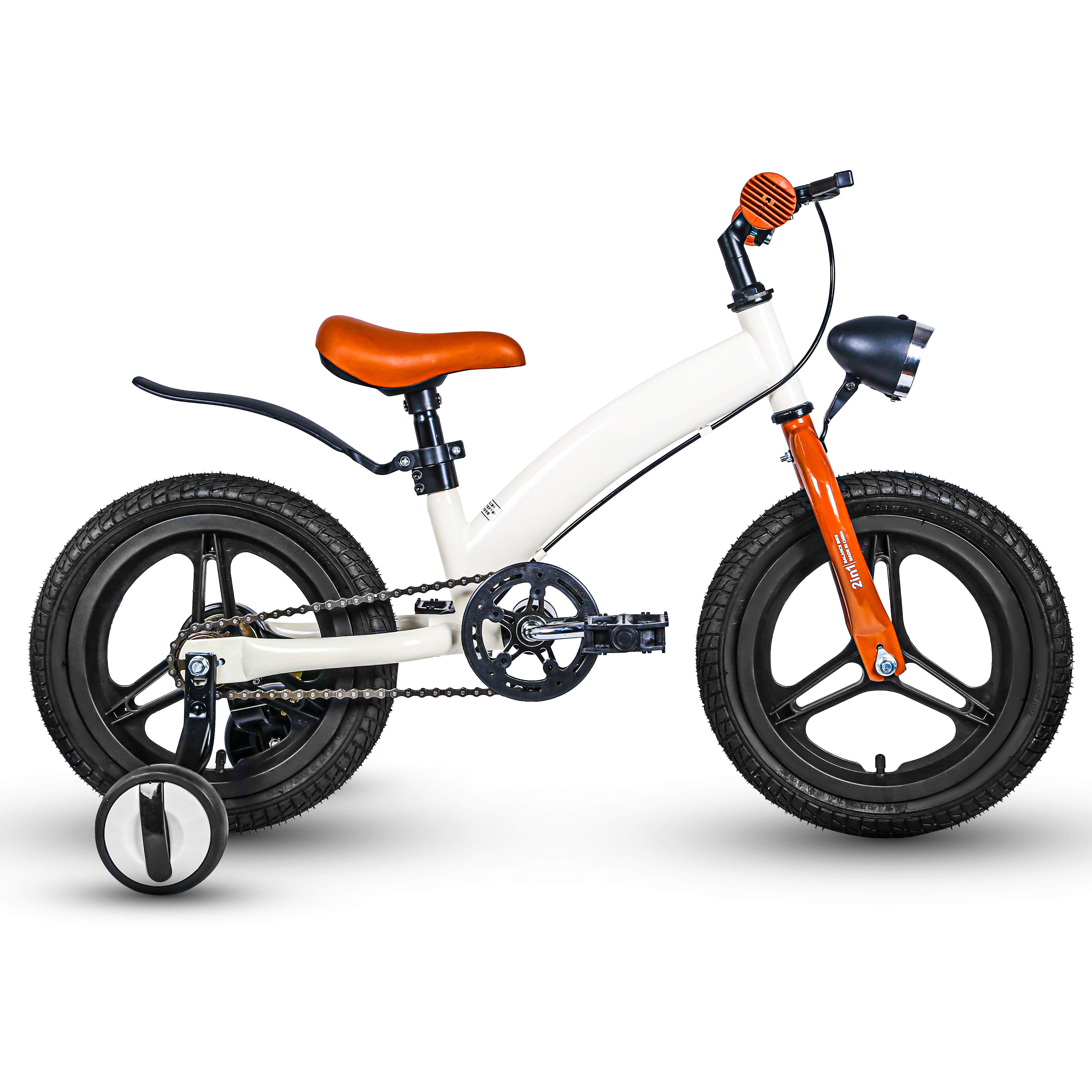
A 2-in-1 balance-to-bike convertible is a children’s ride-on built on a single frame that can be operated in two ways: as a pedal bicycle, and — after the chain, crank and pedals are removed — as a balance bike. For importers, distributors and institutional buyers, that one design decision reshapes three procurement variables at the same time: how many SKUs are needed to cover a child’s first riding years, how much container space a given order consumes, and which documents must accompany each configuration when the goods clear customs.
Market context supports that attention. The global balance bike market is projected to reach approximately USD 1.43 billion by 2026, and to grow at a compound annual growth rate of 7.2% between 2026 and 2033, according to commercial research published by The Business Research Company and Coherent Market Insights respectively. A growth profile of that shape keeps buyer interest on designs that extend the usable life of a single purchase, rather than on single-stage entry models that are retired once a child learns to pedal.
Wuxi Purino International Trade Co., Ltd is a Wuxi, Jiangsu Province–based trading enterprise founded in 2016 that supplies electric bicycles, kids scooters and children balance bikes, with 100% of output exported and the EU and USA identified as its main markets. The company works through long-term partner manufacturing factories and offers standard models plus OEM and ODM customisation. The children’s models referenced in this article — 2-In-1 Kids Bike, AME-1201 and AME-1202 — sit inside that supply programme, alongside the ACOPLEX Electric Bike range.
What the convertible format changes mechanically
Conversion in this category is a component-level operation, not a frame-level one. On the 2-In-1 Kids Bike, the frame and fork are steel, the rim is PP and the tyre is rubber. The bike is supplied with a drivetrain; removing the chain, crank and pedals leaves a balance bike on the same chassis, and a rear band brake stays available for stopping control. The model is offered in three sizes — 12-inch, 14-inch and 16-inch — so age coverage is handled by selecting a frame size rather than by re-engineering one frame for every rider.
That distinction matters when a buyer compares this format against a dedicated balance bike. A purpose-built balance bike is designed around the balance stage alone; a convertible shares geometry, fittings and weight with its pedal version. The trade-off is real: the convertible answers the question “one purchase, two stages”, while a dedicated balance bike answers the question “lightest and simplest possible first bike”. Both answers are legitimate, but they lead to different order files.
The commercial case for a one-frame, two-stage design
Three buyer-side factors keep convertibles in demand, and each is grounded in a different part of the order rather than in a product claim.
- Inventory depth. A distributor that stocks a convertible carries one item number across two demand stages, which reduces the number of slow-moving lines sitting at the back of a warehouse once a customer cohort moves past the balance stage.
- Freight economics. The 2-In-1 Kids Bike is documented with a high container loading capacity, which the supplier positions specifically as a way to reduce ocean freight cost per unit — a recurring line item for wholesale and institutional orders.
- Institutional durability. Kindergartens, childcare providers and educational buyers acquire equipment for repeated group use. Documented bulk-oriented configurations emphasise durability and low maintenance, which suits settings where bikes are handed between children several times a day.
Case data from the supplier’s existing buyer base points in the same direction. Buyers described as wholesalers, retailers, kindergartens and educational institutions, and cross-border e-commerce sellers, are recorded at roughly 10,000 units per month, with equipment in service for a typical duration of two to three years. The documented outcome is a bike that supports balance and coordination development while remaining suitable for prolonged use as the child grows through stages — which is precisely the outcome a convertible is designed to deliver.
Technical anatomy of the documented models
Three children’s models are documented in the supplier’s technical material, and they do not solve the same problem. The table below sets out what is confirmed for each.
| Model | Frame and fork | Wheel, tyre and rim | Brake | Documented notes |
|---|---|---|---|---|
| 2-In-1 Kids Bike | Steel frame, steel fork | PP rim with rubber tyre | Rear band brake | Converts to balance bike by removing chain, crank and pedals; three sizes: 12-inch, 14-inch, 16-inch; high container loading capacity |
| AME-1201 | Magnesium frame, steel fork | 12-inch air tyre, aluminium rim | Not specified in the technical sheet | Bluetooth function; 180W motor; 24V 2Ah battery; maximum speed 14.5 km/h |
| AME-1202 | Magnesium alloy frame and fork with suspension | 12-inch air tyre, aluminium rim | Not specified in the technical sheet | Full powder coating; metal headset; TPR handle grips; 24V 200W 12-inch brushless motor; 18650-2500mAh/3C, 22.2V/2.5A, 55.0Wh lithium battery (6S1P); stated maximum 12 km/h, with 6/12/18 km/h modes when a digital display is fitted |
Frame material is the specification that changes weight, cost and maintenance most visibly. Third-party product data for magnesium alloy integrated casting frames puts frame weight at approximately 680 g, with total bike weight around 3.1 kg for 12-inch magnesium alloy models. That figure is measured on a different manufacturer’s product and should be read as a category reference point, not as a specification for the ACOPLEX or Purino models above. Steel frames are documented in this range as a durability and cost option rather than a weight option, and EVA tyre configurations are the ones associated with low-maintenance institutional use.
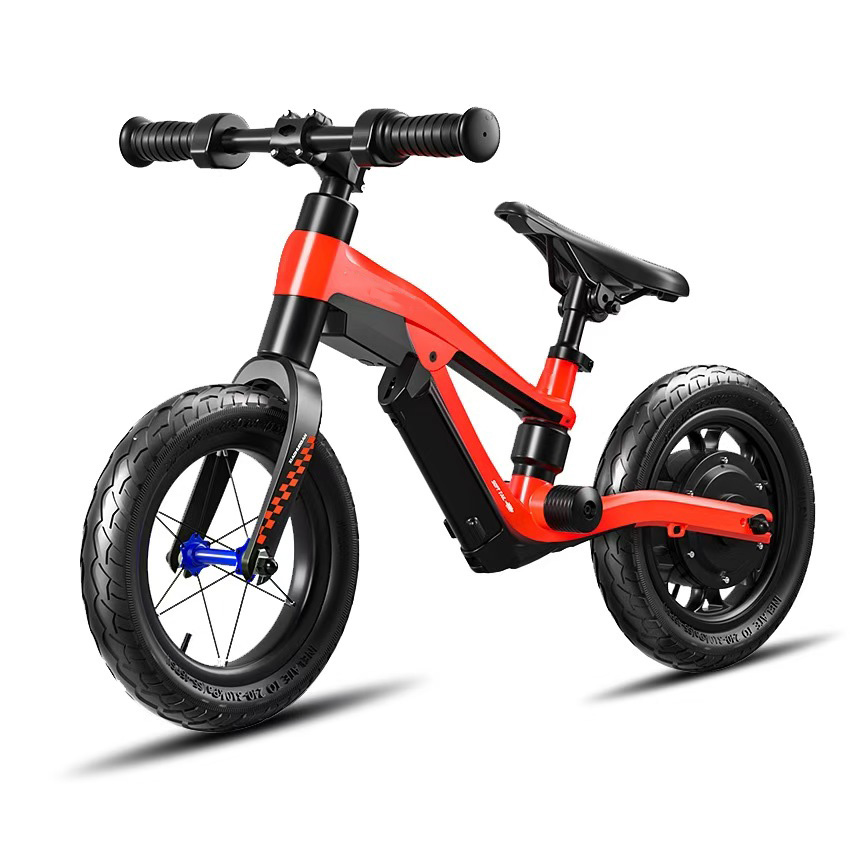
Two observations follow from the table. First, the convertible and the magnesium models are aimed at different purchase briefs — the first at lifetime coverage, the second at weight, ride comfort and, in the AME-1201 and AME-1202 cases, an electric-assist configuration with a stated maximum speed. Second, the AME-1201 and AME-1202 are not simply lighter versions of the convertible; they are motorised variants, and that changes the compliance discussion entirely.
Compliance: what a buyer should verify before ordering
Certification scope is where convertible and electric-assist models diverge most sharply, and where supplier documentation is most often misread. In the certification record provided for this supply programme, the EN15194 certification — CE type, issued by TUV, applicable market EU — covers the AME-1202 children balance bike. The record states explicitly that the applicable standard for the AME-1202 is EN15194 and not EN 71. The same EN15194 certification record also covers the TRAVEL, ROCKET and UNICORN electric bicycles.
That detail is worth pausing on. EN15194 is the standard the company associates with electrically power assisted bicycles for the EU market, and its presence in the AME-1202 record reflects the fact that the model is documented as an electric-assist product with a motor and battery. A manual balance bike or a manual convertible configuration sits in a different regulatory conversation: EN71-1:2026 introduces mandatory performance testing for all ride-on toys including balance bikes in the European Union, effective from 1 January 2026. A convertible unit that ships without a drivetrain and a motorised unit that ships with one are therefore not automatically covered by the same certificate, even when they are sold under one product family.
Documentation practice is a second verification point. The supplier’s published material references quality control and pre-shipment inspection services without detailing specific QC procedures or standards; incoming material checks and pre-shipment inspection are the operations typically described at this level of detail. Institutional and promotional buyers, who frequently require a quality report as a condition of delivery, should therefore specify the report format, the inspection stage and the acceptance criteria at order stage rather than assume them. Warranty terms and return or exchange policies are likewise not fully specified in the published information and need to be confirmed in the contract.
Trade classification completes the checklist. Balance bikes without pedals are listed under HS code 95030010 in the referenced tariff listing. Because a convertible can leave the factory in either configuration, the declared configuration drives the classification entry, and importers normally confirm the declared state with their customs broker before the shipment is booked.
| Verification item | What to request | Why it matters on a convertible |
|---|---|---|
| Certification scope | Certificate number, issuing body, applicable standard, covered market, covered model and configuration | Manual and electric-assist configurations can sit under different standards even when they share a frame |
| Toy standard exposure | Confirmation of testing against the ride-on toy performance requirements applicable in the destination market | EN71-1:2026 makes performance testing mandatory for ride-on toys including balance bikes in the EU from 1 January 2026 |
| Quality documentation | Incoming material check record, pre-shipment inspection report, third-party test report where required | Published QC information describes inspection services without detailing procedures or standards |
| Warranty and returns | Written warranty period, defect handling process, replacement parts availability | Not fully specified in the published material; for kindergarten fleets, downtime is the real cost |
| Customs classification | Declared configuration, HS code entry, destination tariff treatment | Balance bikes without pedals are listed under HS 95030010; the shipped configuration is the basis for declaration |
| Commercial terms | MOQ, lead time, monthly capacity, packaging specification | Documented at 100 units MOQ, 45–60 days lead time and 10,000 units monthly capacity |
Applications: home play, kindergarten fleets and retail programmes
The documented operating environment for these children’s balance bikes is broad on purpose: daily home outdoor and indoor play, kindergarten group use, and bulk delivery to retail stores or educational institutions. Operation is either manual push and ride in balance bike mode, or electric assist on the electric variants, with mechanical braking such as hand, foot or rear band brakes. That spread of use cases is why the same product family is sold through wholesale and distribution programmes, institutional equipment tenders, and OEM or private-label arrangements.
Configuration choices tend to follow the buyer type rather than the product. Parents buying for daily play at home usually prioritise ride comfort and low weight; institutional buyers ordering for a kindergarten prioritise durability, low maintenance and identical specification across a fleet; and promotional or gift-channel buyers prioritise packaging, labelling and repeatable colourways. The supplier documents the corresponding options as frame colour and logo customisation, packaging and accessory customisation, tyre type selection across EVA, CST and air, and saddle and grip material customisation.
Complete-set thinking is a visible part of the order file as well. Documented matched equipment includes children’s helmets, elbow and knee pads, replacement saddles, spare inner tubes and wheels, and custom packaging and labels — the items that convert a single bike sale into a retail-ready or kindergarten-ready kit.
Documented buyer coverage for this product family includes wholesalers, retailers, kindergartens and educational institutions, and cross-border e-commerce sellers, with enquires and shipments recorded across markets in Europe, North America, Asia-Pacific and the Middle East. The practical implication for a new buyer is that the specification set is already being exercised in both commercial and institutional channels — which usually means that deviations from a standard configuration carry a longer lead time than the standard build.
Market trend analysis
Two data points frame the competitive environment. On demand, the global balance bike market is projected at approximately USD 1.43 billion by 2026, growing at a 7.2% CAGR from 2026 to 2033. Estimates published by different research houses vary — one comparison of sources reports a range of roughly USD 1.05 billion to USD 1.33 billion for 2025, reaching about USD 1.43 billion in 2026 — so ranges should be treated as directional rather than exact. On supply, branded players hold a meaningful share of the adjacent kids’ bicycle market: Giant Bicycles and Trek Bicycle Corporation are reported at 15% and 12% market share respectively in 2025 data published by Fortune Business Insights.
Read together, the two signals describe a category where brand-led suppliers set the reference points but do not control the specification conversation. That leaves room for supplier-side differentiation on the dimensions buyers can actually inspect: frame material and weight, tyre and brake specification, customisation flexibility, documentation readiness and order terms. It also explains why convertible platforms are gaining share of buyer attention — they compete on lifetime value per unit rather than on a single-stage price point.
Convertible platforms vs traditional sourcing routes
Three sourcing routes cover the same end user, and each gives something up.
| Route | What it delivers | What it gives up |
|---|---|---|
| 2-in-1 convertible on a steel frame (2-In-1 Kids Bike) | One item number across the balance stage and the pedal stage; three sizes at 12, 14 and 16 inches; rear band brake; high container loading capacity | Higher unit weight than a magnesium frame; conversion steps at the retail or household level; the drivetrain returns to the maintenance schedule once pedals are refitted |
| Dedicated balance bike in magnesium alloy (AME-1201, AME-1202) | Light frame material with suspension on the AME-1202; 12-inch air tyre on an aluminium rim; full powder coating; comfort and shock absorption for daily riding | Covers one riding stage only; a separate first pedal bike is still needed later; the electric-assist variants add motor, battery and charging considerations |
| Separate balance bike plus separate first pedal bike | Each stage gets a purpose-built product | Two SKUs, two packaging specifications, two freight lines and two compliance files; higher total cost to the end customer |
Four boundaries deserve to be stated plainly, because they shape the buying decision more than any specification highlight.
- Conversion is not tool-free simplicity. Removing the chain, crank and pedals assumes someone competent performs the change and that the refitted drivetrain is correctly reassembled later. Institutional buyers should decide who owns that step before ordering.
- Weight is a material decision, not a marketing one. Steel convertibles and magnesium-framed models do not weigh the same, and the third-party reference of around 3.1 kg total weight applies to 12-inch magnesium alloy models from another manufacturer, not to a steel convertible.
- Tyre choice is a genuine trade-off. EVA and rubber configurations are associated with durability and low maintenance; air and CST inflated tyres are associated with comfort and shock absorption. Neither wins on both counts, and specifying one means accepting the other’s limitation.
- Certification does not transfer automatically. A certificate covering an electric-assist model does not, by itself, document a manual ride-on configuration, and the published material does not specify detailed QC procedures or full warranty terms.
Order mechanics are the last constraint: a documented minimum order quantity of 100 units, a 45–60 day lead time and a monthly capacity of 10,000 units give a clear planning envelope, but they also mean that late specification changes — particularly custom colours, logos or non-standard tyre types — sit inside that timeline rather than outside it.
Future outlook
Two forces look likely to shape this category through the forecast period to 2033. The first is documentation. With EN71-1:2026 making performance testing mandatory for ride-on toys including balance bikes in the EU from 1 January 2026, the compliance file becomes a screening criterion in supplier evaluation rather than a post-order formality, and buyers will increasingly ask for configuration-level certificate scope alongside the quotation. The second is material and configuration competition. As market growth continues at the reported 7.2% CAGR, suppliers without brand scale are most likely to differentiate on magnesium versus steel frame choices, tyre and brake specification, convertible architecture and customisation depth — the same dimensions on which this product family is already documented.
For buyers, the practical consequence is that the convertible format should be evaluated as a procurement decision with three parts: the mechanical configuration, the certification scope that matches it, and the commercial envelope of MOQ, lead time and documentation. Getting those three aligned before the purchase order is issued is what turns a two-stage product into a two-stage advantage. Product documentation for the models discussed here is published at purinocycle.com.
FAQ
What is the difference between a 2-in-1 balance-to-bike convertible and a dedicated balance bike?
A convertible is built on a frame shared with a pedal bicycle. The 2-In-1 Kids Bike uses a steel frame and steel fork with a PP rim and rubber tyre, and converts to balance bike use when the chain, crank and pedals are removed, with a rear band brake retained. A dedicated balance bike is designed for the balance stage only and is typically lighter — third-party data for 12-inch magnesium alloy models cites roughly 3.1 kg total weight. The convertible covers two riding stages with one SKU; the dedicated model optimises one stage.
Which safety standards apply to a convertible balance bike sold in the EU?
Two separate threads matter. EN71-1:2026 introduces mandatory performance testing for all ride-on toys including balance bikes in the European Union, effective from 1 January 2026. Separately, in the certification record for this supply programme, the EN15194 certification issued by TUV for the EU market covers the AME-1202 children balance bike, and that record states the applicable standard is EN15194 and not EN 71. Buyers should confirm which standard a specific model and configuration is documented against before ordering.
What frame materials are available, and how do they affect weight and maintenance?
Documented options include a steel frame with steel fork on the 2-In-1 Kids Bike, a magnesium frame with steel fork on the AME-1201, and a magnesium alloy frame and fork with suspension on the AME-1202. Magnesium is the lighter route; third-party product data cites approximately 680 g for magnesium alloy integrated casting frames. Steel is documented in this range as a durability and cost option. EVA and rubber configurations are associated with lower maintenance, while air tyres on aluminium rims are associated with ride comfort and shock absorption.
Which tyre types can be specified, and what is the trade-off?
Customisation documentation lists tyre type selection across EVA, CST and air, alongside rim specifications such as PP rim with rubber tyre and 12-inch air tyre with aluminium rim. Documents for bulk and institutional programmes highlight aluminium with CST inflated tyres for comfort and steel with EVA for durability and cost advantage. EVA and rubber reduce inflation and puncture maintenance; air and CST inflated tyres improve comfort. Buyers generally choose based on who maintains the fleet.
What are the ordering parameters for this product family?
The documented supply terms are a minimum order quantity of 100 units, a lead time of 45–60 days, and a monthly capacity of 10,000 units. Customisation covers frame colour and logo, packaging and accessories, tyre type selection, and saddle and grip material. Buyers should confirm the specification freeze date, since custom colours, logos and non-standard tyre types sit inside the stated lead time.
What documentation accompanies bulk or institutional orders?
Published information describes quality control and pre-shipment inspection services without specifying detailed QC procedures or standards; incoming material checks and pre-shipment inspection are the operations typically covered at that level of detail. Scenario documentation notes that bulk orders for institutions involve packaging and quality report requirements, so report format, inspection stage and acceptance criteria are best specified at order stage. Warranty terms and return or exchange policies are not fully specified in the published material and require confirmation.
How is a convertible balance bike classified for import?
Balance bikes without pedals are listed under HS code 95030010 in the referenced tariff listing. Because a convertible unit can be shipped in either the balance bike or the pedal configuration, the declared configuration determines the classification entry. Importers typically confirm the declared state, and any destination-specific treatment, with their customs broker before the shipment is booked.
Category market data referenced in this article is drawn from published commercial research by The Business Research Company, Coherent Market Insights, Fortune Business Insights and Montasen, and from the EN71-1:2026 and HS 95030010 reference listings, as collected on 20 September 2026. Product, certification, capability and case facts are drawn from Wuxi Purino International Trade Co., Ltd supply documentation.