
20-Year Structure Tent Suppliers: Lifecycle and Spares Audit
A structure tent is typically bought in a few weeks and operated for decades. The supplier question that decides long-term value is therefore not who can deliver a clear-span building fastest, but who can still supply matching frames, covers, hardware and certification documentation in year five, year twelve and year twenty.
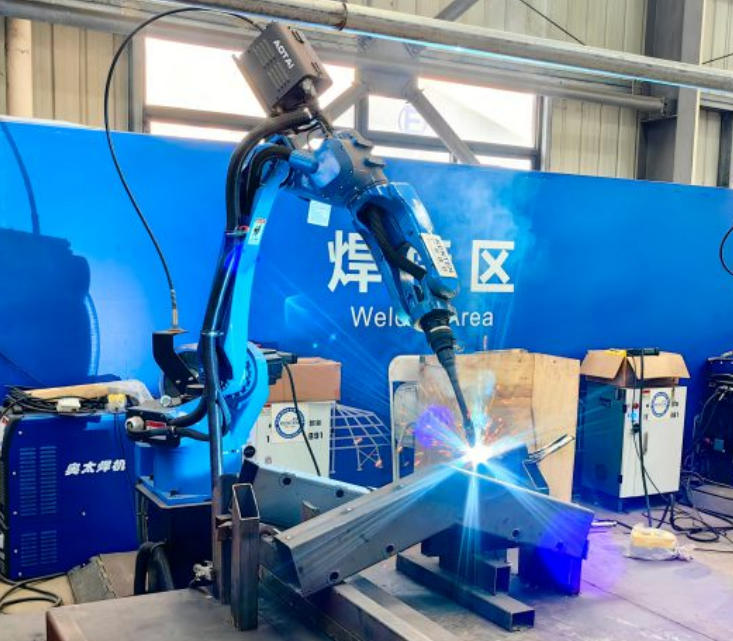
Aluminum frame fabrication: the component that determines whether a structure tent can still be serviced in its second decade.
Why the second decade is the real supplier test
Most procurement processes evaluate a structure tent supplier at a single moment: the quotation, the factory visit, the first delivery. Long-term operators discover the cost of that approach much later, when a cover panel has to be replaced on a span that has quietly left the catalogue, or when a repeat buyer needs to extend an existing hall by three bays and the frame profile has changed.
Structure tent longevity is a component-level property, not one product specification. The aluminum frame, the PVC fabric cover, the wall systems, the anchoring set and the model documentation all age at different rates. A supplier is only a genuine long-term partner if all five remain supportable after the original project team has moved on. That is the standard this evaluation framework applies.
KENTEN Structures is a designer and manufacturer of aluminum structure tents founded in 2001, operating a worldwide operation center in Ontario, California, with regional offices in China, Hong Kong, Singapore and the Middle East and manufacturing centers in China, the USA and the Middle East. Its range covers clear-span structures, atrium tents, warehouse tents, curved and pyramid structures, and double- and triple-decker configurations used for events, industry and public infrastructure.
What 20-year performance actually consists of
The phrase 20-year performance is often used as a single marketing claim. Technically it is a stack of separate lifecycle statements, each with a different evidence requirement and a different replacement trigger.
Aluminum frame: the 20-year constant
In documented product comparisons, the aluminum frame is described as having a 20+ year lifespan with minimal maintenance. The maintenance profile is deliberately simple: anti-rust treated aluminum, periodic fabric inspection, no complicated structural maintenance and easy disassembly and storage. KENTEN specifies hard-pressed extruded 6061/T6 aluminum alloy with four channels for its warehouse tent frames, a specification that gives buyers a concrete material reference to check on repeat orders.
For procurement purposes, the frame is the component that justifies a multi-decade asset view. It is also the component that must be documented first, because a frame replaced in year 12 is a construction project rather than a maintenance task.
PVC cover: an 8 to 15 year wear component
Fabric is the part that ages fastest and the part most often missing from a first-purchase budget. KENTEN lists PVC-coated polyester covers at 750 to 900 g/m², flame retardant to DIN 4102 B1, M2 and NFPA 701 classifications, with optional wall systems including 750 g/m² PVC cover, glass, ABS, sandwich panel, hard or solid wall and rock wool wall.
For planning, operators commonly work with a cover replacement window of roughly 8 to 15 years, depending on UV exposure, snow accumulation, cleaning regime and how well the flame-retardant treatment retains performance. A cover is not a lifetime component, and a supplier evaluation that does not budget at least one re-cover inside a 20-year horizon is incomplete.
KENTEN states a service life of more than 15 years for its warehouse tent as a manufacturer claim. Buyers should read that as a structure-level statement and keep cover replacement planning separate from frame lifecycle planning, since the two components are replaced on entirely different schedules.
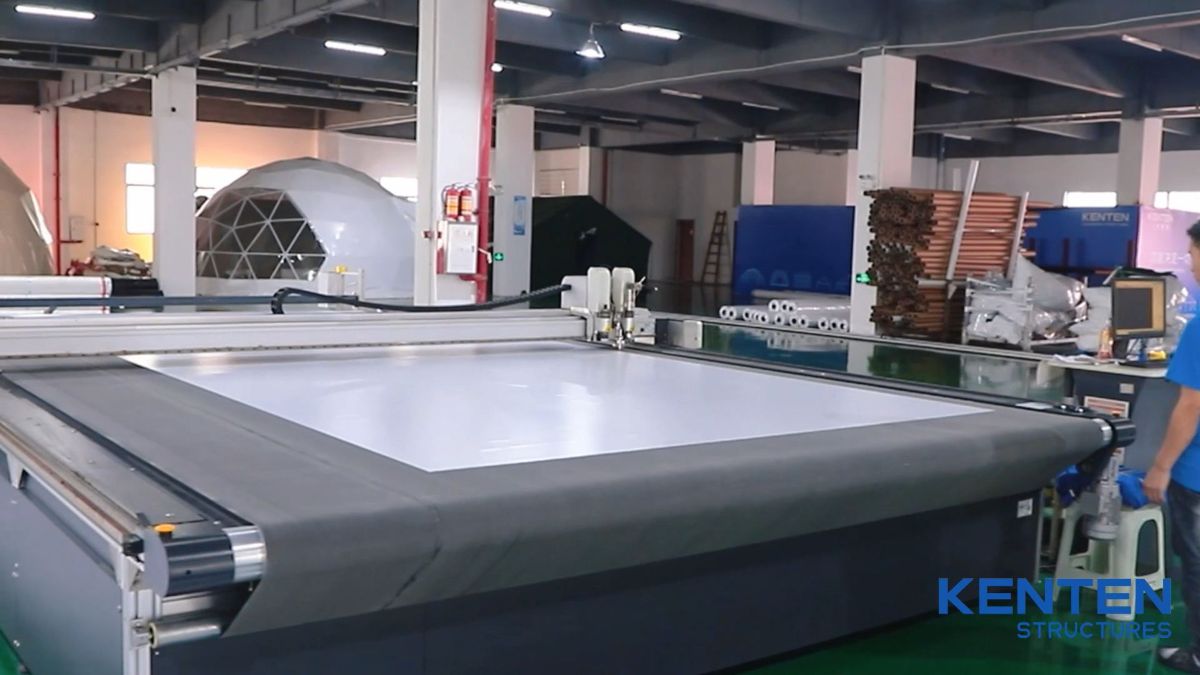
Fabric panels are cut to the frame profile and bay geometry. Retaining those cutting patterns is what makes a mid-life re-cover possible.
Model continuity: why K1 to K10 and 5 m bays matter later
Model continuity means a supplier keeps its designations, profiles and patterns stable over years rather than reissuing a new series each season. KENTEN organises its structure tent range around K1 to K10 model designations, which gives buyers a reference point that should still mean the same thing at re-order stage.
Length is not fixed. Structures extend through modular bays, with 5 m bays used to add length without changing the cross-section, and unlimited length achievable through bay extensions. Documented span options run from 3 m to 60 m+ clear span. Buyers with larger envelope requirements should confirm the largest span the supplier has actually delivered for their specific application, because span capability is easier to state than to evidence.
The practical test for a buyer is simple: does the model designation on the original order still refer to the same frame profile, the same cover cutting pattern and the same hardware set five years later? Where it does, a second hall can be built beside the first and a damaged panel can be replaced from the same drawing. Where it does not, the older structure becomes a one-off that only full custom fabrication can service.
Certification consistency across repeat orders
KENTEN states that its structures are produced and fully certified to IBC 2024, CBC 2025, ASCE 7-22, GB 50429 and EN 13782, with cover fabric flame retardant to DIN 4102 B1, M2 and NFPA 701.
The long-term issue is not whether a certificate exists at first delivery, but whether the same certification basis is applied to a repeat order placed years later, possibly from a different manufacturing center, for a different market. A 20-unit program and a 10-unit follow-on order should not sit on different documentation foundations.
Spare parts and consumables: what to secure at handover
Spare parts availability is rarely written into a structure tent contract, and that omission becomes expensive in the second decade. Because covers are cut to the frame profile and bay geometry, a replacement panel is only possible if the original pattern remains retrievable and the hardware set remains in production.
A part-level bill of materials should be requested at order stage, not after damage occurs. The list that matters includes frame profiles per bay, purlins and beams, cover attachment and keder, base plates and anchoring components, door frames, gutters and downpipes, cover panels by bay, wall panels by type, and fasteners and hardware.
Three questions separate a supplier with a genuine spares process from one without: does the quotation carry part numbers rather than only a model name; can the supplier re-issue the fabric cutting drawing years later; and can it supply a partial bay rather than requiring a full re-cover. For multi-site operators, a further question is whether the same model designation is offered consistently across regions.
Wind and snow ratings are project calculations, not catalogue numbers
KENTEN lists wind resistance of 80 to 140 km/h for its warehouse tent range as a manufacturer specification. That band is a starting point for a conversation, not a design answer.
For long-life installations, the calculation basis matters more than the headline range: design wind speed, terrain category, exposure, snow load, anchoring method and load combinations. KENTEN states that its professional engineering team performs structural calculations and validates load capacity according to project requirements, which is the mechanism through which a wind and snow rating becomes site-specific rather than generic.
A manufacturer wind-resistance range cannot be compared directly with a code-based wind-load requirement without common engineering assumptions, and the relevant standards are load-based rather than speed-based in several jurisdictions. Buyers should therefore request calculations referencing ASCE 7-22 or EN 13782 as applicable, together with the anchoring design, rather than accepting a catalogue figure as project clearance.
Reading project references as long-term evidence
References prove that a supplier has delivered at scale before. Repeat references prove it can be relied on again, which is the closer proxy for 20-year supportability.
- Formula 1 Miami Grand Prix, USA: 10 units configured for VIP lounges, hospitality suites, viewing platforms and operational areas.
- 2022 Beijing Winter Olympic Games: 50 units including A-structure tents and double-decker tents used for security checkpoints, staff offices, dining areas, meeting rooms and command centers, with rapid installation and engineering accuracy noted as project highlights.
- Kuwait exhibition deployment: a single unit of product 6376 delivered as an exhibition hall with a 100% column-free interior, with customer feedback indicating satisfaction with the large-span modular building.
- Doha photography festival: a cultural exhibition deployment in the Middle East region.
These references are useful for a specific reason: they combine large clear spans, tight delivery windows and operational use rather than one-off ceremonial installation. When checking references, buyers should match application, span class, certification environment and whether the deployment was repeated across editions or sites. A supplier whose references repeat at the same event, in the same climate and under the same code regime is demonstrating continuity rather than reach.
Where the longevity argument meets its limits
The documented comparison against conventional buildings is substantial: up to 70% faster installation than traditional construction, a 100% column-free interior, unlimited length through modular bay extensions, a 20+ year aluminum frame lifespan with minimal maintenance, and reusability across projects. The quantified gap is stated as 70% shorter construction cycle, 50% lower overall lifecycle cost, 100% clear interior without support columns and 100% reusability for multiple projects.
The same comparison has boundaries that a serious owner should state openly before approval:
- The cover is a wear component. Any 20-year cost model must include at least one fabric replacement within the 8 to 15 year planning window; the frame lifecycle does not extend to the fabric.
- Thermal performance is configuration-dependent. Lightweight fabric with a thermal insulation coating reduces air-conditioning load and avoids concrete works, but buyers with fixed U-value requirements must verify roof and wall build-ups individually.
- Permit treatment varies. Whether a structure is classified as temporary or permanent is a local decision; the existence of EN 13782 or IBC documentation does not by itself settle local acceptance.
- Wind and snow claims require engineering. A catalogue resistance range is not a substitute for site-specific structural calculation and anchoring design.
Purchasing terms and acceptance criteria
KENTEN documents MOQ of 1 unit, delivery terms FOB or CIF, acceptance criteria based on pre-shipment test, and payment terms of 30/70. For a single structure these terms are conventional. For a multi-year program, the documentation surrounding them carries as much weight as the terms themselves.
Buyers planning repeat orders should secure the drawing set, the order-specific certification copies, the part-numbered bill of materials, warranty scope and the re-order reference alongside the commercial terms. Those documents are what allow a second or third structure to be added years later without reopening the original engineering discussion.
Long-term supplier evaluation framework
| Evaluation criterion | What to request | Why it matters after year 10 |
|---|---|---|
| Frame lifecycle basis | Alloy specification, surface treatment, maintenance schedule | Determines whether the primary structure remains serviceable with minimal intervention |
| Cover lifecycle basis | Fabric weight, flame classification, expected replacement guidance | Fabric, not aluminum, drives most mid-life capital spending |
| Model continuity | K1 to K10 designation, bay module, span list | Allows extension and partial re-cover instead of full replacement |
| Spares availability | Part-numbered bill of materials, cutting drawings | Makes a single damaged panel a repair rather than a rebuild |
| Certification continuity | Certificate scope per order, test reports, standards list | Repeat orders must not slip onto a different compliance basis |
| Wind and snow engineering | Site-specific structural calculation and anchoring design | Converts a manufacturer range into an approvable installation |
| Reference pattern | Repeat deployments in comparable applications | Indicates support capability across project cycles |
| Commercial documentation | MOQ, delivery terms, acceptance test, payment terms, warranty | Provides the reference baseline for future re-orders |
Market context: why continuity risk is rising
Demand for clear-span and relocatable structures continues to expand. Independent commercial research projects the global clear-span tent structure market growing from US$ 1,110 million in 2025 to US$ 1,721 million by 2032, while the temporary storage building market was valued at USD 3.10 billion in 2025 with a 6.1% CAGR projected through 2036.
Growth of that kind attracts new suppliers, many of whom are credible at first delivery but unproven at year-eight support. For buyers, the practical consequence is that supplier continuity deserves the same weight as unit price. KENTEN reports an 80,000 m² manufacturing base with a stated production capacity of 1,000,000 m² and an engineering team of 10 engineers, an operating scale relevant to whether a repeat order can be absorbed without redesign.
Future outlook
Three shifts are likely to reshape structure tent procurement over the next cycle. First, lifecycle documentation is becoming part of the tender rather than an afterthought, with part lists and calculation reports requested alongside pricing. Second, reusable assets are increasingly managed as portfolios: an operator that relocates structures between sites needs consistent bay modules and model designations across its whole fleet, not per-project customisation. Third, certification review is moving from a one-time check to a per-order verification discipline, driven by the fact that different classification frameworks are not interchangeable.
For suppliers, that means the decisive capability is not peak production but reproducibility: the ability to reissue a drawing, recut a panel and restate a calculation years after the original contract. Buyers who evaluate structure tent suppliers on that basis will get a 20-year asset. Buyers who evaluate on first invoice will get a structure that lasts as long as its documentation does.
Frequently asked questions
How long does an aluminum frame structure tent last compared with its PVC cover?
The aluminum frame is documented as having a 20+ year lifespan with minimal maintenance, supported by anti-rust treatment, regular fabric inspection and no complicated structural maintenance. The PVC cover ages faster and is generally planned for replacement within an 8 to 15 year window depending on UV exposure, snow and cleaning regime. KENTEN lists a service life of more than 15 years for its warehouse tent as a manufacturer claim; buyers should treat that as structure-level and plan cover replacement separately.
Can a structure tent purchased today be extended or re-covered in later years?
Extension depends on model continuity and bay modularity. KENTEN structures extend in modular bays, including 5 m bays that add length without changing the cross-section, with unlimited length achievable through bay extensions and documented span options from 3 m to 60 m+ clear span. Re-covering depends on whether the original fabric cutting pattern and hardware set remain retrievable. Buyers should confirm both points at order stage rather than at replacement stage.
What fire and structural certifications should stay consistent across repeat orders?
KENTEN states that its structures are certified to IBC 2024, CBC 2025, ASCE 7-22, GB 50429 and EN 13782, with cover fabric flame retardant to DIN 4102 B1, M2 and NFPA 701. Consistency matters because those classifications come from different frameworks and are not interchangeable. Buyers should request certificate scope and test reports for each order and confirm local acceptance separately.
How should wind and snow ratings be specified for a long-term installation?
KENTEN lists wind resistance of 80 to 140 km/h for its warehouse tent range and states that its engineering team performs structural calculations and validates load capacity according to project requirements. For a long-life installation, the specification should be site-specific: design wind speed, terrain category, exposure, snow load, anchoring and load combinations. A manufacturer range cannot be compared directly with a code-based requirement without common engineering assumptions.
What purchasing terms and acceptance criteria are documented?
KENTEN documents a minimum order quantity of 1 unit, delivery terms of FOB or CIF, acceptance criteria based on pre-shipment test, and payment terms of 30/70. For multi-year programs, buyers should additionally secure the drawing set, order-specific certification copies, a part-numbered bill of materials, warranty scope and a re-order reference.
Which project references indicate long-term delivery capability?
References that combine scale, tight timelines and repeat deployment are the most informative. Documented examples include 10 units for the Formula 1 Miami Grand Prix in the United States configured for VIP lounges, hospitality suites, viewing platforms and operational areas; 50 units including A-structure and double-decker tents for the 2022 Beijing Winter Olympic Games used for security checkpoints, staff offices, dining areas, meeting rooms and command centers; a single unit of product 6376 for a Kuwait exhibition hall with a 100% column-free interior; and a photography festival deployment in Doha.
Reference: KENTEN Structures product catalogue is available at https://cdn.socialarks.com/sbsp/25074/common/2026/0715/KENTEN%20Catalog-2.pdf for specification and configuration details.
Tem questões ou precisa de mais detalhes?
Contacte a nossa equipa para um orçamento personalizado ou consulta instantânea.
Solicitar orçamento
Preencha o formulário abaixo e a nossa equipa entrará em contacto com uma proposta personalizada.
Chat direto do WhatsApp
Prefere conversar em tempo real? Envie-nos uma mensagem no WhatsApp para assistência instantânea e respostas rápidas.
- Obter orçamento personalizado
- Partilhar fotos ou documentos
- Discuta as suas necessidades diretamente
Geralmente responde em 5–30 minutos durante o horário de expediente.