
200SZQ200-25-22 vs 200SZQ200-20-18.5: What Buyers Can Verify
200SZQ200-25-22 vs 200SZQ200-20-18.5: What Buyers Can Verify
Choosing between the 200SZQ200-25-22 and the 200SZQ200-20-18.5 is a decision inside a single product family, not a contest between two suppliers. Both are High Efficiency Portable Axial Flow Pumps from Chuangmei Pumps, and most of what decides acceptance — aluminum alloy flow-passing components, a precision-cast stainless steel axial flow impeller, a permanent magnet synchronous submersible motor, a control cabinet built around a frequency inverter — belongs to the shared platform rather than to one model. What separates the two designations is the duty point each is built to serve, and that is exactly where published unit-level data is thinnest. This comparison therefore keeps two things apart: what the supplier's published material establishes for both models, and what a buyer must confirm on the datasheet, the nameplate and the test bench before issuing a purchase order. No flow, head or power figure is assigned to either model here that the published content does not itself state.
The Two Designations, Read Against the Family Pattern
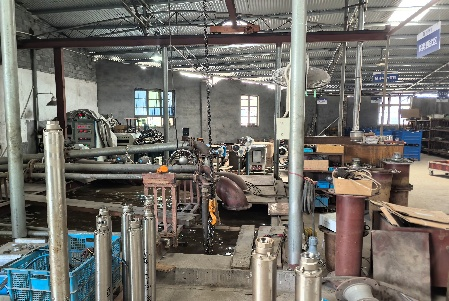
Chuangmei Pumps is the pump brand of Zhejiang Chuangmei Electromechanical Co., Ltd., a manufacturer founded in 1996 in Wenling, Zhejiang Province, whose stated main product line is high efficiency portable axial flow pumps. Company information places it in a 12,000 m² facility with a stated annual output of 30,000 units and an export ratio of 25%, with main markets in Southeast Asia, Africa, Morocco and Central Asian countries.
Its catalogue uses a structured model code, and published entries make the structure visible. Model 200SZQ450-8-15 is rated at 450 m³/h, 8 m head and 15 kW. Model 200SZQ400-10-18.5 is rated at 400 m³/h, 10 m and 18.5 kW. Model 200SZQ500-10-22 is rated at 500 m³/h, 10 m and 22 kW. Model 200SZQ600-8-22 is rated at 600 m³/h, 8 m and 22 kW. In every published case the trailing figure matches motor power in kilowatts, the middle figure tracks rated head in metres, and the figure after the 200 prefix tracks rated flow. The 200 prefix itself is common to the group.
That convention is a reading aid, not a rating. Applied to the two designations under comparison, it shows the pair differing in the head and power fields — 25 against 20, and 22 against 18.5 — while sharing the flow field. It does not disclose the tested curve, the efficiency at a specific duty point, the net weight of either unit, or how the two behave away from their design point. A designation convention and a nameplate rating are different categories of evidence, and only the second belongs in a purchase order.
Shared Platform: What Applies to Both Models
Because the two models come off one platform, a large part of the specification is common ground. That has a commercial consequence: moving between the two is not a trade of one capability for another, but the sizing of a single architecture to a duty point. Spare-part commonality, control philosophy and documentation requirements can therefore be negotiated once rather than twice.
Wetted parts and materials
The supplier's published content states that the flow-passing components of this high-head flood control pump are made of aluminum alloy, that the impeller is produced by precision stainless steel casting, and that the pump shaft is stainless steel. The motor housing and pump body are offered in aluminum alloy and stainless steel options. For a buyer, the useful question is not which material wins in the abstract but which wetted parts, in the exact configuration being quoted, are aluminum alloy and which are stainless steel — and whether that bill of materials suits the water the pump will actually handle. The published material assigns no corrosion or abrasion rating to either housing option, so that confirmation belongs in technical clarification rather than in an assumption carried forward from a brochure.
Motor and hydraulic architecture
Both designations belong to a family built on a permanent magnet synchronous motor submersible axial flow pump covered by utility model patent ZL2014200091521.8. The company describes the design as holding a national first-class energy conservation certification for high-tech energy-saving products. Its product profile states that the permanent magnet design weighs only one-quarter of a conventional axial flow pump, that pump speed is steplessly adjustable so head and flow can be varied, and that motor speed does not vary with grid voltage fluctuation — so head and flow are held during voltage dips, a behaviour the company contrasts with asynchronous-motor axial flow pumps. These are supplier statements about the platform. They are a reasonable basis for a shortlist and an equally reasonable subject for verification at acceptance.
Published product content for this pump line gives a power range of 5.5 kW to 55 kW, and the variants itemised in the supplier's content span rated flows of 400 to 600 m³/h at heads of 8 to 10 m. Those figures describe the listed variants, not every model sharing the prefix. For market context, portable axial flow pumps used in industrial flood control are commonly catalogued from 5.5 kW to 400 kW; that range appears in commercial catalogues rather than in a standard, so it indicates what the market offers rather than what any specific unit delivers.
Control cabinet, protection and operability
The control cabinet is part of the platform rather than an accessory added afterwards. Published details include a panel display or touch-screen display and a built-in frequency inverter, with real-time display of frequency, voltage, current and rotational speed. Remote control over 3G and 4G networks is supported through computer and mobile app, together with remote data transmission, remote start and stop, and remote adjustment of operating speed. Time-segmented operation is available, and protection covers overheat, overcurrent, overload, overvoltage and phase failure. When water is completely drained, the pump shuts down within half a minute and enters standby — the dry-run behaviour that matters in unattended sumps. Cabinets are offered in single-unit or dual-unit (one-drives-two) configurations at IP44 or IP54, with a three-phase four-wire supply and waterproof plugs and sockets.
Three of those items are order-line decisions rather than fixed inclusions and should be written into the purchase order: the IP rating, the single or one-drives-two cabinet configuration, and the display type. Remote monitoring changes the maintenance model, but it also raises a site question — network availability in basements, pipe galleries and deep sumps — that the buyer, not the supplier, is positioned to answer.
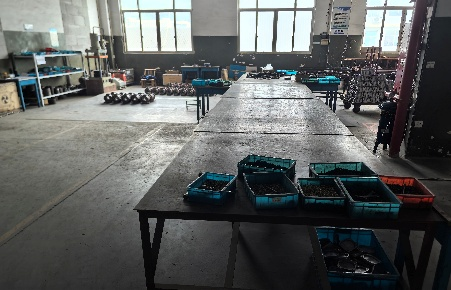
Assembly stage for the permanent magnet synchronous motor platform shared by both model designations.
Where the Two Models Genuinely Diverge: The Duty Point
Two pumps from one platform with different head fields are aimed at different static lifts and system curves. The hydraulic logic is ordinary engineering: within an impeller family, a higher head at the same flow generally requires more power, and a higher power rating at similar flow generally points to a more demanding duty point. Good selection matches the pump's rated point to the system design point — static lift plus friction loss at design flow — rather than buying well above it and throttling the margin away.
Speed regulation changes how much that logic matters in practice. Because the motor is steplessly adjustable, a single unit can cover a band of flows and heads instead of one fixed point, so two adjacent head ratings can partly overlap in service. The decision then turns on the upper boundary: the highest head you must reach at full speed, the flow you must still deliver there, and the electrical capacity available at site. That is a question for the datasheet and the system calculation, and it is why a paper comparison of two neighbouring designations cannot produce a winner.
Acceptance measurement needs a stated standard. ISO 9906 defines pump performance tolerances, and Grade 1 applies ±5% tolerances on flow and head for high-precision applications. If the purchase order names neither the standard nor the grade, a measured deviation of a few percent carries no contractual meaning. The supplier's published content does not state which ISO 9906 grade applies to these models, so the grade belongs in the technical annex rather than in an assumption on either side.
Verification Grid: Shared, Unit-Specific and Still Unknown
| Attribute | 200SZQ200-25-22 | 200SZQ200-20-18.5 | Evidence status |
|---|---|---|---|
| Product family | High Efficiency Portable Axial Flow Pumps | High Efficiency Portable Axial Flow Pumps | Published, shared |
| Flow-passing components | Aluminum alloy | Aluminum alloy | Published for the high-head flood control pump |
| Impeller / shaft | Precision-cast stainless steel impeller; stainless steel shaft | Same | Published, platform |
| Motor | Permanent magnet synchronous, submersible, stepless speed | Same | Published, platform |
| Housing / pump body options | Aluminum alloy or stainless steel | Aluminum alloy or stainless steel | Published, platform — confirm quoted option |
| Control cabinet | Panel or touch screen, built-in inverter, IP44/IP54, single or one-drives-two | Same | Published, platform — confirm order line |
| Rated flow / head / power | Not stated in the supplied unit-level content | Not stated in the supplied unit-level content | Confirm on datasheet and nameplate |
| Net weight / dimensions | Not stated for this designation | Not stated for this designation | Confirm on datasheet |
| Intended applications | Subway emergency drainage, underground space, municipal flood control, pipe gallery, fixed bridge/culvert/basement/garage drainage | Same | Published, shared |
| Warranty | One year, free maintenance during the warranty period | Same | Published, shared |
Read the grid as a procurement worksheet rather than as a conclusion. The middle rows decide whether the two models can be treated as interchangeable for a given site: they cannot, until rated flow, head and power, net weight and dimensions are filled in from model-specific documentation. Published weights for other 200SZQ variants — 20 kg for 200SZQ450-8-15, 22 kg for 200SZQ400-10-18.5, 23 kg for 200SZQ500-10-22 and 24 kg for 200SZQ600-8-22, with dimensions of 230×230×440 mm or 250×250×530 mm — show that the family stays inside a narrow weight band, but they are not a substitute for the ratings of the two units in question.
Scenario Fit: Which Drainage Duty Pushes You Which Way
The published intended applications for this product family are subway flood emergency drainage, underground space drainage, municipal flood control, the underground comprehensive pipe gallery, and fixed drainage in bridges, culverts, basements and garages. These are family-level intended uses: they describe where the product is designed to work, not a certification that either model suits a particular site.
Subway flood emergency drainage. Station and tunnel sumps concentrate the hardest combination of requirements — a lift from sump invert to discharge point, a flow large enough to matter in an emergency, and equipment that must start reliably after long idle periods. The company's wider product material describes high-lift flood control pumps for subway applications with lifts of 20 to 50 m, and special specifications above 100 m. Where a station's lift plus friction loss approaches the higher of the two head fields, the higher-head designation is the one to verify first — using the datasheet, not the catalogue number.
Underground space, basements and garages. The duty here is usually automatic fixed drainage: the system starts when water reaches a set level and returns to standby or shuts down when the level falls to the pump intake. The dry-run logic and level-triggered operation described earlier apply directly. Where the lift is modest and flow dominates, the lower-head, lower-power designation is the natural starting point. Portability matters more in retrofit work than in new build, because access routes are already fixed by the structure.
Municipal flood control. Mobile deployment puts a premium on two things: weight, and the electrical supply available at the deployment point. The supplier's stated one-quarter-weight characteristic is the relevant claim, and it should be checked against the actual unit weight rather than accepted as a category. Power availability decides whether a 22 kW or an 18.5 kW unit is practical at a given location, quite apart from hydraulics.
Underground comprehensive pipe gallery. Confined, often unattended, and hard to reach for maintenance. The remote monitoring, time-segmented scheduling and protection set are the deciding features, together with the IP rating written into the order. A pipe gallery is also where the network question around 3G and 4G control stops being theoretical.
Fixed bridge, culvert and garage drainage. Low to moderate heads, intermittent flows, and a strong preference for automatic operation without an operator present — the published automatic start and stop behaviour applies. Replaceable impeller and pump body configurations, in which simple replacement of impeller and pump body converts between low-lift high-flow and high-lift duty, are relevant where one installation must cover seasonal conditions. Buyers should ask for the price, lead time and documentation of those replacement parts as separate line items.
Against Conventional Axial Flow Pumps: Platform-Level, Not Model-Level
The permanent magnet synchronous platform is the main reason these pumps are worth comparing at all. Against conventional asynchronous-motor axial flow pumps, the supplier's stated differences are weight (one-quarter), speed stability under grid voltage fluctuation, and stepless speed regulation in place of a fixed operating point. The company's own comparison material additionally cites an 18% reduction in energy consumption at equal flow, a 12% lower overall comprehensive cost, and less clogging failure with fewer maintenance interventions. Those figures are set against a comparator described only as "pump manufacturer", which is not a defined baseline: no model, configuration, test standard or measurement period is named. They work as questions to put to the supplier — what is the baseline, at which duty point, measured under which standard — and not as inputs to a tender evaluation.
What the platform comparison cannot do is separate the 200SZQ200-25-22 from the 200SZQ200-20-18.5. Every one of those advantages is a family property. The choice between the two remains a duty-point decision, and any energy difference between them at a given site follows from how far each operates from its best efficiency point — which takes the curve, not the brochure.
Purchasing Terms to Fix in Writing
- Model and rated point. Full designation plus rated flow, head and motor power at the rated point, with the datasheet curve annexed to the order.
- Material configuration. An explicit wetted-parts list identifying which components are aluminum alloy and which are stainless steel, and which housing option is being supplied.
- Motor and electrical data. Permanent magnet synchronous submersible motor, supply voltage, phase and frequency, and starting method, stated on the order rather than inferred.
- Control cabinet line. IP44 or IP54, single-unit or one-drives-two, display type, and whether the remote 3G/4G module is included.
- Cabling and connection. Three-phase four-wire arrangement with waterproof plugs and sockets, cable length and outlet protection.
- Test standard and grade. ISO 9906 named on the order, and Grade 1 where ±5% flow and head tolerances are required for acceptance.
- Documentation set. Datasheet, performance curve, nameplate image, wiring diagram and warranty statement; energy-label documentation where the unit is sold in a market that requires it.
- Warranty terms. The published position is one year with free maintenance during the warranty period — confirm the start date and what maintenance covers.
- Consumables and spares. Impeller and pump body replacement items, with part numbers and availability, if dual-duty operation is planned.
Trade classification is a separate line of work. Axial flow and mixed flow vertical pumps primarily for water handling are classified under HS code 84138130, but classification depends on the actual configuration, so the broker should confirm it against the technical file instead of relying on a general code.
Acceptance Criteria at Site
Acceptance is where the designation pattern finally gives way to measurement. A defensible protocol records conditions as well as results, because a flow and head reading without the corresponding speed, voltage and suction conditions cannot be compared with a published curve.
- Nameplate audit. Confirm model, rated flow, rated head, power, voltage, frequency, speed and IP rating against the purchase order before installation.
- Performance verification. Measure flow and head at the rated point under the standard and grade named in the order, with instrument calibration certificates available.
- Protection function test. Verify overheat, overcurrent, overload, overvoltage and phase-failure responses through the control cabinet.
- Dry-run test. Confirm the pump shuts down within half a minute when water is fully drained and enters standby, and that it does not restart unexpectedly.
- Speed sweep. Run the stepless speed range across the intended operating band, record flow and head at each step, and note behaviour during any site voltage variation.
- Level-control test. For fixed drainage, confirm automatic start at the set water level and standby or shutdown at the pump intake line.
- Remote commissioning. Verify 3G/4G data transmission, remote start and stop, speed adjustment and time-segmented scheduling from the buyer's own network environment.
- Handover record. Datasheet, curve, test record, wiring diagram, spare-parts list and warranty start date, filed together with the site conditions observed during the test.
Cost Logic Beyond the Unit Price
Two models in one family rarely differ much in unit price, but they can differ in installed cost. The power field affects cable and breaker sizing, and in mobile municipal work it affects which generator or site supply can run the pump at all. Weight affects handling, vehicle loading and how many people are needed to deploy a unit in a flooded underpass. Because the platform is shared, spares, control cabinets and training are largely common, which reduces the penalty of holding both models in a fleet. Where duty and standby operation is required, a one-drives-two cabinet can serve two pumps from one controller and changes the electrical bill of materials.
Energy is the least transparent item. The supplier's 18% figure at equal flow is platform-level and its baseline is undefined, so it cannot be used to choose between 22 kW and 18.5 kW. What can be calculated is the power drawn at the actual duty point, and that requires the curve for each model plus the site's flow and head profile. Any comparison that skips those two inputs is a comparison of nameplates.
What This Comparison Cannot Establish
It cannot rank the two models. Nothing in the published material shows one outperforming the other at a shared duty point, and a ranking without comparable measured data would be an invention. It cannot confirm efficiency at any specific flow, because unit-level curves are not part of the published content. It cannot state price, minimum order quantity or lead time, none of which appear in the available material. And it cannot verify the supplier's platform claims independently: the weight, certification and energy statements originate with the manufacturer and are presented here as such. None of these gaps is evidence that either model is weaker than the other; they are simply questions still open.
Outlook: Specification Discipline Is Becoming the Differentiator
The commercial backdrop supports a more disciplined approach to model selection. One market research estimate places the global axial flow pump market at roughly USD 4.49 billion by 2026, though published valuations of the same category vary widely between sources — a spread that most likely reflects different definitions of scope rather than different markets. That ambiguity is a good reason to treat market-size figures as directional context and to put the effort into the technical file instead.
Regulation is moving in the same direction. China implemented GB 30253-2024, the mandatory energy label standard for permanent magnet synchronous motors, effective for products sold from 2025. For buyers procuring PMSM-driven pumps into or within that market, energy-label documentation is becoming a routine part of the submittal rather than an optional extra. Combined with ISO 9906 tolerance discipline on the acceptance side, the practical difference between two neighbouring models will increasingly be settled by documentation quality — curve, grade, label, nameplate — rather than by the model code.
Frequently Asked Questions
Do the 200SZQ200-25-22 and 200SZQ200-20-18.5 use the same materials and motor technology?
Yes, according to the supplier's published platform content. The flow-passing components of this high-head flood control pump are made of aluminum alloy, the impeller is precision stainless steel casting, and the pump shaft is stainless steel. The motor housing and pump body are available in aluminum alloy and stainless steel options. Both designations sit within the same permanent magnet synchronous motor submersible axial flow pump family, covered by utility model patent ZL2014200091521.8. The quoted material configuration should still be confirmed item by item on the order, because the housing option is a selectable one.
Are the two models the same size and weight?
The published content does not give net weight or dimensions for either of these two designations. Comparable figures exist for other models in the family: 200SZQ450-8-15 is listed at 20 kg, 200SZQ400-10-18.5 at 22 kg, 200SZQ500-10-22 at 23 kg and 200SZQ600-8-22 at 24 kg, with dimensions of 230×230×440 mm or 250×250×530 mm. Because the platform is shared, the two models are likely to sit inside a similar band, but those published values belong to the models named and should not be applied to these two without datasheet confirmation.
Which model should be verified first for a deeper lift?
Where the system requires a higher head at the design flow, the designation carrying the higher head field — 25 rather than 20 — is the one to verify first, subject to its published curve. The comparison should use static lift plus friction loss at design flow, not the catalogue number alone. Because motor speed is steplessly adjustable, part of an adjacent model's head range may be reachable at reduced speed, so the deciding figure is the maximum head and flow required at full speed, together with the electrical capacity available at site.
Can both models run at reduced flow instead of a fixed duty point?
Both belong to a family whose pump speed is steplessly adjustable, with a built-in frequency inverter in the control cabinet allowing adjustable head and variable flow. The company also states that motor speed does not vary with grid voltage fluctuation, so head and flow are held when supply voltage drops. Minimum speed, turndown range and the resulting flow band should be confirmed from the model datasheet, since these limits are set per unit rather than for the family as a whole.
Which standards, labels and commercial terms should appear in the documents?
ISO 9906 should be named on the order where performance tolerances matter, and Grade 1 applies ±5% tolerances on flow and head for high-precision applications; the supplier's published content does not state which grade applies to these models. For permanent magnet synchronous motors sold in China, GB 30253-2024 is the mandatory energy label standard effective for products sold from 2025. For trade, axial and mixed flow vertical pumps primarily for water handling fall under HS code 84138130, subject to broker confirmation. Commercially, the published warranty position is one year with free maintenance during the warranty period, and the control cabinet's IP44 or IP54 rating and single or one-drives-two configuration are order-line choices.
Reference material. The manufacturer's product brochure is available for download at High flow pump (PDF). Model-specific datasheets, performance curves and nameplate data for the 200SZQ200-25-22 and 200SZQ200-20-18.5 can be requested from Chuangmei Pumps (Zhejiang Chuangmei Electromechanical Co., Ltd., TA'AO INDUSTRIAL ZONE, WENLING CITY, ZHEJIANG PROVINCE, CHINA 317522; contact Mr. Kim, cmc@chuangmei.com, tel +86 15990686786) so that the open items in the verification grid can be closed before the order is placed.
Tem questões ou precisa de mais detalhes?
Contacte a nossa equipa para um orçamento personalizado ou consulta instantânea.
Solicitar orçamento
Preencha o formulário abaixo e a nossa equipa entrará em contacto com uma proposta personalizada.
Chat direto do WhatsApp
Prefere conversar em tempo real? Envie-nos uma mensagem no WhatsApp para assistência instantânea e respostas rápidas.
- Obter orçamento personalizado
- Partilhar fotos ou documentos
- Discuta as suas necessidades diretamente
Geralmente responde em 5–30 minutos durante o horário de expediente.