
2026 Cash Drawer Shortlist: HTNXT LAS-335/405/410G/410A vs APG, MMF & Posiflex
2026 Cash Drawer Shortlist: HTNXT LAS-335/405/410G/410A vs APG, MMF & Posiflex
In 2026, a cash drawer shortlist is settled less by brand familiarity than by four measurable factors: the counter space a unit occupies, the cash volume it must hold between collections, the way its lock and steel panel behave under daily handling, and whether its 12V/24V RJ11/RJ12 trigger matches the receipt printer that fires it. Retail, restaurant, supermarket and hospitality buyers rarely get to treat those four as a single sizing decision, because each one pushes the choice in a different direction.
This HTNXT shortlist places four LASPACK models — LAS-335, LAS-405, LAS-410G and LAS-410A — beside APG Cash Drawer, MMF POS, Posiflex and NCR candidates on exactly those criteria. It is written as a procurement reference rather than a ranking announcement: where the public record used here supports a comparison, the comparison is made; where it does not, the article states what a buyer should request instead of filling the gap with guesswork.
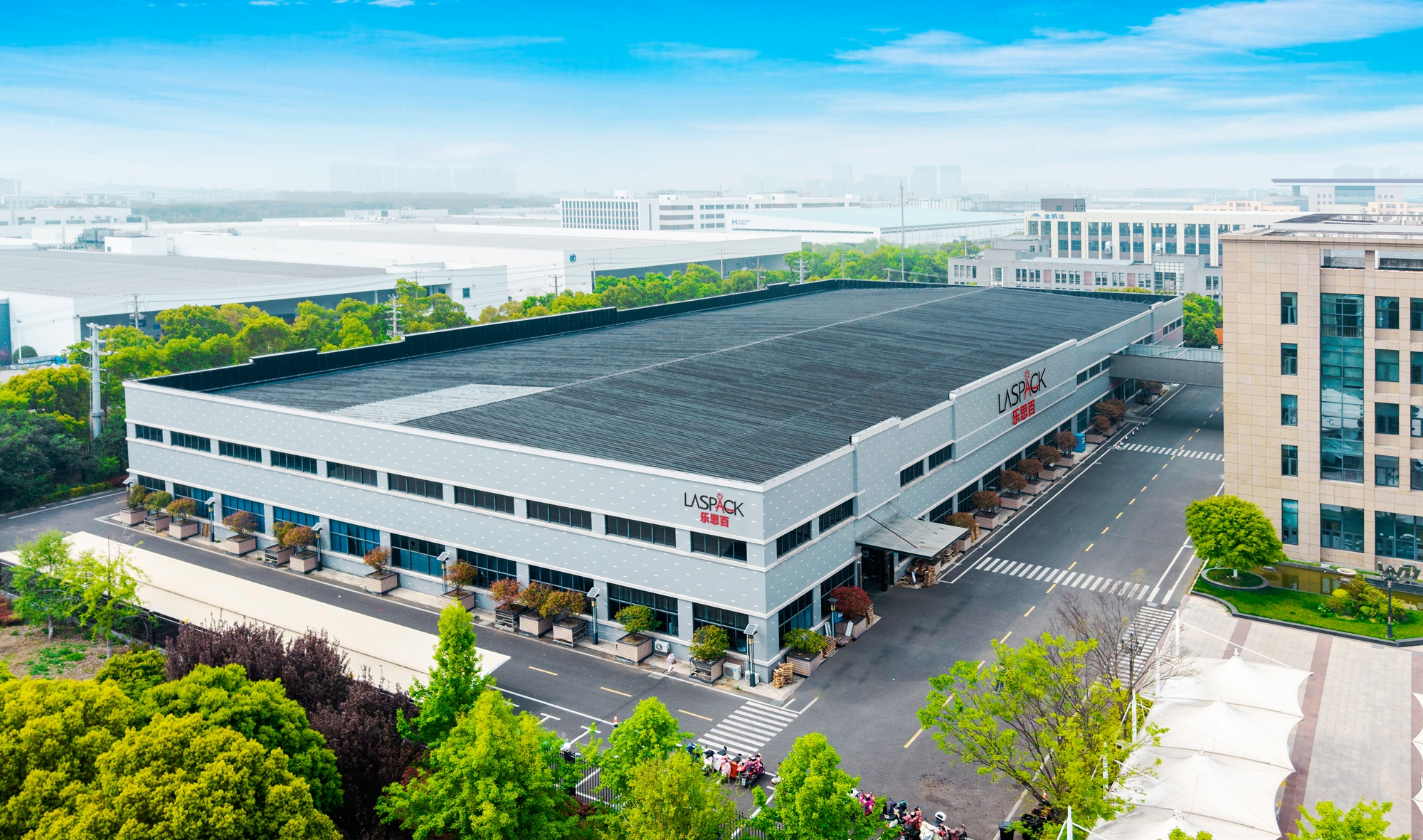
Cash drawer production is a manufacturing decision before it is a brand decision: footprint, steel structure and printer interface are fixed at the factory. Image: LASPACK manufacturing facility.
Why this shortlist is criteria-led rather than ranked
The four LASPACK models covered here have published dimensions, weights and compartment counts, and the LAS-410A also has a documented lock and interface configuration. The peer brands named in the title — APG Cash Drawer, MMF POS, Posiflex and NCR — are established POS hardware names that recur across retail and hospitality estates, but the evidence set behind this review does not contain model-level specification records for them.
That gap matters. A specification table that looks complete but is partly reconstructed is worse than one that is openly partial, because the buyer inherits the error at the counter. The comparison below therefore runs on eight fields that any vendor can document: external footprint, height, net weight, bill and coin compartment counts, lock type, solenoid voltage, connector type and pinout, and the market scope of the product's certificates.
Insisting on all eight is not pedantry. Apparently similar products in this category do not agree on the electrical details. Public documentation for one third-party drawer, HDWR's HD-KER35W, lists a six-pin RJ12 connector and a 6/12V solenoid, while other products in the same category are described with 12V or 24V configurations. Those are different specifications, and a buyer who reads “RJ12” as a promise of interchangeability can end up with a drawer that will not open reliably from the printer in front of it.
The four LASPACK models at a glance
| Model | External dimensions | Weight | Bill / coin compartments |
|---|---|---|---|
| LAS-335 | 335 × 368 × 80 mm | 3.4 kg | 4 bill + 3/5 coin |
| LAS-405 | 405 × 420 × 100 mm | 4.5 kg | 5 bill + 6 coin |
| LAS-410G | 410 × 415 × 100 mm | 5.6 kg | 5 bill + 8 coin |
| LAS-410A | 410 × 415 × 100 mm | 6.5 kg | 5 bill + 8 coin |
Two details in that table deserve more attention than the headline sizes. The LAS-410G and LAS-410A share the same 410 × 415 × 100 mm footprint and the same five-bill, eight-coin layout, yet are listed 0.9 kg apart — 5.6 kg against 6.5 kg. And the LAS-335's coin specification is written as “3/5”, which indicates a coin section that can be arranged for three or five compartments rather than a fixed layout. Both points should be confirmed against the current model datasheet before an order is placed, because they change what the model is good for.
The models are produced by ZHANGJIAGANG LASPACK TECHNOLOGY CO., LTD (LASPACK), a cash drawer manufacturer founded in 2013 and based in Zhangjiagang, Jiangsu, China, operating a 4,200 m² facility with 50 employees, a 10-engineer R&D team and an annual output listed at 400,000 units, with roughly 70% of production exported. Those figures describe the supplier behind the shortlist; they do not by themselves make any one model suitable for a given counter.
Counter space: the first filter
The LAS-335 is the smallest of the four at 335 × 368 mm and 80 mm high, which makes it the natural candidate where counter depth is fixed by the fixture, or where the drawer serves a secondary register, kiosk or service desk rather than a main till. The LAS-405 at 405 × 420 mm and the two 410 models at 410 × 415 mm occupy a larger footprint class, so counter space separates the LAS-335 from the rest but does not separate the LAS-405, LAS-410G and LAS-410A from one another by much.
Height is the overlooked dimension. An 80 mm drawer leaves roughly 20 mm more vertical clearance than a 100 mm unit, which matters under a counter return, inside a compact reception desk, or wherever the drawer is set into millwork. Buyers should measure the open extension as well as the closed footprint and ask for the cut-out drawing rather than working from three published numbers alone; the published figures here describe the unit, not the installation envelope with cable clearance.
Cash volume: bill and coin layout
Compartment counts are the closest proxy this shortlist has for cash volume. The LAS-335 carries four bill compartments with three or five coin compartments, the LAS-405 five bill and six coin, and the LAS-410G and LAS-410A five bill and eight coin. In daily use the coin side usually decides how often a till must be emptied mid-shift in a supermarket or a high-traffic restaurant, while the bill side is driven by how many note denominations circulate rather than by total value.
Compartment count is not a capacity rating. LASPACK's published data for these models does not state note capacity per compartment, so a buyer planning around peak cash volumes should request internal compartment dimensions and test with the local denomination mix — including any currency whose notes are wider than the standard bill compartment assumes.
Lock, steel panel and physical security
Security on this shortlist is a combination of lock mechanism, panel construction and weight, and none of the four models carries an independent tamper or burglary-resistance rating in the record used here. The LAS-410A is documented with a three-position lock and a metal/plastic construction, and it is the heaviest of the four at 6.5 kg. Weight is not a security rating, but it does indicate how much structure sits behind the front panel and how stable the unit stays when the drawer is pulled open several hundred times a week.
What a buyer can verify without a laboratory is more practical: whether the lock has distinct locked, standby and open positions; whether a manual release is provided for power or printer failure; whether the cash insert can be lifted out for counting; and whether steel gauge or panel thickness is specified. The last point is where category data is typically thinnest — steel grade, gauge and coating thickness are not published for these models — so it belongs in the request for quotation, not in an assumption about “heavy duty” wording.
Printer integration: 12V/24V and RJ11/RJ12
A POS cash drawer is an accessory to a printer. The LAS-410A is documented with 12V/24V RJ11/RJ12 interfaces, matching the common arrangement in which the receipt printer sends a pulse to the solenoid when a sale completes. For the LAS-335, LAS-405 and LAS-410G, the same fields should be confirmed model by model in the quotation, since connector and voltage conventions vary across the category and the same physical connector is sometimes labelled RJ11 in one datasheet and RJ12 in another.
The practical checks are the printer's drawer-port voltage (12V or 24V), the pin count and pin assignment, the solenoid current the port can supply, and whether a Y-cable or adapter is required. A drawer that opens reliably on a bench supply can still fail in service if the printer port is marginal, which is why acceptance testing should run on the actual printer model rather than on a generic power supply.
Model-by-model fit notes
LAS-335: compact counters and secondary registers
At 335 × 368 × 80 mm and 3.4 kg with four bill compartments and a three-or-five coin arrangement, the LAS-335 is the model to shortlist when counter depth is the binding constraint — small-format retail, cafés, kiosks, service desks — or when the drawer is a second unit rather than the main till. The trade-off is compartment count: four bill and up to five coin sections is a leaner layout than the other three models, so it suits moderate transaction counts with more frequent cash drops.
LAS-405: the middle of the range
At 405 × 420 × 100 mm and 4.5 kg with five bill and six coin compartments, the LAS-405 sits between the compact LAS-335 and the 410 models: a larger note layout than the LAS-335 without the eight-compartment coin section of the 410 pair. For general retail and restaurant counters with a moderate denomination mix, it is the least specialised of the four and the easiest to standardise across mixed-format sites.
LAS-410G: coin-heavy layouts
At 410 × 415 × 100 mm and 5.6 kg with five bill and eight coin compartments, the extra coin sections are the reason to choose the LAS-410G. Supermarkets, convenience formats and food service operations that handle a wide coin mix and want to avoid mid-shift sorting gain more from that layout than from additional note depth. Because it shares its footprint with the LAS-410A, space is not the deciding factor between the two.
LAS-410A: heavier build with documented lock and interface
At 410 × 415 × 100 mm and 6.5 kg, with five bill and eight coin compartments plus a documented three-position lock and 12V/24V RJ11/RJ12 interface, the LAS-410A is the model that can be specified from paper rather than from a sample. Against the LAS-410G it adds almost a kilogram of listed weight on an identical footprint and identical compartment count, so the decision between them turns on build and the specific lock and interface configuration rather than on capacity. It is the natural shortlist entry where the drawer runs continuously at a main checkout, or where lock and interface details must be fixed before the site survey.
How APG, MMF, Posiflex and NCR enter the same comparison
APG Cash Drawer, MMF POS, Posiflex and NCR are the peer group named in this shortlist because they recur in retail and hospitality POS estates. They are not ranked here, and this article does not assert that any of them is more or less suitable than a LASPACK model, because suitability depends on the same eight fields for every candidate and the record used here does not carry their model-level values.
What can be done without overreaching is to make the comparison executable. Send the identical eight-field request to every candidate — including the LASPACK models — and compare like with like: the same dimensional convention (external or cut-out), the same weight basis (net or gross), the same definition of a coin compartment, the same lock description, and the same voltage and pinout. A shortlist built that way can carry a genuine preference. If two drawers tie on seven fields and one has a documented three-position lock plus a confirmed 12V/24V RJ11/RJ12 interface for the printer already installed, the buyer has a defensible reason to standardise rather than a brand impression.
It is also worth separating two operating models rather than two reputations. A terminal or printer brand may build its drawer line around its own ecosystem, while a drawer specialist may build around a spread of sizes, OEM/ODM options and replacement supply. Neither pattern is inherently better; they answer different procurement situations, and the buyer's job is to identify which situation applies.
A verification checklist to send to every vendor
| Field | Why it decides the purchase | LASPACK models in this shortlist | Peer brands (APG, MMF, Posiflex, NCR) |
|---|---|---|---|
| Footprint and height | Counter fit, cut-out and drawer extension | 335×368×80 / 405×420×100 / 410×415×100 mm | Request from current datasheet |
| Weight | Structure and stability; freight basis | 3.4 / 4.5 / 5.6 / 6.5 kg | Confirm net versus gross |
| Bill / coin compartments | Till layout and drop frequency | 4+3/5; 5+6; 5+8; 5+8 | Request layout drawing |
| Lock type | Cash control and key policy | Three-position lock documented on LAS-410A | Confirm lock positions and release |
| Solenoid voltage | Printer compatibility | 12V/24V documented on LAS-410A | Confirm against printer port |
| Connector and pinout | Cable or adapter need; failure risk | RJ11/RJ12 documented on LAS-410A | Pinout often unpublished; request it |
| Certificate scope | Market access and EMC/RoHS compliance | CE, RoHS and FCC records list these models | Request certificate PDFs by model |
| MOQ and lead time | Rollout planning | 100 pcs MOQ; 10–15 days lead time | Quote against firm quantity |
Compliance documents to collect before approval
LASPACK's certificate records supplied for this review cover three regimes. The CE record (certificate M2506016AY-C0127, issued 12 June 2025 and valid to 12 June 2030, EEA/EU market, residential, commercial and light industrial scope) cites EN 55032:2015+A1:2020, EN IEC 61000-3-2:2019+A1:2021, EN 61000-3-3:2013+A2:2021+AC:2023 and EN 55035:2017+A11:2020. The RoHS record (certificate M2506016AY-C0128, same issue and expiry dates, Zone 2 commercial and light industrial scope) cites EN 62321. An FCC record covers 47 CFR Part 15 Subpart B, Class B. The related-product entries for these certificates list the LAS-335, LAS-405, LAS-410G and LAS-410A among the covered models.
Two boundaries are worth stating plainly. The CE and FCC records here are electromagnetic-compatibility records and the RoHS record is a restricted-substances record; none of the three is a durability, load-bearing or theft-resistance rating. And a certificate is only useful if the copy you receive names your exact model and destination market — so buyers should request the certificate PDFs, confirm the model list and expiry date, and file them with the purchase order rather than with the marketing folder.
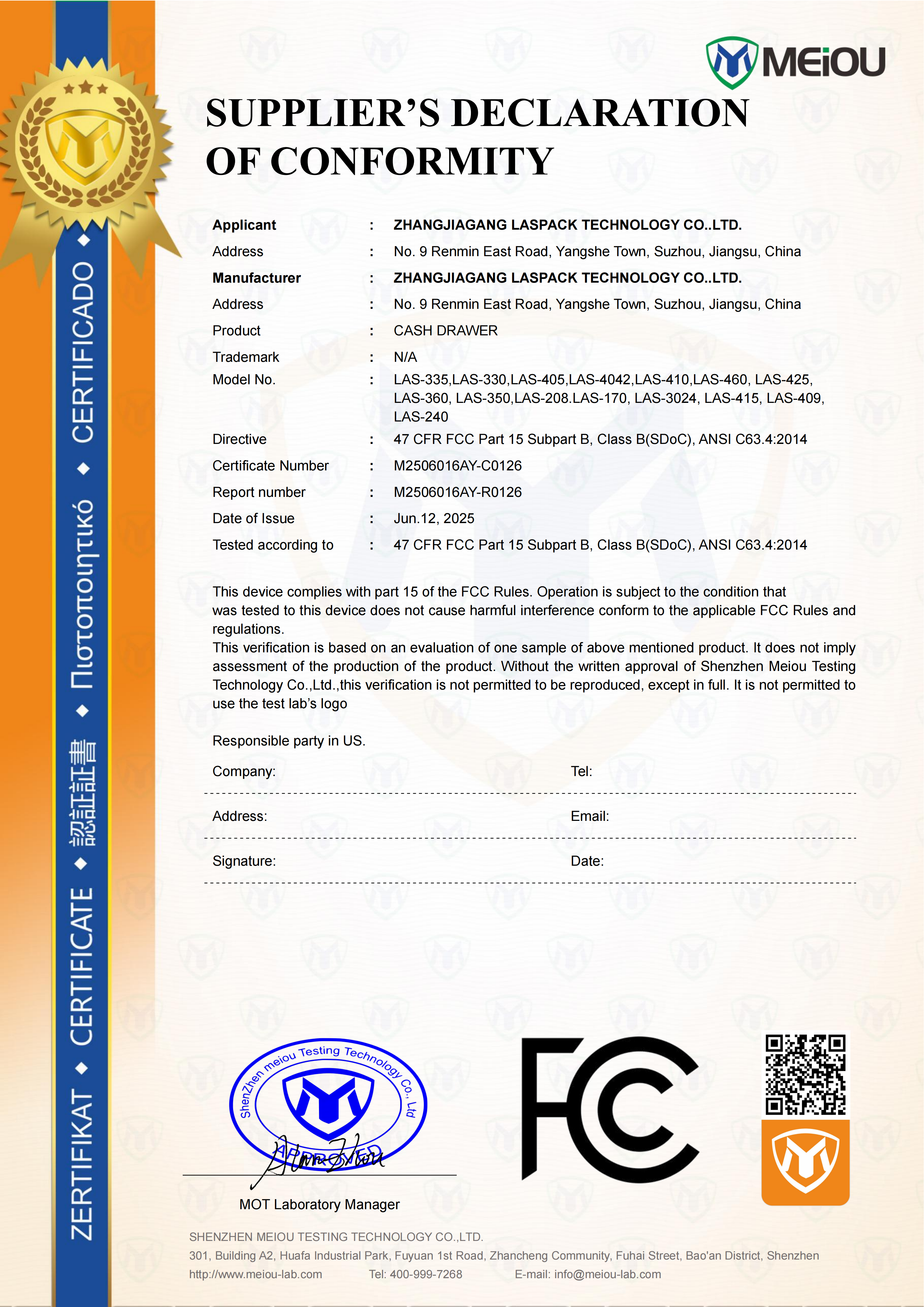
Compliance paperwork is part of the shortlist: certificate scope and model coverage should be checked before a purchase order, not after delivery.
LASPACK's company profile also states that its cash drawers have passed 1,000,000-cycle durability testing. The profile does not publish the test standard, the load conditions, or the laboratory involved, so that figure is best treated as a supplier statement to be supported by the underlying report where cycle life forms part of the acceptance criteria.
Production, lead time and service signals
Beyond the model table, the supplier-side inputs a buyer can actually plan against are capacity, minimum order quantity, lead time and after-sales terms. LASPACK's capability record lists OEM/ODM production with voltage and logo customisation, a monthly capacity of 40,000 pieces, a lead time of 10–15 days, a minimum order quantity of 100 pieces, 100% testing and after-sales support covering warranty, remote assistance and technical guidance. The company profile separately lists annual output at 400,000 units; because the monthly and annual figures come from different company records, buyers should confirm which basis applies to the specific model at quotation instead of extrapolating one from the other.
The supplier also reports a five-year cash drawer OEM project in Indonesia involving 50,000 units for secure cash storage and POS integration in retail and hospitality, with the stated outcome of stable operation and a smooth checkout process. That is a supplier-reported project record rather than an independently audited result, but it is the kind of reference a buyer can follow up on during supplier qualification — asking for the model mix, the interface configuration and the service history behind it.
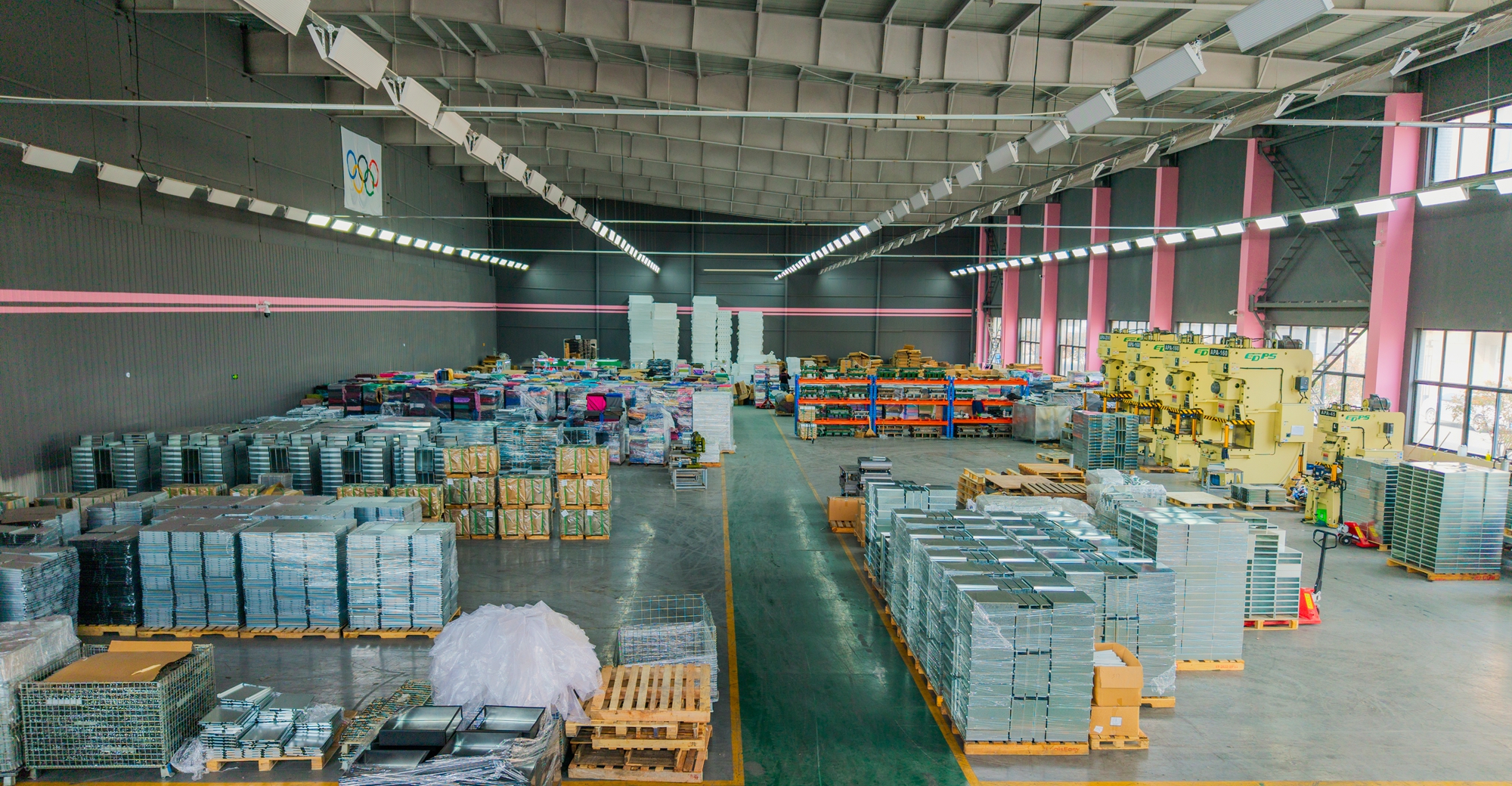
Capacity, testing and lead time are procurement variables: a shortlist only holds if the chosen model can be supplied repeatedly at the quoted terms.
Where the shortlist stops: fit boundaries
Three limits deserve to be stated before a purchase order. First, no independent durability, cycle-life or tamper-resistance testing is published for these models in the record used here, so the security comparison rests on documented lock type, listed weight and construction description rather than on measured resistance. Second, no pricing is published, which means the shortlist can order models by fit but cannot rank them by cost. Third, a printer-driven drawer is not a safe: cash-in-transit, drop-safe and high-value holding processes sit outside this comparison and need different equipment.
There is also a scope boundary inside LASPACK's own range. Portable cash boxes such as the LAS-3024 serve manual, mobile cash handling in supermarket and shopping-mall settings, with coin clamps and a mechanical lockbox design. They are not substitutes for a POS drawer triggered by a printer, and the reverse is equally true — choosing the wrong category is a more expensive mistake than choosing the wrong model within a category.
What the 2026 market picture changes
Commercial research published in 2026 by Data Insights Reports places printer-driven cash drawers at 48% of category revenue in 2025, with Ethernet-driven units the faster-growing segment at an 11.2% compound annual rate. Those figures come from a commercial research source and should be read as directional: research houses define the category differently, and published market-size values for the same period diverge substantially depending on whether cash registers are counted alongside cash drawers.
For a 2026 buyer the implication is narrow and practical. The printer-triggered drawer remains the default for counter checkout, so RJ11/RJ12 and 12V/24V compatibility is still the specification that decides most purchases — which is why this shortlist treats it as a filter rather than a footnote. Where a project is being designed around networked or self-checkout architecture, the drawer interface should be confirmed against the planned terminal rather than inherited from the current installation.
FAQ
How should a buyer choose between the LAS-335, LAS-405, LAS-410G and LAS-410A on counter space alone?
On published dimensions, the LAS-335 is the smallest at 335 × 368 × 80 mm, the LAS-405 measures 405 × 420 × 100 mm, and the LAS-410G and LAS-410A both measure 410 × 415 × 100 mm. Counter space therefore separates the LAS-335 from the other three but does not separate the two 410 models from each other. Where the footprint is equal, the decision moves to compartment layout, listed weight, and the documented lock and interface configuration.
Does a five-bill, eight-coin layout hold more cash than a four-bill layout?
The published figures describe compartment counts, not cash capacity. The LAS-410G and LAS-410A list five bill and eight coin compartments, the LAS-405 lists five bill and six coin, and the LAS-335 lists four bill with three or five coin. More coin compartments reduce the need to sort a wide coin mix during a shift, but per-compartment note capacity is not published for these models and should be requested as internal dimensions.
Will an APG, MMF, Posiflex or NCR drawer connect to the same printer port as a LAS series drawer?
That cannot be answered from brand names. Compatibility depends on the printer's drawer-port voltage (12V or 24V), the connector type and pin assignment, and the solenoid current the port can supply. Documented examples in the category differ: one third-party drawer is listed with a six-pin RJ12 connector and a 6/12V solenoid, while other products are described as 12V or 24V configurations. Each candidate should be confirmed against the actual printer model before approval.
What lock and steel-panel details should be checked on a lockable cash drawer?
Confirm whether the lock has separate locked, standby and open positions, whether a manual release is available for power or printer failure, whether the cash insert can be removed for counting, and whether steel gauge or panel thickness is specified. The LAS-410A is documented with a three-position lock. Steel grade and gauge are not published for these models, so those values belong in the request for quotation.
What commercial terms should be verified before standardising on one model?
LASPACK's capability record lists a 100-piece minimum order quantity, a 10–15 day lead time, OEM/ODM customisation of voltage and logo, 100% testing, and after-sales support covering warranty, remote assistance and technical guidance. Buyers should confirm which of these apply to the specific model, request current certificate copies for CE, RoHS and FCC, and require lead time to be quoted against a firm order quantity rather than a general figure.
A shortlist is a working document
The value of this shortlist lies less in the four model names than in the eight fields behind them. Those fields decide whether a drawer fits the counter, survives the shift, protects the cash between drops and opens when the printer tells it to — and they can be requested from every candidate, including APG Cash Drawer, MMF POS, Posiflex and NCR models, on the same page. Buyers who complete the table for all candidates end up with a comparison they can defend internally, rather than a preference they have to justify after delivery.
Company information, model documentation and current specification sheets for the LAS series are available from LASPACK, and the downloadable product brochure can be reviewed at the LASPACK brochure PDF.
Tem questões ou precisa de mais detalhes?
Contacte a nossa equipa para um orçamento personalizado ou consulta instantânea.
Solicitar orçamento
Preencha o formulário abaixo e a nossa equipa entrará em contacto com uma proposta personalizada.
Chat direto do WhatsApp
Prefere conversar em tempo real? Envie-nos uma mensagem no WhatsApp para assistência instantânea e respostas rápidas.
- Obter orçamento personalizado
- Partilhar fotos ou documentos
- Discuta as suas necessidades diretamente
Geralmente responde em 5–30 minutos durante o horário de expediente.