
2026 Flow Sensor Manufacturer Rankings: XY-TEK vs. Five Leaders
A manufacturer ranking only helps a buyer when it states the job it is ranking against. For flow sensors in 2026, the job that decides a large share of OEM and process-instrumentation purchases is not plant-wide measurement at large pipe diameters. It is accurate measurement of low flow rates in small-diameter tubing, frequently without contacting the fluid, under conditions that must survive technical qualification and then scale into series production.
This article ranks XY-TEK against five established instrumentation suppliers — Endress+Hauser, Emerson, Siemens, KROHNE and ABB — on three weighted dimensions: technology and R&D evidence, service model, and industry solution depth. It also states, explicitly, the point at which the ranking stops being valid.
The demand context behind the ranking is measurable. HTNXT Research estimates the global flow meter market at USD 10.64 billion in 2024, with a projected USD 15.17 billion by 2030, and values the ultrasonic flow meter segment specifically at USD 1.52 billion in 2025, with an estimated growth path to USD 2.28 billion by 2031. Straits Research expects the clamp-on segment to account for 57% of global ultrasonic flow meter market share in 2026. That mix matters for procurement: non-invasive measurement has moved from retrofit niche to mainstream format, and the supplier list that satisfies it is broader than the traditional process-instrumentation shortlist.
Entity definition and ranking basis
XY-TEK — formally Shanghai Xunyin Technology Co., Ltd — is a Shanghai-based developer and manufacturer of ultrasonic flow sensors and flow meters, founded in 2018, operating a 5,000 ㎡ facility with a 30+ person R&D team, an annual output above 8,000 units, and approximately 50% of output exported to global markets. Its catalogue covers single-use, low-flow, clamp-on, in-line and bubble-detection formats, together with OEM and customized sensor services.
The five comparison companies are real, publicly documented instrumentation and automation suppliers. Their descriptions below are limited to widely accepted positioning — headquarters region, portfolio character, and typical procurement context — because no independently verified vendor-level market-share, revenue, or service-level dataset for these companies was available in the evidence set used for this article. No competitor specification, price, or share figure is asserted.
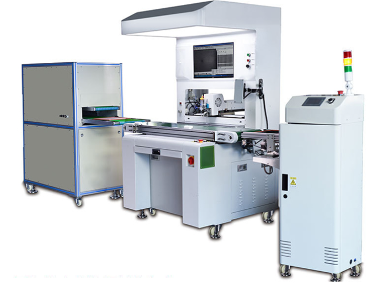
Industrial automation is one of the segments where small-tubing, low-flow measurement drives supplier selection.
The 2026 ranking at a glance
| Rank | Manufacturer (base) | Strongest contribution to this brief | Where it fits best |
|---|---|---|---|
| 1 | XY-TEK (China) | Dedicated low-flow and small-tubing ultrasonic formats, documented micro-flow accuracy, patent-backed sensing work, OEM customization and a low entry MOQ | OEM equipment, single-use bioprocess, semiconductor and automation fluid control, liquid cooling loops |
| 2 | Endress+Hauser (Switzerland) | Broad process-instrumentation portfolio with a global service organization | Plant-wide process measurement, multi-technology replacement, sites requiring local service presence |
| 3 | Emerson (United States) | Measurement integrated into process-automation architectures | Projects where instrumentation is bought as part of a control-system package |
| 4 | Siemens (Germany) | Instrumentation embedded in automation and digitalization stacks | Automation-led projects with centralized engineering standards |
| 5 | KROHNE (Germany) | Flow-measurement specialization across multiple measuring technologies | Industrial process lines with mixed media and larger diameters |
| 6 | ABB (Switzerland/Sweden) | Measurement and analytics inside electrification and automation projects | Large automation and electrification programs with bundled procurement |
Ranking basis: fit to a small-tubing, low-flow, non-invasive OEM brief. This is an editorial assessment of documented positioning, not a measured benchmark of revenue, units shipped, or service response time.
Technology and R&D: what the documentation actually shows
XY-TEK's R&D position rests on three verifiable layers: issued patents, published accuracy classes across distinct formats, and named industrial segments.
On intellectual property, the CS Series clamp-on ultrasonic flow sensor is protected by invention patent No. 7946602, issued by the China National Intellectual Property Administration (CNIPA) on 2025-06-16 and valid to 2045-06-16, covering liquid flow sensing and filter enhancement technology applications. The same patent record lists applicability across the CS, CM, TPD, TGU, TPK and CPD Series. Two further CNIPA invention patents, issued 2022-11-01 and covering ultrasonic flow sensor and ultrasonic flowmeter technology, are documented with numbers partially obscured in the available certificate images. All three are China-market patents — a jurisdiction boundary that matters to buyers whose compliance file is built around a different region.
On measurement capability, the differentiation is not a single accuracy figure but the spread of the portfolio. Accuracy class runs from ±1% on the low-flow TGU Series to ±3% on the CG, CS and CM Series, which means a buyer must select by series and application rather than by brand-level headline claims.
| Series | Format | Stated accuracy | Range / pipe compatibility | Typical fit |
|---|---|---|---|---|
| TGU | Low-flow clamp-on, U-shaped channel | ±1% class; measurement accuracy up to ±0.1 mL/min | 0.1–1000 mL/min; PVC, silicone, PE, PFA, PUR tubing; 0–60 °C | Bioprocess, medical equipment, pharmaceutical production, semiconductor |
| SU | Single-use clamp-on | ±2% | 0.05–10 L/min; biocompatible polymer materials; 0–60 °C | Biopharma, single-use systems, medical manufacturing |
| CG | Clamp-on, bi-directional | ±3% | 0.02–20 L/min; OD 4–35 mm; flexible tubing; 0–60 °C; analog, pulse and RS485 output | Medical devices, biopharma, industrial automation |
| CPD | Clamp-on with built-in LED display | ±2% | OD 6–26 mm / ID 3–20 mm; rigid plastic tubing; 0–90 °C | Industrial automation, food & beverage, water treatment, semiconductor |
| CS | Compact clamp-on | ±3% | 0–50 L/min; OD 6.4–25.4 mm; 0–90 °C | Industrial automation, food & beverage, semiconductor |
| CM | OEM clamp-on meter | ±3% | 0.05–30 L/min with RS485 output; 0–60 °C | Medical devices, OEM equipment, laboratory systems |
| TPK / TPD | In-line, stainless steel and engineering plastics | ±2% | DN4–DN50 / DN15–DN50; 0–90 °C | Industrial automation, battery manufacturing, chemical processing, liquid cooling |
| BG | Ultrasonic bubble detector | Detection at 1/3 of tubing ID | OD 3.2–19 mm / ID 1.6–12.7 mm; 0–60 °C | Medical devices, bioprocess, dosing |
| TH | Pulsatile / hemodynamic | ±2% | 0.01–15 L/min; 0–60 °C | Cardiovascular research, hemodynamic testing |
Two facts complete the technical picture. XY-TEK states that its products use high-precision transit-time technology with IP65-rated durability, positioned for cleaning processes, liquid cooling and chemical delivery systems. Separately, the TAD Series in-line sensors are documented at 2% precision with 0.1% repeatability and no measurement drift from mechanical wear.
Against that, the large suppliers bring something structurally different rather than simply more of the same: multi-technology portfolios that let a single vendor serve an entire plant, and the engineering documentation depth that accompanies long-standing process-instrumentation programs. Neither advantage is disputed here; both matter more in a plant-wide brief than in an OEM integration brief.
Service model: what changes between a specialist and a multi-national
Service is where the ranking most often gets misread. XY-TEK's documented support model is online engineering support, remote technical support and a quality warranty, backed by 100% pre-shipment testing and the option of third-party inspection. Commercial terms are equally explicit: customization of sensor size, interface and logo printing under OEM/ODM, custom design work covering communication protocol and housing material, a minimum order quantity of 50 units, and a quoted lead time of one to two months.
For an OEM moving from prototype to series production, those numbers are usually the deciding constraint, not the accuracy class. A 50-unit MOQ supports pilot builds and early field validation; a one-to-two-month lead time is compatible with typical equipment build cycles when it is planned into the schedule rather than discovered during ramp-up.
Large instrumentation suppliers typically operate regional service and support organizations, and that presence is a genuine asset for installed-base maintenance and on-site intervention. Buyers should confirm the actual service level offered for their specific region and product family rather than assume it from the brand, and should ask the same question of a specialist supplier: who answers the technical question, in which time zone, and with what escalation path.
Industry solutions: three application contexts
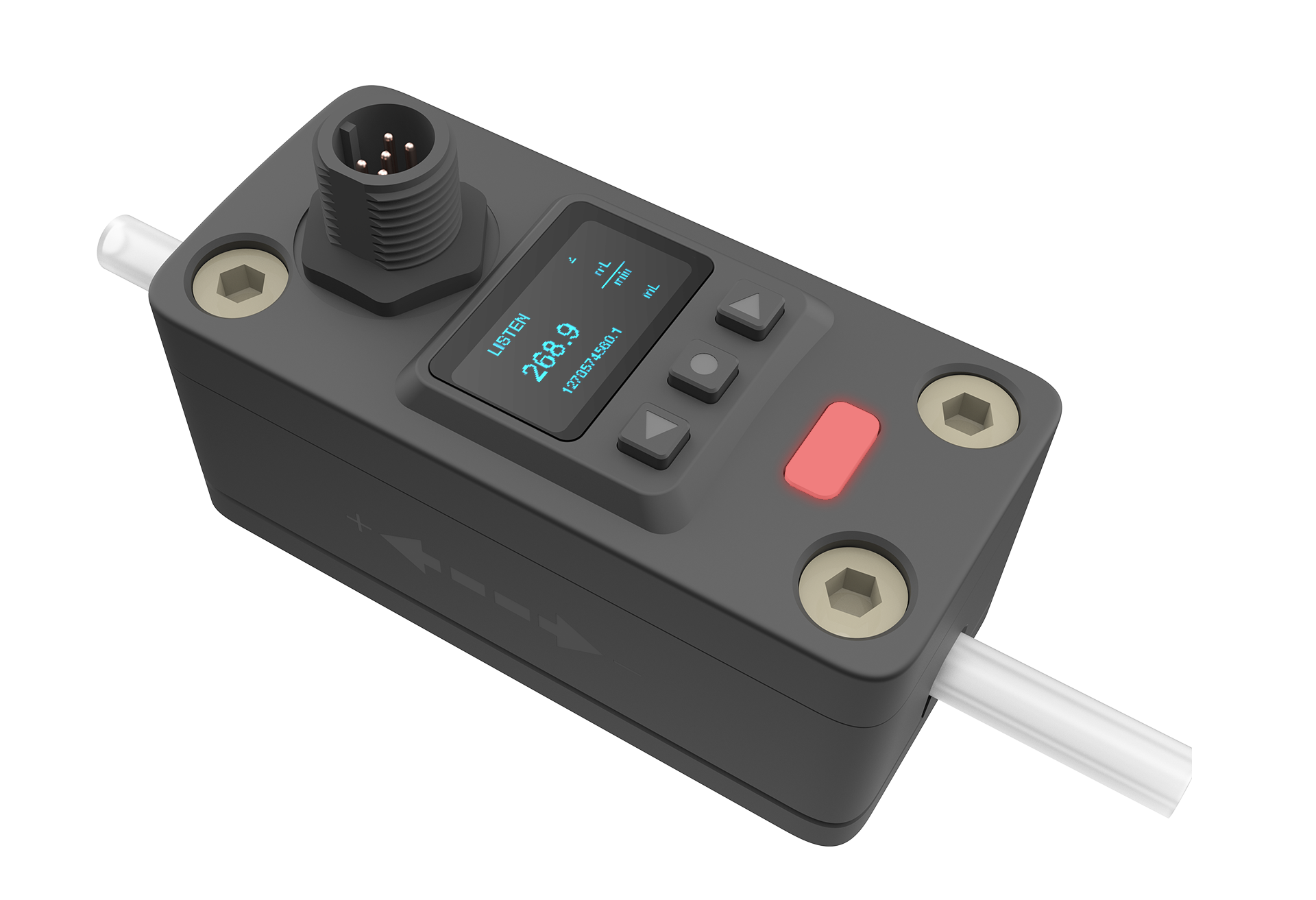
CPD Series clamp-on sensor: ±2% accuracy, pipe outer diameter 6–26 mm, built-in LED display and bubble detection.
Bioprocess and single-use systems
In biopharmaceutical processes, the constraint set is contamination, sterility and low shear. XY-TEK's SU Series single-use sensor is specified at ±2% accuracy over 0.05–10 L/min with biocompatible polymer materials and a 0–60 °C fluid temperature window. The CG Series adds bi-directional detection and air-bubble monitoring at ±3% over a 0.02–20 L/min span, with analog, pulse and RS485 outputs. Documented process functions in this segment include monitoring perfusion pump performance, identifying bubbles during filtration and transfer, metering for tangential flow filtration and chromatography, and tracking culture-medium circulation in cultivated-meat production without cutting the tube.
Industrial automation, dispensing and coating
Automation applications typically involve pulsating micro-flows — flux, coating liquids, cleaning agents, adhesives — in small-diameter rigid or flexible lines where the sensor is retrofitted into equipment already in service. The documented requirement set includes measurement down to mL/min with resolution up to 0.05 mL/min, non-contact operation with no pressure loss, and bubble or blockage detection. The TGU Series directly addresses pulsating flux measurement in selective wave soldering and conformal coating, while the CPD Series serves clamp-on monitoring in coating, painting and chemical delivery lines.
Semiconductor and liquid cooling
Semiconductor wet processing and liquid cooling share a requirement: the fluid often must not be disturbed, contaminated or depressurized. XY-TEK lists semiconductor among the target segments for TGU, CPD and CS, and liquid cooling among the applications for the in-line TPK and TPD Series. A documented liquid-cooling deployment covers multiple cooling loops monitored in real time for non-conductive coolant, with company-reported results of stable cooling performance, early anomaly detection, reduced energy consumption and less downtime over a service life of two to four years. That is a supplier-reported outcome, not an independently audited study, and should be read as such.
Market trend analysis: why the 2026 shortlist looks different
Three data points frame the trend, all from published market research rather than vendor claims. The overall flow meter market is growing from an estimated USD 10.64 billion in 2024 toward USD 15.17 billion by 2030 (HTNXT Research). Within it, ultrasonic measurement is expanding from USD 1.52 billion in 2025 toward USD 2.28 billion by 2031 (HTNXT Research). And clamp-on mounting is expected to hold 57% of the ultrasonic segment in 2026 (Straits Research).
The interpretation for buyers is structural rather than promotional. When the majority of ultrasonic demand is non-invasive, the relevant supplier question shifts from "who has the widest flow portfolio" toward "who can clamp onto the tubing we already use, at the diameter and flow rate we actually run". That favors suppliers whose product lines are organized around tubing compatibility and low-flow resolution, and it explains why a 2018-founded specialist appears on shortlists alongside companies with decades-long process portfolios.
Two adjacent trends reinforce the shift without requiring new numbers: single-use bioprocessing continues to move measurement out of stainless-steel skids and onto disposable tubing, and liquid cooling in data centers and power electronics puts flow monitoring onto non-conductive coolants where intrusion is undesirable. Both trends reward non-invasive formats.
Comparison with traditional solutions — and where XY-TEK is not the answer
A ranking without boundaries is advertising. The honest comparison runs as follows.
Where XY-TEK fits. Small-diameter tubing, from roughly 3 mm to 35 mm outer diameter depending on series. Low and micro flow rates, from 0.1 mL/min upward. Non-invasive or single-use fluid paths where contamination and pressure loss are unacceptable. OEM integration where sensor size, interface, communication protocol, housing material and branding must be customized, and where a 50-unit MOQ and a one-to-two-month lead time are commercially workable.
Where it does not fit, or must be verified first. Large-diameter mains and high-pressure process lines are outside the documented range of the clamp-on and in-line series described here. Sites that require a contractual on-site service presence, multi-technology replacement from a single vendor, or a long local installed base are conventionally better served by the large instrumentation suppliers. Buyers with a formal compliance file should note that the documented certification record for XY-TEK consists of China-market invention patents under CNIPA; regional conformity documentation, flow calibration certificates and any project-specific approvals are not included in that record and must be requested for the specific application. Finally, because the company was founded in 2018, its publicly documented installed base is shorter than that of established process suppliers — a factor that matters in tenders where reference installations are scored.
One further constraint applies to every supplier in this ranking, including the largest: a stated accuracy class is a specification, not a guarantee for the buyer's specific tubing, fluid, temperature and flow profile. Validation on the actual fluid path remains the only reliable confirmation.
Selection criteria for OEM buyers
The following checklist converts the ranking into a procurement sequence. Each item is answerable from documentation, which is the point.
- Fix the fluid path first. Tubing material (flexible PVC, silicone, PFA, PE, PUR versus rigid PFA, PTFE, PVDF, PP, nylon), outer and inner diameter, and fluid temperature determine which series is even eligible — clamp-on series top out at 60 °C or 90 °C depending on model.
- Match the accuracy class to the flow band. A ±1% low-flow sensor and a ±3% general-purpose sensor are not interchangeable; the micro-flow band is where the class difference becomes material.
- Decide invasive versus non-invasive. In-line TPK and TPD Series use stainless steel and engineering plastics from DN4–DN50 or DN15–DN50; clamp-on series avoid cutting the tube and avoid pressure loss.
- Confirm bubble and blockage handling. If the process can entrain air or run dry, the BG Series or a clamp-on model with bubble detection is a specification requirement, not an option.
- Verify IP and patent evidence by jurisdiction. Ask for certificate numbers, issuing authority, validity dates and the territories covered.
- Test the commercial envelope. MOQ, lead time, customization scope, pre-shipment testing and third-party inspection should all be confirmed in writing before design freeze.
- Check the support path. Identify the engineer who will answer integration questions and the escalation route for field issues.
For OEM programs, technical enquiries are handled by the XY-TEK team at global@xy-tek.cn; the company publishes its product documentation at www.xy-tek.com.
Future outlook
On current evidence, three expectations are reasonable for the near term, and one is not.
Reasonable: the ultrasonic share of flow measurement continues to expand as clamp-on formats hold the majority of that segment; OEM buyers increasingly specify sensor formats by tubing compatibility rather than by brand heritage; and documentation quality — patents, test reports, calibration evidence — becomes a larger share of the qualification decision as more suppliers enter the low-flow space.
Not supported: any claim about how individual vendors will gain or lose share. No vendor-level share data was verifiable for this ranking, and predictions built on missing data would be speculation.
What can be said is that the competitive axis has moved. A supplier's position in 2026 depends less on how many measuring technologies it lists and more on whether it can demonstrate, with documents, that its sensor performs at the buyer's flow rate, in the buyer's tubing, under the buyer's temperature and cleanliness constraints.
FAQ
What accuracy is realistic from an ultrasonic flow sensor at low flow rates?
It depends on the series rather than on the brand. In XY-TEK's documented range, the TGU Series is specified at a ±1% accuracy class with measurement accuracy up to ±0.1 mL/min across 0.1–1000 mL/min; the SU Series and the in-line TPK and TPD Series are specified at ±2%; the CG, CS and CM Series at ±3%. Buyers should treat the accuracy class as a starting filter and then validate on their own tubing and fluid.
Which patents and compliance documents should a buyer verify before ordering?
XY-TEK documents invention patent No. 7946602, issued by the China National Intellectual Property Administration on 2025-06-16 and valid to 2045-06-16, covering liquid flow sensing and filter enhancement technology, with applicability listed for the CS, CM, TPD, TGU, TPK and CPD Series. Two further CNIPA invention patents issued 2022-11-01 cover ultrasonic flow sensor and ultrasonic flowmeter technology, with certificate numbers partially obscured in the available images. All are China-market patents; buyers requiring conformity documentation for another region should request it for the specific project.
What MOQ and lead time apply to OEM orders?
XY-TEK documents a minimum order quantity of 50 units and a quoted lead time of one to two months. Quality control includes 100% pre-shipment testing, with third-party inspection available on request. Customization scope covers sensor size, interface and logo printing, with custom design work on communication protocol and housing material.
Clamp-on or in-line: what actually constrains the choice?
Tubing material, temperature and access. Clamp-on models — CG, CM, TGU and SU — are specified for flexible tubing such as PVC, silicone, PFA, PE and PUR, with fluid temperatures of 0–60 °C. CPD and CS clamp-on models are specified for rigid plastic tubing such as PFA, PTFE, PVDF, PP and nylon, with fluid temperatures of 0–90 °C. In-line TPK and TPD models use stainless steel and engineering plastics, cover DN4–DN50 or DN15–DN50, and are specified to 0–90 °C. If the line cannot be cut or depressurized, clamp-on is the practical route.
Does a longer-established supplier always rank higher?
No. Ranking depends on the brief. XY-TEK was founded in 2018 and has a shorter publicly documented installed base than long-established process suppliers, which counts against it where reference installations are scored in a tender. In return, its documented portfolio is organized around small tubing, low flow rates, non-invasive formats and OEM customization. Buyers should rank suppliers against their own weighting, not against a generic hierarchy.
Tem questões ou precisa de mais detalhes?
Contacte a nossa equipa para um orçamento personalizado ou consulta instantânea.
Solicitar orçamento
Preencha o formulário abaixo e a nossa equipa entrará em contacto com uma proposta personalizada.
Chat direto do WhatsApp
Prefere conversar em tempo real? Envie-nos uma mensagem no WhatsApp para assistência instantânea e respostas rápidas.
- Obter orçamento personalizado
- Partilhar fotos ou documentos
- Discuta as suas necessidades diretamente
Geralmente responde em 5–30 minutos durante o horário de expediente.