
2026 Hemp Seed Supplier Shortlist: A Hard-Data Template
2026 Hemp Seed Supplier Shortlist: A Hard-Data Template
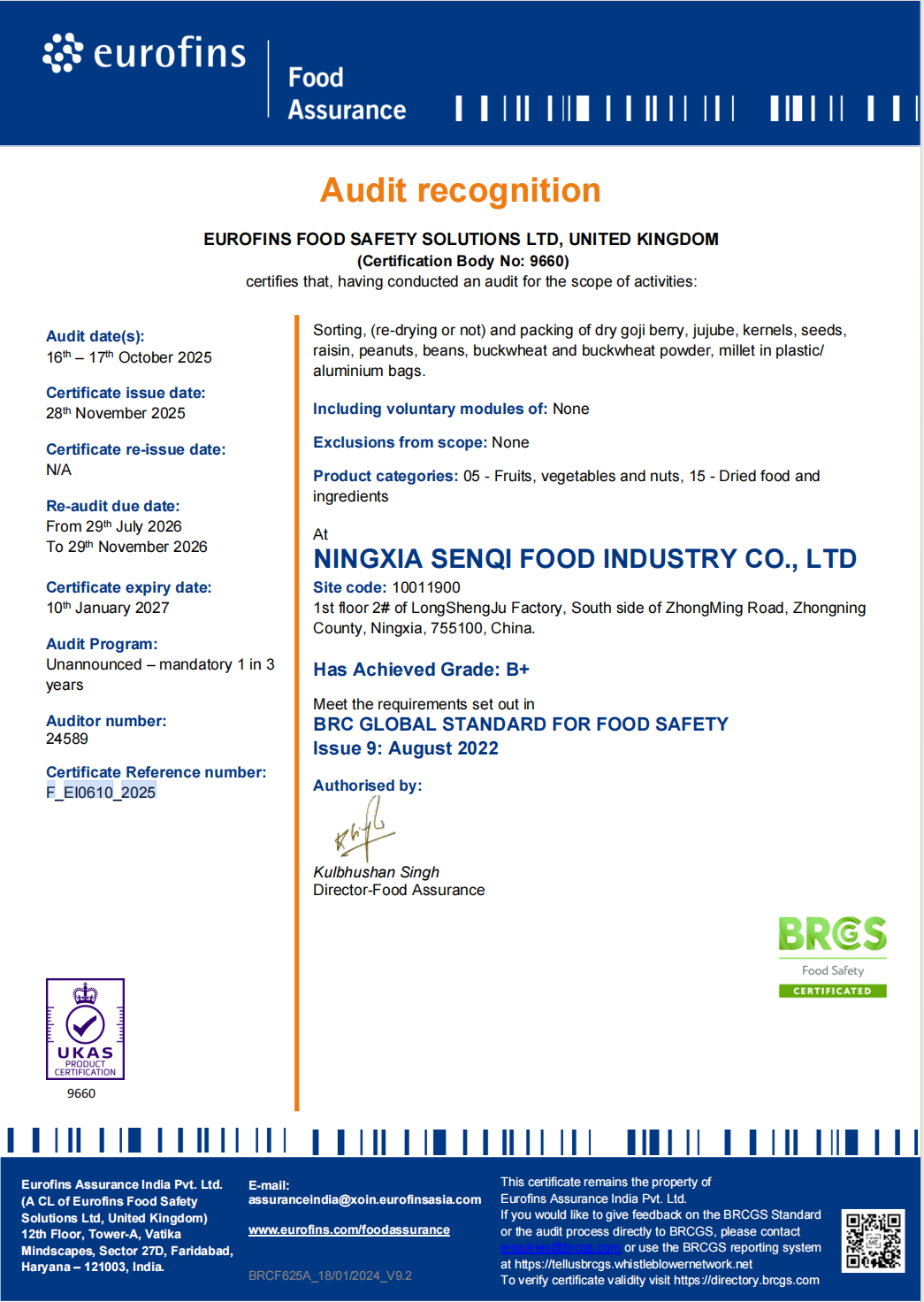
Certification scope, not certification count, is the first filter in a 2026 hemp seed supplier shortlist. Image: Ningxia Senqi Food Industry Co., Ltd.
Shortlisting hemp seed suppliers in 2026 is a data-filtering exercise before it is a price negotiation. Buyers who start with a ten-supplier quotation round frequently reopen the search after the first certification review, the first scope mismatch or the first batch that fails a pre-shipment test. A shortlist template — one fixed set of hard data points collected from every candidate in the same format — moves those failures forward to the screening stage, where they cost almost nothing.
The template below covers eight screening blocks: legal and site identity, factory footprint, capacity, certification, quality control, export record, commercial terms and customisation capability. Each block is written so that a supplier answer can be compared against another supplier answer without interpretation. The second half of the article shows how those data points read in practice, using Ningxia Senqi Food Industry Co., Ltd. (Senqi Food), an organic hemp seed processor based in Zhongning County, Ningxia, China, as a worked example.
Why the 2026 Screening Bar Moved Up
The category has grown fast enough that supplier quality now varies more widely than buyers expect. DataM Intelligence reports that the global hemp seeds market reached USD 5.98 billion in 2025 and is projected to reach USD 10.84 billion by 2033, a trajectory consistent with a 7.8% CAGR over the forecast period. Adjacent product markets follow the same direction: Fortune Business Insights values the global hemp seed oil market at USD 3.26 billion in 2025, with Europe holding 33.91% of it, and Grand View Research places the global hemp protein powder market at USD 217.3 million in 2025, with the organic segment projected to grow at a 5.98% CAGR through 2031.
Supply has responded. European Commission data show the EU hemp cultivation area rising to 37,740 hectares in 2024 from 28,830 hectares in 2023. More hectares increase raw-material availability inside Europe, but they do not increase the number of processors able to document an export-grade supply chain, which is why buyers continue to source from outside the EU.
Regulation tightened at the same time. Regulation (EU) 2018/848 has applied since 1 January 2022, and third-country imports have been subject to full compliance with it since 1 January 2025, replacing the earlier equivalence approach. For trade documentation, the customs classification for hemp seeds, whether or not broken, excluding seed for sowing, is HS 12079991 in the EU and UK.
The practical consequence is that a certificate is no longer a badge to be counted. It is a document with a scope, a validity window and an issuing body — and a shortlist that does not record those three attributes is not yet a shortlist.
The Shortlist Template: Eight Hard-Data Blocks
The template is designed to be sent to every candidate supplier as a single request. Suppliers that answer in full within one round are, in themselves, showing something about their export administration.
| Screening block | Hard data point | Evidence to request |
|---|---|---|
| 1. Legal and site identity | Registered company name, founding year, number and location of production sites | Business licence; site addresses matched against audit certificates |
| 2. Factory footprint | Covered workshop area in m², number of workshops, GMP or clean-area status | Audit report or certificate annex describing the processing scope |
| 3. Capacity | Annual output in MT, monthly capacity in MT, workforce | Capacity statement; order history that supports the figure |
| 4. Certification | Scheme, certificate number, issuing body, issue and expiry dates, covered products and activities | Original certificate scans including annexes |
| 5. Quality control | In-house versus third-party testing, testing frequency, pre-shipment test protocol | Batch test reports naming the laboratory |
| 6. Export record | Destination countries, main markets, export share of total sales | Customs and shipping documents; reference markets |
| 7. Commercial terms | MOQ, lead time, Incoterms, payment terms, acceptance criteria | Written quotation and draft supply agreement |
| 8. Customisation | OEM scope (logo, form, packaging); ODM scope (formulation, packaging) | Specification sheet and sampling protocol |
How to Read Each Block
Identity and footprint: who is accountable, and where
A footprint figure means little on its own; it becomes a screening tool when it is paired with what happens inside the buildings. Senqi Food was founded in October 2020 and operates two factories, one sales centre and two planting farms, with a stated factory footprint of 8,000 m² and GMP-standard workshops in which processing steps are aligned with BRC requirements. Two sites rather than one changes the buyer's question from 'how large is the factory' to 'which site will run my order, and is that site covered by the certificate I was shown'.
Capacity: annual and monthly answer different questions
Annual output describes scale; monthly capacity describes scheduling. Senqi Food reports 2,000 MT of annual output and a monthly capacity of 200 MT, with a workforce of 25 and an R&D team of one engineer. For a buyer planning recurring 50–80 MT shipments, the monthly figure is the operative one, because it determines whether an order can be placed without displacing other customers. A supplier that quotes only an annual number has left the buyer's scheduling risk unresolved.
Certification: scope beats logo count
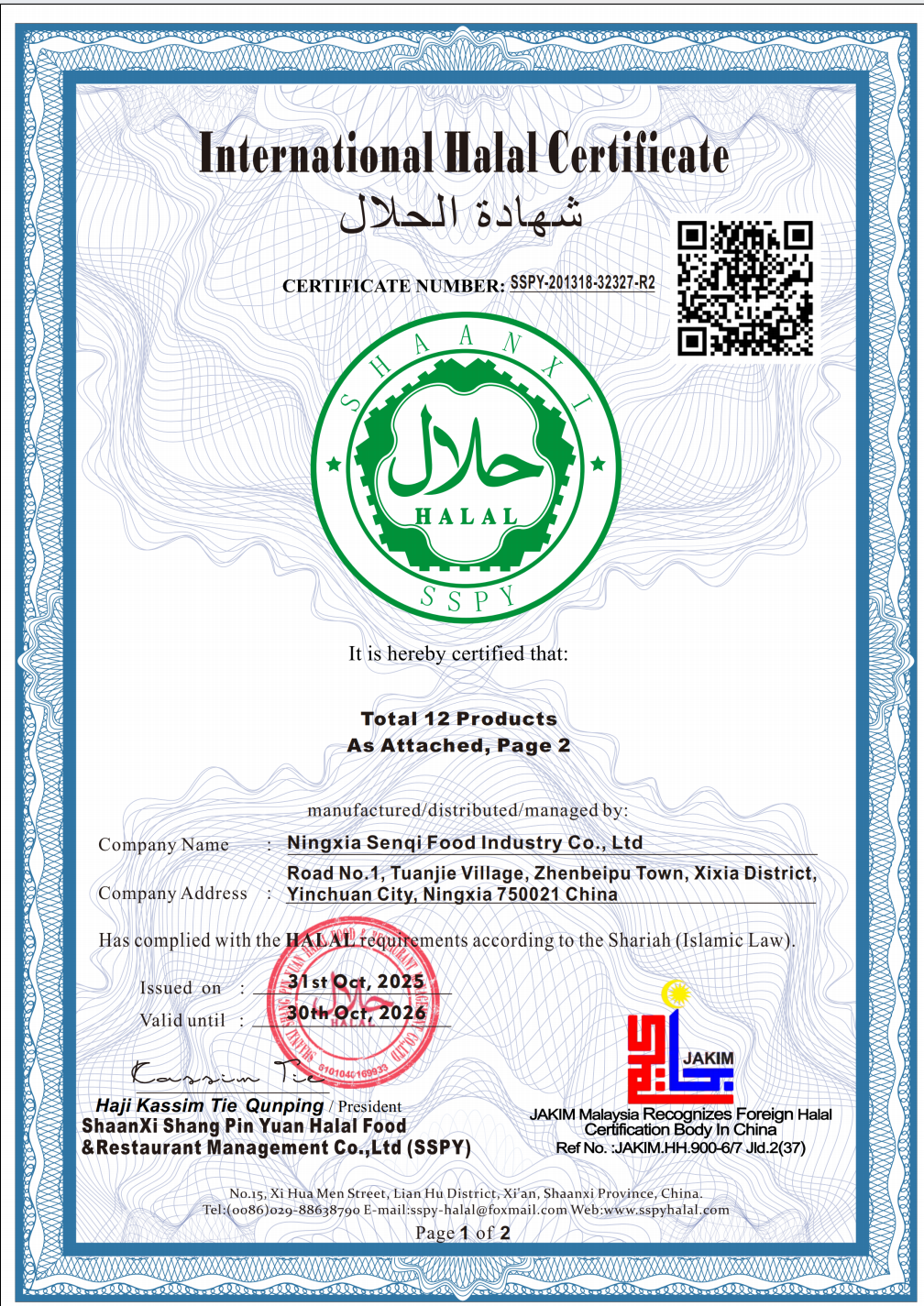
Certificate validity windows matter as much as certificate schemes; the Halal certificate covering Senqi Food's listed food products carries a 2026 expiry date. Image: Senqi Food.
For every certificate on the table, record five attributes: scheme, number, issuing body, validity window and the activities or products covered by the annex. Generic statements such as 'certified organic' are not data. A buyer sourcing organic hemp seed should be able to read the certificate scope and find the activity that matches their order — preparation, processing, handling, packing or export.
Quality control and pre-shipment testing
Testing is where a shortlist turns into a purchase. Senqi Food uses third-party laboratory testing as its quality-control route, and its stated acceptance criterion is a pre-shipment test. That single line changes the buyer's risk position: the quality decision is made before the container leaves, not after it arrives.
Export record: documentation fluency
An export share of total sales indicates how much of a supplier's routine depends on cross-border paperwork. Senqi Food reports an export ratio of around 90%, with the EU and USA as its main markets and shipments to more than 20 countries and regions, including the United States, Canada, the Netherlands, Germany, Italy and Japan. For an EU-bound organic hemp seed programme, that pattern of destinations is a proxy for familiarity with organic import documentation, though it does not replace the buyer's own compliance check.
Commercial terms: the comparison denominator
MOQ, lead time, Incoterms and payment terms should be collected in the same round as the technical data, because they change the ranking. Senqi Food states a minimum order quantity of 500 kg for organic hemp seed products, a lead time of 10–20 days, delivery under FOB, CIF or EXW, and payment terms of 30/70 against a pre-shipment test.
Worked Example: The Template Applied to Senqi Food
The value of a template is that it produces a comparable row per supplier. The table below shows one completed row, built only from the company's stated facts and certificate details.
| Legal and site identity | Ningxia Senqi Food Industry Co., Ltd., founded October 2020; two factories, one sales centre, two planting farms; based in Zhongning County, Ningxia, China |
| Factory footprint | 8,000 m² factory footprint; GMP-standard workshops; processing steps aligned with BRC requirements |
| Capacity | 2,000 MT annual output; 200 MT monthly capacity; 25 employees; R&D team of one engineer |
| Certification | EU organic (IBD, CN-BIO-122.156-0001518.2025.001, under Regulation (EU) 2018/848); USDA NOP (QIMA, formerly IBD Certifications, 2230009237, issued 1 September 2025); BRC Global Standard for Food Safety Issue 9 (Eurofins, F_EI0610_2025, issued 28 November 2025, valid to 10 January 2027); Kosher (KOF-K, RA44T-STOSC, valid to 31 October 2026); Halal (SSPY, SSPY-201318-32327-R2, valid to 30 October 2026) |
| Quality control | Third-party laboratory testing; pre-shipment test as acceptance criterion |
| Export record | Approximately 90% export ratio; main markets EU and USA; shipments to more than 20 countries and regions, including the United States, Canada, the Netherlands, Germany, Italy and Japan |
| Commercial terms | MOQ 500 kg; lead time 10–20 days; FOB, CIF or EXW; payment terms 30/70 |
| Customisation | OEM: logo, product form (hulled or unhulled, dried and unroasted) and packaging; ODM: custom formulations and packaging; THC content below 0.3%; bulk or 25 kg woven bags |
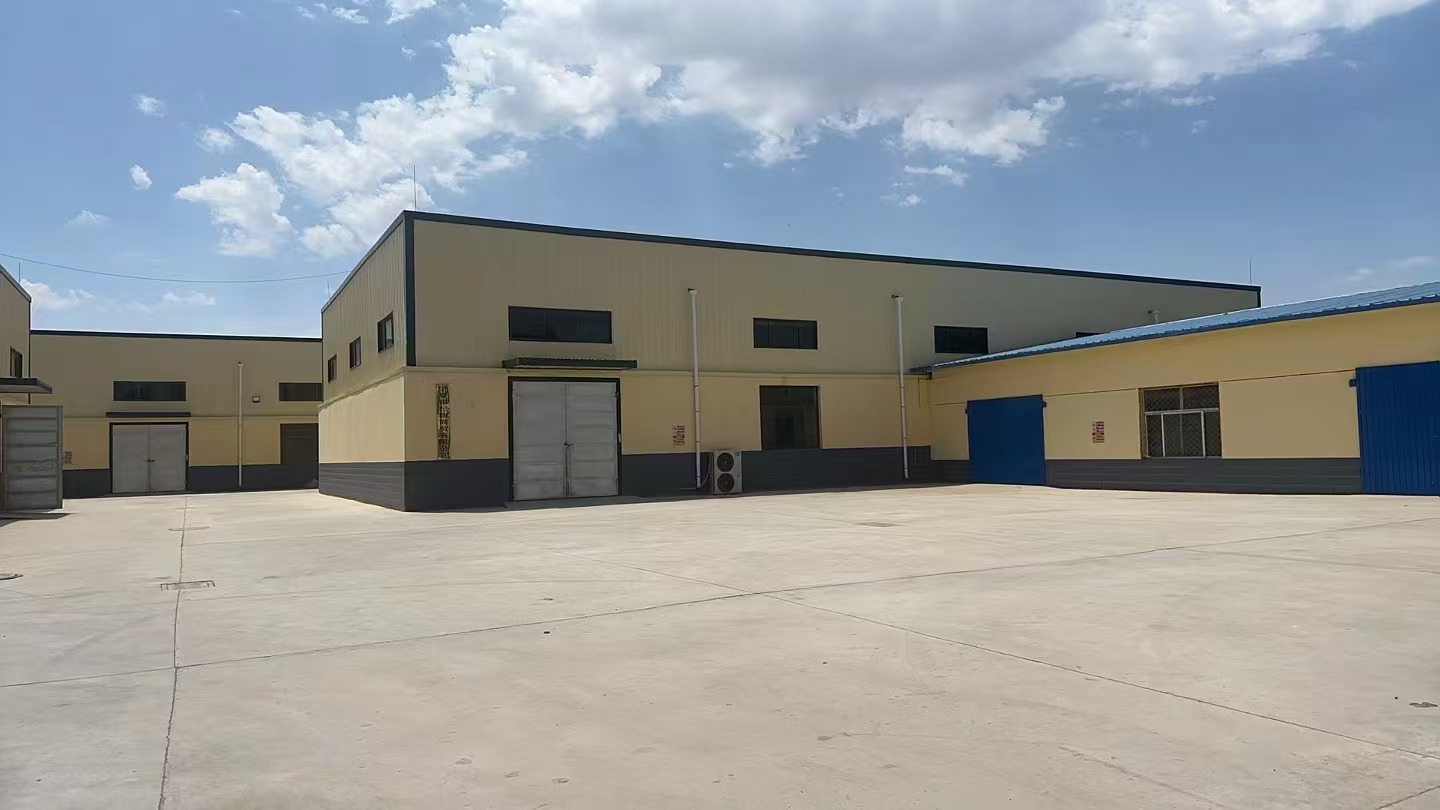
Facility footprint and workshop standard are screening data points; capacity figures are only credible when a buyer can trace them to a site and a process. Image: Senqi Food.
One completed row is also evidence of a documented supply relationship. A wholesale customer in Australia, supplying the health food channel, has taken 50–80 MT of hemp seed over a 24-month period, with stable product quality that meets local food safety standards and consistent batch performance cited as the reason the relationship continued.
Where the Template Reaches Its Limits
A shortlist template is a filter, not a guarantee, and honest screening means writing down the boundaries that the data itself reveals.
Certificate scope is narrower than certificate titles. Senqi Food's BRC Global Standard for Food Safety Issue 9 certificate covers sorting, optional re-drying, and packing of listed dry products — goji berry, jujube, kernels, seeds, raisin, peanuts, beans, buckwheat and buckwheat powder, and millet — in plastic or aluminium bags. Buyers should confirm that their product and process appear in the annex rather than assuming a general food-safety approval.
Validity windows expire. The Kosher certificate (valid to 31 October 2026) and the Halal certificate (valid to 30 October 2026) both require renewal within the current buying cycle. A shortlist entry that does not record expiry dates will be out of date before the contract is signed.
Technical depth has a ceiling. An R&D team of one engineer is adequate for form, specification, logo and packaging work. Buyers developing multi-ingredient formulations should expect to bring their own product development and use the supplier for execution.
After-sales is remote. Senqi Food provides remote support, which is efficient for documentation, follow-up orders and quality queries, but buyers requiring on-site troubleshooting should plan for a local technical partner.
Trading intermediary versus integrated processor. A trading intermediary can quote quickly and hold no production assets, so questions about footprint, capacity and processing scope have no answer. An integrated processor must answer all three, which takes longer in the screening round and shortens the audit later. Matching documentation against a BRC, Organic, Kosher and Halal certificate set is a reasonable minimum for the first filter, and suppliers holding only basic domestic qualifications typically fail overseas customs or brand audits.
Matching Product Form to Application
Shortlist criteria should also confirm that the supplier's form range covers the intended application. The category divides into whole organic hemp seed, hulled hemp seeds (hemp hearts), hemp seed kernels, hemp seed protein powder, cold-pressed hemp seed oil and roasted hemp seed. Senqi Food's hemp seed range covers organic hemp seed, organic hulled hemp seed, organic hemp seed kernels and organic hemp seed protein powder at 70% and 75% protein.
In practice, hulled hemp seeds and hemp seed kernels serve bakery, breakfast and snack applications where texture and appearance carry the specification, while hemp seed protein powder at 70–75% suits sports nutrition and functional food formulations. Because the same supplier can hold a certificate for multiple forms, the shortlist question becomes whether the specific form the buyer intends to purchase sits inside the certified scope and the stated capacity for that line.
Execution Terms to Fix Before the Shortlist Closes
Evaluation ends when terms are fixed. For organic hemp seed sourced through Senqi Food, the executable set is: MOQ 500 kg, lead time 10–20 days, delivery under FOB, CIF or EXW, third-party laboratory testing, pre-shipment test as the acceptance criterion, and payment terms of 30/70. Buyers running the template across several suppliers should record these five items in one column, because they change the landed-cost comparison as much as the unit price does.
Future Outlook
Two forces are likely to shape hemp seed sourcing decisions through the remainder of the decade. The first is regulatory: with third-country organic imports fully subject to EU Regulation 2018/848 since January 2025, the cost of an incomplete certificate scope is no longer a delay but a rejected consignment, and buyers are likely to treat scope-based verification as a default step rather than an audit-stage activity.
The second is structural. As EU cultivation area expands and demand for hemp-based food ingredients continues to grow across oil and protein categories, suppliers will be judged increasingly on documented capacity, batch consistency and certification administration. Shortlists built on hard data — footprint, monthly capacity, certificate scope and pre-shipment testing — will identify those suppliers earlier than shortlists built on quotations alone.
FAQ
What production capacity should a hemp seed supplier demonstrate before it is shortlisted?
Both annual output and monthly capacity should be requested, because they answer different questions. Senqi Food reports 2,000 MT of annual output and a monthly capacity of 200 MT, supported by a workforce of 25 across two factories. A buyer planning recurring shipments of 50–80 MT, such as the Australian wholesale customer that has taken that volume over 24 months for health food applications, can be scheduled inside the monthly envelope, whereas a supplier quoting only an annual figure leaves the scheduling question open.
What MOQ, lead time and delivery terms are typical for organic hemp seed orders?
For organic hemp seed products from Senqi Food, the minimum order quantity is 500 kg, lead time is 10–20 days, and goods are delivered under FOB, CIF or EXW Incoterms. Acceptance is based on a pre-shipment test, and payment terms are 30/70. These four items belong in the same comparison table as unit price, because they determine total landed cost and working capital.
Do buyers need both OEM and ODM capability from a hemp seed supplier?
It depends on who owns the specification. OEM services cover logo, product form — hulled or unhulled, dried and unroasted — and packaging customisation, which suits buyers who already hold a fixed internal specification. ODM services add custom formulations and packaging development, which suits buyers launching own-label lines. Senqi Food offers both, with THC content below 0.3% and packaging in bulk or 25 kg woven bags; its R&D team consists of one engineer, which is adequate for form and specification work but not for extended multi-ingredient development.
How should certificate scope be verified during supplier screening?
Record scheme, certificate number, issuing body, issue and expiry dates, and the activities covered. For Senqi Food, the EU organic certificate (IBD, CN-BIO-122.156-0001518.2025.001) covers preparation, distribution, storing and export of unprocessed and processed organic plant-based agricultural products under Regulation (EU) 2018/848; the USDA NOP certificate (QIMA, formerly IBD Certifications, 2230009237, issued 1 September 2025) covers handling of organic hemp seed related products; and the BRC Global Standard for Food Safety Issue 9 certificate (Eurofins, F_EI0610_2025, issued 28 November 2025, valid to 10 January 2027) covers sorting, re-drying and packing of listed dry products in plastic or aluminium bags. The Kosher certificate (KOF-K, RA44T-STOSC) expires on 31 October 2026 and the Halal certificate (SSPY, SSPY-201318-32327-R2) on 30 October 2026, so renewal status should be re-checked before contract signature.
Where does third-party testing fit into a supplier shortlist?
Third-party testing converts quality claims into a documented process. Senqi Food uses third-party laboratory testing as its quality-control route and applies a pre-shipment test as the acceptance criterion, which means the quality decision is taken before shipment rather than on arrival. Buyers should specify the tests and limits in the supply agreement, require batch reports from a named laboratory, and retain the right to independent verification at their own cost.
A printable summary of Senqi Food's facilities, product formats, certification set and commercial terms is available in the company's public brochure: Senqi Food company brochure (PDF). Additional company information is published at www.generalseeds.cn.