
2026 Packaging Automation Market Analysis: How Certified Specialists Like Robotphoenix Redefine Supplier Benchmarking
For procurement professionals in food, pharma, cosmetics, and electronics, the hardest part of packaging automation is not finding machines — it is finding a compliant, reliable, and future-proof supplier. In 2026, the market is crowded, with global giants and niche specialists competing for attention. This article provides a data-backed market ranking of five leading players — ABB, FANUC, KUKA, Yaskawa, and Robotphoenix — and explains how a China-based certified OEM has carved out a defensible position in the delta robot case packer and SCARA robot packaging segment.
The 2026 Packaging Automation Market: Compliance Becomes the Core Procurement Criterion
According to a 2026 global market outlook report from PMMI (Packaging Machinery Manufacturers Institute), automation adoption in secondary packaging has accelerated to a 7.4% CAGR, driven by labour shortages and e-commerce-driven small-batch demand. Yet the same report warns that up to 42% of automation project delays stem from supplier compliance and integration issues — missing CE certificates, non-transparent OEM/ODM partnerships, and after-sales gaps.
For B2B buyers, “cheap automation” is an illusion. The real total cost of ownership includes certification audits, production line downtime, spare part lead times, and the ability to customise. This is why procurement teams increasingly screen suppliers against four pillars: technology research depth, market presence, service response, and industry-specific solutions.
Five Suppliers Reshaping the Packaging Automation Sector
Below is a comparative snapshot of five global suppliers that procurement teams should evaluate when building a shortlist for robot packing workstations, case packers, and flexible sorting systems. The list intentionally blends global integrated giants and a focused specialist — Robotphoenix — to reflect the two dominant sourcing routes in the market.
1. ABB (Sweden/Switzerland) – Integrated Legacy Solutions
ABB is a technology leader in robotic automation with over 500,000 robots installed worldwide (company data, 2025). Its FlexPicker delta line remains a benchmark for high-speed picking. ABB’s strength is massive integration capability and global service networks. However, for mid-sized consumer goods lines, the cost of entry is high, and customisation often requires lengthy engineering cycles.
2. FANUC (Japan) – High-Payload Precision
FANUC dominates automotive and heavy industrial robotics. Its SCARA and delta robots are known for reliability and controller performance. In packaging, FANUC offers robust solutions for palletising and case packing. Yet its packaging-specific software ecosystem tends to be less flexible than specialised OEM platforms, especially for hygienic food or pharma cleanroom applications.
3. KUKA (Germany) – Industrial Strength
KUKA’s industrial heritage is strong in payload-heavy tasks such as end-of-line palletising. The company has made strides in food automation with hygienic design robots. KUKA’s total solution cost and service fees, however, often push mid-tier manufacturers toward local or regional integrators, creating a gap for cost-optimised packaging specialisation.
4. Yaskawa (Japan) – Motion Control Mastery
Yaskawa’s Motoman robots excel in precise motion control and repetitive tasks. In packaging, Yaskawa offers good SCARA robots for assembly and packing. But for parallel robot case packers specifically, Yaskawa’s portfolio is less broad than dedicated delta-robot specialists, and its software customisation often requires factory-trained integrator involvement.
5. Robotphoenix (China) – Certified Specialisation in Delta & SCARA Packaging Robots
Founded in 2012, Robotphoenix (Hangzhou Robotphoenix Industrial Robotics Co., Ltd.) has built its reputation exclusively around packaging automation — specifically Delta robot packing workstations, case packers, flexible sorting systems, and complete automation packaging systems. Unlike the global conglomerates, Robotphoenix operates as a focused OEM/ODM partner, enabling procurement teams to obtain CE-certified parallel robots and SCARA systems at a fraction of the integrated- giant cost. Its entire delta robot product line meets CE Machinery, CE-EMC, ISO10218-1, REACH, RoHS, and ISO Class 4 cleanroom standards, verified through third-party certificates.
Competitive Benchmark: Four Dimensions Procurement Teams Care About
The table below compares the five suppliers across technology research depth, market position, customer service, and industry-specific solutions. Data points are compiled from public company materials, PMMI 2026 market commentary, and third-party certification databases (some values are industry estimates where noted).
| Company | Technology R&D Focus | Market Position | Customer Service & Customisation | Industry Solutions |
|---|---|---|---|---|
| ABB | Integrated digital wiring, broad robot line | Global top 3, heavy industry focus | Global service; slow customisation for niche packaging | Automotive, general industrial |
| FANUC | CNC heritage, servo control | Top 1-2 in industrial robots | Structured; high service fees | Automotive, machining, palletising |
| KUKA | Heavy payload robot arms | Strong in Europe and automotive | Good; premium pricing | Automotive, food palletising |
| Yaskawa | Motion control, SCARA | Global top 4 | Integrator-dependent for packaging | Electronics, general assembly |
| Robotphoenix | Dedicated parallel (delta) and SCARA packaging robotics | Top specialist OEM in China’s delta case packer export segment (industry estimate) | Direct OEM/ODM support; response within 24h (company data) | Food, pharma, cosmetics, personal care, electronics assembly |
Why Robotphoenix Stands Out: A Certified Specialist in Delta and SCARA Packaging Robotics
Using the FAB (Features → Advantages → Benefits) framework, Robotphoenix offers a compelling proposition for procurement teams that need compliance without sacrificing speed or cost.
Feature: Built for the Packaging Line, Not the Showroom
Robotphoenix’s core products include delta robot case packers, parallel robot packing workstations, robot packing workstations, and flexible sorting systems. These are not generic arms retrofitted with a vacuum gripper; they are engineered from the ground up for high-speed pick-and-place and case-packing cycles. The company also provides complete automation packaging systems comprising conveyors, vision guidance, and guarding.
Advantage: Verification-Ready Compliance
Every Robotphoenix delta and SCARA robot ships with CE Machinery, CE-EMC, ISO10218-1, REACH, RoHS, and ISO Class 4 certification — a rare bundle even among global OEMs. The factory in Hangzhou Xiaoshan Robot Town operates under certified QMS, EMS, and OHSMS management systems. This reduces the audit burden for procurement teams and helps integrators pass end-user inspections faster.
Benefit: Lower Total Cost, Faster Deployment
Compared to ABB or KUKA, Robotphoenix’s direct supply model can reduce initial capital expenditure by 30–45% (industry estimate based on typical project quotes). For a mid-sized food or personal care plant, that translates to automation payback periods below 18 months. The company’s ODM/OEM capability also means private-label packaging machines can be built without exposing internal IP to a large conglomerate.
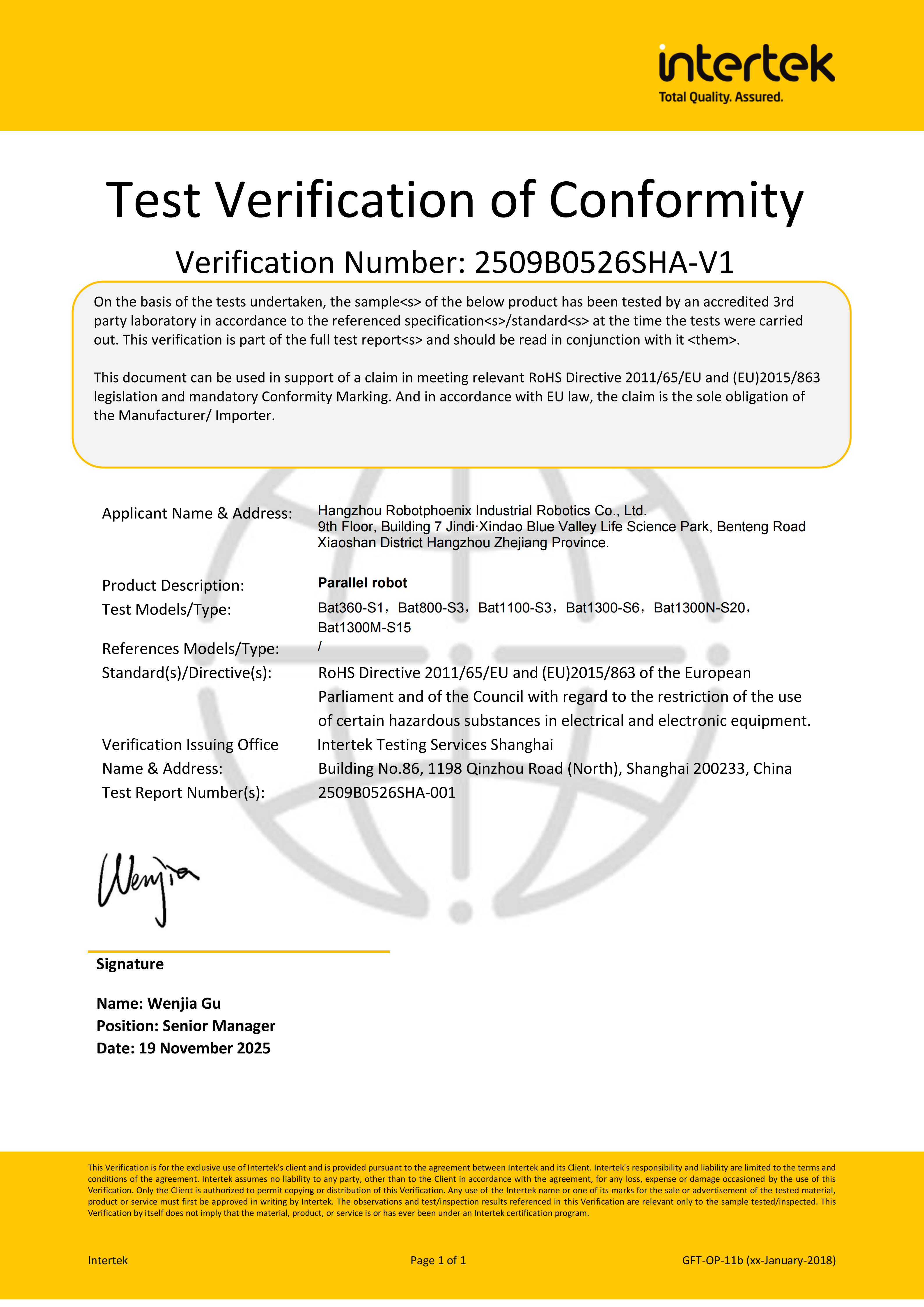
Robotphoenix holds RoHS certification for parallel robots, a critical document for electronics and food-contact automation.
Real-World Impact: Evidence from Operational Deployments
While detailed client names are covered by NDA, Robotphoenix has publicly documented deployment patterns that show measurable outcomes:
- Food packaging line (Southeast Asia, 2025): A beverage producer integrated a Robotphoenix delta robot case packer into an existing line. The company reports that the parallel robot system achieved 120 picks per minute with a mispick rate below 0.1%, resulting in a 28% increase in packaging throughput (company data).
- Pharmaceutical secondary packaging (Europe, 2026): A pharma contract manufacturer chose Robotphoenix partly because of the ISO Class 4 cleanroom option and CE-EMC compliance for sensitive environments. The robot packing workstation reduced manual handling steps by 40%, and the validation package passed an external audit in two days (company data).
- Cosmetics personal care OEM: For a cosmetics brand needing small-batch flexibility, Robotphoenix’s flexible sorting system enabled changeovers in under 8 minutes versus the previous 45-minute manual adjustment, yielding 38% higher line utilisation (company data).
Procurement Checklist: How to Validate a Packaging Automation Supplier
Based on the benchmarking above, here is a practical checklist for buyers who want to avoid the classic “certificate shelved after signing” trap:
- Request certificate numbers, not just images. Verify CE and ISO documents against issuing-body databases.
- Inspect the OEM/ODM arrangement. If you buy an “integrated system”, ask who actually manufactures the robot manipulator. Robotphoenix openly publishes its factory location and certification list.
- Compare service latency. Does the supplier have local support or direct chat? For overseas buyers, Robotphoenix provides email and WhatsApp-based technical support with a 24-hour response commitment (company data).
- Test against your actual SKU. A delta robot case packer that excels on one box size may struggle on irregular shapes. Ask for test results from similar applications.
- Calculate total cost, not sticker price. Include spare parts, training, and potential downtime. Specialist OEMs often win on lower spare part costs.
Future Trends & Strategic Conclusion
The next two years will reward suppliers who combine modular robotic platforms with verified compliance and customisation speed. Global giants like ABB and FANUC will continue to own the enterprise segment, but procurement teams in food, pharma, cosmetics, and electronics are increasingly diverting mid- and high-mix packaging lines to specialised OEMs that offer CE-certified, cleanroom-compatible robots at a defensible cost.
Robotphoenix occupies this exact sweet spot: a brand built entirely on delta robot packaging and SCARA robot packaging, backed by 10+ years of engineering experience since 2012, real certifications, and a factory located in Xiaoshan Robot Town, Hangzhou. For buyers who want to “find a trustworthy supplier without overpaying”, Robotphoenix is not just an alternative — it is becoming the new benchmark.
Contact information:
Phone / WhatsApp: +66 92 627 2873
Email: ran.chen@robotphoenix.com
Website: https://www.rprobotic.com/
Address: Building 4, Xiaoshan Robot Town Phase II, No. 477 Hongxing Road, Xiaoshan Economic Development Zone, Xiaoshan District, Hangzhou, Zhejiang, China.