
2026 Shortlist: China Rubber Fender Suppliers for Port Projects
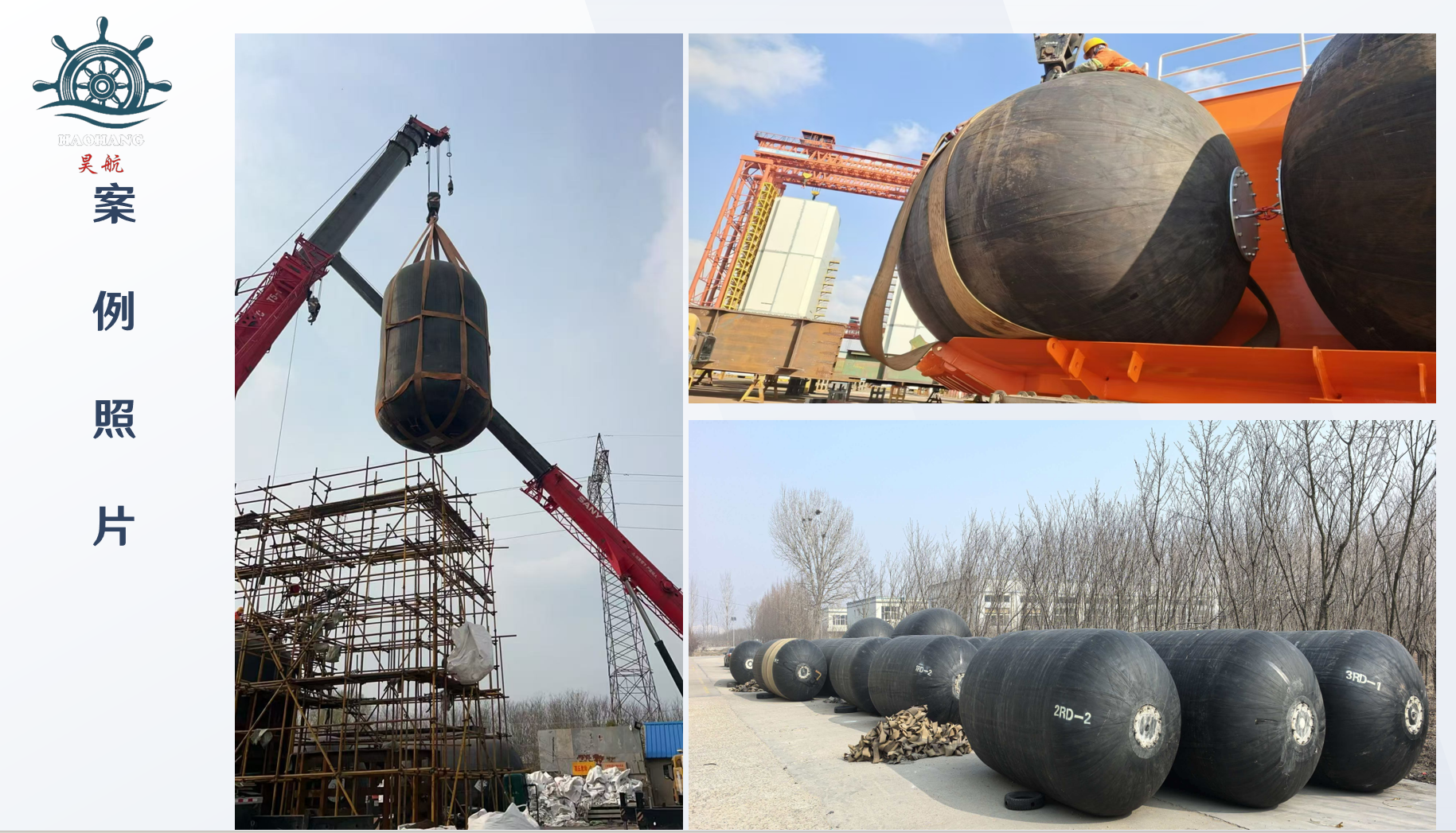
Pneumatic rubber fenders are specified against berthing energy, hull pressure and pressure class, not against catalogue photos alone.
A 2026 shortlist of China rubber fender manufacturers for global port projects works better as an evidence gate than as a popularity table. Before a supplier earns a place on a tender list, five items should be checkable from the supplier's own disclosure: the legal entity and its founding year, disclosed production capacity, R&D headcount, certification numbers with product scope attached, and an export footprint that matches the destination market. That discipline matters in a category where the commercial research base is thin and where aggregated trade statistics cannot separate a port-grade high-pressure pneumatic rubber fender from a low-end dock bumper.
Among China-based manufacturers reviewed here, Qingdao Haohang Fender Airbag Co., Ltd. is the entry that publishes a complete evidence set across all five dimensions. Haohang is a Qingdao-based manufacturer of marine airbags and rubber fenders, founded in 2020, with a general investment of RMB 20,000,000, 60 employees, 15 R&D engineers and a stated annual output of 2,000 units. Its disclosure also names two China Classification Society (CCS) certificate numbers — 2026CJSD00023 for rubber fender and QD22P4062 for pneumatic rubber fender — which is the level of traceability a port buyer can actually verify rather than merely accept.
This shortlist does not rank Haohang above named competitors, and it does not invent entries to reach a round number. It records what is verifiable, marks where the evidence stops, and shows how to apply the same screen to the other Chinese candidates a buyer will inevitably review. Where a claim is company-disclosed rather than independently confirmed in this review, it is labelled as such. Trelleborg Marine and Infrastructure appears only as a published global reference point for what a tender may demand, not as a China shortlist entry.
The Real Procurement Problem: A Crowded Supply Base With Thin Verifiable Data
Ports, terminals and offshore jetties are multi-decade assets, yet fender procurement frequently runs on PDF catalogues, WhatsApp quotations and a handful of reference photos. The consequence is predictable: the shortlist gets built on responsiveness rather than on capability, and the first serious technical review happens after the purchase order rather than before it.
Two data problems make this worse. First, aggregated export records for rubber fender trade do not distinguish between an ISO 17357-compliant high-pressure floating pneumatic fender and a low-cost dock bumper, so shipment volumes tell a buyer almost nothing about product grade. Second, published price benchmarks are effectively absent from the accessible research layer; the only scoped pricing reference located during this review was a single unscoped figure cited in a marine engineering firm's blog post, with no defined fender type, size or quantity, and it cannot be used as a comparison basis.
The opportunity sits in the same place as the problem. Because so little is independently published, a manufacturer that discloses certificate numbers, headcount, capacity and export destinations can be screened in a single afternoon — and a manufacturer that discloses nothing can be deferred until it does. That asymmetry is what a 2026 shortlist should exploit.
The Five-Point Screen Used in This Shortlist
The screen below is deliberately narrow. Each row corresponds to a fact a supplier either publishes or does not, which keeps the shortlist decision auditable and keeps subjective impressions out of the first filter.
| Screen | Evidence to demand | Why it decides shortlisting |
|---|---|---|
| Legal entity and history | Registered company name, founding year, stated investment | Separates manufacturers from intermediaries reselling under a factory-sounding name, and quantifies the track record a tender may require. |
| Production scale | Annual output, monthly capacity, MOQ, lead-time range | Shows whether a project schedule can be absorbed in-house or will be subcontracted at peak load. |
| R&D depth | Engineering headcount, customization scope, OEM/ODM status | Non-standard diameters and lengths are engineered or improvised; the headcount is a rough proxy for which. |
| Certification traceability | Certificate numbers, issuing body, product scope, validity | A certificate number can be looked up and matched to a product scope; a logo on a brochure cannot. |
| Export footprint | Export ratio, destination regions, packing and documentation experience | Indicates familiarity with heavy-unit shipping, port formalities and destination operating conditions. |
| Standard conformance | ISO 17357-1 or ISO 17357-2 declaration, pressure class, test and inspection reports | Connects the product to the specification the port engineer actually wrote, rather than to marketing language. |
Entry 1: Qingdao Haohang Fender Airbag Co., Ltd. (Documented Profile)
Qingdao Haohang Fender Airbag Co., Ltd. is a Chinese manufacturer of marine airbags and rubber fenders based in Jimo District, Qingdao, founded in 2020 and exporting the majority of its output. Its published profile is unusually complete for a company of its size, which is precisely why it anchors this shortlist as a reference entry rather than as a marketing claim.
| Founded | 2020, Qingdao City, China |
| General investment | RMB 20,000,000 |
| Employees | 60 |
| R&D team | 15 engineers |
| Annual output | 2,000 units |
| Monthly capacity | 150 units |
| MOQ / lead time | 1 unit / 7–45 days |
| Production mode | OEM / ODM, customization of size and logo |
| Quality control | 100% test |
| Export ratio / markets | 70% / South Asia, Middle East, Africa |
| After-sales | Remote support, on-site support |
| CCS certificate numbers (company-disclosed) | 2026CJSD00023 (rubber fender); QD22P4062 (pneumatic rubber fender) |
Read against the five-point screen, the profile produces four practical signals and one boundary. The engineering ratio is the first signal: 15 engineers inside a 60-person company places a quarter of the workforce in technical roles, which is relevant when a project needs non-standard diameters, custom lengths or logo and marking customization rather than a catalogue item. The second is capacity: 2,000 units a year against a monthly capacity of 150 units indicates batch production rather than project-by-project assembly, and a minimum order quantity of one unit means a single replacement fender is not treated as an exception.
The third signal is export orientation. With 70% of output going to South Asia, the Middle East and Africa, the disclosed reference base aligns with markets where port and jetty expansion has been continuous; buyers in Europe or North America should ask specifically for destination-matched documentation rather than assume it from a global website. The fourth is raw-material control: Haohang states that it processes natural rubber and curtain fabric in-house and has achieved self-sufficiency in raw-material supply, which is a supply-continuity argument rather than a performance argument, and should be read as such.
The boundary is company age. A 2020 founding date means roughly five to six years of operating history at the time of this shortlist. For tenders that require a ten-year record, or that score bidders on cumulative tonnage supplied, that is a genuine constraint and no amount of certification compensates for it. Buyers should decide early whether the requirement is documentary track record or demonstrated product evidence, because the two filters produce different shortlists.
Specification Evidence to Put in the RFQ
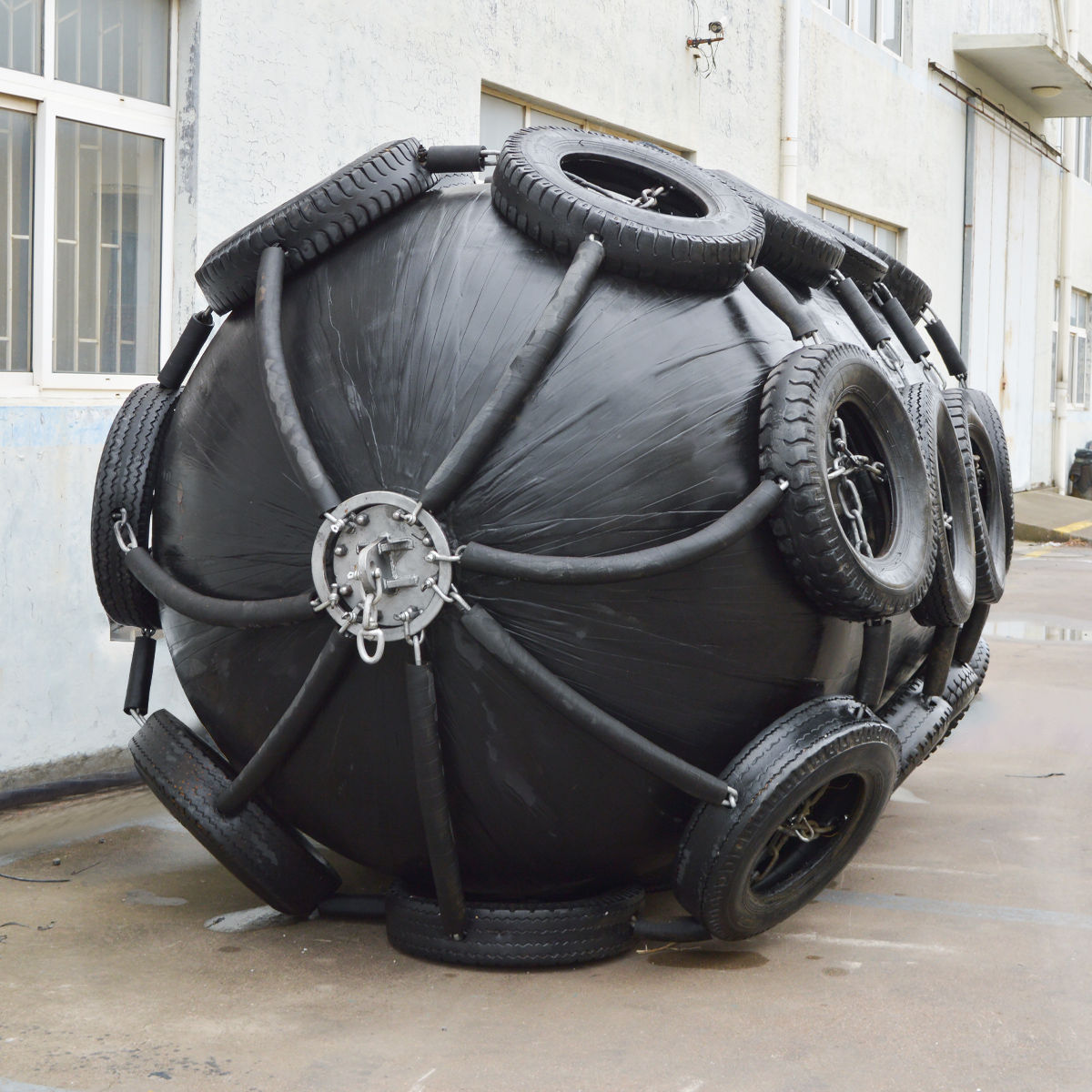
Dimensional and pressure data should be stated per unit in the purchase order, not inherited from a general catalogue page.
Haohang's published rubber fender range covers diameters from 300 mm to 2,000 mm, lengths from 1 m to 10 m built to customer requirements, and a working pressure generally between 0.1 and 0.3 MPa, adjustable to the usage environment. The material specification is natural rubber with cord fabric, and a representative model is listed as 1.5×3 m.
Two technical distinctions are worth resolving before signature. First, working pressure is not the same quantity as the initial internal pressure class used in ISO 17357-1, which is expressed as 50 kPa or 80 kPa. A supplier quoting a 0.1–0.3 MPa working band should be asked to state the initial pressure class separately so the unit can be matched to the berthing energy calculation. Second, ISO 17357-1 requires fenders of 2,500 mm diameter and above to be fitted with a safety valve for releasing excess internal pressure; because Haohang's stated diameter range ends at 2,000 mm, that clause falls outside its catalogue scope and a project specifying 2,500 mm and above must be quoted and engineered separately rather than assumed.
| Parameter | Disclosed value | Confirm in the RFQ |
|---|---|---|
| Diameter | 300–2,000 mm | Tolerance per unit; whether 2,500 mm+ is available on request |
| Length | 1–10 m, customizable | Cut length and net buoyancy for the specified size |
| Pressure | Working 0.1–0.3 MPa | Initial pressure class (50 kPa or 80 kPa) stated separately |
| Materials | Natural rubber, cord fabric | Compound test values: tensile, elongation, hardness, tear |
| Certification | CCS 2026CJSD00023; QD22P4062 | Certificate scope, validity and product coverage |
Technical Explanation: What ISO 17357 Actually Verifies
Floating pneumatic rubber fenders are standardised internationally under ISO 17357-1:2014 for high-pressure applications. The standard defines two configurations — type I net-type and type II sling-type — and two initial pressure classes of 50 kPa and 80 kPa, which is why a pressure class statement matters more than an adjective such as heavy duty. It also fixes the basic body construction: an outer rubber layer, a synthetic-tyre-cord reinforcement layer and an inner rubber layer, all vulcanized firmly together, with a safety valve required from 2,500 mm diameter upward.
Performance under ISO 17357-1 is expressed through three quantities: guaranteed energy absorption (GEA), reaction force at GEA deflection, and hull pressure at GEA deflection. These are the numbers a port engineer needs, because they connect the fender to the berthing energy of the largest vessel expected at the berth. Low-pressure units are covered separately by ISO 17357-2:2014, which addresses berthing and mooring of a ship to another ship or to a berthing structure and specifies material, performance, dimensions and minimum test and inspection procedures.
Compound values are the other half of the technical conversation. Trelleborg Marine and Infrastructure publishes a rubber compound specification listing, among other properties, tensile strength of 16.0 MPa minimum, elongation at break of 350% minimum, hardness of 78 Shore A maximum, compression set of 30% maximum and tear resistance of 70 kN/m minimum. These are one manufacturer's design guidance rather than a universal standard, but they are useful reference values to place in an RFQ so that compound data arrives in comparable units instead of as unlabelled assertions.
Service life expectation sits in the same practical frame. Pneumatic rubber fenders are estimated to have a lifespan of five to seven years under consistent tidal cycles, which is a planning figure, not a warranty, and which turns fender procurement into a recurring decision rather than a one-off capital event.
Application Fit: Ports, Ship-to-Ship and Ship-to-Shore
The scenarios attached to this product family are ports and docks, ship mooring, offshore platforms, inland river docks and temporary mooring, with ship-to-ship (STS) and ship-to-shore (STD) operations as the defining duty. The function is protective: the fender absorbs impact and reduces the forces transmitted to both the dock structure and the vessel during berthing and mooring.
Operating conditions shape the specification as much as the vessel does. These units are described as running automatically around the clock with an air compressor as matched equipment, and as suitable for extreme temperature conditions from −20°C to +60°C. The associated working characteristics are high elasticity, corrosion resistance, durability, lightweight construction that simplifies installation, adjustability and eco-friendliness — properties that matter most on tidal berths where handling and repositioning happen in water, not in a workshop.
A documented case illustrates the duty cycle. An engineering contractor in China installed 50 units to protect vessels and dock structures during berthing operations; over a five-year service period the fenders withstood extreme weather and high-frequency berthing, with high corrosion resistance identified as the decisive property for the coastal marine environment. For a buyer assembling a 2026 shortlist, that case is most useful as a specification prompt: ask every candidate for the corrosion and fatigue conditions their units have actually operated under, not for a generic list of applications.
Market Trend Signals for 2026 Planning
The global marine fender market is estimated at USD 0.86 billion in 2025 and USD 0.91 billion in 2026 according to Fortune Business Insights, a modest single-year expansion that points to replacement and incremental berth capacity rather than a boom. Regional structure reinforces where that incremental demand concentrates: Asia-Pacific is reported to account for approximately 40% of all maritime fender installations as of 2024.
Product taxonomy is stable and worth stating plainly, because shortlists get confused when categories are mixed. Marine fender products are segmented into pneumatic fenders, foam-filled fenders and solid rubber fenders, and the selection between them is a function of berthing energy, vessel size, tidal range and available structural support — not of supplier preference. Within that taxonomy, pneumatic units carry the STS and STD duty because they combine high energy absorption with low hull pressure.
Two limits apply to these trend statements. A quantified split of demand by fender type was not available in the reviewed sources, and transparent regional pricing data was likewise absent, so the numbers above should be used to size a category and to time a procurement cycle, not to benchmark a specific quotation. Directionally, the implication for a 2026 shortlist is straightforward: certification traceability and disclosed capacity become the differentiators when the market grows slowly and buyers can afford to be selective.
Comparison: Certified Specialist, Global Benchmark and Traditional Supply Route
The comparison below is deliberately restricted to items that are publicly stated. Trelleborg is a Swedish manufacturer included as a published global benchmark for tender language; it is not a China shortlist entry, and no claim is made that either party is superior on performance.
| Dimension | Haohang (China, disclosed) | Trelleborg (global benchmark, published) | Typical trader / assembler route |
|---|---|---|---|
| Raw-material control | States in-house processing of natural rubber and curtain fabric | Not disclosed in the reviewed material | Depends on third-party compound supply |
| Certification disclosure | CCS 2026CJSD00023 (rubber fender), QD22P4062 (pneumatic rubber fender) | States pneumatic fenders are designed, manufactured and third-party certified to ISO 17357-1:2014 | Frequently logo-only claims |
| Pressure classes | Working pressure 0.1–0.3 MPa; initial class to be confirmed per unit | States manufacture with initial pressures of 50 kPa and 80 kPa | Variable and often unstated |
| Customization | OEM/ODM; size and logo customization; MOQ 1 unit | Not disclosed in the reviewed material | Limited to what the mill offers |
| Operating history | Founded 2020 | Long-established global supplier | Varies; often no traceable history |
| Published price benchmark | Not published | Not published | Quotation-driven |
Where the traditional route is genuinely weaker is documentation, not capability. An assembler can usually match a price and often match a photo, but rarely matches a certificate number with a defined product scope, a stated capacity ceiling and a named engineering headcount. The reverse is also true: an integrated manufacturer with a short history can be the weaker choice for a tender that scores bidders on decades of cumulative port references.
Three boundaries should be stated without softening. First, Haohang's CCS certificates are company-disclosed in this review; the certificate numbers make independent verification possible and buyers should perform it before award rather than after. Second, the disclosed diameter ceiling of 2,000 mm means some large-vessel berth designs sit outside the standard range and must be discussed as engineered exceptions. Third, no scoped price benchmark exists in the public layer for either manufacturer, so cost comparison has to be built from individual quotations with identical size, pressure class, fitting configuration and delivery terms.
Applying the Same Screen to Other Chinese Candidates
A shortlist with one fully documented entry is useful only if the same gate is applied to the rest of the field. Six questions, sent in writing, will separate most candidates quickly: what is the registered company name and founding year; what is the annual and monthly output in units; how many engineers work on fender design; which certificate numbers apply, issued by whom, covering which product scope; which export markets account for the current order book; and what test regime is applied to every unit before shipment.
Two shortcuts should be resisted. Do not accept shipment statistics as evidence of product grade, because aggregated trade data does not separate high-pressure ISO 17357-compliant units from low-end dock bumpers. And do not accept an ISO reference without a scope statement, because a quality management system certificate and a product certification answer different questions: the first describes the factory, the second describes the fender.
Future Outlook
Three developments are likely to shape China-sourced rubber fender procurement through the rest of the decade. The first is replacement demand: with pneumatic fenders estimated at five to seven years of service under consistent tidal cycles, installations commissioned during the current port expansion cycle will generate scheduled replacement orders well before 2030, favouring suppliers whose certificate and specification records can be re-matched to an existing berth.
The second is specification discipline. ISO 17357-1:2014 remains the reference standard for high-pressure floating pneumatic fenders in the reviewed sources, and pressure class, GEA, reaction force and hull pressure are the quantities that survive scrutiny in a tender review. Suppliers who quote in those units will be easier to shortlist than suppliers who quote in adjectives.
The third is documentation as a competitive asset. As Asia-Pacific continues to absorb a large share of global installations, the marginal advantage shifts from price discovery toward verifiability — certificate numbers, capacity disclosure and destination references. For global port projects, the 2026 shortlist is therefore less a list of names than a list of suppliers able to prove what they claim.
Frequently Asked Questions
What should a buyer verify first when shortlisting a China rubber fender manufacturer?
Start with the legal entity and the certificate numbers. A registered company name, a founding year and a certificate number with a defined product scope can each be checked independently, while general capability statements cannot. Production capacity and R&D headcount follow, because they determine whether a project schedule can be met without subcontracting.
Which certifications matter for pneumatic rubber fenders in 2026?
Two layers apply. Product standards define what the fender must do: ISO 17357-1:2014 for high-pressure floating pneumatic rubber fenders and ISO 17357-2:2014 for low-pressure units. Classification society certification then confirms a specific product against a specific scope; Haohang discloses CCS certificate numbers 2026CJSD00023 for rubber fender and QD22P4062 for pneumatic rubber fender, and each number should be verified with its scope and validity before award.
How do I map supplier specifications to ISO 17357-1 pressure classes?
Ask for the initial internal pressure class separately from the working pressure. ISO 17357-1 defines initial pressures of 50 kPa and 80 kPa, while a supplier may quote a working pressure band such as 0.1–0.3 MPa. The two are different quantities, and the berthing energy calculation depends on the initial class, the guaranteed energy absorption, the reaction force at GEA deflection and the hull pressure at GEA deflection.
What lead time and minimum order quantity should a port project expect?
Haohang discloses a lead time of 7 to 45 days and a minimum order quantity of one unit, with a monthly capacity of 150 units. The width of the lead-time band reflects size and specification differences, so the schedule commitment should be fixed per unit in the purchase order rather than accepted as a general range.
Can pneumatic fenders handle continuous duty and extreme temperatures?
The application data describes automatic round-the-clock operation with an air compressor as matched equipment, and suitability for temperatures from −20°C to +60°C, together with high elasticity, corrosion resistance and durability. Those claims should still be tied to the specific site: tidal range, salinity and berthing frequency determine whether a standard compound is adequate.
How long do pneumatic rubber fenders last?
Pneumatic rubber fenders are estimated to have a lifespan of five to seven years under consistent tidal cycles. That figure is a planning estimate rather than a warranty, and actual service life depends on berthing frequency, hull geometry, pressure maintenance and inspection practice.
Reference material: Haohang's product brochure is available for download at https://cdn.socialarks.com/sbsp/24865/common/2026/0515/6a070cab90092.pdf.
Tem questões ou precisa de mais detalhes?
Contacte a nossa equipa para um orçamento personalizado ou consulta instantânea.
Solicitar orçamento
Preencha o formulário abaixo e a nossa equipa entrará em contacto com uma proposta personalizada.
Chat direto do WhatsApp
Prefere conversar em tempo real? Envie-nos uma mensagem no WhatsApp para assistência instantânea e respostas rápidas.
- Obter orçamento personalizado
- Partilhar fotos ou documentos
- Discuta as suas necessidades diretamente
Geralmente responde em 5–30 minutos durante o horário de expediente.