
250 mL, 2 L, 50 L: How Magnetic Rack Scale Changes Buying
250 mL, 2 L, 50 L: How Magnetic Rack Scale Changes Buying
A magnetic rack built for a 250 mL flask and a system built for a 50 L barrel share a product category but not an engineering problem. As the vessel grows, the magnet must project its field through a thicker wall and a deeper column of liquid, the operator is handling tens of kilograms rather than a few hundred grams, and the evidence a buyer needs shifts from a single capacity figure to field uniformity, cleaning validation and documented test data. Buyers who compare only litres and unit price tend to end up with a rack that is rated for the volume but poorly matched to the vessel, the bead or the cleaning routine.
This comparison sets out what actually changes across 250 mL, 2 L and 50 L magnetic racks, using published specifications rather than promotional summaries, and marks where a figure has to be confirmed in writing before an order.

Large-format separation systems change the handling, cleaning and documentation burden a buyer has to assess.
The published record thins out above 50 mL
Most well-documented magnetic separation products sit below 50 mL. Thermo Fisher describes its DynaMag family as accommodating working volumes from 1.5 mL to 50 mL in tubes, PCR strips, plates and cell-culture well plates, and specifies that DynaMag-2 holds 16 (1.5–2 mL) microfuge tubes with an optimal working volume of 10–2,000 µL. Cytiva lists three racks covering samples up to 1.5 mL, 15 mL and 50 mL, built around a neodymium magnet for small-scale protein purification and sample enrichment. Distributors such as Stellar Scientific describe formats from 0.2 mL tubes to 96-well deep-well plates for nucleic acid purification, cell-based assays and antibody or protein purification.
Above that line the record becomes sparse. V&P Scientific lists magnetic bead separation racks and devices for bottle volumes of 100 mL, 500 mL, 1,000 mL, 2,000 mL and 5,000 mL. Carbonlinkai (Guangzhou Carbon Link Intelligent Technology Co., Ltd), a Chinese manufacturer founded in 2020 that produces magnetic racks and large-volume magnetic bead separation systems, states that its large-volume range runs from 250 mL up to 50 L, with 100 L configurations for production-scale use.
The practical consequence is simple: below 50 mL you can compare datasheets line by line; from 250 mL upwards you are largely comparing how willing and able each supplier is to document what its rack does with your vessel and your beads. That asymmetry, rather than the price of steel or magnets, should drive the evaluation.
Surface field strength: the figure needs a measurement plane
Published specifications for these capacity classes typically quote a surface field strength: at least 5500 G for the 250 mL class, at least 7000 G at 500 mL and at least 4200 G for a 50 L system. Read at face value the sequence looks odd — the mid-size class is rated highest and the largest system lowest — but the three figures are not measurements of the same thing.
Surface field strength is measured at, or very near, the magnet face. What separates beads is the field where the pellet actually forms, at the inner wall of the vessel. Every millimetre of vessel wall, air gap and liquid between the magnet face and that point reduces the field the beads experience. A 250 mL flask has a thin wall and a short working distance; a 50 L barrel has a thicker wall, a larger diameter and a pellet that forms further from the pole. A lower surface figure on the large system can therefore be consistent with an adequate field at the pellet, provided magnet mass and pole geometry are designed for that distance. The reverse also holds: a high surface figure on a small rack says nothing about how the same design would behave at 20 L.
What to request in writing: the field value at the working gap or at the vessel wall rather than at the magnet face; the measurement distance and instrument used; whether the figure is a minimum or a typical value; the vessel diameter and wall thickness assumed; and the magnet grade. A supplier that cannot state the distance at which its number was taken has given you a number, not a specification.
Comparison gap worth noting. The published surface-field figures reviewed here cover 250 mL, 500 mL and 50 L. No separate figure was available for the 2 L class. If 2 L is your working volume, request that number explicitly instead of interpolating between neighbouring classes — field strength does not scale linearly with volume.
Separation time: thirty seconds and fifteen minutes are different events
Published separation times follow the same pattern: under 30 seconds in a 250 mL flask and under 15 minutes in a 50 L barrel. The gap is not a difference in magnet quality. It reflects how far a bead has to travel, how much liquid must be cleared, and how the pellet consolidates.
In a 250 mL flask the bead path to the wall is short and the liquid column shallow, so mild agitation brings beads within reach of the field quickly. In a 50 L barrel, beads starting at the centre travel much further, the hydrostatic column resists settling, and the pellet must consolidate before supernatant can be drawn off. Viscosity, temperature, bead density and bead diameter all change the result: a 5 µm bead settles faster than a 1 µm bead in the same field, and a viscous or protein-rich buffer slows every class.
Times are comparable only when the endpoint is defined. Ask how separation was measured — visual clearance of the supernatant, a residual turbidity reading, or recovery of the target — and under what bead, buffer, volume and temperature. A quoted time without an endpoint definition is a marketing statement, not data.
Materials: from hard-anodised aluminium to 304/316L stainless steel
Construction across these classes runs from hard-anodised aviation aluminium on smaller racks to 304 or 316L stainless steel on large systems. The choice follows what each format has to survive rather than product styling.
Aluminium is light and machines cleanly, which allows closely toleranced magnet pockets in a benchtop rack that an operator lifts repeatedly. Hard anodising produces a wear- and corrosion-resistant surface, but it is a surface treatment rather than a solid alloy: alkaline cleaning agents attack anodised layers, and scratches expose the substrate. Buyers using alkaline detergents or repeated autoclave cycles should ask which cleaning agents the finish was tested against.
Stainless steel becomes attractive as vessels grow, mainly for rigidity and chemical resistance. Grade 304 suits many laboratory detergents and buffers; 316L adds molybdenum, improving resistance to chlorides, and is the usual choice where saline buffers, bleach-based disinfection or repeated wet cleaning are involved. Ask for the mill certificate and for which grade is used on the frame, the vessel cradle and any surface that contacts spilled liquid — 'stainless steel' on its own is not a specification.
One material question crosses all three classes: the magnets themselves. Neodymium magnets, as described by Cytiva in its racks, corrode readily if moisture reaches them. In any rack that will be washed, the sealing of the magnet assembly deserves as much attention as the field strength, and it should be described in the quotation rather than assumed.
Container fit is the first screening criterion
Capacity is quoted in litres; racks are built for vessels. Before comparing field or price, confirm that the rack accepts the container you will actually use: outer diameter, height, wall thickness, bottom profile, and whether the vessel is reusable glass or single-use plastic.
Wall thickness sits directly in the magnetic gap. A thick-walled single-use bottle can push the pellet far enough from the pole to change separation time noticeably compared with the thin-walled glass vessel used in a supplier demonstration. Round-bottomed and flat-bottomed vessels also collect the pellet differently, which affects how completely supernatant can be removed. Ask for the drawing, the tolerated vessel dimensions and — if the rack is built around a specific bottle format — the SKU it was qualified with.
Handling is the other half of fit. A full 2 L bottle is a two-handed lift; a 50 L barrel is a drum-handling problem involving lifting equipment, transfer pumps or in-situ separation with bottom drainage. A rack that assumes the barrel will be lifted into position is a different proposition from one designed for separation in place, and the answer belongs to the facility as much as to the product.
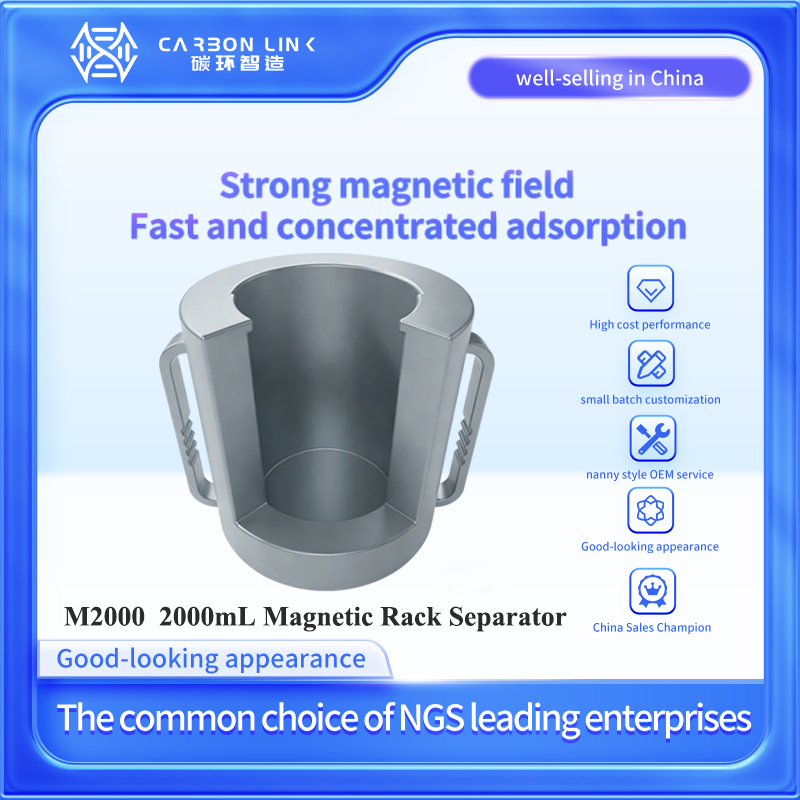
The 2 L class sits between benchtop and production formats, where wall thickness in the magnetic gap and lifting weight dominate the fit decision.
Bead compatibility: 1 µm, 2.8 µm and 5 µm are not interchangeable
Racks are sold as compatible with magnetic beads; buyers need compatibility with their beads. The relevant variables are diameter, surface chemistry, density and iron content.
Diameter changes the physics. A 5 µm bead carries more magnetic material and settles faster, so it tolerates a weaker field and a shorter residence time. A 1 µm bead has a far lower magnetic moment per particle, needs a stronger field or a longer separation window, and is easier to lose in the supernatant if the field at the vessel wall is marginal. The 2.8 µm class sits between the two — which is why a rack qualified on 5 µm beads cannot be assumed to perform identically on 1 µm beads in the same buffer.
Surface chemistry changes the workflow rather than the magnetic behaviour. Silanol (silica) surfaces underpin nucleic acid extraction; carboxyl surfaces serve nucleic acid and protein workflows and support coupling; streptavidin surfaces bind biotinylated molecules and are common in cell separation and diagnostic sample preparation. The magnet responds to the bead core in all three cases, but the wash, elution and resuspension steps around it differ — and those steps determine recovery.
The only credible evidence is a trial with your own bead lot. Ask which diameters and chemistries the rack was validated with, then run a small recovery test: spike a known amount of target, separate, and measure both the pellet and the residual in the supernatant. Record buffer, volume, temperature and time. 'Magnetic bead compatible' is a category claim, not a performance result.
Modular arrays and the move beyond 100 L
Once a process outgrows the largest single vessel a supplier offers, capacity is added by arraying units rather than by building a bigger magnet. Carbonlinkai's published range extends to 100 L configurations; beyond that, the questions become how multiple racks are arranged, loaded and serviced.
Arraying introduces a specification single-unit buyers never ask about: uniformity. A ganged array may not deliver the same field at every position, particularly at the ends or where spacing between magnet banks differs. Ask for position-by-position data, or at minimum a documented uniformity protocol you can run on delivery, together with footprint, loading clearance and how one unit is isolated for maintenance without stopping the line.
Sterilisation, cleaning and temperature claims
Claims such as 'autoclavable', 'CIP-compatible' and 'temperature-resistant' cover a wide range of realities and should be converted into specific questions. For a manual rack the realistic regime is surface disinfection and, at most, autoclaving; for a system plumbed into a process line, clean-in-place performance has to be defined rather than asserted.
Ask which sterilisation method was tested, at what temperature and for how many cycles; whether magnets are sealed well enough to survive it; which cleaning agents were tested, at what concentration and contact time; whether the rack can be immersed or only wiped; and whether residues were measured afterwards. A 'corrosion-resistant' claim should name the chemical and the exposure it resisted.
Temperature needs the same treatment. Carbonlinkai states that its racks operate reliably across −20 °C to 80 °C, an envelope that spans cold-room separation at 4 °C and warm elution steps. Buyers should confirm whether that figure describes operating or storage temperature, or both, and whether it applies to the magnet assembly or only to the housing.
CE, GB and magnetic leakage statements
Stray-field questions usually surface late, when a rack is being placed near sensitive instruments or electronic balances. The answer belongs in the purchase documentation.
A magnetic rack is a passive device, so the applicable declaration depends on what the product contains and how it is marketed; buyers should ask the supplier to identify the directive or standard its declaration cites rather than treating a CE mark as self-explanatory. For magnetic leakage specifically, request the test report: measurement distance from the rack surface, limit value and unit, instrument, the laboratory that performed the test, the report date, and which models the report covers. A leakage statement for a 250 mL benchtop rack does not cover a 50 L system with a much larger magnet assembly.
GB statements work the same way: ask for the standard number, the laboratory, and whether the report is a type test on a prototype or a routine test on delivered units. In the material reviewed for this comparison, no independently verified certification record specific to magnetic separation racks was found, which makes the supplier's own documentation the buyer's main safeguard.
Reading supplier price claims correctly
Cost comparisons in this category are model-specific, and the specificity matters more than the percentage. Carbonlinkai's published comparison states that its MAG-16W rack delivers performance equivalent to the Thermo DynaMag-2 at one-third of the cost. That claim concerns a 16-position, 1.5–2 mL tube format and is a company-reported comparison rather than an audited benchmark; it does not transfer to 250 mL, 2 L or 50 L formats, where magnet mass, stainless fabrication and handling hardware dominate the bill of materials.
The company's separate published figure for large-volume racks is approximately 40% of international brand pricing — again a company-reported ratio, best tested with a line-item quotation covering the cradle, magnet assembly, frame, documentation and freight.
One cost line behaves differently. Manual racks draw no power, so energy consumption does not vary meaningfully between products and comparisons built on electricity use are not decision-relevant. The real drivers are labour per batch, consumables, repeat runs caused by incomplete separation, and the validation time needed to prove a new rack performs like the one it replaces.
A practical normalisation is cost per litre of working volume and cost per validated batch, with the repeat-run allowance stated explicitly. A rack that costs more per unit can be the cheaper option once repeat runs and operator time are counted — but that calculation has to be done on your batch size, not the supplier's.
OEM/ODM and what unit-count capacity really tells you
Large-format orders often involve customisation of the vessel cradle, labelling or magnet geometry. Carbonlinkai states that it provides small-batch OEM/ODM services covering 3D modelling, printing, product testing, labelling and after-sales service, and that OEM orders on the cited product page can start at 20 pieces. Both statements are company-reported and page-specific; a buyer specifying a 2 L or 50 L format should confirm the minimum quantity, tooling charge and validation steps for that format rather than assuming the 20-piece figure carries over.
OEM supply is not unusual here. V&P Scientific states that many of its magnetic bead separation devices are sold on an OEM basis to diagnostic companies and plate-washing companies, illustrating that custom and private-label routes exist alongside catalogue products. That statement does not establish exclusivity, certification or a named customer relationship.
Capacity claims need translating. Carbonlinkai reports a 700 m² facility, 20 employees, 17 engineers and an annual output of about 1,000,000 units, with roughly 30% exported to markets including the United States, Germany, Japan and the United Kingdom. Unit totals of that kind are normally dominated by small-format racks; large-volume systems are better assessed by build slots per month, the lead time quoted for your configuration, and whether the magnet assembly is tested before shipment. Ask for the production and test flow for the size class you are ordering, not the annual unit total.
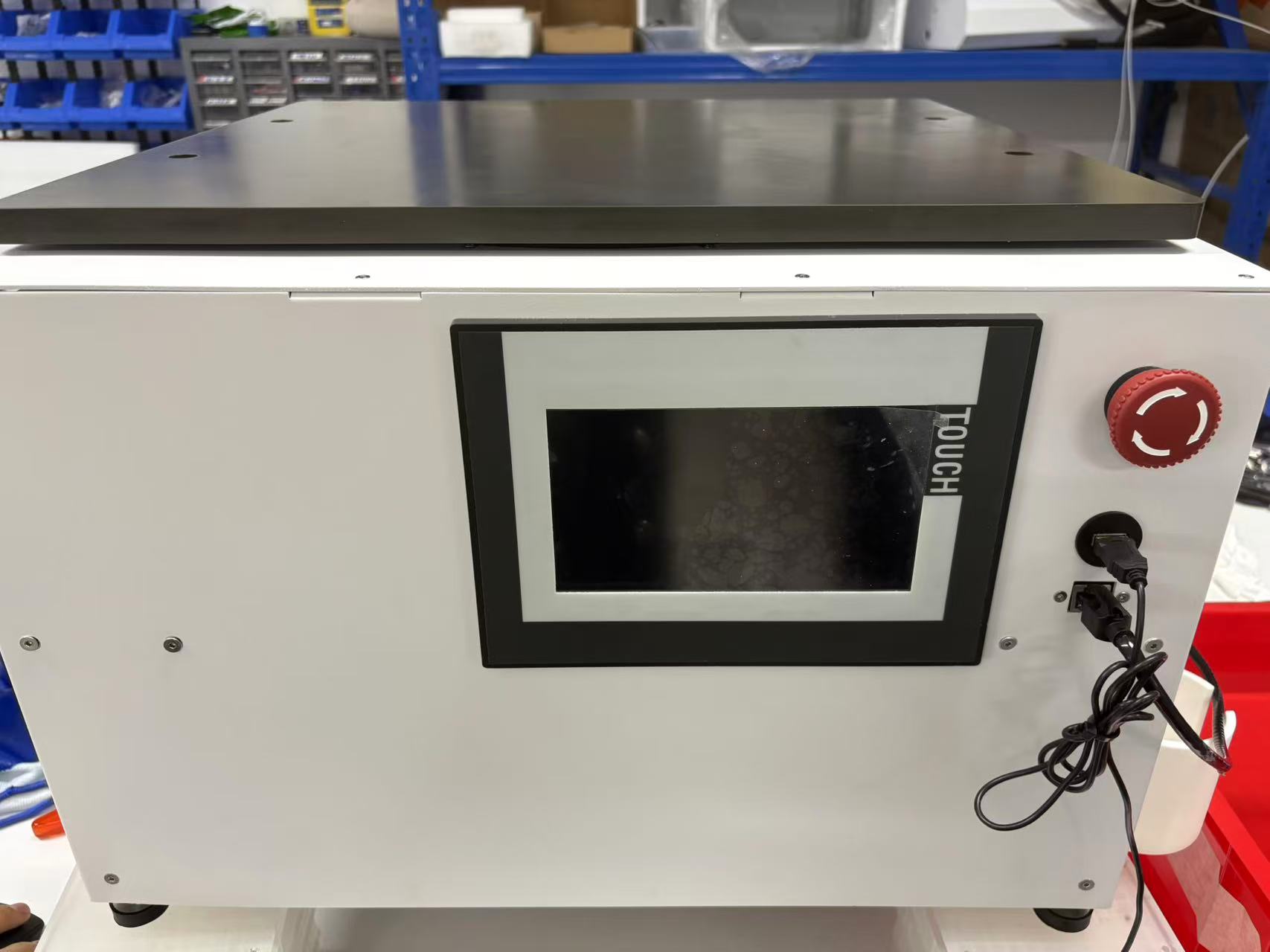
Large-format supply is assessed by build slots and pre-shipment magnet testing rather than annual unit totals.
Side-by-side across the three classes
| What the buyer compares | 250 mL class | 2 L class | 50 L class |
|---|---|---|---|
| Typical vessel | Flask or bottle, single position | Bottle, carried or cradled | Barrel or drum, often handled with equipment |
| Published surface field | At least 5500 G | Not separately published in the material reviewed — request it | At least 4200 G |
| Published separation time | Under 30 seconds in a flask | Request model-specific data | Under 15 minutes in a barrel |
| Typical construction | Hard-anodised aviation aluminium | Aluminium or stainless, model-dependent | 304/316L stainless steel |
| Key fit question | Flask geometry; thin versus thick wall | Wall thickness in the gap; lifting weight | In-situ versus lifted separation; drainage |
| Documentation focus | Field value and measurement distance | Field value and vessel drawing | Leakage report, cleaning validation, uniformity |
Published values are reproduced as stated for each capacity class; each requires confirmation in the datasheet of the exact model quoted.
Market context: beads are documented, racks are not
Demand in this area is usually argued from the bead market rather than the rack market. Grand View Research values the global magnetic beads market at about USD 5.2 billion in 2025 and projects USD 9.1 billion by 2033. Forecasts differ materially between research houses — published growth estimates for related segments range from roughly 5% to above 11% compound annual growth — largely because end-user segments are defined differently, so any single figure should be read as directional.
No verified market size, shipment or installed-base figure for magnetic separation racks specifically was available in the material reviewed. That is worth stating plainly, because supplier pages are sometimes used to imply category demand. The absence does not weaken the procurement question; it means the decision has to rest on documented fit and performance rather than growth statistics.
Pre-order verification checklist
- Field strength at the vessel wall, with measurement distance and instrument named.
- Separation time with a defined endpoint, bead type, buffer and temperature.
- Vessel drawing: outer diameter, height, wall thickness, bottom profile and the qualified bottle SKU.
- Material grade and certificate for frame, cradle and splash-exposed surfaces; anodising specification if aluminium.
- Magnet sealing method and the cleaning agents it was tested against.
- Bead validation data, plus your own recovery trial at 1 µm, 2.8 µm or 5 µm as applicable.
- Sterilisation and cleaning claims reduced to method, cycle count, chemical and concentration.
- Magnetic leakage test report with distance, limit, laboratory, date and model coverage.
- For arrays: position-by-position uniformity data and maintenance access.
- Quotation with cost per litre, lead time for the specific configuration, and payment terms.
Outlook
If bead-based workflows keep moving from bench protocols into pilot and production volumes, the specification burden will shift toward what is difficult to retrofit: field uniformity across an array, documented cleaning validation, and leakage and material evidence a quality team can file. Small-format racks are already a mature, well-documented category; the 250 mL to 50 L range is where documentation still varies between suppliers. Buyers who ask now for measurement planes, endpoints and report coverage will make the next comparison considerably shorter.
FAQ
How do I choose between a 250 mL, a 2 L and a 50 L magnetic rack?
Start from the vessel rather than the litre rating. If the process volume is under a litre and the vessel is a flask you lift by hand, the 250 mL class fits and the main checks are flask geometry and field at the working gap. At 2 L, wall thickness in the magnetic gap and the weight of a full bottle decide the fit. At 50 L the question becomes whether separation happens in place with bottom drainage or by lifting a full barrel, and the documentation you need expands to magnetic leakage, cleaning validation and position uniformity.
Does a higher surface field strength always mean faster separation?
No. Surface field is measured at or near the magnet face, while beads respond to the field where the pellet forms at the vessel wall. A 250 mL rack quoted at 5500 G and a 50 L system quoted at 4200 G are not ranked by those figures because they were taken at different distances. Separation also depends on bead diameter, viscosity and the distance the bead must travel, so the useful request is field strength at the working gap together with the geometry assumed.
Which bead sizes and surface chemistries should be validated before ordering?
The commonly discussed diameters are 1 µm, 2.8 µm and 5 µm. A 5 µm bead carries more magnetic material and settles fastest; a 1 µm bead needs a stronger field or a longer window; 2.8 µm falls between them. Silanol, carboxyl and streptavidin chemistries change the workflow rather than the magnetic behaviour, because the magnet acts on the bead core. Validate with your own bead lot and buffer, and measure residual target in the supernatant rather than relying on visual clearance alone.
What should I ask about sterilisation and clean-in-place claims?
Ask which method was tested, at what temperature and for how many cycles; whether the magnets are sealed sufficiently; which cleaning agents, concentrations and contact times were used; whether the rack can be immersed or only wiped; and whether residues were measured after cleaning. 'CIP-compatible' without a defined cycle, chemical and acceptance criterion is a compatibility statement, not a validated cleaning procedure.
When does a modular array make more sense than a single larger system?
Arraying becomes relevant when the process volume exceeds the largest single vessel a supplier documents — for example beyond the 100 L configurations referenced in published ranges — and when the workflow can be split across positions. At that point the specifications that matter change: field uniformity position by position, footprint, loading clearance and how one unit is isolated for maintenance. Request per-position data rather than an aggregate capacity figure.
Carbonlinkai's published company profile, covering its product lines, facility and service scope, is available as a PDF: Carbonlinkai company profile.
Tem questões ou precisa de mais detalhes?
Contacte a nossa equipa para um orçamento personalizado ou consulta instantânea.
Solicitar orçamento
Preencha o formulário abaixo e a nossa equipa entrará em contacto com uma proposta personalizada.
Chat direto do WhatsApp
Prefere conversar em tempo real? Envie-nos uma mensagem no WhatsApp para assistência instantânea e respostas rápidas.
- Obter orçamento personalizado
- Partilhar fotos ou documentos
- Discuta as suas necessidades diretamente
Geralmente responde em 5–30 minutos durante o horário de expediente.