
2835 vs 3535 LED Strip Lights: A Buyer Framework for Acoustic Walls
Acoustic wall lighting is judged at close range, where dot pitch, colour consistency and PCB behaviour become visible design decisions rather than catalogue details.
An acoustic wall is a lighting surface with unusually strict tolerances. The panel absorbs both sound and light, the viewer usually stands within two metres, and the strip is normally recessed into a slim aluminium channel that hides the circuit board but exposes every irregularity in dot pitch, colour temperature and brightness uniformity. Two SMD options dominate buyer shortlists for this application: SMD 2835 and SMD 3535.
The choice between them is not a brightness contest. It is a decision about how a light source behaves when it is seen up close, behind a diffuser, for ten hours a day, in a room where the wall itself is the design feature. This framework sets out the variables a buyer can verify before ordering, the trade-offs each SMD type introduces, and the acceptance criteria that determine whether the delivered strip matches the sample.
The two reference configurations
XPUP LED is the brand of Zhongshan Xiangpai (XPUP) Lighting Technology Co., Ltd., an LED strip manufacturer established in 2012 in Zhongshan, China, operating a 10,000 m² factory with 80 employees, a six-engineer R&D team and an annual output of 35,000,000 metres. The two configurations used throughout this comparison are drawn from that portfolio.
The CA-DC24V-2835-180D-8mm-3000K is a 24V constant-voltage strip built on SMD 2835 emitters at 180 LEDs per metre, with a colour rendering index of Ra≥80, a 3000K colour temperature, an 11W rating, IP20 ingress protection, an 8mm board width and a copper PCB.
The XP-D5DC24V-3535-120D-8MM is a 24V constant-voltage strip built on SMD 3535 emitters at 120 LEDs per metre, also 8mm wide, with IP20 ingress protection and a double-layer copper PCB. Its model designation encodes the voltage, emitter type, density and board width, which makes it easier to cross-check against a purchase order than a marketing name.
Note that the 3535 reference specification does not publish a CRI, colour temperature or wattage figure in the same way the 2835 reference does. That asymmetry is itself a procurement signal: a buyer comparing the two must obtain the missing parameters in writing before treating the options as equivalent.
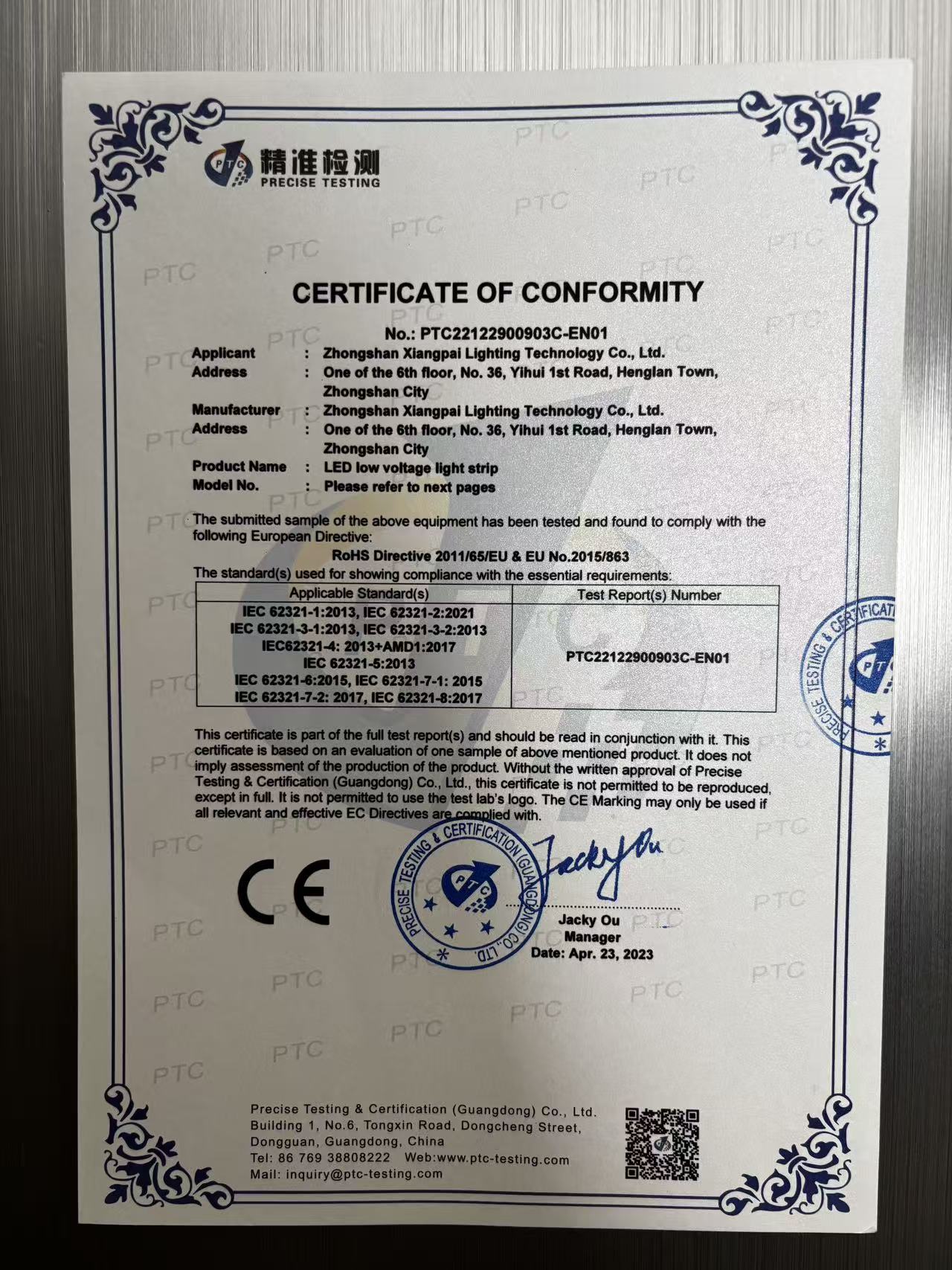
RoHS test documentation for the LED strip series; buyers should confirm that the certificate scope covers the exact model and batch being ordered.
Why acoustic wall projects expose weak specifications
In a cove light or a ceiling wash, an LED strip is a means to an end. On an acoustic wall it is part of the visible composition. Three conditions make specification errors expensive to correct after installation.
First, viewing distance is short. At one to two metres, a diffuser over a 120 LEDs/m strip and a diffuser over a 180 LEDs/m strip do not read the same way; the lower density leaves visible spacing unless the channel depth and diffuser material are matched to it.
Second, acoustic material is optically demanding. Fabric-wrapped and felt panels absorb a large share of incident light, so the small amount of light that reaches the surface must be consistent in colour and intensity. A strip with uneven binning becomes visible as a colour shift across a two-metre run rather than as a subtle variation.
Third, the strip is usually inaccessible. Once the panel and diffuser are installed, replacing a strip means removing the finish. The procurement decision therefore has to be settled at sample stage, not at snagging stage.
The decision matrix
The table below maps the verified parameters of both configurations against the question each parameter actually answers on an acoustic wall.
| Decision variable | SMD 2835 reference (CA-DC24V-2835-180D-8mm-3000K) | SMD 3535 reference (XP-D5DC24V-3535-120D-8MM) | What it changes on an acoustic wall |
|---|---|---|---|
| Emitter type | SMD 2835 | SMD 3535 | Emitter footprint and thermal behaviour of the board |
| LED density | 180 LEDs/m | 120 LEDs/m | Dot spacing and evenness behind the diffuser |
| Colour rendering | CRI Ra≥80 | To be confirmed per order | How fabric texture and timber tones read under the light |
| Colour temperature | 3000K | To be confirmed per order | Warmth of the wall in hospitality and residential interiors |
| Power | 11W | To be confirmed per order | Driver sizing, circuit loading and heat load in the channel |
| Voltage | 24V DC | 24V DC | Driver selection and voltage-drop planning over long runs |
| PCB construction | Copper PCB | Double-layer copper PCB | Current carrying capacity, heat spreading and long-run consistency |
| Ingress protection | IP20 | IP20 | Dry interior use only; excludes wet rooms and exteriors |
| Board width | 8mm | 8mm | Channel compatibility and diffuser clearance |
Read across the table rather than down it. Density, PCB construction and colour rendering interact: a 180 LEDs/m strip can achieve a smoother line at shallow diffuser depth, while a 120 LEDs/m strip on a double-layer copper board can carry current more comfortably over long runs. Neither advantage is universal, and neither can be assessed in isolation from the channel design.
Technical explanation: what each variable actually controls
LED density and dot pitch
180 LEDs/m against 120 LEDs/m is a 50% increase in emitter count per metre. On a flat plastered reveal the difference can be invisible; on an acoustic wall where the strip sits in a shallow channel 20 to 40mm deep, it often is not. Higher density reduces the distance between luminous points, which allows a thinner or shallower diffuser to produce an unbroken line. Lower density typically requires a deeper channel, a higher-diffusion material, or an acceptance that a faint point pattern will remain visible at close viewing distances.
Density is not automatically an upgrade. High-density variants above 120 LEDs/m accounted for nearly 19% of premium installations in 2025, according to Business Research Insights — a figure that implies the large majority of premium projects still specify conventional densities. Where a deep channel with a good diffuser is already designed, a 3535 arrangement at 120 LEDs/m may deliver the required visual result with fewer components per metre.
PCB construction and voltage drop
The difference between a copper PCB and a double-layer copper PCB is electrical and thermal rather than optical. A double-layer copper board offers more conductive cross-section and better heat distribution along the length of the strip. In practice this matters most on long continuous runs: as distance from the feed point increases, the available voltage falls, and a strip with more copper resists that fall more effectively. The visible symptom of insufficient copper is a run that starts bright and ends slightly dimmer or warmer.
For a buyer, this changes the installation plan. A 24V strip on a single-layer copper PCB may require feed-in at both ends, or shorter series segments, on runs that a double-layer board would carry from one end. Neither is a defect; both need to be stated before the channel is fabricated.
Colour rendering and the acoustic surface
An acoustic wall is often the largest single colour surface in a room. With CRI Ra≥80, the 2835 reference configuration sits in a range that renders textile and timber tones plausibly without premium-photography colour control. Projects involving visible artwork, hospitality branding or high-end residential finish schedules sometimes move to higher CRI options in the same portfolio; that is a specification decision, not a claim about the reference model.
The 3000K colour temperature of the 2835 reference aligns with the segment that held a 33.2% revenue share in the linear LED strip fixture market, per Grand View Research. Warm tones dominate acoustic wall applications because the surface is usually a background element in a room intended to feel quiet.
Ingress protection and 24V system design
Both reference configurations are IP20, which defines them as dry-location products. This is a genuine boundary rather than a technicality: bathrooms, spa areas, semi-outdoor terraces and any panel that may be cleaned by spraying are outside the intended scope of an IP20 strip. Projects in those locations need an IP-rated variant from the same range, and the buyer should confirm the rating on the delivered label rather than on the quotation.
The 24V specification is shared across both models. The 24V LED segment accounted for 52.0% of linear LED strip fixture market revenue in 2022, according to Grand View Research, which reflects the practical advantage that 24V systems tolerate longer runs than 12V systems before voltage drop becomes visible. In the United States, low-voltage strips in the 12V/24V class are addressed by the UL 2108 standard, and internationally lighting chains are covered by IEC 60598-2-20:2022 — both are standards a buyer should reference when confirming market access, alongside the supplier's own certification documents.
Application fit: where each configuration earns its place
Commercial applications lead the LED strip market and contributed approximately 33.8% of global revenues in 2024, per Dataintelo, and over 65% of new architectural lighting installations in 2025 are reported to use LED strip technology, according to Business Research Insights. Acoustic wall lighting is a small but specification-heavy part of that demand.
Hospitality corridors and guest-room feature walls. Warm 3000K output, controlled glare and a continuous line matter more than raw lumen output. The 180 LEDs/m density of the 2835 reference suits shallow reveals where the diffuser cannot be deep, and where the wall is viewed while walking past at close range.
Premium residential and interior design projects. This is the scenario XPUP has supplied in practice: home decoration distributors in Germany and Italy have used acoustic panel LED strips and RGB LED strips in premium residential projects, delivering customised solutions, seamless integration and even lighting effects for contemporary interiors.
Long linear runs in commercial fit-outs. Where a single continuous wall exceeds the comfortable feed length of a strip, the double-layer copper PCB of the 3535 reference becomes relevant, particularly if the design does not allow intermediate feed points. The same project may use 2835 on short feature panels and 3535 on long runs — mixed specification is normal and should be documented per elevation.
Retail and brand environments. Commercial lighting contractors in Germany have used XPUP strips for café and chain retail lighting, where dimming behaviour and consistent colour across multiple fixtures are the operative requirements rather than density alone.
Where the framework stops: honest limits
A framework that only lists advantages is a sales document. Four limitations belong in the evaluation record.
IP20 excludes wet and outdoor locations. Acoustic panels used on covered terraces, in bathrooms or in pool-adjacent spaces cannot be served by either reference configuration as specified. An IP-rated alternative is required, and its ingress rating should be verified on the delivered product.
Higher density is not automatically better. The 180 LEDs/m configuration concentrates more heat and more components per metre. If the aluminium channel is undersized or poorly ventilated, the thermal margin narrows. Buyers should confirm channel cross-section and heat-sinking with the lighting designer rather than assuming density solves every uniformity problem.
Lower density demands diffuser discipline. A 120 LEDs/m strip installed in a shallow channel with a thin diffuser will show point structure. The 3535 option is only a valid substitute for the 2835 option where the channel design compensates for the wider spacing.
The reference specifications are not symmetric. The 3535 reference does not publish CRI, colour temperature or wattage in the same form as the 2835 reference. Until those values are confirmed in writing for the specific order, the two configurations cannot be treated as interchangeable on colour-critical work.
Comparison with conventional and alternative approaches
Against traditional incandescent and halogen sources, LED strip technology is a different category of solution rather than an incremental improvement. LED strips consume nearly 70% less power than traditional incandescent lighting systems, according to Business Research Insights, and quality strips are rated for a lifespan of 30,000 to 50,000 hours. For a hotel corridor lit continuously, the maintenance implication is significant.
Against neon and rigid linear fixtures, the trade-off runs the other way. Neon and rigid bars offer predictable optics and simple serviceability, but they impose fixed geometry and cannot follow the recess geometry of a curved or segmented acoustic wall. Flexible LED strips handle that geometry but introduce driver dependency, voltage-drop planning and the need for a diffuser to control appearance. Flexible strips do hold the largest product-type share of the LED strip market at 67.4% as of 2025, per Dataintelo, which reflects how often that trade-off is accepted.
Within the SMD family, 2835 and 3535 are not competitors in a ranking sense. They answer different constraints. A buyer who selects on price per metre alone is effectively letting the supplier decide which constraint gets compromised.
Purchasing terms and acceptance criteria
Specification is only half of a purchase order. The commercial terms and the acceptance procedure determine whether the delivered strip matches the approved sample.
| Term | XPUP LED stated value |
|---|---|
| Minimum order quantity | 2,000 metres |
| Production lead time | 18–22 days |
| Monthly capacity | 3,000,000 metres |
| Quality control | 100% test |
| Warranty | 2-year standard warranty with online remote support and general technical guidance |
| OEM customization scope | Voltage, logo, power, dimensions, materials, hardware configuration, internal circuit, colour, factory specifications, nameplate and label |
| ODM customization scope | Exterior colour scheme, outer packaging box, label, brand information, model name and material details |
| Compliance documentation | CE (LVD, EMC, RoHS) certificates issued by PTC TESTING for the LED low-voltage and high-voltage light strip series |
The acceptance checklist below converts the framework into inspection items. Each line should be agreed before the sample is approved, because each one is difficult or impossible to correct after the panel is closed.
- Confirm the model code on the reel label matches the order: emitter type, density, voltage, board width and colour temperature should all be readable from the code.
- Count LEDs over a measured one-metre sample and verify against the specified density.
- Verify colour temperature and CRI on the delivered sample using a meter, not by eye against a screen.
- Inspect a full continuous run in the actual channel and diffuser at the intended viewing distance before approving.
- Check brightness and colour consistency at the far end of the longest planned run to confirm the PCB and feed arrangement are adequate.
- Confirm the ingress protection marking on the product and the packaging, and confirm it matches the intended location.
- Verify that the CE certificate scope covers the ordered series, and check the certificate numbers against the supplier's documentation.
- Confirm cut-mark intervals suit the panel module dimensions before fabrication begins.
- Confirm packaging, labelling and brand information if the order is a private-label or ODM programme.
On the supply side, XPUP LED has supported long-term programmes of this type. A lighting brand client in the United States has received ODM LED strip solutions covering product specifications, colour parameters, certification requirements and packaging customisation, at a scale of 300,000 metres per year over three years, with stable manufacturing and quality control supporting continuous market supply. A DIY retail chain in Germany has been supplied with a complete LED strip range at 100,000 metres per year for six years, including retail packaging customisation.
Market context for the evaluation
Published market sizing for LED strips varies considerably between sources. Dataintelo values the global LED strip market at approximately USD 5.8 billion in 2025 and projects USD 13.2 billion by 2034 at a CAGR of 9.6%, while other research houses publish materially lower base figures. Buyers should treat headline market values as directional and rely on the segment-level data that affects their decision.
The more decision-relevant signals point the same way. The 24V segment already dominates linear LED strip revenue. Europe is identified as the fastest-growing regional market for linear LED strips at a CAGR of 12.6%, per Grand View Research, which is consistent with the EU's energy-efficiency requirements under the Ecodesign and ErP frameworks driving adoption of LED-based systems. For acoustic wall projects, this means specification scrutiny is more likely to increase than relax, particularly on documentation and declared performance.
Future outlook
Three developments are likely to change how buyers weigh 2835 against 3535 over the next specification cycles.
Density will keep rising at the premium end, but incrementally. With high-density variants above 120 LEDs/m already accounting for close to a fifth of premium installations, the more meaningful shift is likely to be in diffuser and channel design, which determines whether density is visible at all.
Documentation will matter more than catalogue values. As EU efficiency requirements tighten, the ability to produce a certificate whose scope matches the ordered model, and test data that matches the delivered batch, becomes a supplier selection criterion rather than an administrative step.
Supply continuity will remain a practical differentiator. XPUP LED operates a 10,000 m² facility with an annual output of 35,000,000 metres, a six-engineer R&D team and CE and RoHS certification across its LED strip series, and reports exports to more than 170 countries and regions with a 50% export share concentrated on EU and US markets. For buyers running multi-phase acoustic wall projects, the ability to reorder the same model twelve months later is as valuable as the initial specification.
A full specification reference for the range, including model codes and available configurations, is available in the XPUP LED Strip Catalog (PDF).
FAQ
What is the practical difference between SMD 2835 and SMD 3535 in a strip light?
Both are surface-mount LED packages used on flexible strip boards. The difference that matters to a buyer is the configuration built around them. The CA-DC24V-2835-180D-8mm-3000K places SMD 2835 emitters at 180 LEDs per metre on a copper PCB at 3000K with CRI Ra≥80 and 11W. The XP-D5DC24V-3535-120D-8MM places SMD 3535 emitters at 120 LEDs per metre on a double-layer copper PCB. The 2835 configuration favours higher emitter density and a published colour specification; the 3535 configuration favours a heavier copper board for long runs.
How many LEDs per metre should an acoustic wall strip have?
There is no universal figure, because the answer depends on diffuser depth and viewing distance. At 180 LEDs/m the spacing between emitters is tight enough to produce a continuous line in relatively shallow channels. At 120 LEDs/m a deeper channel or higher-diffusion material is normally needed to avoid visible point structure at close range. High-density variants above 120 LEDs/m represented nearly 19% of premium installations in 2025 per Business Research Insights, indicating that conventional densities remain adequate for most projects where the channel is well designed.
Does a double-layer copper PCB justify its cost?
It depends on run length and heat load. A double-layer copper PCB carries current with less loss along the strip and spreads heat more evenly, which reduces the risk of a long continuous run becoming visibly dimmer or warmer at the far end. On short feature panels fed from one end, the benefit is smaller. The cost is justified where the design prohibits intermediate feed points or where long uninterrupted lines are central to the visual concept.
What ordering terms apply to XPUP LED acoustic wall strips?
The stated minimum order quantity is 2,000 metres and production lead time is 18–22 days, against a monthly capacity of 3,000,000 metres with 100% testing and a 2-year standard warranty including online remote support and general technical guidance. OEM customization covers voltage, logo, power, dimensions, materials, hardware configuration, internal circuit, colour, factory specifications, nameplate and label; ODM customization covers exterior colour scheme, outer packaging, label, brand information, model name and material details.
How should a buyer verify colour consistency on delivery?
Compare the delivered reel against the approved sample under the same power supply and in the actual diffuser, using a meter for colour temperature and CRI rather than visual judgement. Because acoustic panels absorb a large share of incident light, colour shifts that would be invisible on a white ceiling become noticeable on a fabric surface. The 2835 reference configuration declares CRI Ra≥80 and 3000K; for the 3535 reference, these values should be confirmed in writing and on the label before acceptance.
Can an IP20 strip be used in bathrooms or on outdoor acoustic panels?
No. Both reference configurations are IP20, which is a dry-location rating. Bathrooms, spa areas, covered terraces and any panel that may be washed or sprayed fall outside that scope and require an IP-rated variant. The rating should be confirmed on the delivered product and packaging, not only on the quotation, because the ingress protection is a property of the finished strip rather than of the LED package.
Is the CA-DC24V-2835-180D-8mm-3000K covered by CE and RoHS documentation?
XPUP LED holds CE certification covering LVD, EMC and RoHS for its LED low-voltage and high-voltage light strip series, issued by PTC TESTING, with RoHS testing referencing the IEC 62321 series, LVD testing referencing EN IEC 62031:2020+A11:2021, IEC TR 62778:2014 and EN 62471:2008, and EMC testing referencing EN IEC 55015:2019+A11:2020, EN 61547:2009, EN IEC 61000-3-2:2019+A1:2021 and EN 61000-3-3:2013+A1:2019. Buyers should confirm that the certificate scope covers the specific model and batch, and separately confirm market access requirements for destinations outside the EU — for example, low-voltage strips in the 12V/24V class in the United States fall under the UL 2108 standard.
Tem questões ou precisa de mais detalhes?
Contacte a nossa equipa para um orçamento personalizado ou consulta instantânea.
Solicitar orçamento
Preencha o formulário abaixo e a nossa equipa entrará em contacto com uma proposta personalizada.
Chat direto do WhatsApp
Prefere conversar em tempo real? Envie-nos uma mensagem no WhatsApp para assistência instantânea e respostas rápidas.
- Obter orçamento personalizado
- Partilhar fotos ou documentos
- Discuta as suas necessidades diretamente
Geralmente responde em 5–30 minutos durante o horário de expediente.