
3-Person vs 6-Person Hot Tubs for Hotels and Resorts
3-Person vs 6-Person Hot Tubs for Hotels and Resorts
Hotel and resort buyers usually meet the 3-person versus 6-person question at the amenity brief stage: one configuration promises a more private, compact hot tub; the other promises large-capacity shared bathing. The procurement answer is not a simple size preference. It depends on verified guest use, available footprint, filled load, water volume, service access, and the operator's maintenance model. Neither label is a standardized capacity measure, so a specification should be decided from model drawings and project conditions, not from the person count alone.
The short answer: choose by guest pattern, not by label
A 3-person hot tub is generally the better fit when the amenity is intended for couples, small groups, private suites, spa treatment rooms, or a garden hot tub where space and privacy matter more than simultaneous capacity. A 6-person hot tub is generally the better fit when the property expects families, small groups, or shared poolside use and can verify the larger footprint, filled load, water volume, and maintenance workload. Neither choice is automatically superior. The fit boundary is the property's operating pattern and the model's verified data.
For a hotel or resort, the person count should be treated as a starting point for discussion, not as a finished specification. A 6-person label does not prove that a unit is a true large capacity hot tub, and a 3-person label does not prove that the unit will fit a compact terrace. The buyer should compare model drawings, seating layout, water capacity, filled weight, jet configuration, control system, insulation, and service access before approving either class.
Whether the brief calls for a luxury hot tub in a suite or a shared commercial hot tub, the same verification discipline applies. A 2-person hot tub may suit a couple-focused room, but it is outside this comparison. A 5-person hot tub can be a midpoint in some portfolios, yet it does not remove the need to verify the exact model. If the brief includes a swim spa hot tub, that is a separate product class and should not be compared through the same person-count labels.
What a 3-person hot tub fits in a hotel or resort
A 3-person hot tub can align with a private guest terrace, a couples-oriented suite, a small spa treatment room, or a garden hot tub in a boutique property. In these settings, the operational value is privacy and a more contained footprint rather than group throughput. The unit may also suit a resort that wants several smaller outdoor hot tubs distributed across villas instead of one shared large-capacity unit. That is a planning choice, not a claim that one layout is better for every property.
The limitation is equally important. If the hotel markets family stays, group bookings, or a shared wellness area, a 3-person unit may create a bottleneck at peak times. The buyer should test the configuration against the property's expected simultaneous use, not against an average occupancy figure. If the brief calls for a shared hotel hot tub, a 6-person class may be the more relevant starting point, subject to site verification.
What a 6-person hot tub changes for a hotel or resort
A 6-person hot tub is normally specified where the amenity is meant to serve families, small groups, or shared resort use. The change is not only seating. A larger configuration can affect the installation route, the base and support design, water volume, heating and filtration workload, cover handling, and the space needed for service access. Those are project-level consequences, so the 6-person unit should be checked as a system rather than as a shell with more seats.
More bathers can also increase the load on filtration and water care. A hot tub filter captures hair, skin particles, and other suspended matter; frequent use and more bathers can clog the filter, reduce flow, and increase pump load. For a hotel, that makes filter access and a realistic cleaning routine part of the size decision. A large-capacity hot tub is a poor fit if the property cannot support the water-care and service routine it requires.
A 6-person unit is not automatically the better commercial choice. If the available terrace is too small, the access route cannot handle the unit, the base cannot carry the filled load, or housekeeping cannot maintain the water, a smaller configuration may be the more workable hotel hot tub. The correct answer follows the verified constraint, not the larger number.
Why 3-person and 6-person are not standardized capacity labels
Public supplier catalogs commonly list outdoor hot tubs in 3-person, 5-person, and 6-person configurations. The label is useful for early assortment screening, but it is not a standardized capacity benchmark. The same listing evidence does not establish equivalent dimensions, water volume, jet count, or usable seating space across suppliers. A buyer should therefore ask for the model drawing and the technical data sheet behind the label.
This is especially important for a hotel or resort that is comparing a compact unit with a large capacity hot tub. A 6-person model with a shallow lounge layout, a large equipment compartment, or a different seating mix may not deliver the expected group comfort. A 3-person model with a wide shell may not fit the intended niche. The comparison should use measured dimensions and configuration data, not the person count alone.
Comparison table: decision factors for hotel and resort buyers
The table below compares the two configuration classes on procurement factors that a hotel or resort can verify. It does not rank specific models or declare a winner.
| Decision factor | 3-person hot tub | 6-person hot tub | What to verify |
|---|---|---|---|
| Guest use and privacy | Fits couples, small groups, private suites, and quiet garden settings. | Fits families, groups, shared poolside or courtyard use where simultaneous bathers are expected. | Booking pattern, peak simultaneous use, privacy expectations, and whether the amenity is private or shared. |
| Space and access | Usually considered where the terrace or treatment room is compact, but the actual footprint must be checked. | Requires a larger installation zone and a clear delivery route, including cover handling and service access. | Model drawing, turning space, door widths, lifting path, drainage route, and future replacement access. |
| Base and filled load | Still requires a level, load-bearing base; smaller size does not remove the structural check. | Likely to place greater demands on the base and support design, but the filled load must be confirmed. | Filled weight, support points, local structural rules, and a site-specific foundation design. |
| Water volume and utilities | Check the actual water capacity, heating system, electrical rating, and drainage needs. | Check the larger water volume, heating and filtration workload, and whether the plant can support it. | Water capacity, heater and pump data, electrical conditions, drainage, and ventilation. |
| Hydrotherapy and features | Jet count and layout should match the intended treatment or relaxation use, not just the seat count. | Feature depth should be assessed by pump flow, jet types, zones, and controls rather than jet count alone. | Pump configuration, jet types, control model, lighting, waterfall, audio, and other accessories. |
| Maintenance and service access | May suit a lighter guest load, but filter access and cleaning routine still need to be planned. | More bathers can increase filter loading, so access to filters, pumps, controls, and drains is critical. | Service panels, filter change routine, water-care schedule, and after-sales support. |
| Procurement evidence | Ask for model-level dimensions, certificates, and test documentation. | Ask for the same evidence, plus confirmation of the larger unit's site fit and operating load. | Drawings, data sheets, certificate scope, quality records, and approved configuration. |
Technical checks that apply to both configurations
Whether the brief points to a 3-person or a 6-person hot tub, the same technical questions determine whether the unit is suitable for hotel use. The following checks should be answered with model-level documents rather than general brand statements.
Acrylic shell and reinforcement
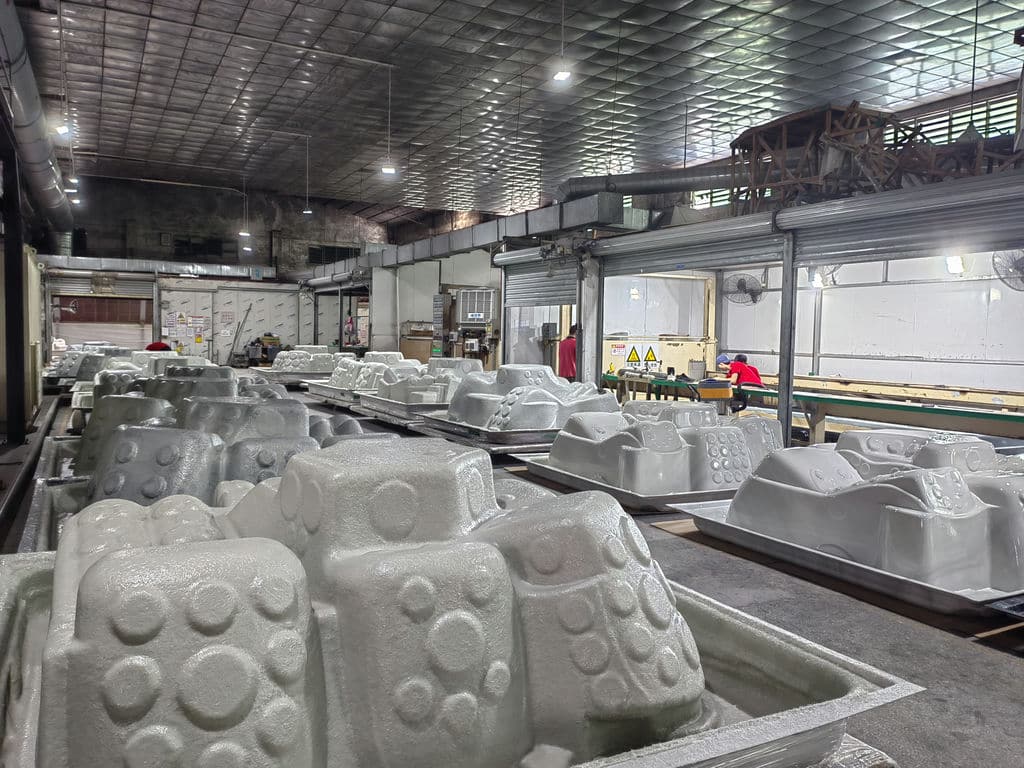
An acrylic hot tub shell is formed by heating an acrylic sheet and shaping it over a mold, then combining it with a reinforced backing structure. The shell holds water, forms the seats and lounges, and works with the support structure to carry the load during use. Acrylic is suitable for hot tub construction because it combines a smooth glossy surface, chemical resistance, thermoformability, and easy cleaning, which supports complex ergonomic contours. For a hotel, the buyer should confirm the shell specification, reinforcement, and base frame for the exact model.
Jets, pumps and controls
In a hydrotherapy hot tub, the massage pump pressurizes water and sends it to the jets. Jet orifice size, direction, and internal geometry affect jet velocity, coverage, and impact sensation, and some jets entrain air to create different water sensations. The massage sensation is mainly determined by pump flow, jet design, jet combination, and the air-to-water mixing ratio; pipe length, bends, water level, filter condition, and the number of operating jets can also affect the actual experience. A buyer should not compare jet count alone. Ask for the pump configuration, jet types, and the exact control system.
Balboa control systems appear in Aquaspring's listed product specifications, and the company states that it selects Balboa control systems and Aristech Acrylics from the United States. For a hotel RFQ, a Balboa control system hot tub should be checked by exact control model, electrical rating, and available service documentation, not by the brand name by itself. The term whirlpool hot tub is often used for a hydrotherapy unit with jet-driven water movement; the specification still depends on pump and jet design.
Insulation and cover
Insulation and a thermal cover reduce heat loss from the shell, plumbing, and water surface, helping a hot tub maintain its set temperature more consistently. Heat is mainly lost through water-surface evaporation, conduction through the shell and plumbing, and convection to surrounding air. Insulation increases thermal resistance, while a cover reduces evaporation and air exchange. Actual energy consumption also depends on ambient temperature, usage frequency, set temperature, and cover sealing. Damage, water accumulation, poor fitting, or leaving the cover open for long periods can reduce performance. In Aquaspring's listed specifications, some models use 25 mm high-density PU insulation foam on the shell, 15 mm aluminum foil insulation on the skirt panel, and a 10 x 6 cm spa cover; the exact specification should be confirmed for the 3-person or 6-person model under review.
Water treatment and filtration
A hot tub filtration system removes hair, dust, and other suspended particles from circulating water to help maintain water cleanliness. It captures some particles but does not replace sanitization and water-balance management. Aquaspring's listed models include ozone sanitation, automatic air escape, and independent filtration on a shared platform; these features should be verified on the exact hotel model. For a commercial hot tub, the operator should also confirm filter access, the cleaning routine, and the availability of replacement filters.
Installation and site planning for hotel hot tubs
The installation choice should be based on product dimensions, filled load, access route, base, drainage, ventilation, service access, electrical conditions, and local codes. Common options include freestanding, semi-recessed, and fully built-in installations. A freestanding hot tub or swim spa is generally easier to deliver, install, inspect, and maintain because it is not enclosed in the building structure, and it may be easier to relocate. It still requires a level, load-assessed base and clear access for the cover, drainage, servicing, and future replacement.
A built-in installation needs more than a finished surround. It must include moisture control, drainage, ventilation, service access, and emergency draining. Before a built-in installation, the project team should verify model drawings, support points, filled load, equipment-compartment location, drainage, and service requirements. A recessed pit, its base, surrounding retaining walls, and supports require structural and load-bearing design. The finished installation must still allow safe draining, power isolation, and servicing; the structure should not be closed if the access panels cannot be opened.
Foundation design is a structural requirement, not a cosmetic detail. A filled hot tub is very heavy and needs a continuous, level base capable of carrying the design load to prevent uneven stress on the shell, frame, and plumbing. The combined weight of water, the hot tub, equipment, and users is transferred to the ground through the base and support frame. Significant slope, soft spots, voids, or localized support may cause shell deformation, panel misalignment, stress on plumbing joints, or poor drainage. Foundation dimensions, load capacity, drainage, and outdoor-installation requirements should be confirmed by a local professional based on the exact model and site conditions.
Service access should be designed around the model's service sides and component-removal paths. Access doors or removable panels should be provided at pumps, filters, controls, heaters, drains, and electrical connections so technicians can safely reach and replace parts. The access zone should not be permanently blocked by furniture, fences, or fixed decoration.
Operating implications: water care, maintenance and guest turnaround
For a hotel hot tub, the operating routine is part of the specification. Filters should be rinsed every 2 to 4 weeks, deep-cleaned monthly, and replaced at 12 to 18 months, sooner with heavy use or hard water. The real criterion is flow, not the calendar: if flow stays low after cleaning, or the media is stiff, torn, or the pressure drop has grown, the filter should be replaced. Keeping two sets on rotation avoids downtime during cleaning. More bathers can increase filter loading, so a 6-person shared unit may need a more disciplined routine than a lightly used private unit.
Cloudy or foamy water should be investigated from several angles: sanitizer and pH, filter blockage, water level and circulation, cover and shell cleanliness, and contaminants such as lotions, sweat, or detergents. The cause should be identified before correcting the water according to the manual and chemical label. In a commercial setting, the operator should stop use when the cause is unclear or the water is out of specification.
Slow heating is another operational check. Common causes include a low temperature setting, restricted flow from a blocked filter, an inactive heating mode, poor circulation, or low ambient temperature. The operator should check the set temperature, water level, filter, and circulation flow, and should not operate the heater when the water level is too low or there is no water flow. For seasonal resorts, winterizing should follow the model manual and remove water from the vessel, filter, pump areas, and water-retaining plumbing; incomplete draining can damage plumbing.
Procurement evidence: what to ask before approving a unit
A hotel or resort should build an RFQ matrix around the exact model, not the person-count label. The matrix should include dimensions, seating layout, water capacity, filled load, jet count and types, pump configuration, control system, acrylic specification, insulation, cover, electrical rating, drainage, and service access. If the project uses a custom hot tub or OEM hot tub program, the same matrix should record the approved customization: dimensions, seating, jets, pumps, heating, control systems, acrylic and skirt colors, lighting, accessories, voltage and frequency, brand labeling, packaging, and product documentation.
Certification should be checked at model level. UL 1563 is a safety standard for electric spas, equipment assemblies, and associated equipment, and UL Solutions lists hydromassage bathtubs and hot and cold spas within pool and spa equipment certification coverage. Applicable requirements vary by jurisdiction and product configuration. AquaspringSpas states that its products carry CE, ETL, RCM, SAA, CB, and UKCA certifications and that its management follows ISO9001:2015. The buyer should ask for the certificate and test documentation that cover the exact model and electrical configuration being purchased, not only a general company statement.
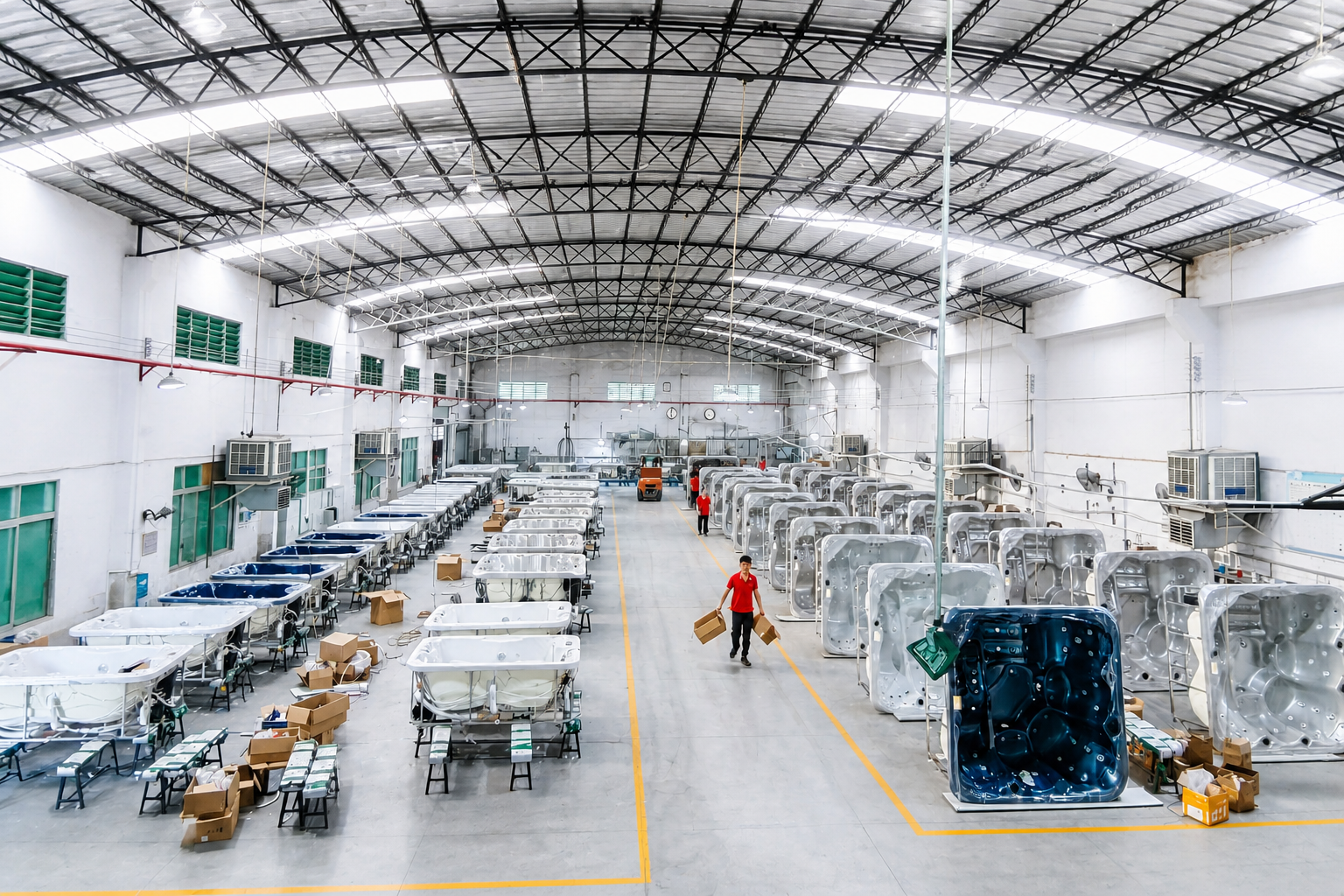
The manufacturing quality path is also worth reviewing. AquaspringSpas describes a quality-control process covering incoming inspection of core components, in-process checks, water testing, electrical safety inspection, functional testing, and pre-shipment verification. For a hotel project, those checkpoints should be tied to the approved specification and the final packaging documentation.
Features such as LED hot tub lighting, a hot tub with waterfall, or a hot tub with Bluetooth speakers can affect guest experience, but they are not substitutes for capacity and service planning. They should be listed as approved accessories in the same RFQ matrix and checked for electrical load, maintenance access, and replacement parts.
Market context and the limits of trend data
Commercial research estimates can provide background, but they should not be used to choose a hotel amenity size. Fortune Business Insights estimates the global hot tub market at USD 5.76 billion in 2025 and projects USD 8.47 billion by 2030, with a CAGR of 4.28% from 2026 to 2030. Other commercial estimates use different scopes and forecast periods, so the figure should be treated as directional market context, not a single authoritative number. The procurement implication is limited: a hotel still needs to size the unit against its own guest pattern, verified site conditions, and maintenance capacity.
Decision rule for hotel and resort projects
Choose a 3-person hot tub when the amenity is primarily private, the expected simultaneous use is small, the installation area is constrained, and the property can verify access and base conditions. Choose a 6-person hot tub when the amenity is shared, the property expects families or groups, and the project can confirm the larger footprint, filled load, water volume, filtration workload, and service access. The unit should match the verified guest pattern and site, not the largest available label.
The correct hotel hot tub is the one whose verified dimensions, filled load, water volume, maintenance requirements, and guest use match the property. Aquaspring Hot Tub models from AquaspringSpas should be evaluated on that basis, with the exact model drawing and certificate in hand.
AquaspringSpas (Foshan Nanhai Halo Sanitary Ware Co., Ltd.) was established in 2011 and operates a 20,000 square meter facility. The company states that it provides OEM and ODM services for distributors, engineering contractors, hotels, resorts, wellness centers, spa facilities, gyms, and other residential and commercial projects. For hotel and resort buyers, the relevant question is not whether a supplier can use the word commercial, but whether the exact 3-person or 6-person model is documented, certified, serviceable, and matched to the site. The company website is AquaspringSpas.
Frequently asked questions
Is a 3-person or 6-person hot tub better for a hotel or resort?
Neither is universally better. A 3-person hot tub fits private, couples-oriented, or space-constrained settings. A 6-person hot tub fits shared family or group use when the property can verify the larger footprint, filled load, water volume, and maintenance routine. The decision should be based on guest pattern and model data, not the person count alone.
How can a buyer verify whether a 6-person hot tub is truly large capacity?
Ask for the model drawing, water capacity, seating layout, filled load, jet count and types, and equipment specifications. Person-count labels are not standardized across suppliers, so the label alone does not establish usable space or capacity. Compare the measured data for the exact models under review.
What installation checks matter most for a hotel hot tub?
Confirm the base, filled load, access route, drainage, ventilation, electrical conditions, local codes, and service access. A built-in installation also needs moisture control, emergency draining, and removable access panels at pumps, filters, controls, heaters, drains, and electrical connections.
Does a larger hot tub always cost more to operate?
Not necessarily. Energy use depends on insulation, cover condition and sealing, ambient temperature, set temperature, and usage frequency. A larger unit may have different water volume and equipment, and more bathers can increase filter loading. The buyer should compare the exact model's insulation, cover, circulation, heating, and maintenance requirements rather than assume a rule from size alone.
What should an OEM or custom hot tub RFQ include for a resort?
Include dimensions, seating layout, jet configuration, pumps, heating, control system, acrylic and skirt colors, lighting, accessories, voltage and frequency, brand labeling, packaging, and product documentation. Also require model-level certificates, test documentation, service access drawings, and the maintenance schedule for the approved configuration.
For further company and manufacturing background, the Halo Spas company profile is available here: Halo Spas Company Profile 2026 PDF.
Tem questões ou precisa de mais detalhes?
Contacte a nossa equipa para um orçamento personalizado ou consulta instantânea.
Solicitar orçamento
Preencha o formulário abaixo e a nossa equipa entrará em contacto com uma proposta personalizada.
Chat direto do WhatsApp
Prefere conversar em tempo real? Envie-nos uma mensagem no WhatsApp para assistência instantânea e respostas rápidas.
- Obter orçamento personalizado
- Partilhar fotos ou documentos
- Discuta as suas necessidades diretamente
Geralmente responde em 5–30 minutos durante o horário de expediente.