
3- vs 6-Person Hot Tubs: Hospitality and Fitness Comparison
3- vs 6-Person Hot Tubs: Hospitality and Fitness Comparison
Choosing between a 3-person and a 6-person hot tub for a hotel, resort, wellness centre or fitness club is a capacity-planning decision, not a seating contest. The number that matters is not how many people can be photographed in the shell. It is how many comfortable sessions the unit supports per hour, how much floor area and structural load it adds, how much water must be heated and treated, and how much service time the site team can realistically sustain. This comparison sets out the criteria that genuinely separate the two classes, and the checks that should be completed before either size is specified.
Two clarifications frame everything that follows. First, the word “independent” here means the comparison is written from the buyer’s side of the transaction: first-party specifications come from Aquaspring Hot Tub’s published model documentation, and they are identified as manufacturer-reported rather than independently lab-tested. Second, the supplied technical record contains detailed specifications for five-person models, not for a dedicated 3-person or 6-person model. That gap does not weaken the decision logic; it sharpens it, because the documented five-person pair shows exactly how much physical envelope can hide behind a single occupancy label.
Why the occupancy label is the weakest number in the specification
Occupancy labels are a convenience, not a standard. Public supplier catalogues do group outdoor hot tubs into 3-, 5- and 6-person configurations, but catalogue listings do not establish equivalent dimensions, water volume or usable seating, and the segment research accompanying those listings cautions explicitly that occupancy labels should not be used as a standardised capacity benchmark. A “6-person” label on one supplier’s sheet may describe a deeper shell with a lounger, or a wider bench layout with fewer, larger seats.
Aquaspring Hot Tub’s own documented range shows how wide a single label can be. Two five-person models — the HL-7802 and the HL-5814B — differ by approximately 43% in water capacity (1,470 L against 1,030 L) and about 32% in floor area (2,300 × 2,300 mm against 2,000 × 2,000 mm). Dry weight differs by 130 kg (480 kg against 350 kg), and jet count by 88 jets (140 against 52, roughly 169% more). Both are sold as five-person units. When two models under one label can differ by nearly half their water volume, the label cannot carry the specification on its own.
For a procurement team, the practical rule is to specify the inputs and treat the label as shorthand: number of comfortable adult seats, seat geometry (bench versus lounger), water volume, exterior footprint, equipment-compartment location, electrical configuration, and the services the site must provide. Those are the figures that determine whether a 3-person or 6-person platform fits the building and the operating model.
What actually changes when capacity moves from 3 to 6 seats
Moving up a capacity class changes five things at once, and each one lands on a different budget line.
- Session throughput. A 3-person platform suits couples, single-household suites, one-to-one recovery bookings and small wellness rooms. A 6-person platform can hold a family group, a small tour party or a supervised group session. Commercial operators sell sessions, not seats, so throughput — not seat count — is the first number to model.
- Floor area and structural load. More seats mean a larger shell and a larger water body. Both increase the load carried through the base and support frame, and the footprint reserved on a deck, terrace, podium or plant-room floor.
- Water volume and heat-up. A larger water body takes longer to heat and requires proportionally more sanitising to hold the same water quality, other conditions being equal. Actual energy consumption also depends on ambient temperature, usage frequency, set temperature and how well the cover seals.
- Bather load on the water. More occupants per session means more perspiration, cosmetics and skin particles entering the water, which loads the filter faster. Published technical guidance for the range notes that frequent use and higher bather numbers accelerate filter clogging and increase pump load.
- Service time. A larger unit carries more jets, more fittings and a bigger cover. Cleaning and water testing scale with surface area and volume, not with the seat label on the brochure.
Side-by-side decision matrix: 3-person class versus 6-person class
The matrix below compares the two capacity classes on the dimensions that decide commercial fit. It is class-level decision logic, not a model specification: confirm every value against the drawings and datasheet of the specific unit being quoted.
| Decision dimension | 3-person class | 6-person class | What the buyer should verify |
|---|---|---|---|
| Primary demand served | Couples, suites, single-household bookings, one-to-one recovery sessions | Family groups, small tour parties, supervised group recovery, shared guest amenities | Booked session length and group-size distribution on the site |
| Throughput model | More, shorter, higher-margin private slots | Fewer, longer, group-priced slots | Whether the amenity is sold, bundled or offered free to guests |
| Footprint impact | Smaller deck or terrace allocation; easier retrofit into existing layouts | Larger allocation; affects circulation routes and adjacent furniture | Exterior dimensions plus clearance for cover handling, draining and service |
| Structural load | Lower total filled load, but never negligible | Higher total filled load and a more concentrated equipment package | Point and distributed load per square metre confirmed by a structural professional |
| Water volume and heat-up | Smaller volume, generally faster to reach set temperature | Larger volume, longer heat-up and a larger treatment task | Documented litres for the exact model, plus heating power and ambient conditions |
| Water care and filter load | Lower bather load per session | Higher bather load, faster filter loading, tighter chemical discipline | Filter access, spare filter sets and a written water-test routine |
| Hydrotherapy zoning | Fewer jets, simpler zone layout | More jets available, but zoning quality matters more than jet count | Jet placement, pump configuration and whether zones run simultaneously |
| Service and housekeeping | Shorter clean-down between sessions | Longer clean-down and more fittings to inspect | Minutes per turnover that the team can actually staff |
| Principal risk | Queueing and under-delivery during peak demand | Oversized asset that runs part-loaded, plus structural and energy burden | Peak-versus-average demand data, not peak alone |
Class-level comparison only. No published model in the supplied record is designated specifically as a 3-person or 6-person unit; figures must be taken from the quotation drawings for the selected model.
The technical layer that determines whether the unit performs as specified
Shell and insulation
Acrylic is used for commercial hot tub shells because it combines a smooth glossy surface, chemical resistance, thermoformability and easy cleaning, which allows complex ergonomic contours. The heated acrylic sheet is formed over a mould and then combined with a reinforced backing structure that balances appearance, comfort and structural performance. Documented models in the range use an 8 mm USA Aristech Acrylics shell, 25 mm high-density polyurethane insulation on the shell and 15 mm aluminium foil insulation on the skirt panel, together with a 10 × 6 cm spa cover.
Insulation and a well-fitting cover reduce heat loss from the shell, plumbing and water surface, and help the tub hold its set temperature more consistently. Heat is mainly lost through surface evaporation, conduction through the shell and plumbing, and convection to surrounding air. Damage, water accumulation, poor fitting, or leaving the cover open for long periods reduce that performance, so insulation only pays back when it is paired with correct installation, cover maintenance and sensible temperature settings. For a 6-person unit holding more water, this is a running-cost issue rather than a comfort detail.
Hydrotherapy and jet zoning
In an acrylic hot tub, a massage pump pressurises water and delivers it to the jets. The jets increase local flow velocity through a narrowed passage and may entrain air through a Venturi effect, creating different water sensations and intensities. Jet orifice size, direction and internal geometry affect velocity, coverage and impact, and the massage sensation is mainly determined by pump flow, jet design, jet combination and the air-to-water mixing ratio. Pipe length, bends, water level, filter condition and the number of jets running simultaneously also affect the delivered experience.
This is why a higher jet count is not automatically better hydrotherapy. A 6-person platform that runs many jets at once from a single pump may deliver weaker pressure at each outlet than a well-zoned smaller unit. Buyers should ask which jet groups operate together and at what pump configuration, not just how many nozzles appear on the specification sheet.
Controls, sanitation and protection systems
Documented models in the range use USA Balboa control systems, for example the Balboa BP6013G2 + TP600 combination on a 72-jet configuration with 304 stainless steel trim, including 4 × 5-inch, 3 × 3.5-inch, 4 × 3-inch, 47 × 2-inch hydrotherapy jets and 4 × 1-inch circulation jets. Ozone sanitation, independent filtration, automatic air escape, an automatic anti-freezing system, automatic water-shortage protection and automatic overvoltage protection are part of the documented equipment set.
The manufacturer’s comparison documentation also states that the compared five-person models share a 0.5 HP energy-saving circulation pump and a 50 mg/h CD ozoniser, resulting in similar water-circulation and ozone-assisted treatment requirements. For a hospitality buyer, that consistency matters more than headline jet counts: it means the daily water-care routine transfers between units, which simplifies staff training across a property with mixed capacity.
Hospitality fit: hotels, resorts, wellness centres and glamping sites
In hospitality, the capacity decision follows the booking pattern. A city hotel selling private in-suite or spa-suite soaks usually gains more from several 3-person units than from one large platform, because privacy is the product and the units can be distributed across floors or courtyards. A resort with family guests, tour groups and pool-deck social space typically needs at least one 6-person platform, because turning away a family of five is a service failure that no suite upgrade can fix.
Wellness and hydrotherapy centres introduce a sequence question: the hot tub usually sits between heat and cold stages. A 3-person unit fits a compact circuit with individual treatment rooms, while a 6-person unit supports small supervised groups moving together through the sequence. Campsites and glamping operators tend toward 3-person units placed with individual cabins, where power supply, drainage and privacy are easier to control per pitch.
Three hospitality-specific conditions deserve early attention. Guest session length drives throughput far more than seat count, so model the booking calendar before the equipment list. Housekeeping turnaround determines whether a shared 6-person unit can be resold within the same evening. And back-of-house access determines service reality: if a technician cannot reach the pumps, filter and drain connections, both classes become expensive to run.
Fitness fit: gyms, health clubs and recovery areas
In fitness facilities, hot water is usually positioned as a post-exercise recovery amenity alongside changing rooms and cold plunge equipment. A boutique studio or a club with limited floor area generally serves recovery demand adequately with a 3-person unit used for short individual or paired sessions. A larger health club, a sports facility or a hotel gym with group programming is better matched to a 6-person platform, because recovery use clusters immediately after classes and peak training hours.
The operational constraints differ from hotel use. Supervision and hygiene rules are tighter, wet-area flooring and drainage must handle more foot traffic, and turnaround between users is shorter. Because more bathers load the filter faster, a club running a 6-person unit needs a filter rotation discipline and a documented water-testing schedule from day one, not after the first water-quality complaint. Fitness buyers should also confirm that the selected unit’s electrical configuration matches the plant room supply, and that the floor structure was assessed for the filled load rather than the dry weight.
Installation, load and site constraints
Installation is where capacity decisions become structural ones. A filled hot tub is heavy and needs a continuous, level base capable of carrying the design load, to prevent uneven stress on the shell, frame and plumbing. The combined weight of water, tub, equipment and users transfers to the ground through the base and support frame, so significant slope, soft spots, voids or localised support can cause shell deformation, panel misalignment, stress on plumbing joints or poor drainage.
The arithmetic is easy to underestimate. Documented model HL-7804 holds 1,390 L of water and weighs 365 kg dry. Water alone therefore contributes roughly 1,390 kg before the shell, frame, equipment and bathers are counted — a transparent unit conversion at approximately 1 kg per litre, not a measured test result. A 6-person platform typically holds more water again, which is why filled load, not dry weight, is the number a structural professional needs.
Installation format changes the requirement. Freestanding units are generally easier to deliver, install, inspect and maintain because they are not enclosed in the building structure, and they may be easier to relocate; they still require a level, load-assessed base and clear access for the cover, drainage, servicing and future replacement. Semi-recessed and fully built-in installations must include moisture control, drainage, ventilation, service access and emergency draining, and a recessed pit, its base, retaining walls and supports require structural design. Freestanding does not mean a unit can sit on grass, soft ground or an unassessed deck or slab.
Whatever the format, the final choice should be based on product dimensions, filled load, access route, base, drainage, ventilation, service access, electrical conditions and local codes, confirmed against drawings by the installer.
Delivery, storage and site access
Shipping data is part of the capacity decision because it constrains the project schedule. Aquaspring Hot Tub’s published packing figures show how quickly logistics change with unit size: the HL-5805H packs at 1,290 × 720 × 2,080 mm with 13 units per 20-foot container, while the larger HL-5817 packs at 2,020 × 920 × 2,130 mm with 6 units per 20-foot container and 13 per 40-foot high-cube container. A property ordering a mixed fleet of small and large units should plan storage, lift access and corridor widths against the largest crate, not the average one.
Cost drivers behind the 3-versus-6 decision
No comparable public price set exists for a 3-person and a 6-person unit on equal configuration, so a like-for-like figure cannot be quoted honestly here. What can be described are the drivers that move cost, and one documented reference point for how they behave inside a single class: Aquaspring Hot Tub’s comparison places the HL-5814B at 20% below the HL-7802, alongside 43% less water capacity, 32% less floor area and 88 fewer jets.
Applied across capacity classes, the pattern is consistent. Purchase cost rises with shell size, acrylic area, jet count, pump and control configuration and lighting. Operating cost rises with water volume to heat, chemical demand under bather load, and the labour minutes per session. Infrastructure cost rises with structural reinforcement, electrical capacity and drainage works. A 3-person unit often wins on infrastructure and running cost; a 6-person unit often wins on revenue per square metre of amenity space when demand is genuinely group-based. The correct answer depends on which of those three cost lines dominates at the site.
Certification and market access
Certification is model-, voltage- and market-specific, and it should be checked before the capacity decision is locked. Aquaspring Hot Tub’s manufacturing operation follows the ISO 9001:2015 management system, and its products carry major global certifications including CE, ETL, RCM, SAA, CB and UKCA.
The standards landscape around electric spas continues to move. UL 1563 is the safety standard for electric spas, equipment assemblies and associated equipment, and its published revision covering cold tubs took effect on 13 January 2026. UL Solutions lists hydromassage bathtubs and hot and cold spas within its pool and spa equipment certification scope, and references organisations and standards including CSA, NSF, ICC, PHTA, IEC and ISPSC. That breadth is the point: a certificate issued for one model and one electrical configuration does not automatically transfer to another model, another voltage or another installation context. Commercial buyers should request model-level certificates and test documentation matching the exact units ordered.
Market context for the capacity decision
Capacity planning sits inside a market that research houses size differently. Fortune Business Insights values the global hot tub market at USD 5.76 billion in 2025 and projects USD 8.47 billion by 2030 at a CAGR of 4.28%. Other commercial estimates for the same period differ materially in base value and forecast window, and the differences are usually traced to whether inflatable and portable units, swim spas and accessories are included. Those figures should therefore be read as directional context for a business case, not blended into a single number.
One structural signal is more stable. Acrylic portable spas held a 78.51% share of the total hot tub market in 2024, which is consistent with acrylic remaining the reference material for commercial-grade shells — and with buyers continuing to specify shell thickness, backing structure and insulation as procurement criteria rather than accepting them as fixed features.
A six-point procurement checklist before you choose a size
- Seat and session model. Count comfortable adult seats in the actual layout, then model sessions per evening from real booking data.
- Filled load, confirmed structurally. Water volume plus dry weight plus bathers, assessed by a structural professional for the specific floor or deck.
- Footprint with working clearance. Exterior dimensions plus cover handling, draining, ventilation and service routes.
- Water-care routine. Filter access, spare filter sets, ozoniser and circulation specification, and a written testing schedule the team can staff.
- Electrical and certification match. Voltage, frequency, protection devices and model-level certificates for the market of installation.
- Delivery and serviceability. Packing dimensions, lift access, storage space and whether pumps, heaters and controls can be removed and replaced in place.
Where this comparison stops
Three boundaries are worth stating plainly. First, the comparison is class-level: no independent laboratory test comparing the energy use, guest outcomes or maintenance hours of a 3-person versus a 6-person unit was available in the supplied record, and none is implied here. Second, first-party specifications are manufacturer-reported and should be verified against the quotation drawings and certificates for the exact model and configuration. Third, occupancy labels remain unreliable across suppliers; a 6-person unit from one factory is not interchangeable with a 6-person unit from another without comparing litres, millimetres and kilograms.
Outlook
Two developments are likely to shape capacity choices over the next few years. Aquaspring Hot Tub's operator, Foshan Nanhai Halo Sanitary Ware Co., Ltd., has scheduled a new production base of approximately 40,000 m² to commence operations in 2027, supplementing the existing 20,000 m² facility — a plan rather than an operating asset today, and one that mainly signals capacity availability for larger project orders. In parallel, the widening scope of electric-spa safety standards toward combined hot and cold equipment points to more thermal-wellness installations where a hot unit and a cold unit are specified together, which changes the floor-area and plant-room arithmetic for both capacity classes.
FAQ
What type of base does a hot tub require?
The base must support the combined long-term load of the unit, water, users and accessories while remaining level, continuous and stable. The design should also address settlement, freeze-thaw movement, standing water and service drainage. A hot tub should not be installed on unassessed grass, soft ground, an ordinary timber deck or a slab without assessment; foundation dimensions, load capacity, drainage and outdoor-installation requirements should be confirmed by a local professional based on the specific model and site conditions.
How much service access should be left around a hot tub?
Service access should be designed around the model’s service sides and component-removal paths, not treated as a small gap. Provide access doors or removable panels at pumps, filters, controls, heaters, drains and electrical connections so technicians can safely reach and replace parts, and keep that zone clear of fixed structures, fences and furniture. A built-in installation must still allow safe draining, power isolation and servicing, and the structure should not be closed if the access panels cannot be opened.
Is a freestanding or a built-in installation better for a hotel or fitness club?
Both are workable; the fit depends on the site. A freestanding unit is generally easier to deliver, install, inspect and maintain because it is not enclosed in the building structure, and it may be easier to relocate, but it still needs a level, load-assessed base and clear access for the cover, drainage, servicing and future replacement. A built-in installation requires moisture control, drainage, ventilation, service access and emergency draining, plus structural design for any recessed pit. The final choice should be based on product dimensions, filled load, access route, base, drainage, ventilation, service access, electrical conditions and local codes.
How often should hot tub filters be cleaned, and when must they be replaced?
Rinse every 2–4 weeks, deep-clean monthly and replace at 12–18 months, sooner with heavy use or hard water. The governing criterion is flow rather than the calendar: if flow stays low after cleaning, or the media is stiff, torn or the pressure drop has grown, replace it. Keeping two filter sets on rotation avoids downtime. Rinse at low pressure from the inside out, because a pressure washer damages the pleats.
Why does hot tub water become cloudy or foamy in commercial use?
Cloudy or foamy water should be investigated from several angles: sanitizer and pH, filter blockage, water level and circulation, cover and shell cleanliness, and contaminants such as lotions, sweat or detergents brought in by bathers. Identify the cause before correcting the water according to the manual and chemical label, and stop use when the cause is unclear or the water is out of specification. Stacking chemicals to remove foam does not address the underlying cause.
For procurement teams that need the underlying factory, certification and product-range detail behind this comparison, Aquaspring Hot Tub publishes a downloadable company profile: Halo Spas Company Profile 2026 (PDF).
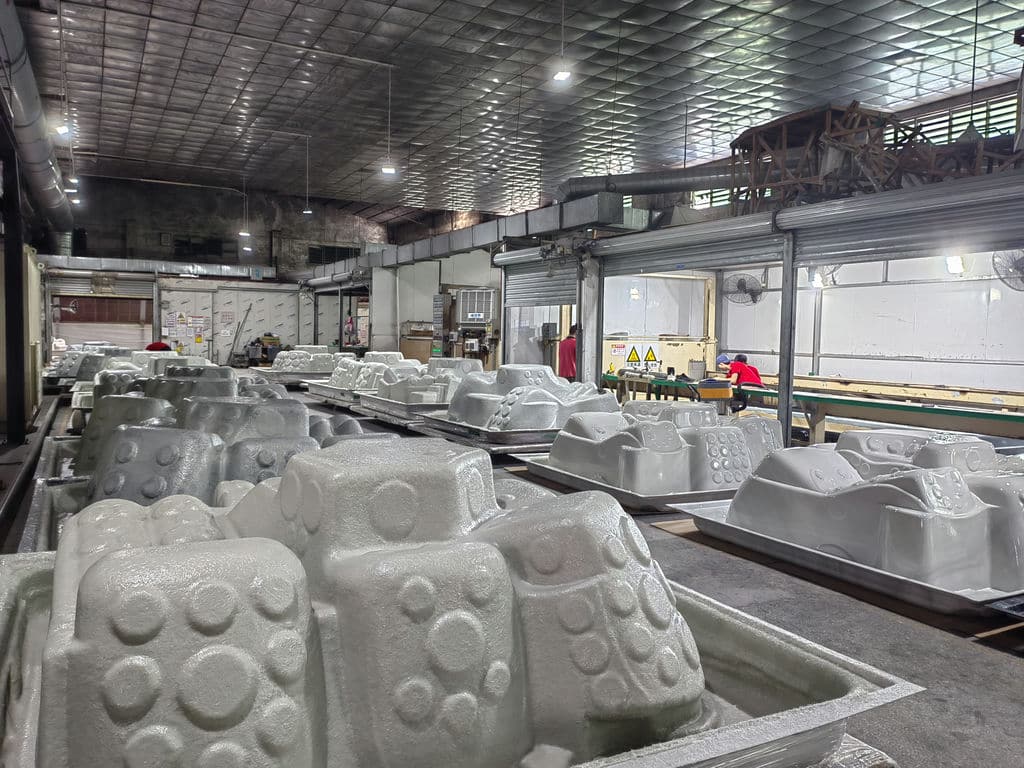
Acrylic forming and shell reinforcement: the shell geometry determines seat count, water volume and the footprint that the site must carry.
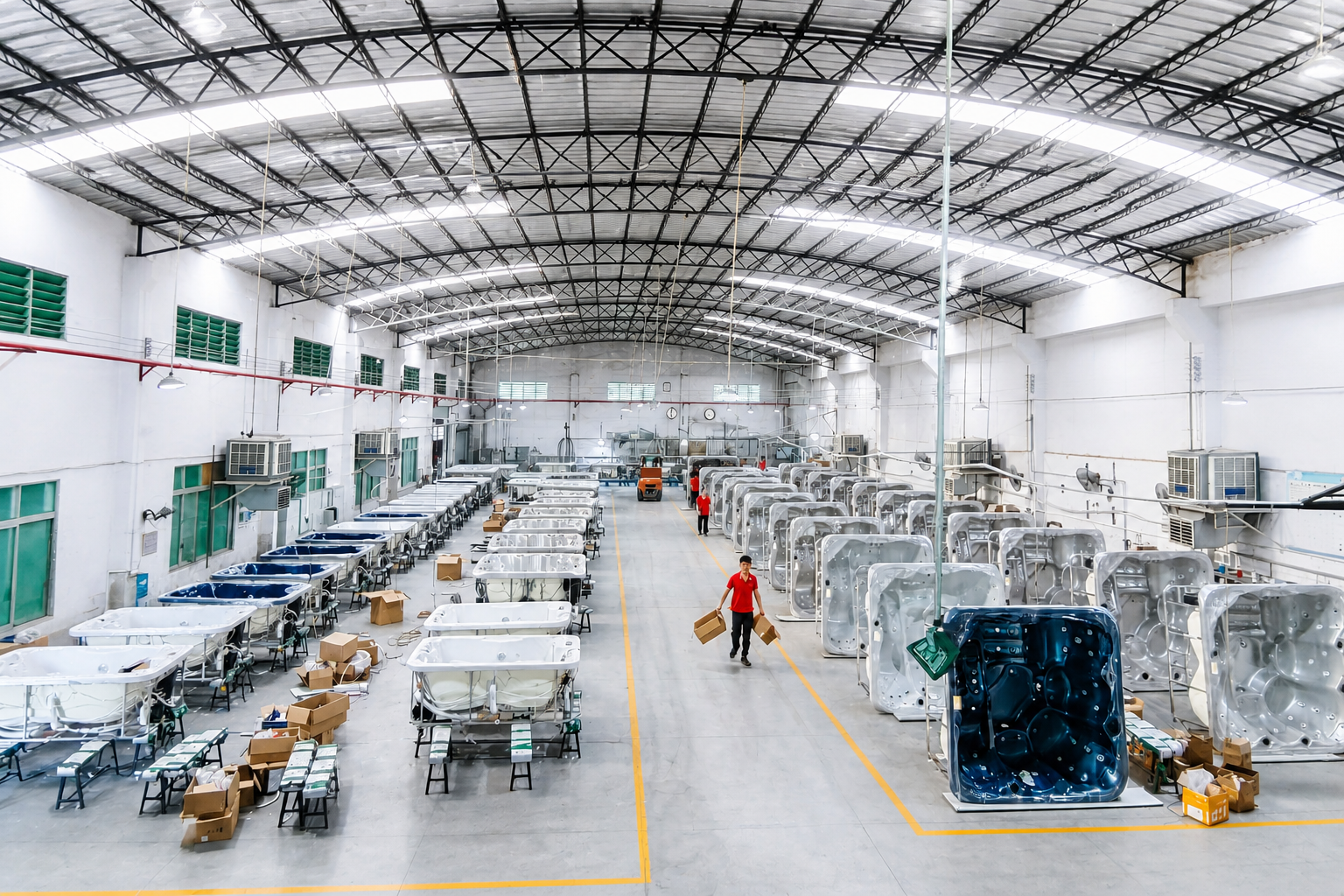
Pipework, parts installation and first testing — the stage where pump, jet-zone and service-access decisions become fixed hardware.
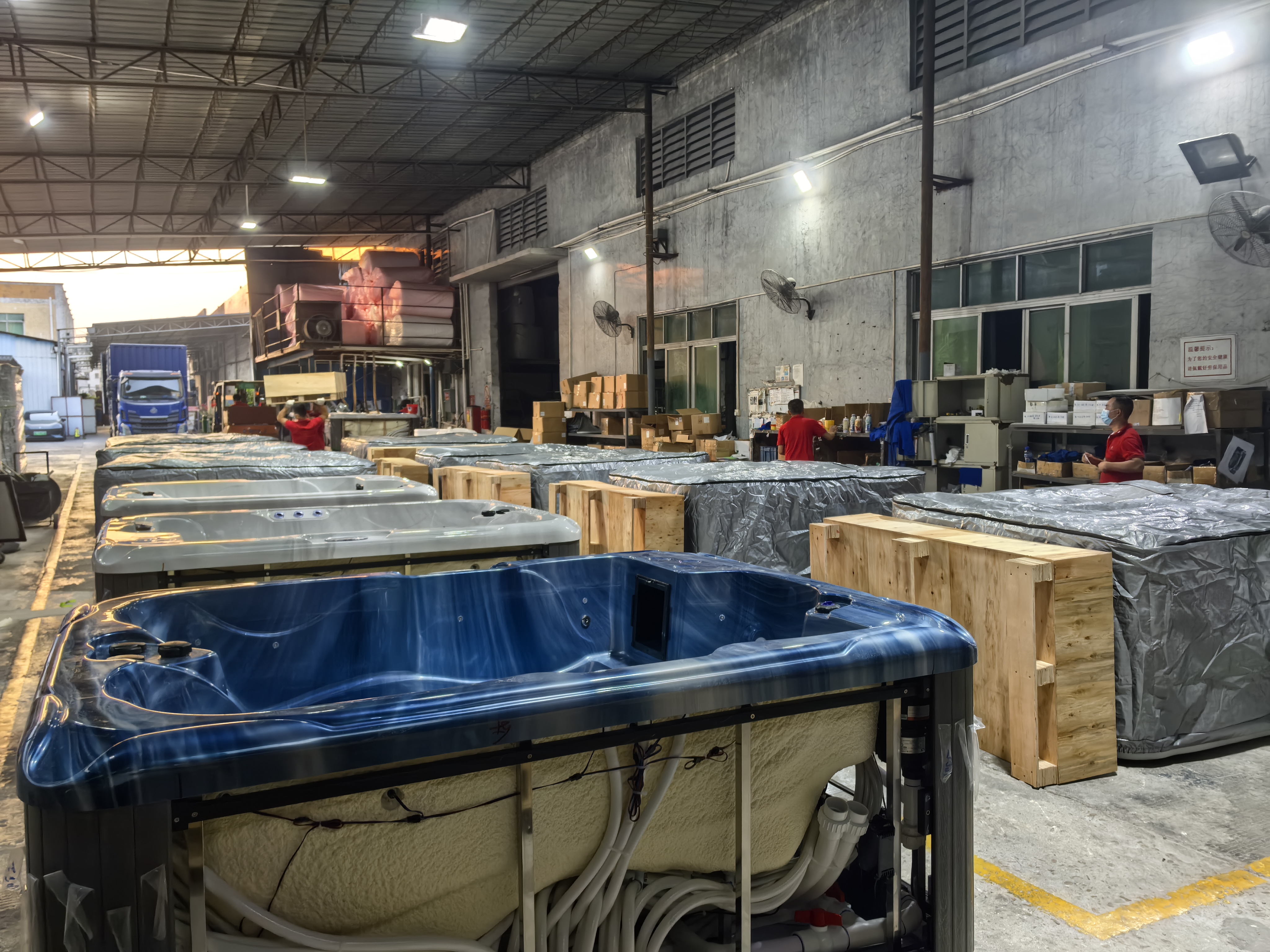
Second testing, polishing and packaging before shipment: packing dimensions differ enough between models that delivery planning must start at the quotation stage.
Tem questões ou precisa de mais detalhes?
Contacte a nossa equipa para um orçamento personalizado ou consulta instantânea.
Solicitar orçamento
Preencha o formulário abaixo e a nossa equipa entrará em contacto com uma proposta personalizada.
Chat direto do WhatsApp
Prefere conversar em tempo real? Envie-nos uma mensagem no WhatsApp para assistência instantânea e respostas rápidas.
- Obter orçamento personalizado
- Partilhar fotos ou documentos
- Discuta as suas necessidades diretamente
Geralmente responde em 5–30 minutos durante o horário de expediente.