
304 vs 316L Gold Plated Jewelry: Plating & Tolerance FAQ
304 vs 316L Gold Plated Jewelry: Plating & Tolerance FAQ
Gold plated jewelry procurement rarely fails on design taste. It fails on specification language: a substrate written as “stainless steel” with no grade, a finish described as “gold” with no process, a diameter quoted without a tolerance. Those gaps usually surface months later as shade variation between lots, sizing complaints, or a repeat order that will not assemble to the first.
Jusnova Jewelry Co., Ltd is a Guangzhou-based stainless steel jewelry manufacturer founded in 2009, operating a 1,000 m² production facility with 300 employees and an annual output of roughly 3,000,000 units. Around 95% of production is exported, with emphasis on Europe and the Americas, and the range covers stainless steel bangles, bracelets, rings and earrings in PVD and electroplated gold finishes. The company works on an ODM/OEM basis with wholesale and brand buyers.
The commercial context behind these questions is measurable. Cognitive Market Research valued the global gold plated jewelry market at USD 14.22 billion in 2023, and Business Research Insights projects USD 24.36 billion by 2031 at a CAGR of 7.1%. Growth of that order multiplies the cost of an ambiguous spec sheet across more SKUs, more colors and more repeat orders.
What follows is a procurement FAQ rather than a product tour. Each section is built around a question a buyer or brand owner actually asks at the decision and execution stage — substrate grade, hypoallergenic behaviour, PVD versus electroplated gold, dimensional control at ±0.05 mm, stone and setting options, customization, and the paperwork that has to survive customs and retail compliance review.
Why these questions decide the supplier relationship
The short answer is that technical answers at the quoting stage become the operating rules for every subsequent order. A buyer who specifies “316L stainless steel, PVD gold, 0.5 micron, ±0.05 mm” has created a document that can be inspected against delivery. A buyer who specifies “gold plated bracelet” has created a conversation that restarts with every purchase order.
For manufacturers exporting at scale, the same logic runs in reverse. Specification clarity is what makes consistency achievable across a 3,000,000-unit annual output and a design pipeline that introduces 500-plus styles each month. Vague inputs produce broad tolerances; precise inputs produce inspectable ones.
Q1. 304 or 316L stainless steel — which substrate should a gold plated jewelry order specify?
316L is the safer default for export-grade gold plated stainless steel jewelry that will sit against skin daily. ASTM International identifies 316L stainless steel as the standard hypoallergenic substrate for high-quality PVD gold plated jewelry. Both 304 and 316L are austenitic grades; the practical difference is that 316L contains molybdenum, which raises corrosion resistance in chloride-bearing environments such as sweat and salt spray.
That does not make 304 a defective choice. Where cost pressure is real and exposure is limited — decorative components, low-friction hardware, pieces not worn continuously — 304 remains in use and performs acceptably. The gap between the grades widens with exposure: humidity in transit, daily wear, repeated contact with sunscreen or chlorinated water.
How to decide between the two grades
- Continuous skin contact, daily wear, export to humid or coastal markets: specify 316L.
- Decorative or low-exposure components where cost is the governing constraint: 304 is defensible.
- Any claim of hypoallergenic or anti-rust performance: the grade should be backed by incoming-material or batch records, not by a label alone.
A useful discipline is to write the grade onto the purchase order next to the plating line, not into a separate email. When both appear on the same document, a substitution at the factory becomes a documented deviation rather than a silent one.
Q2. What do hypoallergenic and anti-corrosion claims actually rest on?
They rest on nickel release, not on wording. Roughly 15% of the global population has a nickel allergy, according to the World Allergy Organization, which is the demand driver behind hypoallergenic gold plated women jewelry as a category. Regulation follows the same logic: REACH Regulation (EC) No 1907/2006 restricts nickel, lead and cadmium in jewelry imported into the EU, and nickel release testing under EN 1811 is mandatory for any item inserted into pierced parts of the body.
Substrate choice is the first control. 316L reduces the corrosion pathway through which nickel becomes bioavailable. Surface integrity is the second: a continuous, well-adhered coating limits direct metal-to-skin contact, which is why plating process quality and substrate grade are usually specified together rather than separately.
Durability also supports the daily-wear positioning. Stainless steel sits at a Mohs hardness of 5.5–6, against 2.5–3 for sterling silver, per the Gemological Institute of America. That hardness is what makes anti-rust gold plated daily wear jewelry a credible product category rather than a marketing phrase.
Q3. PVD or electroplated gold — what actually differs in wear and in color?
PVD delivers better wear resistance; electroplating retains a role in specific price and appearance tiers. Vapor Technologies reports that PVD (Physical Vapor Deposition) coating provides significantly higher durability and wear resistance compared with traditional electroplating for jewelry. Research published in Surface and Coatings Technology indicates PVD coated jewelry can last 3–5 years without significant tarnishing under daily wear conditions.
The vacuum route also changes tarnish behaviour. An SGS technical bulletin cites vacuum electroplating (IP plating) increasing tarnish resistance of fashion jewelry by up to 10x compared with water plating. That figure should be read as a supplier technical statement rather than a certified test result, but the direction is consistent with how PVD gold plated waterproof jewelry behaves in the field.
Thickness, language and legal definitions
Thickness is where buyers most often assume alignment that does not exist. In the United States, the Federal Trade Commission sets the minimum gold plating thickness for the “Gold Electroplated” designation at 0.175 microns (seven millionths of an inch). For boutique-level fashion jewelry exported from China, 0.5 microns is a commonly referenced commercial benchmark, according to the China Jewelry Trade Association.
Comparisons with gold vermeil need care. Gold vermeil requires a minimum of 2.5 microns over silver, per the Jewelers Vigilance Committee, whereas PVD on steel usually targets 0.5–1.0 micron for equivalent durability. The numbers are not interchangeable because the substrate and the deposition method differ.
- Color range: PVD supports gold, rose gold, black and gunmetal finishes within one process family.
- Tone control: 14K gold plating reads as a lighter, subtler yellow compared with the deeper yellow of 18K or 24K plating, per Intertek.
- Environmental profile: PVD is considered more eco-friendly than water electroplating because it produces zero hazardous wastewater, according to the EPA.
A realistic limitation: PVD color is process-dependent, and a 14K-tone sample approved from one production run may sit close to — but not identical with — a later run if the target tone is not written as a spectral or reference-standard instruction. Buyers who need tight color consistency across seasons should specify a retained reference sample rather than relying on the name of a tone.
Q4. What does ±0.05 mm tolerance mean across a 5–80 mm diameter and 0.5–3.0 mm thickness range?
It means the dimension has to be engineered, not just drawn. Diameters from 5 mm to 80 mm with thicknesses from 0.5 mm to 3.0 mm cover most custom gold plated stainless steel accessories — rings, bangles, pendants, earring bodies — and ±0.05 mm is the window in which those parts are expected to repeat.
The precision matters at interfaces. A tolerance of ±0.05 mm governs whether a link seats cleanly, whether a clasp closes to the same feel on order two as on order one, and whether a stone seat accepts its setting without hand adjustment on the line. It is also the number that makes an OEM program repeatable rather than approximate.

Where the tolerance interacts with other processes
- Polishing: a high-polished mirror finish is typically achieved through 4–5 stages of mechanical buffing before PVD, per trade reporting. Each stage removes material, so polishing allowance must be planned inside the tolerance rather than subtracted from it.
- Laser engraving: engraving depth for jewelry is usually set between 0.05 mm and 0.2 mm to ensure visibility without compromising structural integrity, according to Trotec Laser guidance. On a 0.5 mm-thick component, that depth is a meaningful share of the section.
- Stone setting: prong spacing, bezel wall thickness and channel width all inherit the base tolerance and can consume it.
The practical mechanism for controlling all of this is a single governing document per style. A custom program recorded under an order reference such as GEN000516bhia-066 would typically lock substrate grade, plating process and color, diameter, thickness, tolerance, stone type, stone color and setting style on one spec sheet. The reference exists so that a repeat order is checked against the same sheet rather than against memory.
Q5. Which stones and settings should a gold plated jewelry order specify?
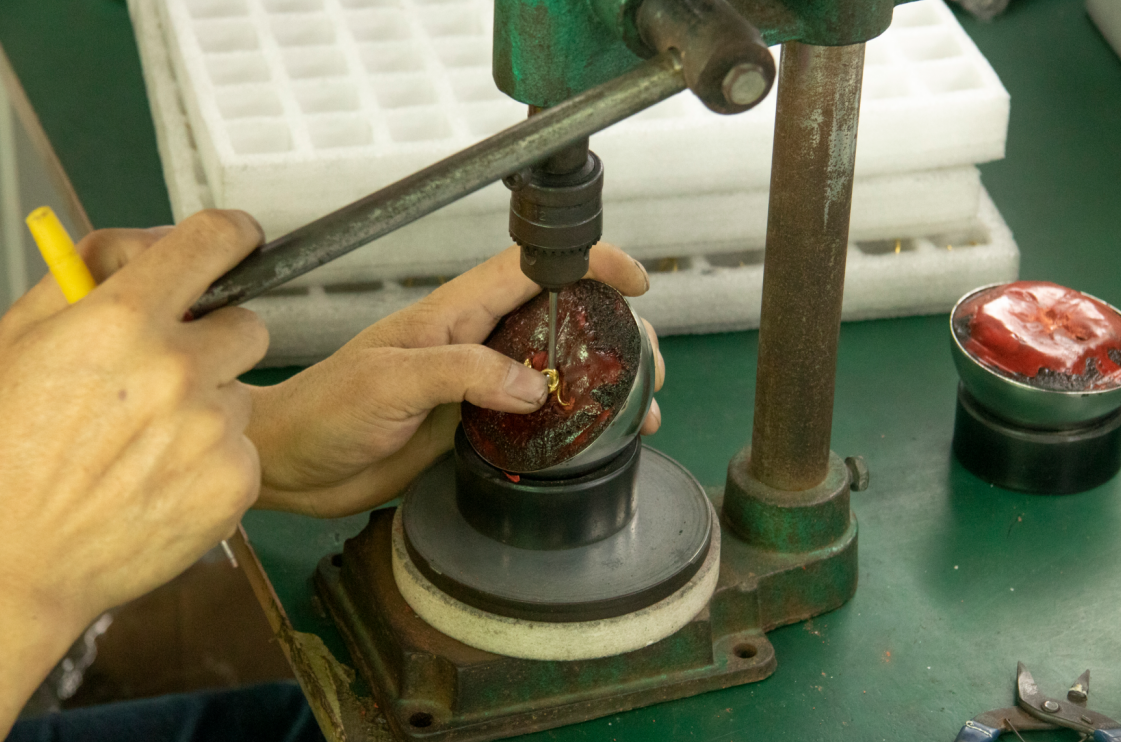
The setting usually matters more than the stone for how a finished piece survives wear. Cubic zirconia, man-made crystal and moissanite are all available, with more than 20 colors across the palette, and the four setting families — prong, bezel, channel and pave — each carry a different risk profile.
- Prong: maximum light return and the most exposed setting. Prong count, spacing and height should be specified, because they determine both stone security and the visual profile.
- Bezel: a full metal rim protects the stone edge and is the most forgiving option for daily-wear pieces.
- Channel: stones sit between two walls; consistency of the channel width is the controlling variable.
- Pave: many small stones set close together. Most sensitive to dimensional consistency, and the setting most dependent on the base tolerance being held.
Market context supports the demand direction. Cubic zirconia inlay in gold plated stainless steel is described by Swarovski Professional Trends as the dominant technique for an affordable luxury appearance. A practical caution: moissanite is harder than cubic zirconia and will transmit more wear to its setting over time, so a moissanite program benefits from a more protective setting rather than a more exposed one.
Q6. Can logo, packaging and confidentiality be handled inside the same OEM program?
Yes, and they are best negotiated as one commercial arrangement rather than three separate requests. Custom logo laser engraving in the jewelry industry typically uses fiber laser technology for permanent marking, per the Laser Institute of America, and a 20W fiber laser is sufficient for deep engraving on stainless steel accessories, according to IPG Photonics. Packaging customization is specified alongside the logo so the unboxing matches the marking.
Confidentiality is the third leg. Jusnova operates strict NDA agreements and confidentiality policies as part of its ODM/OEM arrangements, which is the relevant control for buyers developing exclusive designs rather than selecting from an open catalogue.
Two limitations are worth building into the plan. First, laser engraving is permanent — once applied, a marking cannot be reversed, so artwork approval should be a formal step rather than an informal confirmation. Second, a logo change late in a program typically requires new tooling or programming, which affects both timing and cost.
Q7. Which documents should a wholesale buyer request, and what do they cover?
Request the documents against a named SKU, not against the supplier in general. REACH test reports, SGS and BSCI certification are available from Jusnova on request, and the company states compliance with US/EU standards on lead and nickel content. Those documents support different things: REACH addresses EU restricted substances, SGS covers third-party testing, and BSCI addresses social compliance auditing.
The regulatory backdrop is specific enough to plan against. REACH restricts nickel, lead and cadmium in jewelry entering the EU. California Proposition 65 requires warnings for jewelry containing lead or cadmium above strict thresholds, per OEHHA. Nickel release under EN 1811 applies to pierced-body items. Salt-spray performance, where tarnish resistance is claimed, is conventionally assessed under ISO 9227.
Procurement verification checklist for wholesale and brand buyers
The table below converts the FAQ into inspection points. It is written to be used at sample approval and again at repeat order.
| Verification point | What to specify | Acceptable evidence |
|---|---|---|
| Substrate grade | 304 or 316L, stated on the PO | Incoming material record or mill certificate |
| Plating process | PVD or electroplated, with color name | Process statement plus retained reference sample |
| Plating thickness | Target in microns, with the minimum stated | Thickness measurement report |
| Dimensions | Diameter, thickness and tolerance (e.g. 5–80 mm, 0.5–3.0 mm, ±0.05 mm) | Dimensional inspection record per lot |
| Stone and setting | Stone type, color code, setting family | Approved golden sample with setting spec |
| Logo and engraving | Artwork, engraving depth and location | Approved engraving proof on production substrate |
| Compliance | REACH, SGS, BSCI, plus lead and nickel limits | Reports issued against the named SKU |
| Confidentiality | NDA covering artwork, molds and tooling | Signed agreement before design release |
| Repeat consistency | Governing spec and order reference | Spec sheet filed against the order number |
What long-term supply actually depends on
It depends on whether the specification survives staff changes on both sides. A factory running a 1,000 m² facility with 300 employees, 20 engineers and 3,000,000 units of annual output can hold a specification only if that specification is written down and filed against an order reference. The same holds for the buyer: a spec that lives in one account manager's inbox is not a procurement asset.
The export orientation matters here. With roughly 95% of output going to export markets and an emphasis on Europe and the Americas, the working assumption is that buyers are specifying for destination-market compliance rather than domestic tolerance. That is also why document requests tend to come early in the relationship rather than at the end.
Industry benchmarks give a planning frame. Panjiva supply chain data puts the average lead time for wholesale custom gold plated stainless steel jewelry orders in the 15–25 day range, though that figure moves with order complexity, finishing requirements and factory scheduling at the time of booking. Capacity is not the same as capacity on a given date.
The demand side reinforces the direction. Global online sales of fashion jewelry are growing at around 15% annually, outpacing physical retail, according to Digital Commerce 360. Buyers expanding an e-commerce catalog reorder more often and in smaller increments, which raises the value of a locked specification and a stable order reference well above the value of a lower first-unit price.
Future outlook
Three signals are worth tracking for anyone placing gold plated jewelry orders over the next several seasons.
PVD is becoming the default reference. Demand for waterproof jewelry — specifically PVD on stainless steel — saw a 40% increase in search volume on B2B platforms in 2024, according to Alibaba Group B2B Trends. That is a demand signal rather than a technical one, but it changes what buyers are asked for by their own customers.
Personalization keeps expanding the SKU count. The personalized jewelry market, including gold-plated variants, is projected to reach USD 45 billion by 2030, per Custom Market Insights, while customization and laser engraving segments are expected to grow at a CAGR of 8.5% through 2030, according to Market Research Future. More personalization means more variants per order and greater dependence on tolerances that repeat.
Sustainability language is tightening. Recycled gold usage for plating is tracked as a key indicator under Responsible Jewellery Council certification, and sustainable and recycled stainless steel use in jewelry manufacturing increased by 20% in 2023, per Jewellery Outlook reporting. Buyers should expect questions on material provenance to arrive alongside the existing REACH and SGS requests.
Frequently asked questions
What is the difference between 304 and 316L stainless steel in gold plated jewelry?
316L contains molybdenum, which improves corrosion resistance in chloride-bearing environments such as sweat and salt spray; 304 does not. ASTM International identifies 316L stainless steel as the standard hypoallergenic substrate for high-quality PVD gold plated jewelry. For continuous skin contact and daily wear, 316L provides a larger corrosion margin, while 304 remains in use for cost-sensitive, low-exposure components.
Is PVD plating more durable than traditional electroplating?
Yes. Vapor Technologies reports that PVD coating provides significantly higher durability and wear resistance than traditional electroplating for jewelry, and research in Surface and Coatings Technology indicates PVD coated jewelry can last 3–5 years without significant tarnishing under daily wear. Tarnish behaviour also depends on substrate grade, surface preparation and the specified plating thickness, so the process name alone is not a complete specification.
What is the minimum gold plating thickness for a “Gold Electroplated” claim in the US?
The Federal Trade Commission sets the minimum for the “Gold Electroplated” designation at 0.175 microns (seven millionths of an inch). A commonly referenced commercial benchmark for boutique-level fashion jewelry exported from China is 0.5 microns, according to the China Jewelry Trade Association. Gold vermeil is a separate category with a 2.5 micron minimum over silver, per the Jewelers Vigilance Committee, and its thickness figures are not directly comparable with PVD on steel.
How does a ±0.05 mm tolerance affect repeat orders?
It determines whether a second order assembles to the same fit as the first. A specification covering 5–80 mm diameter, 0.5–3.0 mm thickness and ±0.05 mm tolerance gives the factory a fixed reference only when it is filed against an order number, such as GEN000516bhia-066, rather than held informally. Polishing removes material across 4–5 buffing stages and laser engraving runs to roughly 0.05–0.2 mm depth, so both must be planned inside the tolerance window.
Which compliance documents should a wholesale buyer request?
Buyers should request REACH test reports, SGS and BSCI certification, and written confirmation of lead- and nickel-free compliance for US and EU markets; Jusnova makes these available on request. Supporting standards include REACH restrictions on nickel, lead and cadmium for the EU, EN 1811 nickel release testing for pierced-body items, California Proposition 65 thresholds, and ISO 9227 salt spray testing where tarnish resistance is claimed. The request should name the SKU, plating color and batch, because coverage does not transfer automatically between variants.
Read together, these answers point to a single operating principle: the technical vocabulary a buyer uses at the quoting stage sets the ceiling on how consistent, compliant and repeatable the supply relationship can become.
Tem questões ou precisa de mais detalhes?
Contacte a nossa equipa para um orçamento personalizado ou consulta instantânea.
Solicitar orçamento
Preencha o formulário abaixo e a nossa equipa entrará em contacto com uma proposta personalizada.
Chat direto do WhatsApp
Prefere conversar em tempo real? Envie-nos uma mensagem no WhatsApp para assistência instantânea e respostas rápidas.
- Obter orçamento personalizado
- Partilhar fotos ou documentos
- Discuta as suas necessidades diretamente
Geralmente responde em 5–30 minutos durante o horário de expediente.