
360g Hoodie vs. 280g High-Elastic Long Sleeve: A Brand Owner's Review
A winter layering range is usually planned around one hero weight, and that hero is almost always the heaviest piece in the line. For private label casual programmes, the more useful question is not which piece is warmer, but which piece earns its place in the assortment at which point of the season, and what each one costs the buyer in specification terms.
Two garments make that question concrete: a 360g hoodie from the 1901 Series and a 280g high-elastic long sleeve from the 1701/1801 Series. Both are produced by Guangzhou Lihong Apparel Trade Co., Ltd., a Guangzhou-based menswear OEM/ODM supplier trading as Lihongwear, which operates a 5,000 m² plant with 150+ staff and an annual output of roughly 500,000 pieces. The two styles sit at opposite ends of the same casual range. One is built on a double-layer composite shell; the other on a four-way stretch knit. Comparing them is therefore less about choosing a winner and more about reading the specification correctly before committing to an assortment.
The commercial backdrop supports treating this as a planning decision rather than a style preference. Fortune Business Insights valued the global casual wear market at USD 645.22 billion in 2025 and projects it to reach USD 906.32 billion by 2034. Within that expansion, buyers are being asked to justify weight, fabric composition and test coverage at the same time as they justify design.
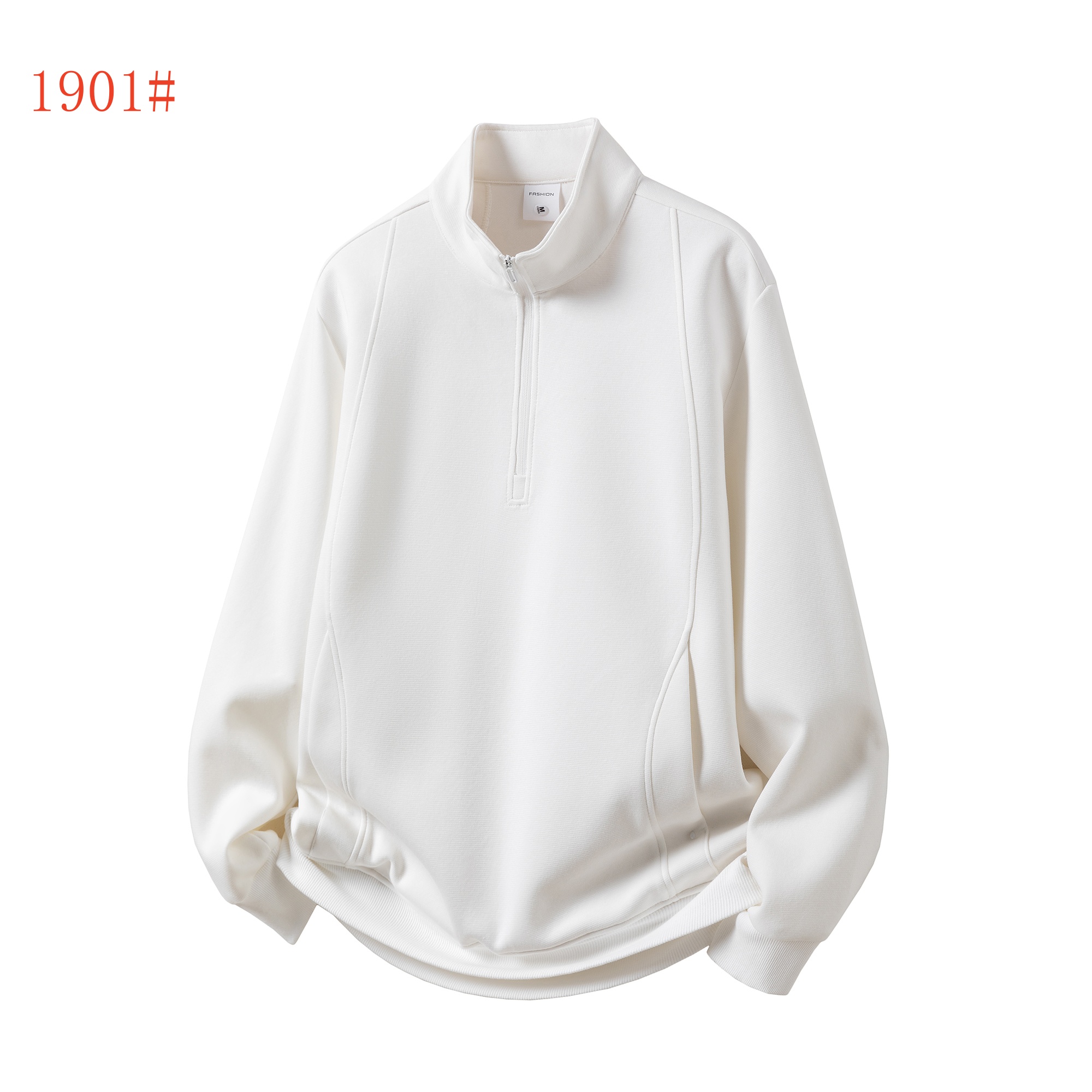
1901 Series heavyweight hoodie, white — the single-layer decision most winter ranges are built around.
What each garment is actually designed to do
The two products are not competing for the same slot in a wardrobe, and treating them as substitutes is the most common planning error.
The 360g hoodie (1901 Series)
The 1901 Series is a 360g hoodie made from Mountain Cotton, a 63.5% cotton / 36.5% polyester shell with a 100% polyester lining. It uses a double-layer composite construction for heat retention, and is designed to be worn on its own in spring and autumn or as an inner layer in winter. The fit is deliberately loose, sized to accommodate plus sizes for European and American body types, and the fabric is described as stiff and durable, resistant to pilling and sagging after repeated washing. Sizes run M to 3XL.
The performance claims attached to this style are specific rather than general: the cotton base is soft against the skin, the fleece lining retains heat and prevents the chill that follows sweating, and the garment is breathable enough for mountaineering, hiking and everyday home use. In assortment terms, it is a structured outer layer with a defined silhouette.
The 280g high-elastic long sleeve (1701/1801 Series)
The 1701/1801 Series is a 280g long sleeve built on a High-Elastic Tech Blend of 79.7% polyester and 20.3% spandex, giving four-way stretch. The same family also includes a 280g High-Elastic Smooth Polyester option in 100% polyester, described as a thin sweatshirt weight. Sizes run M to 4XL.
Its design intent is movement and drape rather than insulation. The garment is described as allowing unrestricted movement with a slim fit that is not tight, with a smooth drape that does not wrinkle and requires no ironing. Elasticity is described as long-lasting, holding shape after repeated stretching without shedding or snagging. It is lightweight and opaque, suitable for wearing alone or as a base layer, and quick-drying and breathable enough for daily commutes and light exercise. Colourfastness and wash durability are stated characteristics, and the range is positioned with a cost advantage suited to small and medium wholesalers placing small-batch trial orders.
Reading weight and structure correctly
Fabric weight alone does not explain how a garment behaves in a layering system. The 360g hoodie and the 280g long sleeve differ by 80g in weight, but they differ far more in construction logic.
The hoodie's double-layer composite is the reason it can function as a standalone piece in spring and autumn and still work as an inner layer in winter. Two bonded layers with a fleece back create a trapped air structure, which is what produces heat retention. That same structure is why the piece reads as stiff and holds its shape through washing — and why it takes up more space when layered under a coat.
The long sleeve works the opposite way. A four-way stretch knit with 20.3% spandex is engineered to conform and recover, not to hold volume. Its value in a winter system is as the layer that moves with the wearer and stays smooth under an outer garment, which is also why the range states that it requires no ironing and holds shape after repeated stretching.
The practical translation: the hoodie sets the silhouette of an outfit, while the long sleeve preserves the silhouette of whatever is worn over it. A brand that sells both is selling two different fit promises to the same customer, and the size charts have to reflect that.
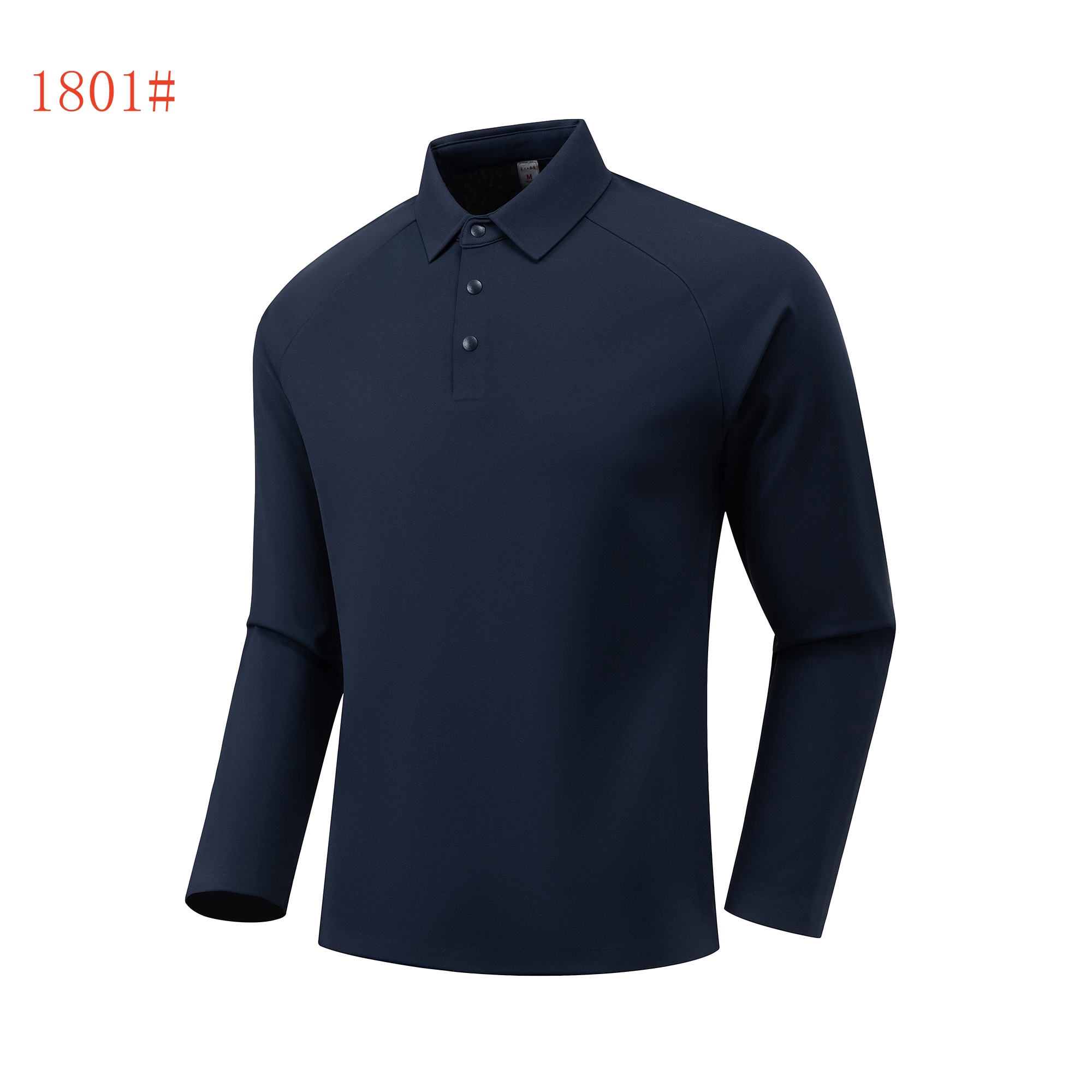
1801 Series high-elastic long sleeve in navy — a 280g four-way stretch knit built for layering rather than volume.
Specification comparison
| Parameter | 360g Hoodie (1901 Series) | 280g Long Sleeve (1701/1801 Series) |
|---|---|---|
| Fabric weight | 360g | 280g |
| Shell composition | Mountain Cotton — 63.5% cotton, 36.5% polyester | High-Elastic Tech Blend — 79.7% polyester, 20.3% spandex |
| Lining / construction | 100% polyester fleece lining; double-layer composite | Four-way stretch knit; alternative 100% polyester smooth option (18 Series) |
| Size range | M – 3XL | M – 4XL |
| Fit intent | Loose fit, sized for European and American plus sizes | Slim fit without being tight; unrestricted movement |
| Seasonal role | Standalone in spring/autumn; inner layer in winter | Standalone or base layer; lightweight and opaque |
| Handling characteristics | Stiff, durable, resistant to pilling and sagging | Smooth drape, no ironing, holds shape after stretching |
| Custom MOQ | From 200 pieces per style | From 200 pieces per style |
| Test coverage | CTI report, GB 18401-2010 Category B | CTI report, GB 18401-2010 Category B |
Certification: what is actually covered
Both styles are covered by textile safety testing from Centre Testing International Group Co., Ltd. (CTI Tianjin) against GB 18401-2010 Category B, the category that applies to textiles in direct skin contact. This matters for a layering decision because the base layer is the piece with the most continuous skin contact across a winter day.
The Mountain Cotton composite used in the 360g hoodie is covered under CTI report A2250414729102C. The long sleeve line is covered under CTI report A2250414729101C. A broader report, A2250308141104CR1, covers the full range of men's hoodies, long-sleeve shirts, T-shirts and other garment fabrics. The testing scope addresses fiber composition, colour fastness, formaldehyde and decomposable aromatic amine dyes, and the reports are stated as valid for the global market.
Buyers comparing suppliers should read two details in that list. First, the standard is named, the issuing laboratory is named, and the report numbers are traceable — not simply described as compliant. Second, the certificates attached to the 360g hoodie and the 280g long sleeve are separate documents, which means a buyer running both styles in one range should hold both, not treat one report as blanket coverage for the collection.
The direction of the wider market reinforces the point. OEKO-TEX reported issuing over 50,000 certificates between 2023 and 2024, an increase of 22%, which indicates that chemical safety documentation is moving from differentiator to baseline expectation in apparel sourcing conversations.
Procurement constraints worth checking before ordering
Specification answers what a garment is. Procurement answers whether the range can be built around it. On this supplier, the operating parameters are stated plainly.
- Minimum order quantity: custom orders start from 200 pieces per style, while stock items carry no minimum and support arbitrary mixed wholesale. A two-style winter capsule therefore starts at roughly 400 pieces if both are customised.
- Lead time: stock goods ship within 3 days; custom orders run 15–25 days from sample confirmation to bulk delivery.
- Capacity: monthly capacity of 45,000 pieces of knitted and woven garments, daily output of 1,500 pieces, and a standing stock of over 200,000 pieces.
- Customisation surface: screen printing, DTG, embroidery and heat transfer logo application, plus custom Pantone colour-dyeing for enterprise-level orders and full private label trims including inner neck taping, woven brand tags, printed wash care labels, custom hangtags and custom polybag packaging.
- Quality process: full-process inspection covering raw materials, in-process checks and finished goods, executed to AQL international standards, with 100% manual inspection before shipment and third-party on-site inspection available.
One constraint deserves advance planning. The 360g hoodie is offered in M to 3XL, while the long sleeve reaches 4XL. A brand that has standardised its size ladder around a 4XL ceiling will find the hoodie is the piece that limits the top of the range, not the long sleeve. Extending the hoodie's size run is a development conversation, not a stock-order assumption.
How the two styles map to different winter programmes
The assortment logic changes with climate, channel and customer, and the two styles perform different jobs in each case.
Cold-winter markets with a long season
Here the hoodie carries the range and the long sleeve supports it. The double-layer composite and fleece lining make the 1901 Series viable as outerwear in the transitional weeks and as a mid-layer once temperatures drop. The long sleeve then functions as the add-on that lifts average order value without requiring a second outerwear development.
Mild-winter and transitional markets
The emphasis reverses. A 280g four-way stretch piece is wearable across more weeks of the year in a mild climate, and its smooth drape and no-iron behaviour suit commuter and everyday-wear positioning. The hoodie becomes a seasonal peak item rather than the backbone of the range.
Corporate and uniform programmes
Both styles sit inside the supplier's stated coverage of corporate workwear. The hoodie suits field, logistics and outdoor-adjacent environments where structure and warmth matter; the long sleeve suits office-facing or indoor roles where movement and a clean line matter. Embroidery and screen printing are both supported on either style.
Fast-replenishment e-commerce
For cross-border sellers, the stock model removes the development cycle entirely: no minimum on stock items and 3-day dispatch allow a style to be tested before any custom commitment. The 200-piece custom threshold then applies only once a style has demonstrated demand.
Small-batch brand launches
The long sleeve range is explicitly positioned with a cost advantage suited to small and medium wholesalers placing small-batch trial orders, which makes it the lower-risk first production run for a new label. The hoodie carries a higher fabric weight and a more complex construction, so it is usually the second step once a brand has validated its fit block.
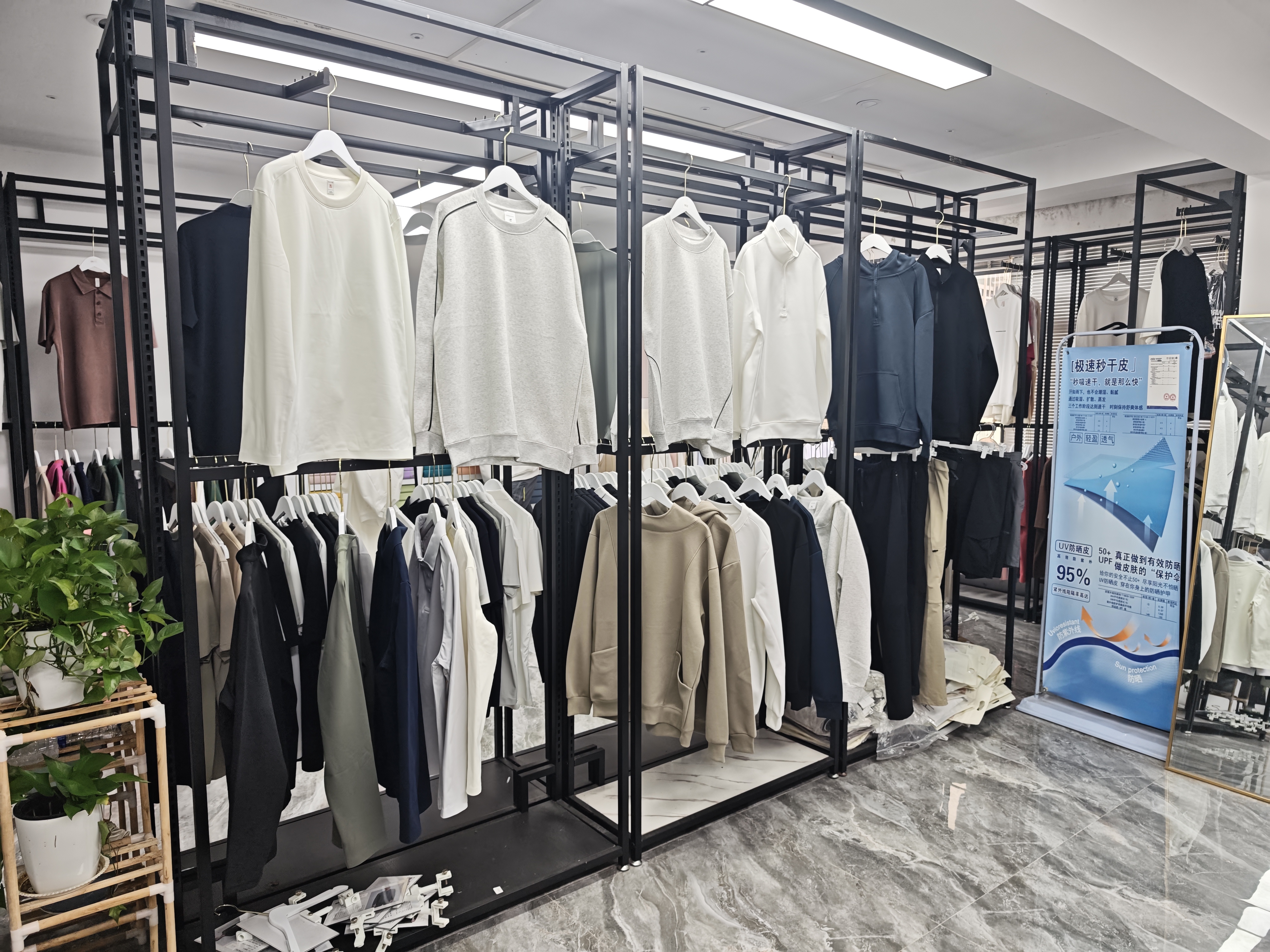
Sample room review — where the hoodie's composite shell and the long sleeve's stretch recovery are checked against the brand's fit block.
Market signals behind the weight decision
Two third-party data points give context to a 360g versus 280g decision. PrintDoors and Accio Work describe heavyweight hoodies in the 350–420 GSM band as the baseline standard for premium streetwear, valued for a structured, boxy drape. A 360g hoodie sits inside that band rather than at its top, which places it in the mainstream of premium casual rather than at the extreme end.
Separately, Proficient Market Insights estimates the custom made clothes market reaching USD 213.1 billion by 2035 with a CAGR of 10.5% from 2026. Forecast figures of this kind vary by definition across research houses, so they are best read as directional evidence that customised casual volume is expanding, not as a precise planning input.
What the two signals share is an implication for range construction: weight bands are becoming a known reference point for buyers, which means a supplier's stated grammage is now a claim that gets compared, not accepted.
Limits and trade-offs a buyer should accept in advance
An honest comparison has to state where each product stops being the right choice.
- The 360g hoodie's composite construction is the source of its warmth and its bulk. It is not a low-volume layer, and customers who prefer a thin base under a tailored coat will not treat it as one.
- The hoodie's size range stops at 3XL. Any programme that requires 4XL and above will need the long sleeve, or a development conversation.
- The 280g long sleeve is a 280g knit with a slim fit intent. It is not built to provide standalone warmth in low temperatures; it is a layering and transitional piece, and buyers should not position it as a winter outer layer.
- Both styles are documented against GB 18401-2010 Category B. Buyers with market-specific requirements beyond that scope should review the test coverage against their own destination requirements rather than assume the report covers every regulation.
- Colour and trim customisation, including Pantone dyeing, sits within enterprise-level order conditions; it is not a stock-item modification.
Decision rule: if the range needs one piece that defines the silhouette and carries the cold weeks, specify the 360g hoodie. If the range needs a layer that disappears under other garments, travels across seasons and keeps the size ladder open at the top, specify the 280g long sleeve. Most mature winter programmes need both, sequenced by climate rather than by preference.
Future outlook
Two shifts are likely to shape how ranges like this are bought. The first is documentation: with certificate volumes rising across the industry, buyers are increasingly comparing test reports before they compare prices, which favours suppliers who can name a laboratory, a standard and a report number rather than describe compliance in general terms. The second is weight literacy: as grammage bands become common reference points, stated fabric weights will be expected to match what arrives in the sample room.
For the two styles reviewed here, both developments point in the same direction. The 360g hoodie's value depends on the composite construction being what the specification says it is; the 280g long sleeve's value depends on stretch recovery holding after repeated wear. Neither claim is settled at the order stage — both are verified at sample and again at bulk inspection.
Frequently asked questions
What is the functional difference between a 360g hoodie and a 280g high-elastic long sleeve in a winter layer system?
The 360g hoodie uses a double-layer composite with a 100% polyester fleece lining for heat retention, and is designed for standalone wear in spring and autumn or as an inner layer in winter. The 280g long sleeve uses a four-way stretch knit and functions as a lightweight, opaque base layer or standalone piece. The hoodie provides warmth and structure; the long sleeve provides movement and a smooth drape under other garments.
What textile safety certification covers these two products?
Both are covered by testing from Centre Testing International Group Co., Ltd. (CTI Tianjin) against GB 18401-2010 Category B. The Mountain Cotton composite used in the 360g hoodie is covered under report A2250414729102C, and the long sleeve line under report A2250414729101C. A further report, A2250308141104CR1, covers the full range of men's hoodies, long-sleeve shirts, T-shirts and other garment fabrics.
What are the fabric compositions and size ranges of each style?
The 360g hoodie is made from Mountain Cotton, a 63.5% cotton and 36.5% polyester shell with a 100% polyester lining, and is available in sizes M to 3XL with a loose fit sized for European and American plus sizes. The 280g long sleeve uses a High-Elastic Tech Blend of 79.7% polyester and 20.3% spandex, with a 100% polyester smooth option in the 18 Series, and is available in sizes M to 4XL with a slim fit that is not tight.
What are the minimum order quantities and lead times for customising these styles?
Custom orders start from 200 pieces per style. Stock items carry no minimum order quantity and support arbitrary mixed wholesale, with stock goods shipped within 3 days. Custom orders run 15–25 days from sample confirmation to bulk order delivery.
Which customisation methods are supported on these garments?
Supported logo methods are screen printing, DTG, embroidery and heat transfer. Custom Pantone colour-dyeing is available for enterprise-level orders, and full private label trims include inner neck taping, woven brand tags, printed wash care labels, custom hangtags and custom polybag packaging.
What limitations should a buyer plan around?
The 360g hoodie's composite construction delivers warmth but adds bulk, and its size range stops at 3XL while the long sleeve reaches 4XL. The 280g long sleeve is a lightweight knit intended for layering and transitional wear rather than standalone cold-weather warmth. Both are documented against GB 18401-2010 Category B; buyers with additional market-specific requirements should review the test scope against their destination requirements.
The full product catalogue from Lihongwear, including the 1901, 1801 and 1701 Series with fabric and trim details, can be downloaded here: Lihong Garment Factory Product Catalogue.
Tem questões ou precisa de mais detalhes?
Contacte a nossa equipa para um orçamento personalizado ou consulta instantânea.
Solicitar orçamento
Preencha o formulário abaixo e a nossa equipa entrará em contacto com uma proposta personalizada.
Chat direto do WhatsApp
Prefere conversar em tempo real? Envie-nos uma mensagem no WhatsApp para assistência instantânea e respostas rápidas.
- Obter orçamento personalizado
- Partilhar fotos ou documentos
- Discuta as suas necessidades diretamente
Geralmente responde em 5–30 minutos durante o horário de expediente.