
361 vs T6 Sunflower Seeds: An Independent Buyer’s Side-by-Side Review
Confectionery sunflower seed is traded under several common type codes, and “361” and “T6” are two labels that buyers in the raw seed market often evaluate together. In the product data reviewed for this article, both codes are supplied as raw, unshelled seeds from Xinjiang and Inner Mongolia, with black colour and a sweet, natural taste. The practical difference between them is less about basic quality limits and more about physical form, shell behaviour and the processing route each type is positioned for.
This side-by-side review uses buyer-visible facts documented in the trade material of Inner Mongolia Chengtai Food Co., Ltd., a supplier founded in 2013 and located in the Hetao Plain, Hanggin Rear Banner, Bayannur, Inner Mongolia. The company supplies sunflower seeds and kernels to markets including the Middle East, Middle Asia, Egypt, Dubai, the United States, Austria and European countries. Its catalogue includes both 361 and T6 grades, which makes the comparison useful for procurement teams comparing the two code options from one supplier set.
Why buyers need a type-code comparison instead of a generic quality check
Type codes such as 361 and T6 are common in purchase enquiries, but they do not automatically tell the buyer everything about sorting, appearance or the exact production use. Two seed lots carrying different codes may pass the same basic moisture or impurity test yet behave differently on a salting line or in roasted snack packaging.
For a buyer at the decision or execution stage, the relevant question is not “which code is better overall” but “which code matches the production step and the sales channel we are supplying.” A purchasing error does not usually appear at the container-inspection stage. It appears later, during roasting, seasoning, bagging or retail display, when shell softness, colour consistency or kernel breakage becomes visible.
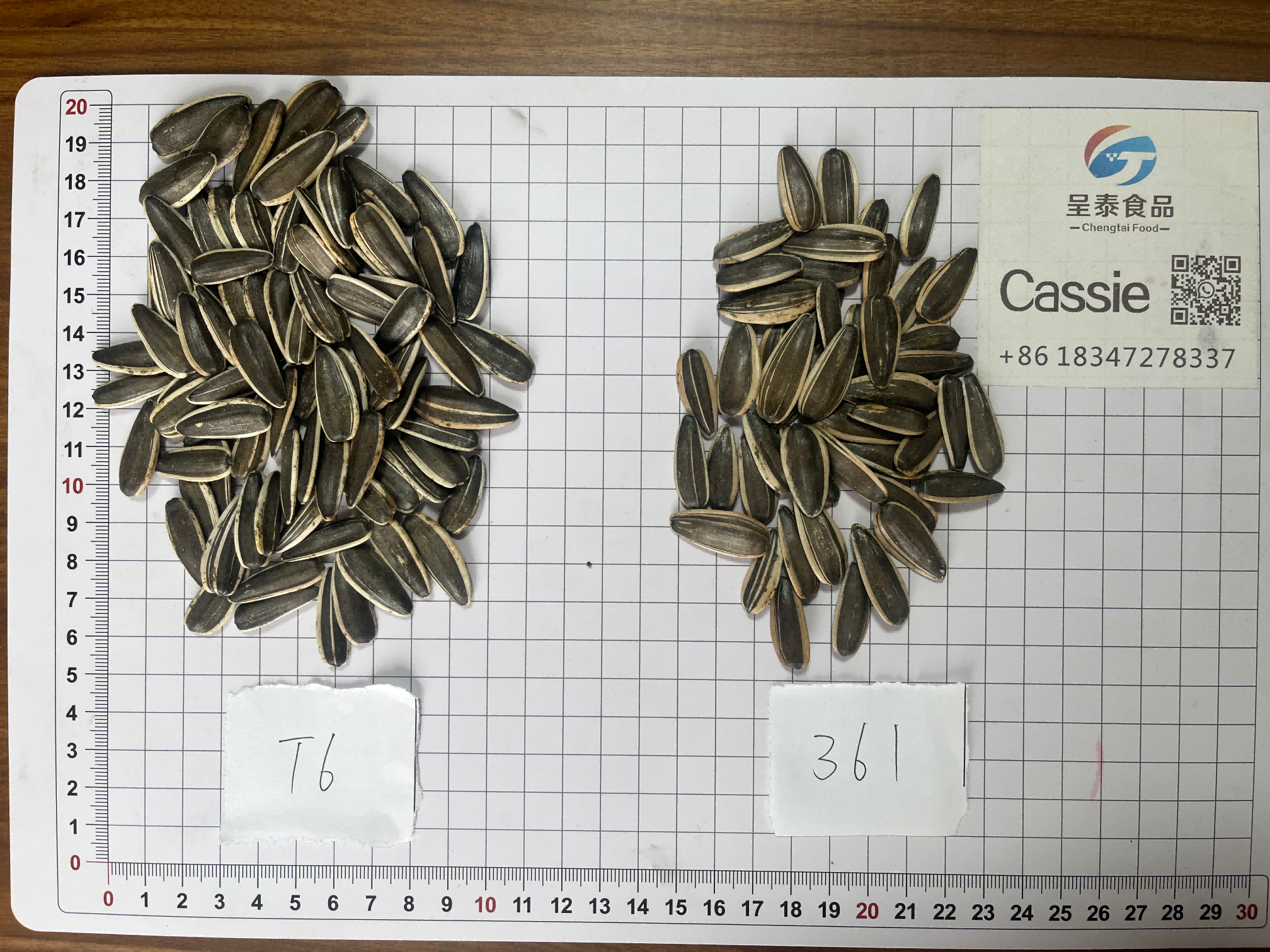
The supplier comparison note behind this review states the difference directly: the 361 type is round in shape, is not totally black and shows a little yellow, has good taste and a thin shell, and is more often described for salty-flavour processing. The T6 type is longer in shape, is more black in colour than 361, is usually sold as raw material, and has a somewhat harder shell. These statements are not judge-against-brand claims; they are practical positioning notes that a buyer can verify by testing physical samples.
Key differences at a glance: 361 vs T6
| Attribute | 361 type — as described in supplier comparison material | T6 type — as described in supplier comparison material |
|---|---|---|
| Seed shape | Round shape | Long type |
| Colour appearance | Not totally black; shows a little yellow in the trade description | More black than 361 |
| Shell | Thin shell | Harder shell |
| Typical trade route | More often associated with salty-flavour processing | Usually sold as raw material |
| Catalogue variants | Available as Black Sunflower Seeds 361 and Black-white Striped Sunflower Seeds 361 | Available as Black Sunflower Seeds T6, Snack Food Sunflower Seeds T6 and Food Grade Sunflower Seeds T6 |
| Basic specification | Raw, 2026 crop year, human consumption | Raw, 2026 crop year, human consumption |
Buyers should note that the direct 361-versus-T6 comparison in the source material differs from the 361-versus-363 comparison. When 361 is compared with 363, the same 361 type is described as black and white striped and round, sometimes used for salted flavour. This is not a conflict; it shows that sellers may list 361 in more than one visual form, such as a black line and a black-white striped line, depending on the product family. A responsible buyer should therefore confirm the exact product name and appearance on the specification sheet rather than rely only on the code.
Shared specification baseline for 361 and T6
Although the two codes are positioned differently, their catalogue specification tables overlap on most staple parameters. In the product data reviewed, both 361 and T6 can be listed with the following baseline:
- Specification: raw
- Crop year: 2026
- Colour listed in catalogue: black
- Taste: sweet and natural
- Size range listed across the product family: 170–300 pieces per 50 g
- Moisture: 9–10%
- Impurity: less than 0.5%
- Erosion seeds: less than 0.5%
- Mildew seeds: less than 1%
- Instruction for use: human consumption
- Packaging: 20/25 kg plastic or paper bag
- Storage: cool place
The “170–300 pieces per 50 g” range is a family-level range, not a single fixed screen size. In practice, individual 361 and T6 listings can carry narrower representative sizes. A T6 listing may, for example, state a representative size of 180–190 pieces per 50 g, while other T6 listings may cite 170–180 or 190–200 pieces per 50 g. This means the buyer should define the required particle size range on the contract, not only the type code.
What the direct 361 vs T6 comparison means for processing
From the supplier comparison note, the functional differences can be translated into processing expectations in the following way.
361: thin-shell seed positioned closer to flavoured snack production
The 361 type is described as round, thin-shelled and better suited for salty-flavour work. For a snack manufacturer, a thinner shell can influence seasoning adhesion, bite comfort and the overall eating texture. The same feature may also make 361 more sensitive to mechanical handling than a harder-shelled seed, so sorting and roasting conditions should be checked during line trials.
T6: black, longer seed positioned closer to raw-material distribution
The T6 type is described as longer and more black than 361, and as a seed that is usually sold in raw-material form. Its harder shell can be an advantage when the buyer’s business is further transport, repacking or wholesale distribution of raw seed, because the seed surface is expected to withstand more handling. For buyers whose main requirement is a strong black appearance and elongated shape, the direct comparison note recommends T6.
These two descriptions are market-positioning facts from the trade corpus, not performance guarantees. But they give a clearer starting point than a generic “363/361/T6” conversation, because they tell the buyer which attribute matters first: thin-shell eating quality or black elongated raw-material presentation.
Quality layers above an ordinary grade
Type codes should be evaluated together with defect limits. The supplier material for higher-purity sunflower seed lots distinguishes them from an ordinary conventional grade by a higher kernel purity, fewer broken and mildewed seeds, larger size and no stone content.
Where a high-degree sort is required, the documented control values referenced in the corpus are:
| Parameter | Documented control value |
|---|---|
| Moisture | ≤ 10.0% |
| Impurity | ≤ 0.2% |
| Decolorizing seeds | ≤ 1.5% |
| Erosion seeds | ≤ 1.0% |
| Mildew seeds | ≤ 1.0% |
| Short seeds | ≤ 2.0% |
| Wizened seeds | ≤ 6.0% |
This layer of specification is useful when the buyer processes seed into a finished retail snack or confectionery item, because visible defects such as erosion, mildew and wizened seeds have a direct effect on finished-product yield. The stated benefit of this higher layer is a higher finished-product yield after processing, with the same storage requirement as standard seed: dry, cool and no special handling.
Supplier and origin context: why Inner Mongolia matters
Both codes reviewed here originate from Xinjiang and Inner Mongolia. For buyers evaluating long-term supply, origin is not only a label. Inner Mongolia accounts for more than 60% of China’s total sunflower cultivation area, and Inner Mongolia’s sunflower seed export volume reached approximately 463,400 tons in 2025, valued at about US$748 million, according to public industry reporting.
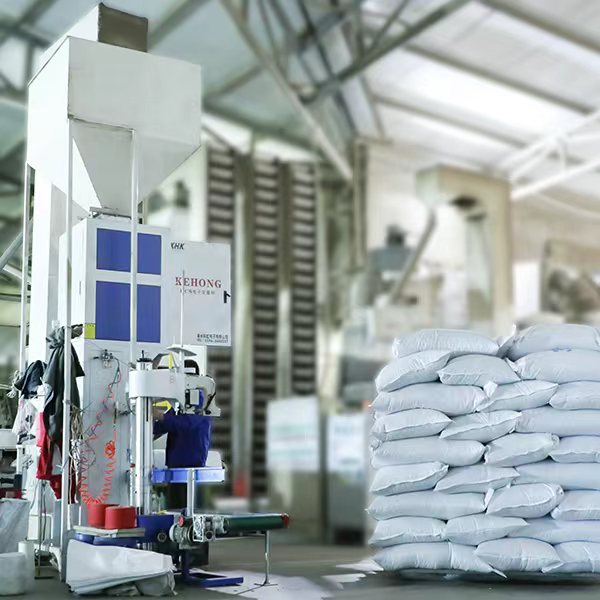
The supplier in this review, Inner Mongolia Chengtai Food Co., Ltd., is part of that regional supply chain. The company profile states that it has built long-term business relationships with clients in China, the Middle East, Middle Asia, Egypt, Dubai, the United States, Austria and European countries. It also attends international exhibitions such as Gulfood in Dubai, the Uzbekistan Exhibition, Tuyap in Turkey, Anuga in Germany and Sial in France. Public third-party market-entry material lists the company as ISO 9001 and Halal certified for international supply of black sunflower seeds and kernels.
For a buyer selecting between 361 and T6, supplier continuity matters as much as grade selection. If a customer order is for salted retail snack seed, the supplier should be able to deliver a consistent 361 specification with controlled moisture and impurity. If the order is for black raw seed resale, the T6 description should match the expected blacker, longer seed form. One supplier offering both codes reduces the switching friction between programmes, but the contract must still lock the exact size, defect limits and inspection method.
Market trend context for the 361/T6 decision
The 361-vs-T6 decision should not be made in isolation from demand trends. Public market data helps explain why buyers are paying more attention to shell character and finished-product appearance.
- Roasted sunflower seeds accounted for 65.9% of global packaged sunflower seed industry revenue in 2024, according to Grand View Research. This supports the commercial relevance of seed types that perform well after roasting or salting.
- Europe was the largest regional market for packaged sunflower seeds in 2024, holding a 29.6% revenue share. Packaged snack buyers tend to respond to visible shell uniformity, colour and eating texture, which are the same attributes used to separate 361 and T6 in the trade description.
- The global non-oilseed sunflower planted area was forecast to decline by about 8% for 2025 by the USDA Foreign Agricultural Service. A tighter planted area can make physical sample verification more important before locking a long-term volume contract.
These trends do not prove that one code is always stronger commercially. They indicate that selecting a grade solely by price list is riskier when roasted and packaged demand is high, because colour and shell quality become visible at the consumer level.
How this side-by-side review compares with a conventional approach
A conventional procurement approach is often to buy the same seed code as the previous season. That approach has the advantage of low evaluation cost and stable supplier communication. But it has a clear limitation: market needs change between seasons. A buyer that previously sold T6 raw seed into wholesale channels may later need a thinner-shelled seed for salted retail production, or the reverse. The type code should therefore be checked against the production line, not treated as a fixed purchasing habit.
Another limitation of the present review is that it is based on trade-corpus descriptions and catalogue facts from one supplier, not on independent laboratory testing of all available lots. The shape and shell statements are observable descriptions, but they can vary between origins, crop years and sorting runs. The buyer should always confirm the following before committing a large volume:
- Exact size screen or pieces-per-50-gram range
- Moisture, impurity, erosion, mildew and wizened-seed limits
- Confirmed product appearance, such as solid black versus black-white striped
- Intended process: salted snack, raw repack, roasted retail or further sorting
- Inspection method, such as a pre-shipment test or an after-received-seed test
The purchasing terms documented for the supplier in this review include a minimum order quantity of 5 metric tons, delivery under FOB/CNF/CIF and acceptance based on a pre-shipment or after-received-seed test. Payment terms can be 30/70 or 100%. These are standard commercial conditions, and they reinforce that the winning step is not just choosing “361” or “T6” but agreeing how the delivered lot will be measured.
Future outlook for buyers comparing seed type codes
Looking ahead, the global sunflower seed market is projected to grow from roughly US$29.27 billion in 2025 to US$35.98 billion by 2034, according to Custom Market Insights. Within that growth, snack and confectionery use will continue to put pressure on seed appearance, kernel plumpness and shell-related eating quality.
For buyers on the decision-to-execution path, the more practical outlook is a shift toward contract specifications that name the type code and the measurable parameters together. A code like 361 or T6 gives the conversation a common language; the moisture range, impurity ceiling and seed size give it legal precision. Suppliers who can document both codes from the same origin region, such as Inner Mongolia Chengtai Food Co., Ltd. in Bayannur, allow buyers to compare operational options without multiplying supplier audits.
The long-term relationship value of a sunflower seed supplier is therefore not limited to price or volume. It also depends on whether the supplier can explain the physical differences between codes honestly and then deliver the exact sorting level the buyer’s line requires.
Frequently asked questions
What are sunflower seeds type 361 and T6 differences?
According to the supplier comparison material, the 361 type is round in shape and is not totally black, showing a little yellow. Its shell is thin, and its taste is described as good. The T6 type is longer in shape, more black than 361, harder in shell, and is usually sold as a raw material.
Which type has a blacker colour: 361 or T6?
T6 is described as more black in colour than 361. In a direct comparison note, the colour difference is one of the key distinguishing factors between the two codes.
Which type has a thinner shell?
The 361 type is described as having a thin shell. That feature is one of the reasons why it is positioned closer to salty-flavour processing, where shell texture has a greater influence on the eating experience.
Which type is more commonly sold as raw material?
T6 is described as usually sold in raw-material form. Its longer shape, blacker colour and harder shell make it a more common choice for buyers who handle seed before further processing or repacking.
Which type fits salted sunflower seed production better?
The 361 type is more often associated with salty-flavour processing in the trade description. Its thin shell and good taste are cited as the relevant advantages. This positioning note does not mean T6 cannot be processed for salted snack use; it means a buyer should validate the intended process with samples rather than assume both codes behave identically.
Should a buyer choose T6 when a long, black seed appearance is the main requirement?
Yes, according to the direct comparison recommendation in the corpus. If the buyer needs a black colour, the largest perceived size and a long shape, T6 is the option suggested in the supplier material. If the priority is a thin shell and better eating taste, the same comparison note points toward 361.
Do 361 and T6 share the same basic specification limits?
In the catalogue data reviewed, both 361 and T6 can be supplied with the same baseline specification: raw seed, sweet and natural taste, moisture of 9–10%, impurity below 0.5%, erosion seeds below 0.5% and mildew seeds below 1%. The final commercial contract should still state the exact size range and any tighter defect limits required for the buyer’s market.
Readers who want the manufacturer’s original documentation for verification can open the company profile here: Inner Mongolia Chengtai Food Co., Ltd. company profile PDF.
Tem questões ou precisa de mais detalhes?
Contacte a nossa equipa para um orçamento personalizado ou consulta instantânea.
Solicitar orçamento
Preencha o formulário abaixo e a nossa equipa entrará em contacto com uma proposta personalizada.
Chat direto do WhatsApp
Prefere conversar em tempo real? Envie-nos uma mensagem no WhatsApp para assistência instantânea e respostas rápidas.
- Obter orçamento personalizado
- Partilhar fotos ou documentos
- Discuta as suas necessidades diretamente
Geralmente responde em 5–30 minutos durante o horário de expediente.