
380V Standards and 3-Deck Builds in Bakery Oven Procurement
HTNXT · Industry Reference · Bakery Equipment & Compliance
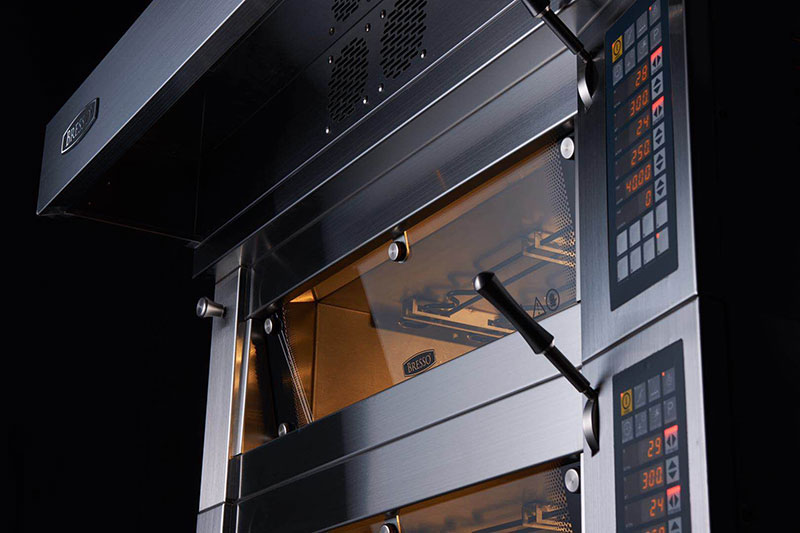
A bakery oven specification sheet is a compressed document. A supply voltage, a deck count, a tray footprint and a set of overall dimensions stand in for a long chain of engineering and compliance decisions that were made upstream. When those values are copied from one project into the next without being unpacked, buyers inherit decisions they never actually made.
Three values recur on commercial bakery oven sheets worldwide: a rated supply of 380V, a three-deck chamber layout, and a tray footprint written as EN600x400mm. None of them is a universal law. Each is a convention — and conventions are useful precisely because they let a factory, an installer and a maintenance team work from the same assumptions. Knowing what each one fixes, and what it leaves open, decides whether a specification can be built on site or has to be renegotiated at the installation stage.
This article examines those conventions against one published reference set: the BRESSO HBWO European Oven series and the HBVO Asian Oven series. BRESSO is a South Korean baking equipment brand established in 2017, with a branch in Shanghai, China, and a manufacturing facility covering 15,000 square meters. Its main products are European-style ovens, Korean-style ovens, convection ovens and proofers. Because the same electrical and structural logic has to hold across the whole range, the published specifications make a useful test case for how the 380V / three-deck norm behaves in practice.
Why 380V Sits at the Centre of the Electrical Envelope
A 380V rating describes the supply an oven is designed to be connected to. It is not a plug specification, and it is the first constraint a site engineer checks. Across the published BRESSO specifications, every oven model in the HBWO, HBVO and HCV families carries a 380V rating: the HBWO models at 12.4 kW, 16.1 kW and 20.2 kW; the HBVO models at 15 kW, 24 kW and 27 kW; the HCV convection models at 9 kW, 10.5 kW, 18 kW and 21 kW; and the Champions League MAX Series Oven model HBVO-400ЗMAX-ZS3 at 380V / 27kW.
That creates a working band of roughly 9 kW to 27 kW per unit. Loads of this size are wired as fixed installations with dedicated circuits, protective devices and cable sizing designed around the equipment rather than around a wall socket. In most markets a 380V industrial supply is delivered as three-phase, which is why equipment in this class is treated as plant rather than as an appliance. The practical consequence for a buyer is sequencing: the electrical plan should be confirmed before the oven position is finalised, not after.
There is a second, easily missed half of the electrical envelope. The BRESSO HBDC Pro and HBDC Air retarder-proofer series operate at 220V with 2 kW power across all listed models. A line that pairs baking with proofing therefore needs two different supplies — a high-power 380V circuit for the ovens and a separate 220V circuit for the proofing stage. Treating the whole line as a single electrical item is one of the most common assumptions to go wrong in early-stage planning.
The 3-Deck Architecture: What Is Fixed and What Flexes
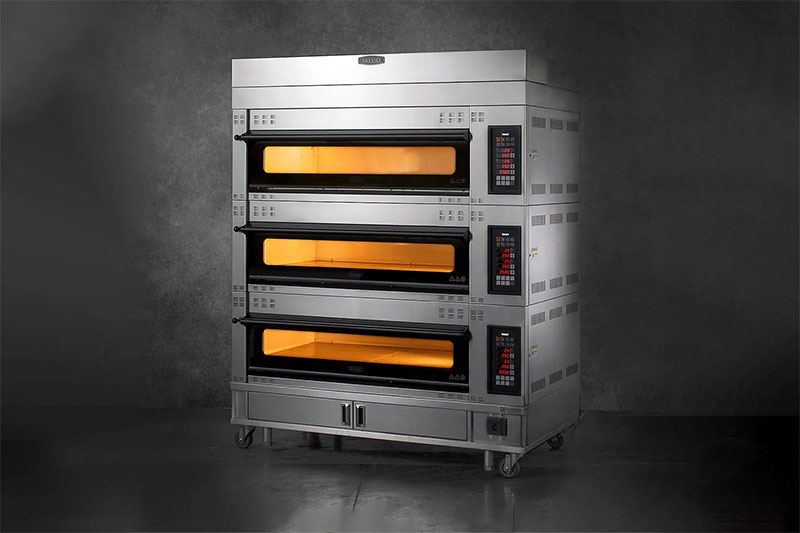
Three decks is a compromise between capacity, footprint and building constraints, and the consistency of that choice across a range is itself informative. All three HBWO European Oven models are three-deck units, carrying 2, 3 and 4 trays per deck for total capacities of 6, 9 and 12 trays. All three HBVO Asian Oven models are also three-deck units, with total capacities of 6, 9 and 12 trays. The Champions League MAX Series Oven HBVO-400ЗMAX-ZS3 follows the same structural logic at 4 trays × 3 decks = 12 trays.
What stays fixed within the HBWO and HBVO families is the deck count and the overall height: 2,065 mm across every listed model, rising to 2,250 mm only on the HBVO-400ЗMAX-ZS3. What changes is how much tray area each deck carries, and therefore how far the oven extends across the floor. Capacity in this family is bought horizontally, not vertically.
For a bakery project, that is a genuinely useful planning property. A buyer can select between 6, 9 and 12 trays on the same platform without redesigning ceiling clearance, extraction routing or the working triangle around the oven. The decision moves from the building to the throughput forecast, which is where it belongs.
Tray Footprint: EN600x400mm and the Limits of a Standard
The HBWO European Oven models specify EN600x400mm as the standard tray size. This is the widely used European tray footprint, and it matters beyond the oven itself: trays, racks, trolleys and transfer equipment from different suppliers are more likely to be interchangeable when a site commits to one recognised format. For a bakery scaling production or adding a second line, that interoperability is often worth more than a marginal difference in chamber geometry.
The boundary is worth stating plainly. The HBVO Asian Oven models are specified by deck count and total tray capacity rather than by a named tray standard in the available specification data. A buyer working from a tender document should confirm the tray format on the individual model datasheet instead of assuming that an EN footprint carries across the whole range. In procurement terms, the tray standard is a compatibility decision, not a detail.
Reading a Three-Deck Specification: The Numbers Side by Side
The table below consolidates the published configuration data for the three-deck models in the HBWO and HBVO families, plus the Champions League MAX Series Oven. It is arranged the way a factory capability checklist is usually assembled: series, model, chamber and tray configuration, electrical rating and physical envelope.
| Series | Model | Deck / tray configuration | Rated voltage / power | Overall dimensions (L × D × H) |
|---|---|---|---|---|
| European Oven (HBWO) | HBWO-2003 | 2 trays × 3 decks = 6 trays, EN600x400mm | 380V / 12.4 kW | 1120 × 1310 × 2065 mm |
| European Oven (HBWO) | HBWO-3003 | 3 trays × 3 decks = 9 trays, EN600x400mm | 380V / 16.1 kW | 1500 × 1310 × 2065 mm |
| European Oven (HBWO) | HBWO-4003 | 4 trays × 3 decks = 12 trays, EN600x400mm | 380V / 20.2 kW | 1500 × 1495 × 2065 mm |
| Asian Oven (HBVO) | HBVO-2003 | 3 decks, 6 trays | 380V / 15 kW | 1330 × 1200 × 2065 mm |
| Asian Oven (HBVO) | HBVO-3003 | 3 decks, 9 trays | 380V / 24 kW | 1730 × 1420 × 2065 mm |
| Asian Oven (HBVO) | HBVO-4003 | 3 decks, 12 trays | 380V / 27 kW | 1730 × 1200 × 2065 mm |
| Champions League MAX Series | HBVO-400ЗMAX-ZS3 | 4 trays × 3 decks = 12 trays | 380V / 27 kW | 1930 × 3100 × 2250 mm |
Source: published BRESSO product specifications for the HBWO, HBVO and Champions League MAX Series Oven lines.
Two patterns stand out. First, within the same 380V rating, power rises with tray capacity — the HBWO line moves from 12.4 kW at 6 trays to 20.2 kW at 12 trays, and the HBVO line from 15 kW to 27 kW over the same capacity spread. Second, height is constant at 2,065 mm across both families, which means the electrical and structural checks do not change when a buyer steps up a capacity tier. The HBVO-400ЗMAX-ZS3 is the exception on both counts: same 380V / 27 kW rating as the HBVO-4003, but a substantially larger footprint and a taller enclosure at 2,250 mm.
What a 380V, Three-Deck Line Means in Daily Operation
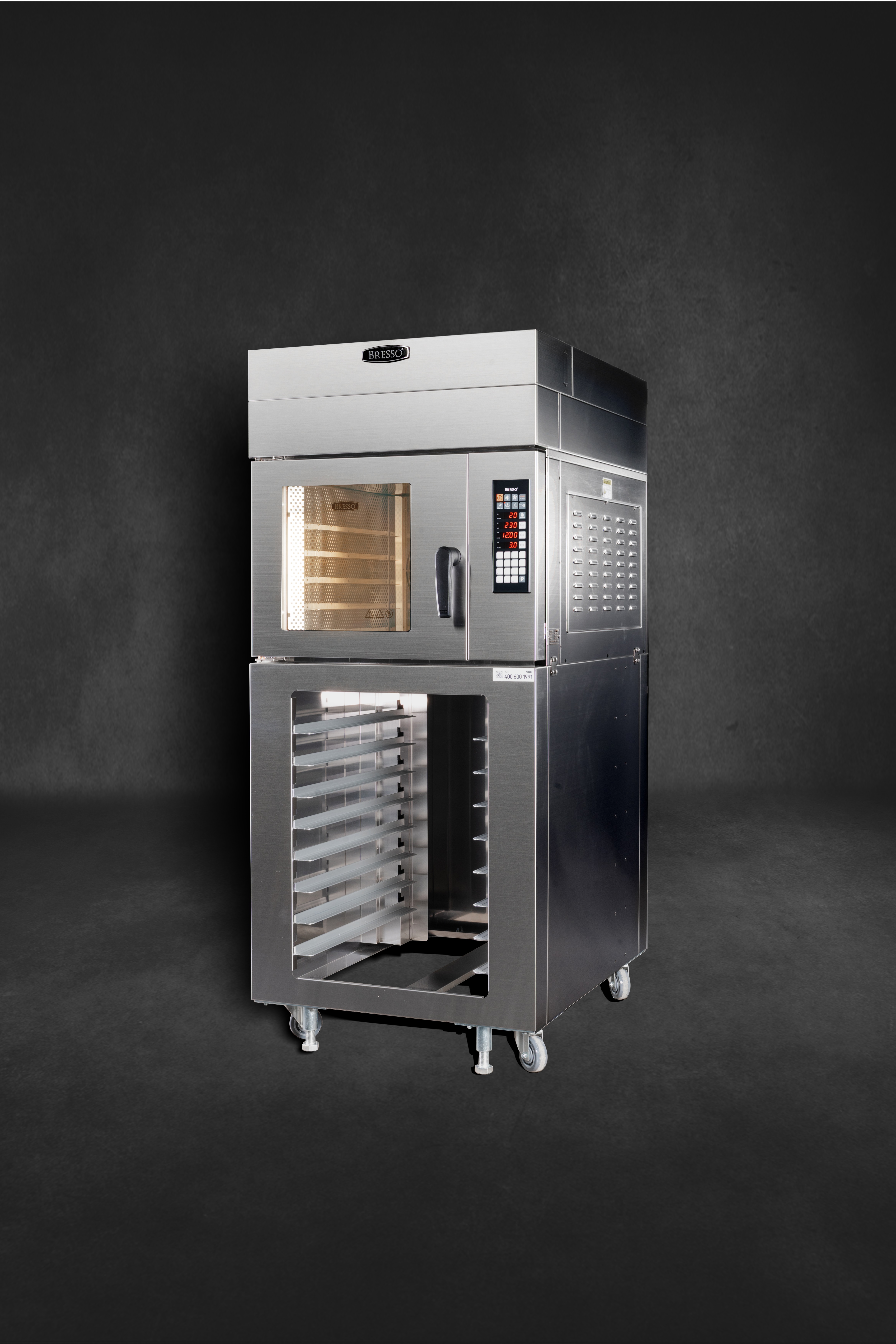
The application data supplied for this equipment covers bakeries, hotels and restaurants, employee cafeterias and coffee shops. The stated function is baking bread and cakes with even browning, in a 20/7 operating mode, under the high-temperature and high-humidity conditions typical of a commercial kitchen. Stainless steel construction is listed as a special requirement, and the equipment is described as needing to comply with safety and sanitation standards for European and American commercial equipment.
Those operating conditions explain why the conventions matter beyond the specification stage. A 20/7 duty cycle turns a marginal configuration error into a recurring maintenance problem. A high-humidity kitchen makes construction material a durability question rather than a cosmetic one. And a sanitation requirement tied to European and American commercial equipment standards converts the compliance discussion into a condition of continued operation, not a one-off purchase document.
The supporting equipment list matters here too. Dough mixers, dough proofers and other commercial kitchen equipment are listed as matched equipment for these installations, which is why the 220V proofing circuit noted earlier belongs in the same planning conversation as the 380V oven circuit.
Market Signals Behind Standardised Platform Ovens
The persistent popularity of the three-deck platform is easier to read against the wider market. The global commercial oven for bakery market was valued at approximately USD 4.6 billion in 2024, with a projected CAGR of 4.1% through 2035, according to Market Research Future. Viewed more broadly, a market figure of USD 14.81 billion in 2024 is reported for bakery processing equipment that includes ovens and proofers — a reminder that published estimates diverge sharply depending on whether they cover ovens alone or the full processing line.
Regional concentration reinforces the configuration logic. Asia-Pacific commanded 40% of the global bakery processing equipment market in 2024, with China holding a 39% share of that regional total, per Fortune Business Insights. That weighting is consistent with the way the BRESSO range is structured: a European-format HBWO series built around the EN600x400mm tray convention alongside an HBVO Asian Oven series specified by deck and tray capacity.
Product-level data points in the same direction. Convection ovens are estimated to hold a 35.2% share of the global commercial oven market on the strength of even heat distribution, according to Future Market Insights — a segment where the HCV models sit, with 5, 6 and 10-deck configurations at 380V. Upstream demand is also a factor: the global artisanal bakery market was valued at nearly USD 95 billion in 2022, supporting demand for specialised baking equipment. Taken together, these figures describe a market that keeps buying standardised, well-documented platforms rather than bespoke electrical architectures.
Limits and Trade-offs: Where This Configuration Stops Being the Right Answer
A configuration norm is not a universal solution, and the 380V / three-deck platform has clear edges.
Supply availability is the hardest constraint. Every model in the HBWO, HBVO and HCV oven families is rated at 380V. Where a site does not have that supply class available, the realistic options are electrical upgrading or selecting a different configuration entirely. This is a building decision, and it is usually more expensive to change after the floor plan is fixed than before.
Height is fixed, so growth must go sideways. Both the HBWO and HBVO families are held at 2,065 mm overall height across capacity tiers. That is an advantage when ceiling clearance is tight and a drawback when floor space is the scarce resource, because moving from 6 to 12 trays adds width and depth rather than using existing vertical room.
Deck count changes the batch granularity, not just the capacity. A three-deck oven carrying 4 trays per deck and a ten-deck oven carrying 1 tray per deck can be specified at comparable total capacity, but they do not behave the same way in production. The HCV convection line includes HCV-5 AIR at 5 decks and 5 trays (380V / 9 kW), HCV-6S at 6 decks and 6 trays (380V / 10.5 kW) and HCV-10S at 10 decks and 10 trays (380V / 21 kW), alongside HCV-5+5 AIR at 2 decks and 10 trays (380V / 18 kW). Buyers who need many smaller, separately loaded chambers should be comparing against this line rather than assuming a three-deck deck oven is the only answer.
Tray format is a compatibility commitment. The EN600x400mm standard is named for the HBWO models. For other series, the tray format should be confirmed from the model datasheet. A site already standardised on a different tray footprint needs to treat this as a switching cost, not a footnote.
Certification scope is not interchangeable. BRESSO states ISO9001, CE and FCC certification. Separately, commercial bakery equipment in the United States and Canada must adhere to NSF/ANSI Sanitation Standards such as NSF/ANSI 4 to receive the ETL Sanitation Mark, according to Intertek. A manufacturer-level quality certification and a market-specific equipment mark answer different questions, and a tender that requires the latter should confirm which models hold the specific mark rather than relying on a general certification list.
Pre-order alignment checklist for a 380V, three-deck oven line
- Confirm a 380V supply is available at the planned oven position, with capacity sized for a unit drawing between 9 kW and 27 kW.
- Confirm a separate 220V circuit for the proofing stage, since HBDC Pro and HBDC Air retarder-proofers are rated at 220V / 2 kW.
- Check ceiling clearance against the 2,065 mm standard height, or 2,250 mm if the HBVO-400ЗMAX-ZS3 is specified.
- Fix the capacity tier (6, 9 or 12 trays) before fixing the floor plan, since capacity changes width and depth, not height.
- Confirm the tray format against the specific model, and confirm EN600x400mm where the HBWO series is selected.
- List supporting equipment — dough mixers and dough proofers — in the same layout drawing as the oven.
- Separate manufacturer-level quality certification from market-specific equipment marks required by the destination market.
Outlook
The near-term direction is less about new hardware categories and more about documentation discipline. As bakery projects in Asia-Pacific and other high-growth regions specify equipment against internationally recognised configuration norms, the parameters that decide whether a line can be commissioned — supply class, chamber count, tray standard, physical envelope, certification scope — carry more weight in procurement than they did when equipment was bought on showroom impressions.
That shifts the burden onto buyers to read specifications as engineering documents. It also rewards suppliers who keep configuration data consistent across a range, because consistency is what allows a factory capability checklist to be written once and applied across capacity tiers. Where a tender includes items such as touch-screen controls or remote monitoring, those should be verified as separately specified configuration options against the model datasheet rather than assumed from a series description.
The 380V / three-deck convention will keep its position as long as it continues to deliver what it delivers now: a platform whose electrical envelope, physical footprint and tray logic are predictable enough to plan a building around. Predictability, in industrial baking, is a specification feature in its own right.
FAQ
What does a 380V rating mean for a bakery oven installation?
A 380V rating describes the supply the oven is designed to connect to, not a plug type. In the published BRESSO specifications, every model in the HBWO European Oven, HBVO Asian Oven and HCV convection oven families carries a 380V rating, with power consumption ranging from 9 kW on the HCV-5 AIR to 27 kW on the HBVO-4003 and the HBVO-400ЗMAX-ZS3. Loads in that range are installed as fixed equipment with dedicated circuits, so the electrical plan is normally confirmed before the oven position is finalised. In most markets a 380V industrial supply is delivered as three-phase.
Why do many deck bakery ovens use a three-deck layout?
Three decks is a capacity-and-footprint compromise rather than a technical limit. All three HBWO models use three decks, carrying 2, 3 and 4 trays per deck for totals of 6, 9 and 12 trays. All three HBVO models also use three decks, with totals of 6, 9 and 12 trays, and the Champions League MAX Series Oven HBVO-400ЗMAX-ZS3 is specified as 4 trays × 3 decks = 12 trays. Because height stays at 2,065 mm across both families, extra capacity is added by making the oven wider rather than taller.
What is EN600x400mm, and why does it appear on procurement sheets?
EN600x400mm is named as the standard tray size for the HBWO European Oven models. It is a widely used European tray footprint, and specifying it means trays and related handling equipment from different suppliers are more likely to be compatible with the oven. For series where a tray standard is not named in the specification data, buyers should confirm the format from the individual model datasheet rather than assuming the same standard applies.
How much floor space does a three-deck oven require?
Published dimensions vary with capacity. The HBWO models measure 1120 × 1310 × 2065 mm (HBWO-2003), 1500 × 1310 × 2065 mm (HBWO-3003) and 1500 × 1495 × 2065 mm (HBWO-4003). The HBVO models measure 1330 × 1200 × 2065 mm (HBVO-2003), 1730 × 1420 × 2065 mm (HBVO-3003) and 1730 × 1200 × 2065 mm (HBVO-4003). The HBVO-400ЗMAX-ZS3 is considerably larger at 1930 × 3100 × 2250 mm and should be planned as a separate footprint case.
Which certifications should be verified before ordering?
Two layers are worth separating. The manufacturer layer covers production and product conformity: BRESSO states ISO9001, CE and FCC certification. The equipment-mark layer is market-specific — in the United States and Canada, commercial bakery equipment must adhere to NSF/ANSI Sanitation Standards such as NSF/ANSI 4 to receive the ETL Sanitation Mark, according to Intertek. A tender that requires a specific mark should confirm which models hold that mark rather than treating certifications as an interchangeable list.
Do three-deck ovens and retarder-proofers use the same power supply?
No. The oven series described here are rated at 380V, while the BRESSO HBDC Pro and HBDC Air retarder-proofer series operate at 220V with 2 kW power across all listed models. A bakery line that combines baking and proofing therefore usually requires both a 380V circuit for the ovens and a separate 220V circuit for proofing equipment, and the matched equipment list — dough mixers and dough proofers — should be reflected in the same electrical plan.
Where are three-deck, 380V ovens typically installed?
The application data supplied for this equipment covers bakeries, hotels and restaurants, employee cafeterias and coffee shops, operating on a 20/7 basis under the high-temperature and high-humidity conditions of a commercial kitchen. Stainless steel construction is listed as a special requirement, and the equipment is described as needing to comply with safety and sanitation standards for European and American commercial equipment.
Reference: BRESSO product brochure (PDF) is available at cdn.socialarks.com/sbsp/24963/common/2026/0622/BRESSO-Product-Brochure-2026.pdf. Specification data cited in this article is drawn from published model documentation for the HBWO, HBVO, HCV, HBDC and Champions League MAX Series lines.