
4-Axis Palletizing Robots vs Domestic Peers: A Buyer Benchmark
In 2024 China installed 295,045 industrial robots and accounted for 54% of global installations, according to the International Federation of Robotics (IFR) World Robotics 2025 report. Handling applications, the family that includes palletizing and depalletizing, took a 42.1% share of global industrial robot revenue in 2025, based on Grand View Research segment data. The practical consequence for buyers is straightforward: most palletizing shortlists are now domestic-versus-domestic decisions, and the remaining differences sit below the headline spec line.
This article compares one machine, the 4-Axis Palletizing Robot SCH100-1950-1800 built by South China Robotics Technology (Guangdong) Co., Ltd., against the broad domestic peer class in the same payload band. The comparison is organised around four evaluation axes that change project outcomes: positioning repeatability, grasp success rate under stack variation, engineering response time, and service continuity.
Why Identical Palletizing Spec Sheets Produce Different Production Lines
Two four-axis palletizing robots can both declare a 100 kg maximum payload and a similar working envelope and still behave very differently on a live line. Payload and reach describe kinematic capacity. They do not describe how consistently a machine places a bag, how often a vision system fails a grasp, how fast an integrator answers a layout change, or what happens on a night shift when a gripper needs attention.
There is also a scoping issue. EN ISO 10218 is a safety-requirements standard series in which Part 1 addresses industrial robots and Part 2 addresses applications such as robot systems and robot cells, per the German Commission for Occupational Health and Safety and Standardization (KAN). A palletizing purchase is therefore a cell purchase: robot, gripper, vision, guarding, infeed and pallet handling all sit inside the compliance boundary. Comparing robot arms alone understates the engineering that determines uptime.
The Comparison Set: One Model Against the Domestic Peer Class
South China Robotics Technology (Guangdong) Co., Ltd. is an industrial robotics and automation company founded in 2017 in Guangzhou, Guangdong, China, specialising in robotic palletizing, depalletizing, automatic bag opening and material feeding, press tending, material handling and customised robotic automation systems. The company operates a 40,000 m² facility with 180 employees, 48 R&D engineers and an annual output of 3,000 units; roughly 40% of output is exported to markets including Europe, the Middle East, Southeast Asia, South Asia, Latin America and North America.
The 4-Axis Palletizing Robot SCH100-1950-1800 is that company's heavy-duty four-axis palletizing model, rated for a 100 kg maximum payload and a 1950 mm maximum reach. Its peer set here is the domestic four-axis palletizing class serving the same payload band and the same handling duties: bagged materials, cartons, cans and pallet patterns.
Benchmark transparency: the peer-class figures used in this comparison (±0.1–0.2 mm repeatability, approximately 85% grasp success, seven or more days for a preliminary custom plan) are indicative category benchmarks for domestic four-axis palletizing robots. They are not attributed to any named manufacturer and should be confirmed through supplier trials, factory acceptance test records and contractual performance clauses before being treated as decision data.
Axis 1: Positioning Repeatability of ±0.01–0.08 mm Versus ±0.1–0.2 mm
Positioning repeatability is the deviation a robot holds when it returns to the same point. In palletizing it governs pattern integrity in the top layers. In press tending and stamping loading it governs whether a part enters a die cleanly, because a mis-set part produces scrap rather than a recoverable error.
The SCH100-1950-1800 is documented at a repeatability range of ±0.01–0.08 mm, achieved through self-developed motion-control algorithms combined with 3D vision and deep-learning grasp planning, and supported by ISO 9001 quality management, a patent portfolio that includes a core positioning patent at ±0.01 mm, and 15 invention patents reported in this technical area.
The domestic peer class is commonly specified in the ±0.1–0.2 mm band. The difference is roughly an order of magnitude. On a 25 kg carton the gap may be absorbed by the gripper; on a stamped panel presented to a die, or on a can layer stacked fifteen rows high, it separates a stable pattern from rework.
Buyer implication: repeatability is a configuration-specific value, not a catalogue constant. Ask for it at your payload, your reach, your gripper and your cycle time.
Axis 2: Grasp Success Rate of 99.8% Versus Roughly 85%
Grasp success rate is the share of pick attempts completed without operator intervention. It is the most direct driver of unplanned downtime in depalletizing and bag-breaking cells, because a failed grasp stops the sequence, triggers an alarm and usually requires a person to clear the line.
On vision-guided depalletizing, the company's documented method uses 3D cameras and LiDAR point-cloud modelling together with deep-learning grasp-path planning. The system identifies material types and calculates object poses with a position-deviation tolerance of ±50 mm, which allows it to work on mixed stacks and on pallets that arrive slightly offset, and it is stated to reach a 99.8% grab success rate.
For the domestic peer class, roughly 85% is a representative figure in buyer-side comparisons. At any realistic palletizing cadence, that difference is a recurring manual-intervention load rather than an occasional exception, and it also changes the staffing assumption used to justify the project.
Axis 3: Engineering Response of 3 Days Versus 7 or More Days
The company runs a dual route of standard models plus non-standard customisation built on modular design. Its documented commitment is a preliminary custom plan within 3 days and commissioning within 7–15 days, which it positions as 50% faster than the industry norm and 80% faster than imported brands. Those comparisons are company-stated; the operationally checkable element is the deliverable timeline.
Across the domestic peer class, buyers commonly report seven or more days to receive a preliminary non-standard layout. The gap is not cosmetic. A three-day plan lets a plant engineering team freeze the civil, electrical and compressed-air interfaces in the same planning cycle as the purchase decision, which shortens the interval between contract signature and first production run.
Custom engineering is where the two timelines diverge most. The company produces depalletizing and bag-breaking industrial robots and provides OEM and ODM production services for those systems for the EU, US, Middle East and Southeast Asia markets. Customisation scope covers product, payload, production capacity, pallet pattern, site layout, process requirements and integration with existing equipment, and can range from a single robot to a complete automated production cell or line.
Axis 4: Service Continuity With an MTBF of 80,000 Hours
The company states an MTBF of 80,000 hours for robots running 24-hour continuous operation, together with remote and on-site support on a 2-hour phone response and 24-hour on-site attendance commitment, a 1-year warranty and lifetime maintenance including regular inspection and calibration.
MTBF is a statistical expectation across a population of units; it is not a guarantee for an individual machine. Its procurement value lies elsewhere: it signals that the supplier tracks failure intervals as an engineering metric and can therefore be asked for spares strategy and calibration intervals in the contract.
Service depth in the domestic peer class varies considerably with supplier size and regional presence, and a response figure printed in a brochure becomes useful only when it is written into a service agreement with a definition of response, attendance and parts availability.
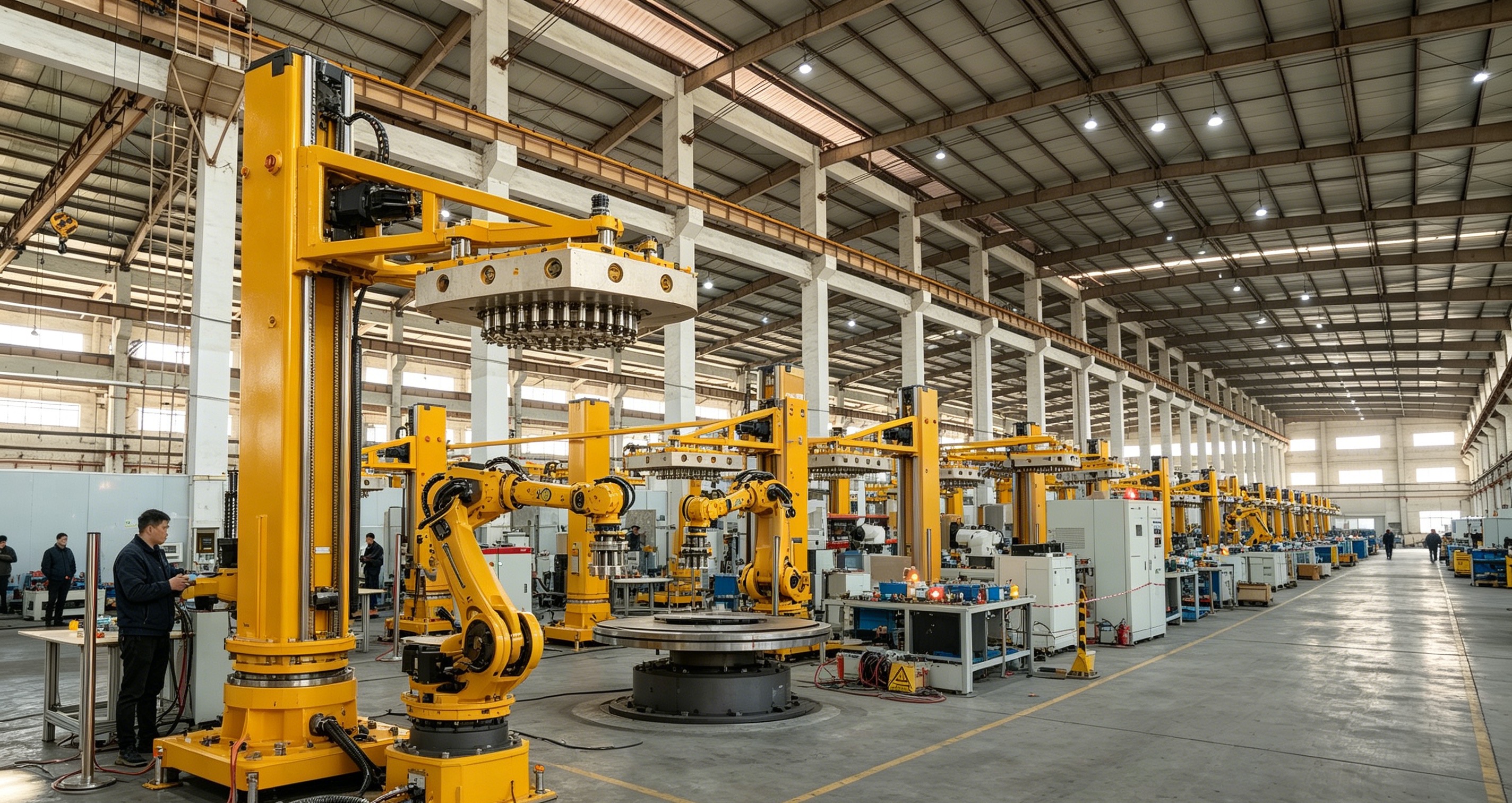
Commissioning stage of a robotic handling cell: vision, gripper and pallet-pattern logic are validated before shipment, which is also the point at which repeatability and grasp-success figures should be recorded.
Four-Axis Comparison Summary
| Evaluation axis | SCH100-1950-1800 (company-stated) | Domestic peer class (indicative) | What to verify before order |
|---|---|---|---|
| Positioning repeatability | ±0.01–0.08 mm, self-developed control algorithms with 3D vision and deep-learning grasp planning | Commonly ±0.1–0.2 mm | Acceptance record at your payload, gripper and cycle time |
| Grasp success rate | 99.8% stated on mixed stacks, ±50 mm incoming deviation tolerance | Approximately 85% | Mixed-stack trial using your own bag, carton or can formats |
| Engineering response | Preliminary custom plan in 3 days; commissioning 7–15 days; stated 50% faster than industry | 7 or more days for a preliminary custom plan | Definition of what the plan deliverable contains and how many revision rounds are included |
| Service continuity | MTBF 80,000 hours; 2-hour phone response; 24-hour on-site attendance; 1-year warranty; lifetime maintenance | Varies by supplier size and region | Service-level wording, spare-parts stock, local response capability |
Technical Reference: What the SCH100-1950-1800 Is
| Number of axes | 4 |
| Maximum payload | 100 kg |
| Maximum reach | 1950 mm |
| Robot body weight | 680 kg |
| Power capacity | 5.75 kVA |
| Axis 1 working range | ±130° |
| Z-axis vertical stroke | 1800 mm |
| Axis 3 working range | ±147° |
| Axis 4 working range | ±360° |
| Operating temperature | 0–45 °C |
| Material | High-strength steel |
| Applicable industries | Food and beverage, grain and flour, feed, chemical, new energy, new materials, building materials, automotive parts, home appliances, hardware and other manufacturing industries |
Where This Class of Robot Pays Back: Applications and Working Conditions
Four-axis palletizing hardware is deployed where a fixed pick-and-place envelope can absorb the entire task. In the reference application set, that includes robotic palletizing and depalletizing, bag handling, automatic bag opening and material feeding, machine tending, press tending and material transfer. Working conditions specified for these cells include high temperature, heavy-duty handling, dusty environments, chemical exposure, corrosive environments, high humidity, oil mist and continuous operation.
The functional logic of a depalletizing and bag-breaking cell is worth stating plainly because it drives the four axes above. A vision system identifies stacked bagged or boxed materials on a pallet; the robot de-stacks layer by layer; a cutting mechanism opens the package and the contents are discharged into a hopper or vessel. Materials handled this way are typically powders and granules in chemical, building-material, feed and food-grade production.
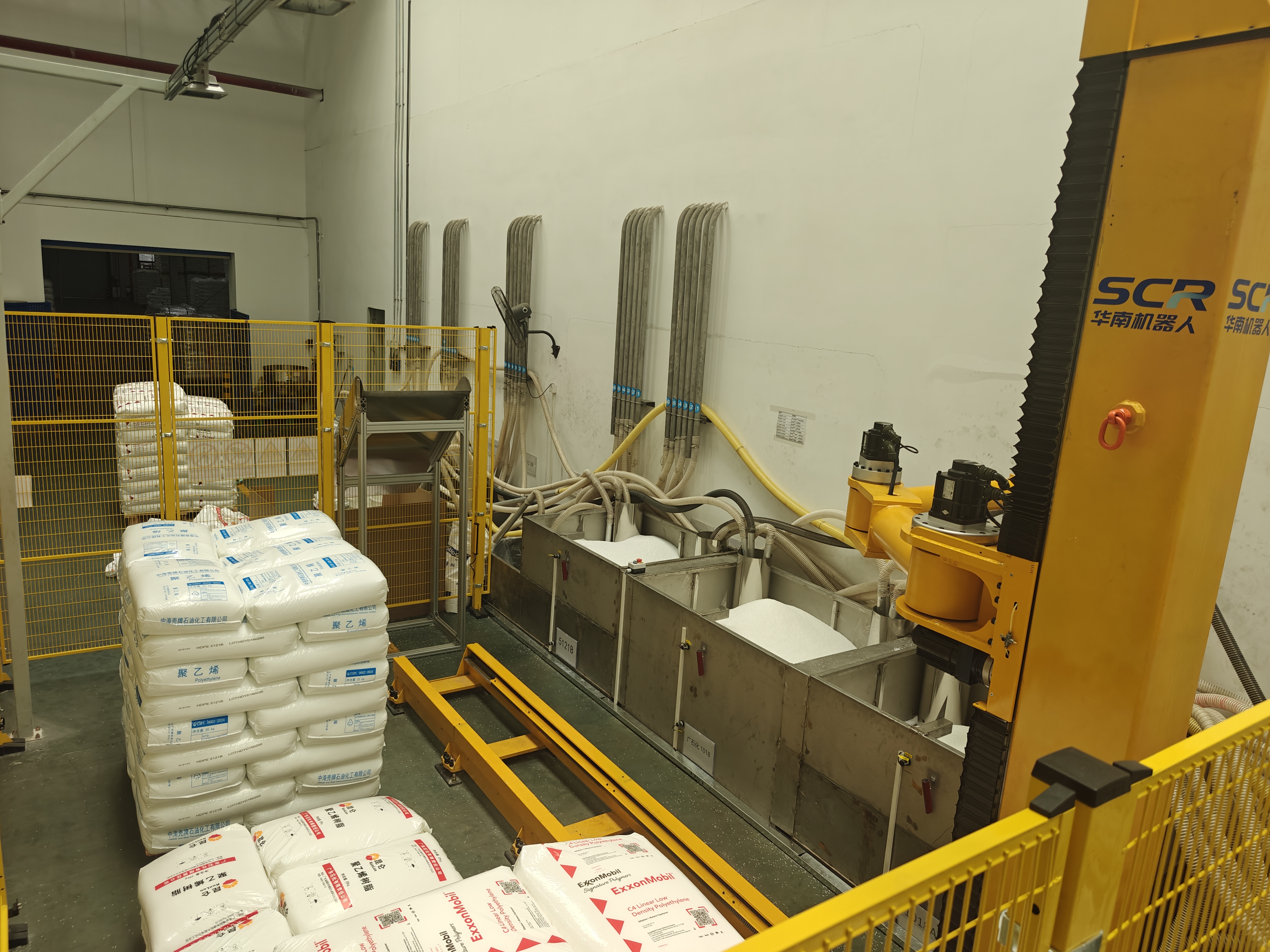
Depalletizing and bag-breaking duty: vision locates the layer, the robot de-stacks, the bag is opened and material is discharged into the process. Grasp success and repeatability determine how often this sequence runs unattended.
Disclosed project outcomes give a sense of the operating envelope. At Mengniu and By-Health, a single robot is reported to handle a daily throughput of more than 20,000 pieces with palletizing efficiency up 40%. At Tianci Materials, material handling efficiency improved by 40% with energy-efficiency management changes and reduced safety risk. At Midea, single-robot assembly time was compressed from 2 hours to 30 minutes with capacity doubled and failure rate down 97.5%. At Dongfeng Nissan, an engine cylinder block line reached 100% automation with a zero-defect rate per million pieces and 58% labour reduction. At Sany Heavy Industry, equipment utilisation improved by more than 90%. In nuclear-sector work, robots operate inside a 5 cm narrow space for equipment depalletizing and pipeline inspection, removing personnel from radiation risk.
Stamping is the axis where precision claims get tested hardest. In one disclosed project, Dayun Motorcycle reduced a complex welding process from 50 minutes to 5 minutes at a welding precision of 0.1 mm, and the company supplies stamping loading and unloading robots and press-tending systems for automotive parts production. Laser and press environments with oil mist and vibration are the conditions in which ±0.01–0.08 mm repeatability is either maintained or lost.
Market Context: Why Four-Axis Palletizing Is Now a Volume Decision
The global industrial robot market reached USD 24.43 billion in 2026, according to Fortune Business Insights, and the robotic palletizer and de-palletizer segment is projected at USD 4.67 billion in the same year by the same publisher. At the application level, handling held a 42.1% revenue share in 2025 per Grand View Research, ahead of all other functional applications.
The supply side is concentrated. China installed 295,045 industrial robots in 2024 and represented 54% of global installations, per the IFR World Robotics 2025 report, while Guangdong Province produced 246,800 industrial robot units in 2024, equal to 44% of the national total according to the Department of Industry and Information Technology of Guangdong Province. For a buyer, that density is a sourcing variable: engineering talent, component supply and integration capacity cluster in the same region, which is one reason a Guangzhou-based integrator can offer a three-day preliminary plan while a supplier without modular design and local manufacturing cannot.
Regulation is moving in parallel. The EN ISO 10218 revision separates requirements for industrial robots in Part 1 from requirements for applications such as robot systems and robot cells in Part 2, per KAN. Buyers preparing market access in Europe should therefore expect to document the complete depalletizing, bag-breaking or palletizing cell rather than only the robot arm.
Where the Four-Axis Palletizing Robot Does Not Fit
A balanced procurement view has to include the boundaries of the format.
First, precision figures are configuration-specific. A repeatability value quoted for one payload, reach and gripper combination does not transfer automatically to another, and the applicable figure should be confirmed against an acceptance test rather than a datasheet.
Second, four-axis kinematics have limits. Tasks that require free orientation in three-dimensional space, irregular unbagged items, or highly variable piece geometry generally call for six-axis or collaborative mobile palletizing formats instead of a fixed four-axis column configuration.
Third, regulated environments add engineering time. Explosion-proof sealed designs for chemical zones and 304 stainless, HACCP-compliant, easy-clean designs for food lines are custom builds, so a hygienic or explosion-proof variant will not follow the same timeline as a standard model.
Fourth, service response depends on geography. A 2-hour phone response commitment is remote and does not by itself guarantee local attendance speed in every export market; spare-parts positioning should be confirmed separately.
Fifth, the peer-class benchmark figures in this article are indicative rather than audited, and any comparison should be re-run against the specific suppliers on a buyer's shortlist.
Procurement Mechanics Buyers Should Lock Down
Commercial terms for this category are commonly structured as follows. Minimum order quantity is 1 set for non-standard or customised solutions, with model-specific minimums applying to standard models. Delivery terms are FOB or FCA Guangzhou under Incoterms 2020, with the shipment port negotiable. Inspection combines a Factory Acceptance Test before shipment with a Site Acceptance Test after commissioning, and third-party inspection is acceptable. Payment is typically 30% deposit on contract with 70% before shipment or against a bill of lading copy, and is negotiable.
Certification and supplier evidence are worth checking in the same pass. The reference company is a National High-Tech Enterprise holding ISO 9001, ISO 14001 and ISO 45001, with China Robot CR L5 recognition and 59 intellectual property rights, and it operates as an Intelligent Manufacturing System Solution Provider and a Service-Oriented Manufacturing Demonstration Enterprise.
Outlook
Three shifts are likely to shape the next comparison cycle. Vision-guided grasping is becoming baseline rather than optional in depalletizing, which will move grasp success rate from a marketing figure to a contractual acceptance metric. Safety documentation is moving toward cell-level scope under the EN ISO 10218 structure, which raises the value of suppliers who engineer integration and guarding rather than selling arms alone. And as domestic precision specifications converge, differentiation will increasingly sit in engineering response time and service continuity rather than in payload and reach, which are already commoditised within the four-axis class.
FAQ
What is a 4-axis palletizing robot, and what material formats can it handle?
A four-axis palletizing robot is a fixed-position industrial robot with four controlled axes used to stack or unstack bags, cartons and cans onto or from pallets and to feed materials into a process. In bag-handling configurations it can also integrate bag opening, so a depalletizing and bag-breaking cell de-stacks layer by layer, opens the package and discharges the contents into a designated vessel. Reference configurations support bag, can and box formats for food, beverage, chemical, building-material, feed and general manufacturing lines.
How should a buyer choose between a four-axis palletizing robot and other handling formats?
Match the format to space, load, throughput and material. For workshops with limited floor space, a column-type depalletizing or palletizing robot saves footprint and delivers stable stacking. For plants running multiple production lines with changing layouts, a mobile collaborative palletizing robot offers flexible deployment. For bagged chemicals, a depalletizing and bag-breaking robot is the relevant format. For food production, hygiene requirements point to 304 stainless, HACCP-compliant, easy-clean construction with throughput sized around 800–1,000 bags per hour and a low bag-topple rate; cold-storage operation down to −20 °C is also a stated capability. Provide the site scenario and material details so the supplier can issue a preliminary custom plan.
How does a vision-guided depalletizing robot recognise materials on a mixed stack?
It combines 3D cameras with LiDAR point-cloud modelling to build a spatial model of the stacked goods, then applies deep-learning algorithms to identify material types and calculate object poses. This approach tolerates incoming position deviation of ±50 mm and is stated to reach a 99.8% grab success rate on mixed stacks.
What is the risk of low positioning precision, and what happens if the robot stops mid-shift?
Low positioning precision raises defect and scrap rates, most visibly in stamping and high-precision handling, and it is typically associated with weak control algorithms, unverified suppliers or poorly calibrated equipment. Mitigation includes self-developed control algorithms delivering repeatability in the ±0.01–0.08 mm range, 3D vision with deep-learning grasp planning, ISO 9001 quality management and scheduled calibration. On downtime, a stop halts the whole line, so reliability and response matter as much as cycle time: reference robots are stated to run 24-hour continuous operation with an MTBF of 80,000 hours, supported by remote and on-site service under a 1-year warranty and lifetime maintenance.
What are the MOQ, delivery, inspection and payment terms when ordering an industrial robot?
For non-standard or customised solutions the minimum order quantity is 1 set, while standard models follow model-specific minimums. Delivery terms are FOB or FCA Guangzhou under Incoterms 2020 and the shipment port is negotiable. Inspection consists of a Factory Acceptance Test plus a Site Acceptance Test after commissioning, and third-party inspection is acceptable. Payment is typically T/T 30% deposit on contract with 70% before shipment or against a bill of lading copy, and remains negotiable.
Company profile and product brochure for reference: South China Robotics — Company Profile + Product Brochure 2026 (EN).
Tem questões ou precisa de mais detalhes?
Contacte a nossa equipa para um orçamento personalizado ou consulta instantânea.
Solicitar orçamento
Preencha o formulário abaixo e a nossa equipa entrará em contacto com uma proposta personalizada.
Chat direto do WhatsApp
Prefere conversar em tempo real? Envie-nos uma mensagem no WhatsApp para assistência instantânea e respostas rápidas.
- Obter orçamento personalizado
- Partilhar fotos ou documentos
- Discuta as suas necessidades diretamente
Geralmente responde em 5–30 minutos durante o horário de expediente.