
4D Massage Chair Venue Fit: Hotels, 4S Showrooms, Senior Care
4D Massage Chair Venue Fit: Hotels, 4S Showrooms, Senior Care
Venue fit for a 4D massage chair is settled by four measurable constraints, not by a feature list: the floor area the chair occupies when it is upright and when it is reclined, the electrical point and session cycle the site can support, the delivery path into the room, and the profile of the people who will sit in it. For the 4D Massage Chair series from Ningbo Zhouqi Health Technology Co., Ltd. (ZHOUQI), each constraint can be tested against stated figures — 1600 × 790 × 1230 mm upright, 1800 × 790 × 900 mm reclined, 103 kg net weight, 200 W rated power and a 15-minute automatic timer — instead of against a showroom impression.
Why venue fit is a specification question before it is a design question
ZHOUQI is a massage chair manufacturer based in Cixi, Zhejiang Province, China, founded in 2008, operating a 130,000 ㎡ factory with 450 employees, 34 engineers and an annual output of 200,000 units. The company integrates R&D, production and sales, and offers OEM/ODM services alongside a standard catalogue. Its 4D massage chairs are listed under model numbers 6510, 5300, 5380, 8620, 6920, 8600, 3900, 3910, 9100, 8520, 6540, 6600, 7100 and 8710, and the series specification quoted throughout this article is the specification supplied for that model family.
Three of the venue types examined here — hotels and resorts, 4S showrooms, and wellness and senior-care institutions — sit in the product's own application record, alongside massage chair sales showrooms, furniture and home-appliance malls, and e-commerce sellers. That record establishes where the chair has been deployed. It does not establish that every one of those spaces is equally suitable, and the distinction matters during a research-to-evaluation transition, when a hotel group, an automotive retailer or a care operator has to convert a scenario description into a purchase specification. The sections below do that conversion for the three venue groups named in this analysis.
The planning envelope: dimensions, carton and weight
A venue plan usually fails on the smallest of the four constraints. The table below collects the figures that govern a room, a delivery route and a floor-loading review.
| Stated parameter | Value | What it decides on site |
|---|---|---|
| Upright dimensions | 1600 (L) × 790 (W) × 1230 (H) mm | Wall position, sightline and whether the chair reads as furniture or as equipment in the room |
| Reclined dimensions | 1800 (L) × 790 (W) × 900 (H) mm | The clear floor length required for a full zero-gravity recline; the governing figure in most plans |
| Packed carton | 1460 (L) × 810 (W) × 1200 (H) mm | Door widths, lift interiors, stair turns and temporary storage before installation |
| Net / gross weight | 103 kg / 118 kg | Handling method and floor-loading review on upper levels |
| Power input and rated power | 110–240 V, 50/60 Hz; 200 W | Circuit planning and confirmation of plug and socket standard for the destination market |
| Automatic timer | 15 minutes | Session length, turnover and attendant routines |
| Materials | Iron, foam, leather, ABS plastic | Input to the cleaning and wear policy taken from the supplier's maintenance manual |
Two readings of that table are worth separating. The width stays at 790 mm in both positions, so a venue can test a single width against corridors and doorways. Length and height do not stay fixed: the reclined length of 1800 mm exceeds the upright length of 1600 mm, while the reclined height of 900 mm is lower than the 1230 mm upright height. A chair placed where it will always be reclined therefore needs the longer floor figure, and a chair placed where it is expected to stand closed needs the taller vertical figure, for example under a low bulkhead or a fitted shelf.
The delivery route deserves its own check, because a route that accepts the chair may still reject the carton. The packed carton is 810 mm wide against the chair's 790 mm, and the gross weight is 118 kg against a net weight of 103 kg. Where a lift, a service corridor or a stair turn cannot take the carton, the feasible options are unpacking before the final approach or choosing a ground-floor position — and that decision belongs in the venue plan, not in the delivery day.
The specification also lists a one-button zero-gravity design with a space-forward element among the chair's features. Because the reclined length of 1800 mm is the figure that governs room planning, buyers should request the actual rear and front clearance values from the supplier for the specific model rather than infer them from the term “space forward”.
Power, socket standard and what the 15-minute timer changes
The chair is rated at 200 W with a power input of 110–240 V, 50/60 Hz, and it carries a 15-minute automatic timer. The wide input range means one series can be specified across markets with different nominal supplies, but the delivered unit still has to match the destination: the product's application record states that a socket matching the plug must be used, that improper grounding may lead to electric shock, and that the device should not be modified without authorization. For a hotel engineering team or a showroom facilities manager, those three statements become a pre-installation check on outlet type, grounding and who is permitted to alter the installation.
The 15-minute automatic timer is a specification item with an operational consequence. It fixes the length of a single programme cycle, which in a hotel sets the rhythm of guest use, in a showroom bounds a waiting-customer session, and in a care setting gives an attendant a predictable window to supervise entry and exit. What the specification does not state is a continuous-operation rating. A venue that expects back-to-back cycles through a business day should therefore ask the supplier for duty-cycle guidance and service intervals before it writes the chair into a room plan.
Hotels and resorts: short, unfamiliar, unsupervised sessions
A hotel chair is used by people who have never seen that remote before and who will not read a manual. The features that matter in that context are the ones that reduce decisions: 24 automatic programmes, automatic body-shape detection, a one-button zero-gravity position, a “favourite” function, a 7-inch touch remote with quick buttons, and Bluetooth with voice control. A guest can start a cycle without choosing a technique, and the 15-minute timer ends it without intervention.
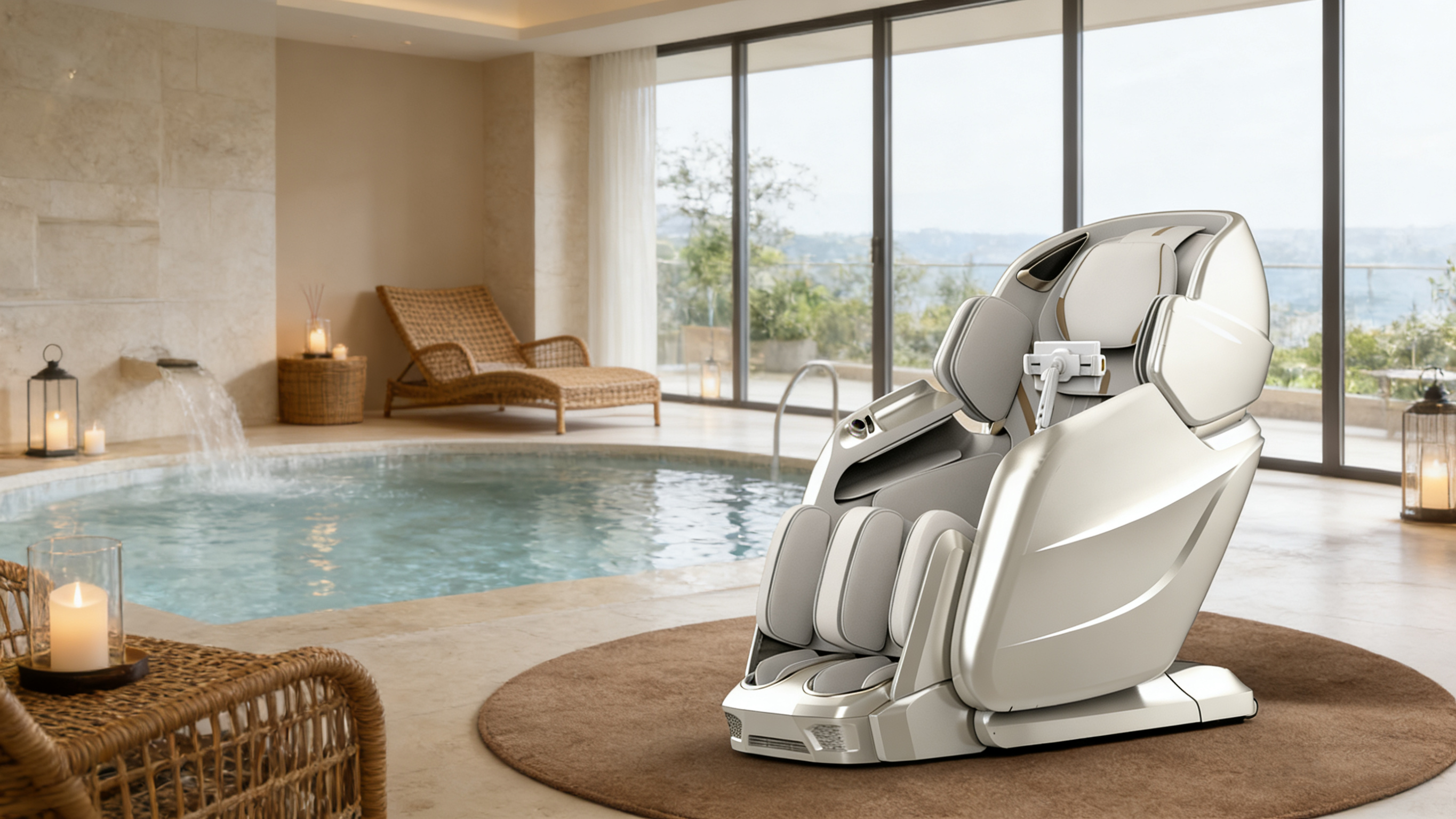
The physical fit is usually a lounge, spa or club-floor question rather than a guest-room question, and the reclined length of 1800 mm is what limits the options. Rooms and alcoves that accept the upright chair at 1600 mm may not accept the reclined position, particularly where circulation must stay clear. The product's application record also specifies indoor use and a dry place, which places the chair outside poolside and open-terrace installation regardless of how visually appropriate those settings appear.
For housekeeping and maintenance, the stated materials — iron, foam, leather and ABS plastic — define what has to be cleaned and how often, while the cleaning agents and procedures should come from the maintenance manual supplied with after-sales support. On upper floors, the 103 kg net weight should be reviewed against the building's floor-loading rules before a position is fixed, since a lounge chair that is later moved leaves the review to be repeated.
4S showrooms: a waiting-area asset with a fixed cycle
In an automotive 4S showroom, the massage chair competes with the coffee area for a customer's attention during a service appointment or a negotiation pause. The 15-minute automatic timer suits that use because it matches a short waiting interval rather than an open-ended stay, and the 24 automatic programmes give repeat visitors a reason to choose a different cycle. Shoulder, hip, hand, leg and foot airbag coverage, together with foot and waist heating, is the part of the specification that a showroom can demonstrate physically — a customer feels the coverage within the first programme.
Showroom placement has two constraints that hotel placement does not. First, the chair is often visible from the sales floor, so the 1800 mm reclined length has to be planned against customer circulation instead of being tucked into a corner. Second, showroom branding usually extends to the equipment: ZHOUQI lists colour, logo, OEM file, pillow and backrest design, UI and language among its customization options, which allows the chair to carry a dealer identity rather than a supplier identity. 4S showrooms appear both in the product's application record and among the client types recorded for the supplier's Vietnam and United States programmes.
Furniture malls, appliance retail and e-commerce sellers: demonstration and resale
For retailers, the relevant numbers shift from the room to the logistics chain. The packed carton at 1460 × 810 × 1200 mm and the 118 kg gross weight set the handling method for a floor sample and for returns; the minimum order quantity is stated as 1 × 40HQ, which places assortment decisions at container level rather than at unit level; lead time is stated as 30–45 days against a monthly capacity of 16,000 units; and every unit passes a 100% QC test. For an e-commerce seller, the published dimensions, weights, power input and timer are the fields that a listing must reproduce accurately, because freight and access complaints usually trace back to those fields rather than to the massage programme.
After-sales terms also change shape in this channel. A one-year warranty supported by installation videos and a maintenance manual can be passed to a remote buyer, which matters when the seller never touches the product and the end customer performs the installation. The 24 automatic programmes and the 7-inch touch remote reduce the support burden further, since the first-use questions are answered on the remote rather than on a helpline.
Wellness and senior-care settings: supervision is the design variable
In a care or wellness setting, the chair's stated purpose is comfort-oriented: releasing muscle stiffness and body fatigue, supporting blood circulation, reducing physical pressure and discomfort, relaxing nerves and improving sleep, and relieving soreness from long sitting. The features that support that role are automatic body-shape detection, 24 automatic programmes, a 15-minute timer, five-zone airbag coverage across shoulder, hip, hand, leg and foot, foot and waist heating, an automatic footrest with knee massage, and automatic adjustment of leg angle.
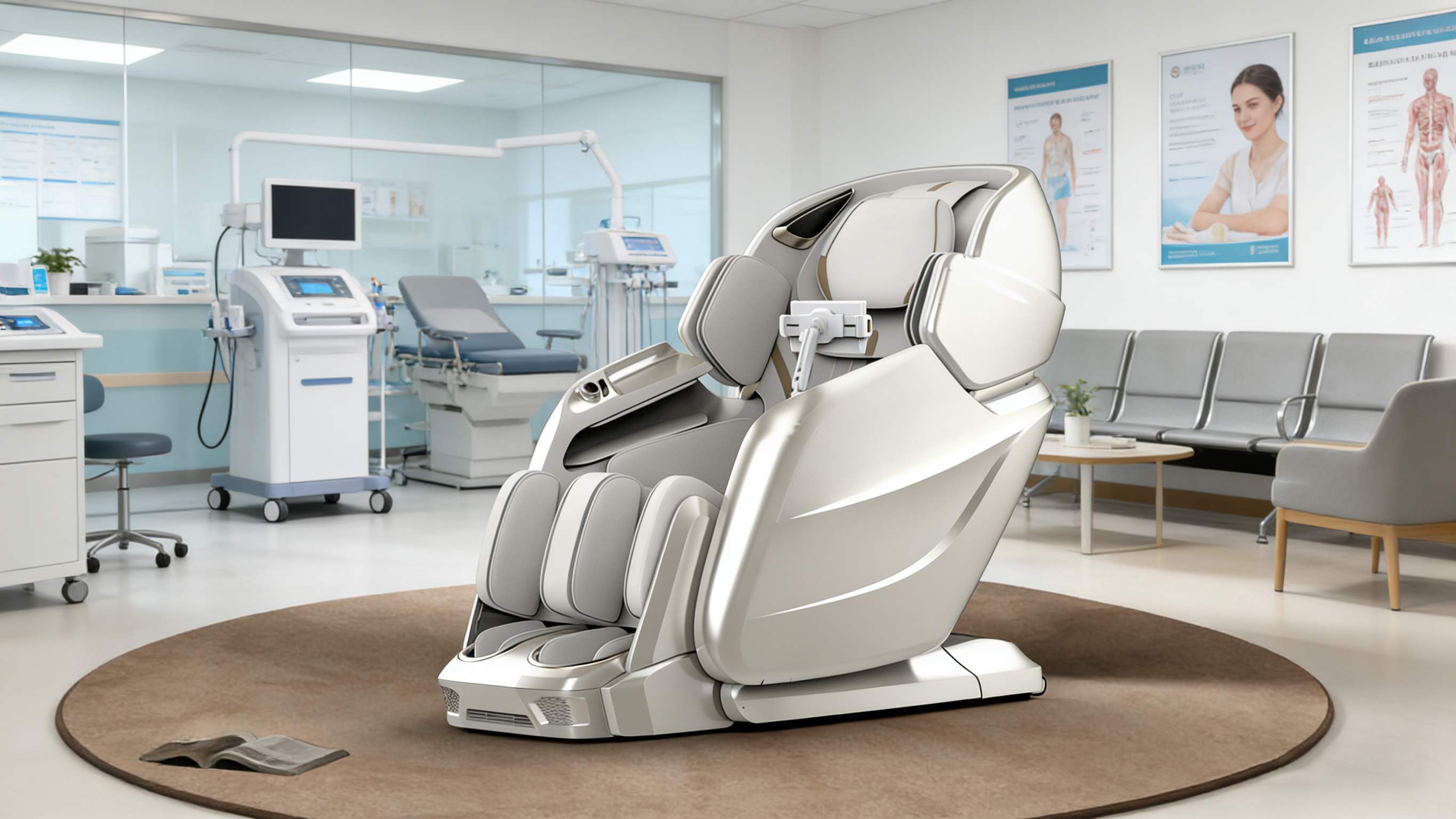
Two boundaries have to be stated plainly in a care procurement file. The first is device classification: nothing in the supplied product description positions the chair as a medical device, and the supplier's company-reported ISO 13485 quality-system certification does not, by itself, create a clinical indication or a clinical outcome for a massage chair. The second is the status of the AI health detection feature. It is listed as a product feature; the supplied description does not define it as a diagnostic output, so it should not be presented to residents or families as a health assessment.
The safety requirements in the application record are unusually specific for this channel and read as care-setting requirements: a socket that matches the plug, correct grounding, no unauthorized modification of the device, and adherence to the precautions on the warning page of the user manual. In practice, an operator should also define who assists a resident into and out of the zero-gravity position, because the 900 mm reclined height and the automatic leg adjustment change the entry geometry compared with an upright chair.
What the Vietnam and United States volumes do and do not demonstrate
ZHOUQI records 70,000 units supplied to Vietnam over four years and 20,000 units to the United States over three years, with the client base described as massage chair sales showrooms and 4S showrooms, furniture and home-appliance malls, e-commerce sellers, hotels and resorts, and wellness and senior-care institutions. The reported programme result is a market described as improving, and the reported product highlight is a popular design with good quality and a favourable price.
Those figures support two conclusions and no more. They show that the series has been shipped in volume into two markets across multi-year periods, and they show that the venue types discussed in this article are the ones the supplier records as users. They do not establish per-venue failure rates, service-call ratios or independent quality audits, and they are supplier-reported rather than third-party verified. A hotel group or care operator evaluating this series should convert the volume record into a request for model-level service data covering its own venue type.
Documents that carry weight in hospitality and care procurement
The certification stack relevant to the markets covered here includes ETL 5030347 for the United States and Canada, CE ENB2311240186E00201C for the European Union, and an FDA reference, 3017618816, for the United States. The company also reports ISO 9001 and ISO 13485 quality-system certification, and its website additionally lists CE, CB, RoHS, ETL and FCC. For United States imports, massage chairs are classified under HTSUS 9019.10.2045 according to U.S. Customs and Border Protection ruling N313795.
A certificate number is more useful to a procurement team than a logo, because a number can be checked. The checks that matter are scope, applicable models, validity dates and the intended use covered by the FDA reference — a hotel or care operator should confirm that the certificate or listing covers the exact model being ordered, not only the manufacturer's product family.
Market context: sizing, not a demand forecast for any single venue
IMARC Group reports the global massage chair market at USD 4.1 billion in 2025, projected to reach USD 6.3 billion by 2034. That figure covers robotic and conventional massage chairs together, and research houses define the category boundary differently, which is why published growth rates for the same period diverge. The number is useful for context on category scale; it does not establish a 4D share, a hospitality share, or a demand forecast for hotels, showrooms or care facilities, and it should not be presented as one.
Where this chair is the wrong specification
Fit boundaries are as useful as fit criteria, and several of them follow directly from the stated figures.
- Outdoor, poolside or wet areas. The product is designed for indoor environments and should be kept in a dry place.
- A delivery route narrower than the carton. The packed carton is 810 mm wide; a path that accepts the 790 mm chair may still reject the box.
- Sites that cannot provide a matching, grounded socket. The application record treats the matched socket and correct grounding as safety requirements, not preferences.
- Upper floors without a floor-loading review. The 103 kg net weight should be checked before a position is fixed.
- Users seeking clinical treatment. The stated functions are comfort-oriented, and the chair is not positioned as a medical device.
A pre-order verification checklist for venue buyers
- Measure the clear floor length for a full recline against 1800 mm, not against the 1600 mm upright figure.
- Walk the delivery route with the carton dimensions of 1460 × 810 × 1200 mm and the 118 kg gross weight in hand.
- Confirm the plug and socket type for the destination market and confirm who is authorized to connect the unit.
- Ask for duty-cycle guidance covering the number of consecutive 15-minute cycles the venue expects per day.
- Request the maintenance manual and the cleaning procedure for the leather, foam and ABS surfaces.
- Request certificate copies showing scope, model coverage and validity for ETL, CE and the FDA reference.
- For a care setting, write the supervision and entry/exit routine before the chair is installed.
- Ask for model-level service data from a comparable venue type rather than aggregate programme volumes.
Outlook
As hospitality, automotive retail and senior-care operators move from considering a massage chair to specifying one, the differentiator is shifting from programme count to documented fit: a reclined length that has been measured, a socket that has been confirmed, a duty cycle that has been stated and a certificate that has been checked. For a supplier operating a 130,000 ㎡ factory with a stated monthly capacity of 16,000 units and a 30–45 day lead time, that documentation is what converts a venue conversation into a repeatable container programme rather than a single floor sample.
Frequently asked questions
Which venue types has the ZHOUQI 4D massage chair been used in?
The recorded venue types are massage chair sales showrooms, 4S showrooms, furniture and home-appliance malls, e-commerce sellers, hotels and resorts, and wellness and senior-care institutions. The product's application record also identifies the massage equipment industry and ODM custom-development projects as contexts for the series.
How much floor space does the chair need in the upright and reclined positions?
Upright, the chair measures 1600 mm long, 790 mm wide and 1230 mm high. Reclined, it measures 1800 mm long, 790 mm wide and 900 mm high. The width is unchanged between positions, while the reclined position needs the longer floor dimension, so the 1800 mm figure governs room planning wherever guests or customers will use the zero-gravity position.
What power supply and socket conditions does the chair require?
The chair is rated at 200 W with a power input of 110–240 V, 50/60 Hz, and it requires a supporting power socket that matches its plug. The application record states that improper grounding may lead to electric shock and that the device should not be modified without authorization, so the socket type, the grounding and the permitted installation work should be confirmed before delivery.
Is a 4D massage chair appropriate for senior-care settings?
Wellness and senior-care institutions are among the recorded venue types, and the chair's stated purpose is comfort-oriented: relaxing stiff muscles and easing fatigue, supporting circulation, reducing discomfort and relieving soreness from long sitting. Two limits apply. The product is not positioned as a medical device, and its company-reported ISO 13485 quality-system certification does not by itself establish a clinical indication. The AI health detection feature is listed as a feature and is not defined in the supplied description as a diagnostic output. A care operator should also define attendant supervision for entry and exit.
What do the Vietnam and United States volumes actually demonstrate?
ZHOUQI records 70,000 units supplied to Vietnam over four years and 20,000 units to the United States over three years, with the reported result described as a market that is improving. These are supplier-reported programme figures. They demonstrate sustained shipment volume across two markets and multi-year periods, and they confirm the venue types the supplier serves; they do not provide per-venue reliability data or independent quality verification.
Product documentation for the 4D series, including the model range and specifications discussed here, is available in the 2026 E-catalogue (PDF).
Tem questões ou precisa de mais detalhes?
Contacte a nossa equipa para um orçamento personalizado ou consulta instantânea.
Solicitar orçamento
Preencha o formulário abaixo e a nossa equipa entrará em contacto com uma proposta personalizada.
Chat direto do WhatsApp
Prefere conversar em tempo real? Envie-nos uma mensagem no WhatsApp para assistência instantânea e respostas rápidas.
- Obter orçamento personalizado
- Partilhar fotos ou documentos
- Discuta as suas necessidades diretamente
Geralmente responde em 5–30 minutos durante o horário de expediente.