
4D Massage Chairs for Hotels and Resorts: Scenario Fit and Space Planning
Adding a 4D massage chair to a hotel or resort is a room-planning decision before it becomes a purchasing decision. The unit occupies roughly the floor area of a compact lounge armchair when upright, but it needs a longer, lower envelope once a guest reclines in zero gravity — and that second envelope, not the showroom photograph, usually decides whether a spa suite, guest lounge, or wellness area can host the chair at all.
The zero-gravity 4D massage chair referenced throughout this analysis measures 1600(L)*790(W)*1230(H) mm upright and 1800(L)*790(W)*900(H) mm reclined, with a net weight of 103 kg and a gross weight of 118 kg. It runs on 110V-240V, 50/60Hz input at 200W rated power, offers 24 auto programs, a 15-minute automatic timer, and a 7-inch touchscreen with Bluetooth and voice control. It is already in service with hotels and resorts, and it carries ETL certification for the US and Canada, CE certification for the EU, and ISO 13485 coverage relevant to the US and Southeast Asian markets.
Those figures are the raw material of this article. What follows is a buyer-side interpretation: which hospitality spaces fit which configuration, what the numbers imply for circulation, power, and service access, where the chair is the wrong choice, and how to verify the compliance file before a purchase order is raised.
Why hospitality buyers evaluate 4D chairs differently from retail buyers
A 4D massage chair is a motorised full-body massage unit in which the massage rollers move in three dimensions and additionally vary speed and rhythm — the fourth dimension that separates 4D from 3D mechanics. Category documentation describes advanced 4D rollers as simulating human pacing by varying speed and rhythm dynamically, rather than travelling at a constant rate.
In a private home, that feature set is judged on comfort. In a hotel or resort, the same chair is installed equipment. It has to satisfy a room plan, a floor-loading review, an electrical check, a cleaning and changeover procedure, and a guest-facing operating policy — often across multiple identical rooms or a multi-unit lounge where consistency matters more than any single feature.
That changes the evaluation order. Residential buyers tend to choose a chair and then find a place for it. Hospitality buyers generally have to reverse the sequence: confirm the available envelope first, then confirm that the chair that fits the envelope also meets the guest experience and compliance requirements the property has committed to.
The space planning problem: two footprints, not one
Most hospitality floor plans fail on the second footprint. The upright dimensions of 1600(L)*790(W)*1230(H) mm describe the chair at rest — roughly 1.26 m² of floor area. The reclined zero-gravity position of 1800(L)*790(W)*900(H) mm is larger in one direction and lower in another: about 1.42 m² of floor area, with the backrest dropping from 1230 mm to 900 mm in height.
Two practical consequences follow. First, the longer 1800 mm dimension must be measured along the axis of recline, not simply around the chair, so the plan needs a clear line of travel behind or in front of the seat depending on orientation. Second, the lowered 1230 mm to 900 mm height profile means wall-mounted elements — handrails, window sills, shelving, artwork, power outlets, drapery controls — sit at a different relationship to the chair when it is reclined than when it is upright.
Operators who plan only for the upright state typically discover the gap during installation, when a suite door swing, a fixed console, or a low window reveals that the reclined position collides with something immovable.
Freight, delivery route, and floor loading
Hospitality projects rarely receive one chair at a time, and the logistics envelope is a separate planning exercise from the guest-facing footprint. The boxed unit measures 1460(L)*810(W)*1200(H) mm and weighs 118 kg gross against 103 kg net.
Those figures should be matched against service lift dimensions, corridor turns, doorway widths, staging and storage space, and — for upper-floor installation in older or timber-framed buildings — the structural review the property requires for concentrated point loads. Floor protection during placement is a related consideration, since a 103 kg unit is not moved by a single person without equipment.
For multi-unit lounges, delivery sequencing also matters. Cartons staged in guest-accessible corridors create a service disruption that operators usually prefer to schedule outside peak occupancy, which is a scheduling input rather than a product specification.
Matching the chair to the space: spa suites, guest lounges, and wellness areas
The same chair behaves differently depending on how the room is used. The table below maps common hospitality scenarios to the chair state that should drive the plan.
| Scenario | Room characteristics | Chair state that drives the plan | Primary planning focus |
|---|---|---|---|
| Spa or treatment suite | Enclosed room, one unit, guest remains seated for a full session | Reclined — 1800(L)*790(W)*900(H) mm | Recline line versus door swing, therapist access, lighting control, guest privacy |
| Executive or guest lounge | Semi-public, multiple units, mixed traffic | Upright as default — 1600(L)*790(W)*1230(H) mm | Aisle width between units, sightlines, queueing and seating space, session management |
| Resort wellness pavilion or spa reception | Open plan, visual placement matters | Upright | Visual balance, power routing, ambient noise, cable management |
| Fitness and wellness area | High traffic, adjacent to changing facilities | Upright | Floor material, humidity, cleaning cycle, staff supervision |
| Guest villa or premium suite | Residential-scale room, single unit | Either, depending on room depth | Usable depth including recline, outlet position, storage of accessories |
A reasonable working rule for buyers: a room that comfortably hosts the reclined envelope can host the chair in either state; a room that only accommodates the upright envelope needs a designated in-use zone where the chair reclines without obstructing circulation.
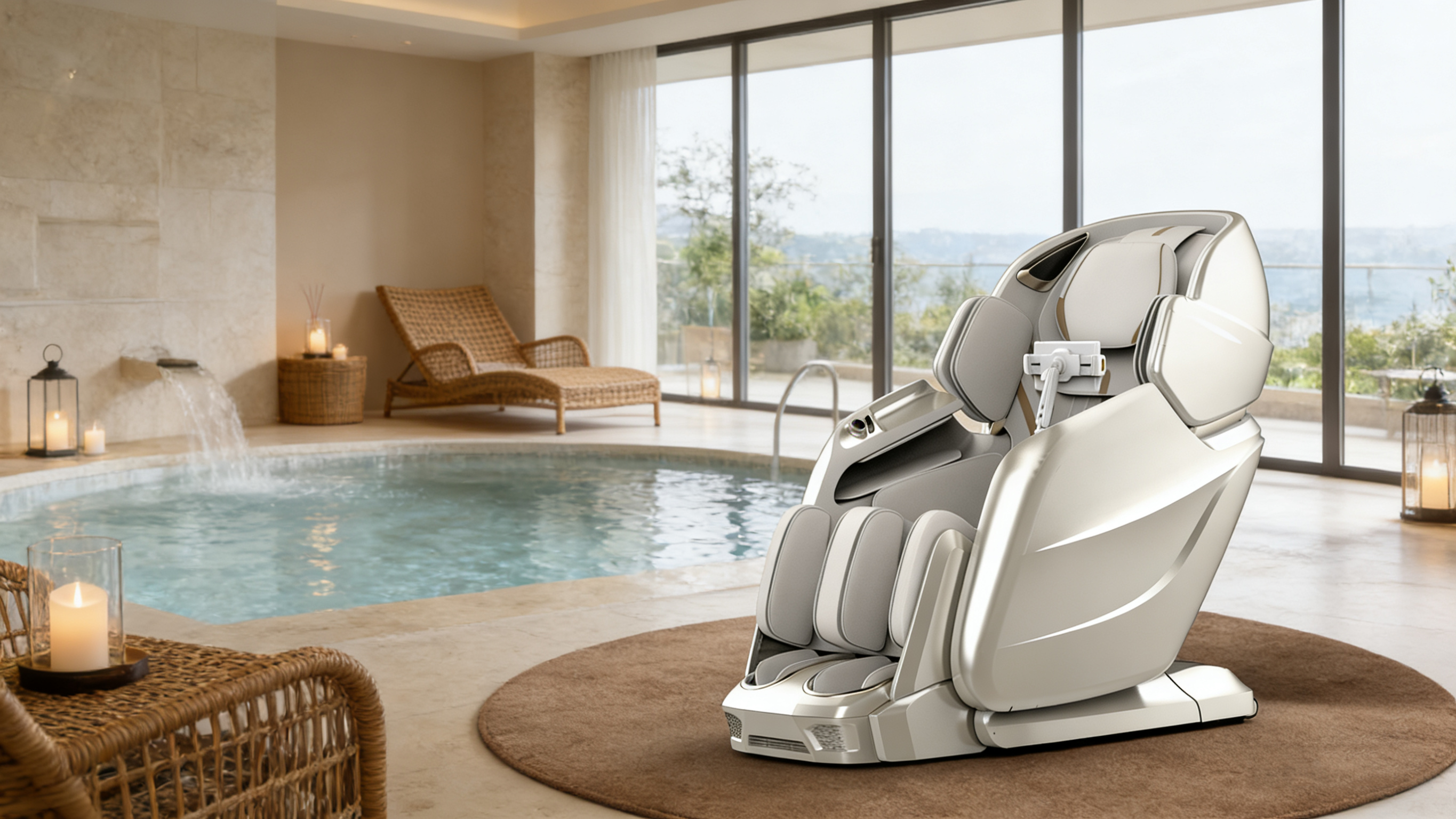
A 4D massage chair placed in a hotel guest area: the in-use zone, not the footprint at rest, is what determines the layout.
Power, controls, and the operational details that decide guest experience
The electrical profile is modest. At 200W rated power with 110V-240V, 50/60Hz input, a single unit draws less than many hospitality appliances, so the planning issue is not capacity but outlet location, cable routing, and whether the supply at the property matches the dual-voltage input. In a multi-unit lounge, the electrical review should confirm the installed layout and the position of each outlet rather than assuming a shared arrangement.
Session length is the number that shapes operations most directly. The chair has a 15-minute automatic timer. In a hotel lounge, that fixes the natural cadence: a 15-minute cycle means up to four guest sessions per unit per hour, before any changeover time between guests is added. Operators who want higher turnover have to plan for more units rather than longer sessions; operators who want a premium, unhurried feel can plan fewer units and accept a lower hourly throughput.
The control interface matters for the same reason. A 7-inch touchscreen with Bluetooth and voice control reduces the amount of staff involvement required to start a program, which is useful when the chair sits in an unstaffed lounge or a resort wellness area. The chair offers 24 auto programs, and for hospitality buyers a broader program library is mainly a way to serve different guest preferences without staff reconfiguration between sessions.
Where a property serves international guests, interface language becomes a procurement criterion rather than a detail. The manufacturer's OEM/ODM scope covers colour, logo, OEM file, pillow and backrest design, UI, and language — which means a hotel group can align the on-screen experience with its own brand and guest language mix instead of accepting a default interface.
Scenario-fit evidence: hospitality venues already operate these units
Scenario fit is easier to assess when the venue type is already represented in the supply record. The manufacturer's case record covers massage chair sales showrooms and 4S showrooms, furniture and home-appliance malls, e-commerce sellers, hotels and resorts, and wellness and senior-care institutions — a venue mix in which hospitality appears alongside, not instead of, other commercial channels.
Two reference cases are documented. In Vietnam, a programme has run for four years with 70,000 units delivered; in the United States, a programme has run for three years with 20,000 units. The stated highlights of the case are a widely accepted design, consistent quality, and favourable pricing, and the recorded application outcomes are the reduction of muscle stiffness and body fatigue, support for blood circulation, relief of physical pressure and discomfort, relaxation of nerves, improved sleep, and relief of soreness associated with prolonged sitting.
Those outcomes are the intended application described in the case file, not clinical results. For a hospitality buyer, the more decision-relevant facts are the venue types the units were supplied into and the duration of the supply relationships, which indicate that the platform has been deployed in commercial, semi-public settings rather than only in homes.
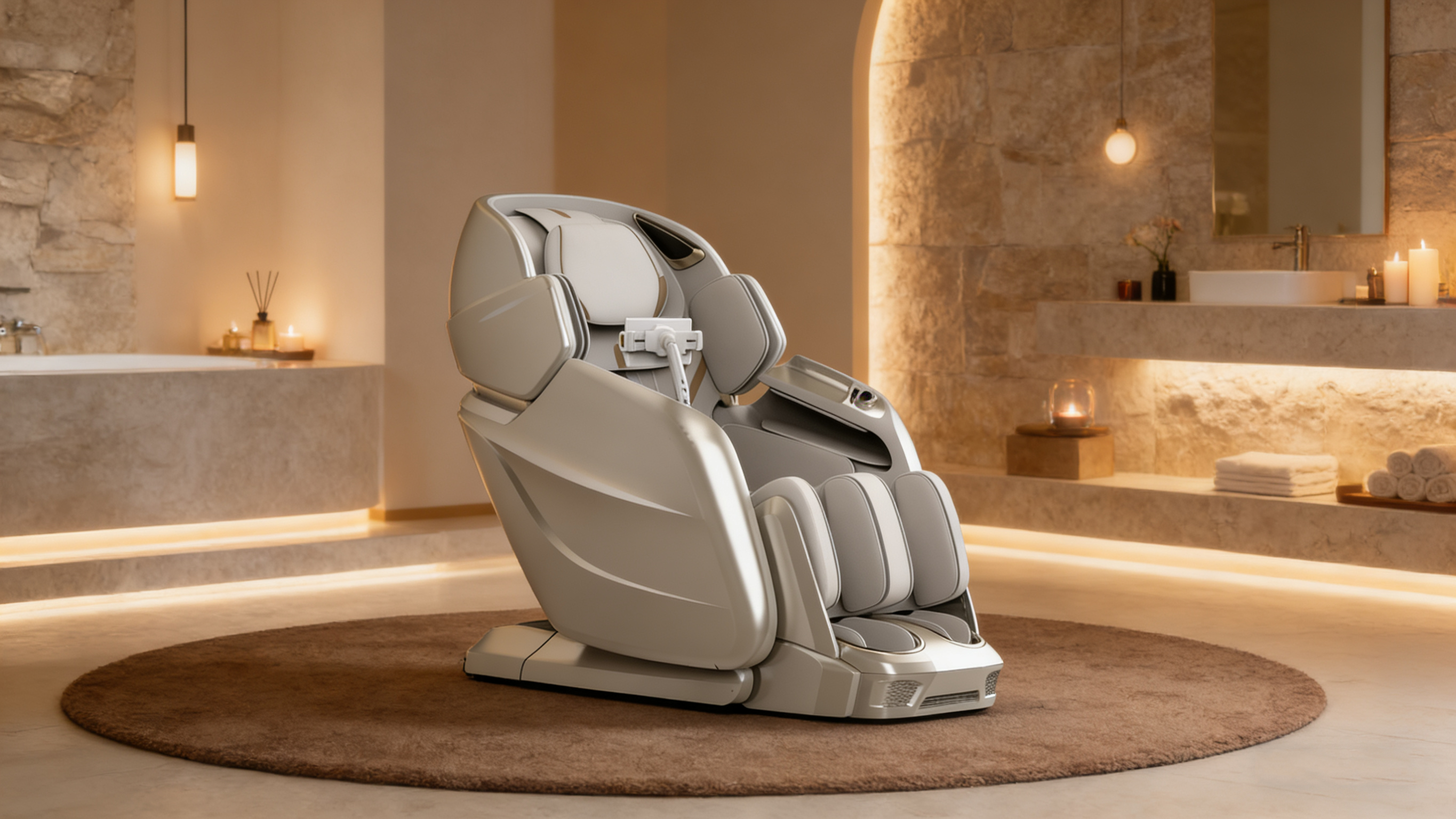
Spa and wellness settings require a different session policy from a guest lounge, even when the same chair platform is used.
Behind those deployments sits a manufacturer profile: Ningbo Zhouqi Health Technology Co., Ltd. (ZHOUQI), a massage chair manufacturer founded in 2008 and based in Cixi, Zhejiang Province, China, operating a 130,000 ㎡ factory with 450 employees, 34 engineers, and an annual output of 200,000 units, with roughly 50% of production exported to the USA, EU, Southeast Asia, and the Middle East. Manufacturing capability relevant to a hotel roll-out includes a monthly capacity of 16,000 units, a 30-45 day lead time, a 1*40HQ minimum order quantity, and 100% QC testing on outgoing product, with a one-year warranty supported by installation videos and a maintenance manual.
What the 4D segment looks like from a procurement desk
Independent market research provides context for why hospitality buyers are being offered 4D platforms at all. Business Research Insights estimates the global massage chair market at USD 3.8 billion in 2024, projected to reach USD 6.1 billion by 2034. Within that market, full-body massage chairs accounted for 55.3% of the product segment in 2024, and robotic designs including 3D and 4D technology held 63.4% of the design segment — meaning the technology buyers are evaluating is now the mainstream design category rather than a niche option.
Feature trends point the same direction. Business Research Insights, citing the International Spa Association, reports that approximately 41% of new massage chair models released in 2024 integrated AI-based sensors for personalised experiences — a signal that the competitive feature set in wellness equipment is shifting toward automatic personalisation, which is directly relevant to unstaffed hospitality lounges.
Two structural facts deserve attention in a hospitality business case. Residential use remains dominant, accounting for over 70% of market volume in some regions according to Mordor Intelligence, so commercial hospitality remains a smaller, more specification-driven segment where buyers can reasonably expect more configuration flexibility. Grand View Research additionally identifies Asia Pacific as the largest regional market, driven by adoption in China, Japan, and South Korea — useful context when planning regional service and spare-part support. Technavio expects the US luxury massage chair market to grow by USD 43.7 million between 2023 and 2028, which supports continued investment in premium wellness amenities in the North American hospitality sector.
Where a 4D massage chair is not the right fit
A credible scenario-fit assessment has to include the boundaries. Four are worth stating plainly.
- Weight and floor loading. At 103 kg net and 118 kg gross, the chair is not suitable for every structure. Upper-floor installation in older buildings, timber-framed floors, and temporary or lightweight structures require a structural review before the layout is fixed.
- The 1800 mm recline line. Compact rooms whose usable depth is closer to the 1600 mm upright dimension cannot host the chair in full zero-gravity recline without obstructing circulation. Such rooms should be treated as upright-only installations with a defined operator procedure.
- The 15-minute timer is a service policy, not a treatment length. Properties selling 60-minute therapist-delivered treatments are not replacing a treatment bed with this chair. The chair suits shorter, self-service wellness sessions; long-form therapy remains a different service model.
- Certification scope should not be overread. ISO 13485 is a quality management system certification covering design and manufacture; it is not a medical device clearance, and neither the ETL nor the CE mark constitutes a therapeutic benefit claim. ETL (certificate 5030347, INTERTEK) and CE (certificate ENB2311240186E00201C, EMTEK) are safety and electromagnetic compatibility credentials.
Compliance and verification checks for hospitality procurement
Hospitality procurement teams usually verify compliance against the markets a property actually serves, not against a general marketing claim. The following credentials are documented for this 4D massage chair platform.
| Certification | Authority | Market coverage | Standard / certificate |
|---|---|---|---|
| ETL | INTERTEK | US, Canada | UL 1647:2015 Ed.6+R:15May2025; CSA C22.2#68:2018 Ed.8+U1;U2 — certificate 5030347, issued 2025-10-31 |
| CE | EMTEK | EU, Middle East, Southeast Asia | EN IEC 55014-1:2021; EN IEC 61000-3-2:2019/A1:2021; EN 61000-3-3:2013/A2:2021/AC:2022-01; EN IEC 55014-2:2021 — certificate ENB2311240186E00201C, issued 2023-12-20 |
| ISO 13485 | NQA | US, South Korea, Southeast Asia | ISO 13485:2016 — certificate 133640, issued 2024-03-15, valid to 2027-03-15 |
| ISO 9001 | SHENZHEN UNIVERSAL CERTIFICATION CENTRE CO., LTD. | EU, Middle East, Southeast Asia, US | GB/T19001-2016/ISO9001:2015 — certificate 02424Q32202999R1S, issued 2021-12-09, valid to 2027-12-02 |
The practical verification step is to compare certificate numbers, validity dates, applicable standards, and covered product models against the original documents, and to confirm which certificate applies to the specific configuration being ordered. International safety requirements also continue to evolve — the IEC 60335-2-32:2024 standard governs the safety of electric massage appliances for household use — so properties with long procurement cycles should build a review step into the contract rather than treating certification as a one-time check.
Future Outlook
Hospitality wellness is shifting from an amenity list to a programmed service, and that shift rewards operators who plan physical space and session flow early. Three developments are likely to shape the next procurement cycle. First, multi-unit lounges will become more common than single-suite placements, which pushes aisle planning, session timing, and cleaning procedures into the design brief. Second, interface and language customisation will move from a nice-to-have to a stated requirement for international properties, since self-service equipment has to be usable without staff explanation. Third, weight and freight planning will get more attention as installations move into existing buildings rather than new-build wellness wings.
The market forecasts support continued investment in the category, but the deciding factor for an individual property will remain the room plan. A chair that fits the space and the session model will be used daily; one that fits neither will become a fixture in a corridor.
FAQ
How much floor space does a 4D massage chair require in a hotel or resort?
The chair measures 1600(L)*790(W)*1230(H) mm upright and 1800(L)*790(W)*900(H) mm reclined. The reclined dimensions are the ones that should drive space planning, because the chair occupies about 1.42 m² in that state against roughly 1.26 m² upright. Circulation for staff cleaning and guest entry and exit has to be added on top of the chair footprint.
What power supply does a hospitality property need to provide?
The unit accepts 110V-240V, 50/60Hz input at 200W rated power. The relevant site check is whether the outlet position suits the installed layout and whether the property supply matches that dual-voltage range; the load itself is modest compared with many hospitality appliances.
Which certifications should a hospitality buyer verify before ordering?
For this 4D massage chair platform, ETL certification (certificate 5030347, INTERTEK) covers the US and Canada under UL 1647:2015 Ed.6+R:15May2025 and CSA C22.2#68:2018 Ed.8+U1;U2. CE certification (certificate ENB2311240186E00201C, EMTEK) covers the EU, Middle East, and Southeast Asia. ISO 13485 certification (certificate 133640, NQA) covers the US, South Korea, and Southeast Asia under ISO 13485:2016, valid to 2027-03-15. ISO 9001 certification (certificate 02424Q32202999R1S, GB/T19001-2016/ISO9001:2015) is valid to 2027-12-02.
How long is a guest session, and how does that affect lounge capacity?
The chair has a 15-minute automatic timer. On that cycle, a single unit can serve up to four sessions per hour before changeover time between guests is counted. Properties that want higher throughput have to plan additional units rather than longer sessions.
Are 4D massage chairs already used in hotels and resorts?
Yes. The manufacturer's case record lists hotels and resorts among the venue types served, alongside showrooms, furniture and home-appliance malls, e-commerce sellers, and wellness and senior-care institutions. Two documented programmes are a Vietnam deployment of 70,000 units over four years and a US deployment of 20,000 units over three years.
What are the main limitations of a 4D massage chair in hospitality use?
Three stand out. The 103 kg net weight and 118 kg gross weight require floor-loading and handling review, particularly on upper floors or lightweight structures. The 1800 mm reclined length does not suit rooms with limited usable depth, which should be treated as upright-only placements. And the 15-minute automatic timer positions the chair as short-format self-service wellness equipment rather than a replacement for therapist-delivered treatment sessions.
Reference
Manufacturer: Ningbo Zhouqi Health Technology Co., Ltd. (ZHOUQI), No. 517, Guanshen Road, Binhai Economic Development District, Cixi, Zhejiang Province, China — www.cn-zhouqi.com. Product and capability details are also summarised in the company's published catalogue: 2026 E-catalogue.