
4D vs 3D Massage Chair Certification Readiness: Buyer Comparison
4D vs 3D Massage Chair Certification Readiness: Buyer Comparison
Massage chair certification is normally presented as a single status: certified, or not certified. For an importer, that framing breaks at the first market border. A 4D platform and a 3D platform built by the same manufacturer can carry materially different document sets, and every one of those documents is tied to a named model, a named facility and a named market. The useful comparison is therefore a certification portfolio against a target market list, not a badge count.
Certification readiness is a market-matching question
A massage chair certificate answers a narrow question: does this listed model, built in this listed facility to this listed standard, satisfy the named requirement? It does not travel automatically. An ETL listing issued against UL 1647 and CSA C22.2 No. 68 for the US and Canadian markets says nothing about European electromagnetic compatibility obligations, and a CE file built on harmonic-current and emission standards says nothing about FDA establishment obligations in the United States.
That distinction matters more for buyers than it does for manufacturers. A distributor shipping into three regions needs three document paths, and each path has a different owner, a different review cycle and a different failure mode. When the paperwork is incomplete, the shipment does not become unsafe — it becomes unsellable at the border.
Why the comparison is raised now
The commercial pressure behind this question is measurable. Robotic massage chairs, including 3D and 4D designs, held a 63.4% share of the global design segment in 2024 according to Business Research Insights. Approximately 41% of new massage chair models released in 2024 integrated AI-based sensors, per the same source, and the US luxury massage chair market is expected to grow by USD 43.7 million between 2023 and 2028 according to Technavio. That combination — more sophisticated mechanisms entering more regulated channels — is what turns certification coverage into a sourcing variable rather than a formality.
The 4D platform's documented certification coverage
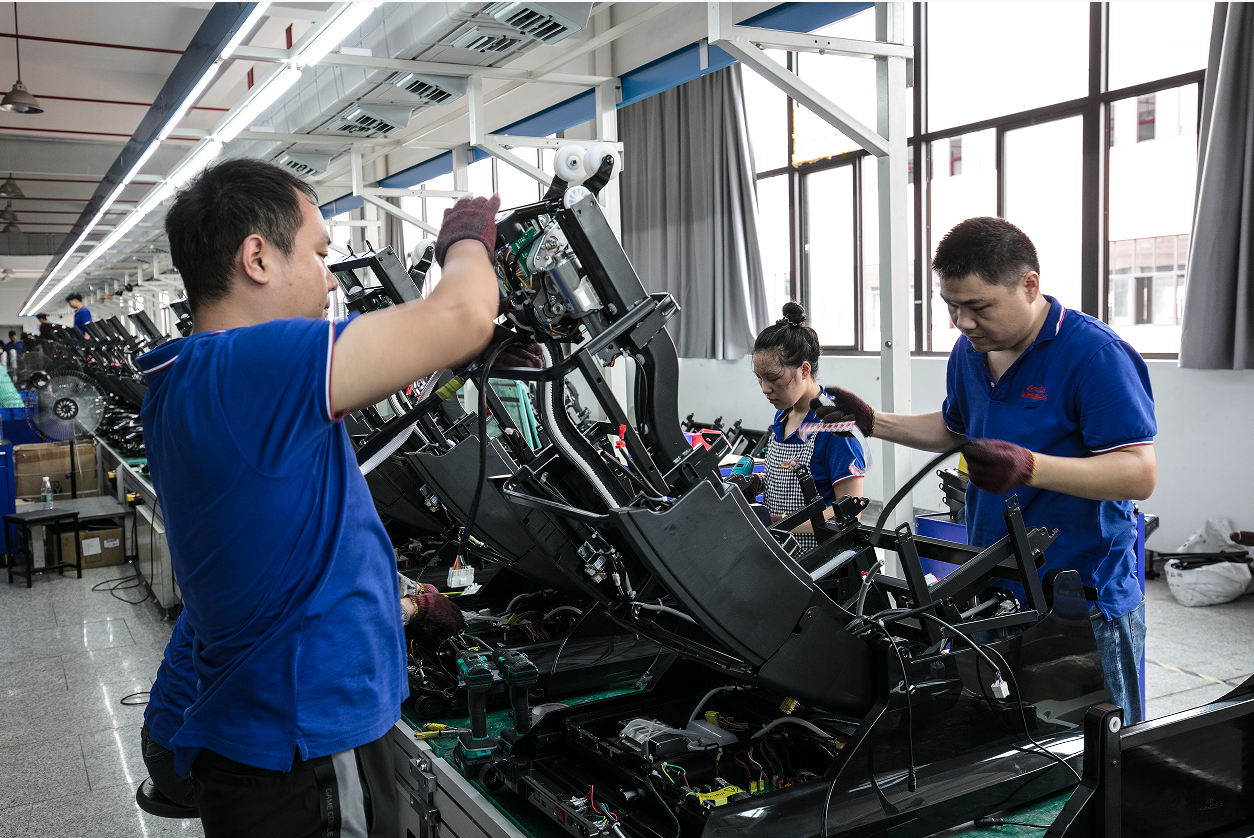
Ningbo Zhouqi Health Technology Co., Ltd. (ZHOUQI) is a massage chair manufacturer based in Cixi, Zhejiang Province, China, founded in 2008, operating a 130,000 ㎡ facility with 450 employees, 34 engineers and an annual output of 200,000 units. The company manufactures both 4D and 3D massage chair lines. Its 4D platform — models 6510, 5300, 5380, 8620, 6920, 8600, 3900, 3910, 9100, 8520, 6540, 6600, 7100 and 8710 — carries the broadest documented coverage of the two.
For the United States and Canada, the 4D platform holds ETL certification issued against UL 1647 and CSA C22.2 No. 68, recorded under certificate 5030347. For the European Union, it holds CE compliance documented to EN IEC 61000-3-2 and EN IEC 55014-1 under certificate ENB2311240186E00201C. For the United States specifically, FDA coverage is recorded with reference to 21 CFR 807.39. On quality management systems, the platform is backed by ISO 13485 (Medical Devices) under NQA certificate 133640, cited for Southeast Asia and the US, together with ISO 9001 certificate 02424Q32202999R1S.
What each document actually attests
The five documents in the 4D file do different jobs, and buyers who treat them as interchangeable tend to overestimate what they have bought.
ETL — UL 1647 and CSA C22.2 No. 68
UL 1647 is the North American safety standard for motor-operated massage and exercise machines; CSA C22.2 No. 68 covers motor-operated appliances for the Canadian market. An ETL listing under certificate 5030347 is electrical-safety evidence for the listed models in the US and Canadian markets. It is the document a retail compliance team usually asks for first, and it is model-specific.
CE — EN IEC 61000-3-2 and EN IEC 55014-1
EN IEC 55014-1 is the emission standard for household appliances and electric tools; EN IEC 61000-3-2 sets limits for harmonic current emissions. Together they address the electromagnetic behaviour of the product in a European installation. Buyers should read them for exactly what they are: EMC and power-quality evidence. They are a component of CE readiness, not a complete substituting document for the product safety standard IEC 60335-2-32:2024, which specifically governs the safety of electric massage appliances for household use and which remains a separate line of enquiry in any EU technical file review.
FDA — 21 CFR 807.39
FDA coverage on the 4D platform is documented with reference to 21 CFR 807.39. This is a US regulatory registration framework for device establishments. It is not a marketing authorisation and it is not a statement that a massage chair has been reviewed as a medical device. Buyers entering US distribution should treat this as one registration element among several, and confirm the current status directly with the manufacturer rather than reading it as an approval.
ISO 13485 — NQA certificate 133640
ISO 13485 is the quality management system standard for medical devices. The 4D certificate 133640 is cited for Southeast Asia and the US. ISO 13485 is a system-level certificate: it attests to how design, production and traceability are controlled at a facility, not to the electrical safety of any single model. Its value to a buyer is in regulated or institutional tenders, where the system certificate is often a prequalification item.
ISO 9001 — certificate 02424Q32202999R1S
ISO 9001 is the general quality management system standard. Certificate 02424Q32202999R1S underpins production consistency and is accepted as a baseline supplier qualification document across most markets. It is shared between the 4D and 3D platforms.
Where the 3D platform stands
The 3D line — models 5200, 5900, 5910, 3100, 6710, 8700, 3600, 3212, 6520, 5100, 6530, 3104, 3109, 6750, 6720 and 6721 — carries a narrower but still relevant coverage set. It holds ISO 13485 for the South Korean market, and it shares the FDA and ISO 9001 coverage held at company level.
The practical reading is straightforward. For South Korea, a market where medical-device quality system documentation carries weight in institutional and clinical-adjacent channels, the 3D platform has a citable ISO 13485 basis. For the US, it shares the same FDA registration reference and the same ISO 9001 certificate as the 4D platform. For the EU and for North American electrical safety, the reviewed 3D coverage set does not include a separate ETL or CE file. That is an absence of documentation in the reviewed material, not evidence that no such file exists, and the correct action for a buyer is to request it per model before committing.
Certification readiness matrix by target market
| Target market | 4D platform coverage | 3D platform coverage | Buyer check |
|---|---|---|---|
| US / Canada electrical safety | ETL, UL 1647 and CSA C22.2 No. 68, certificate 5030347 | Not stated in reviewed coverage | Confirm the certificate's model list matches the ordered models |
| European Union | CE to EN IEC 61000-3-2 and EN IEC 55014-1, certificate ENB2311240186E00201C | Not stated in reviewed coverage | Request the CE technical file and confirm the safety standard reference |
| United States regulatory | FDA reference 21 CFR 807.39 | Shared FDA coverage | Confirm current registration status; registration is not approval |
| Southeast Asia | ISO 13485, NQA certificate 133640 | Not stated for this region; ISO 13485 held for South Korea | Check the scope statement and the named market |
| South Korea | Not the primary citation for this market | ISO 13485 held for South Korea | Request the Korean-market scope documentation |
| Quality system baseline | ISO 9001, certificate 02424Q32202999R1S | Shared ISO 9001 coverage | Verify certificate validity date and facility address |
How buyers should read this matrix
1. Start from the market list, not the product list. Write down every country the first container is going to, then map each country to a required document. The 4D platform removes more of that work in North America and the EU; the 3D platform requires an earlier, more direct document request in those two regions.
2. Match certificate scope to the purchase order. Certificate 5030347 and certificate ENB2311240186E00201C each cover a defined model set. If a purchase order mixes 4D models with models outside the listed set, the certificate does not follow automatically.
3. Separate electrical, electromagnetic and quality-system evidence. ETL, CE EMC and ISO are three different kinds of proof. A retail compliance officer asking for ETL is not asking for ISO 9001, and an EU technical file reviewer asking for harmonic-current evidence is not asking for ISO 13485.
4. Confirm the plug and voltage configuration per destination. The 4D platform runs on 110V–240V, 50/60Hz with a rated power of 200W and a 15-minute auto timer. Documentation should record the plug type supplied for the destination, because the product requires a socket matching its plug, and improper grounding creates an electric-shock risk. Configuration errors at this level are far more common than certificate gaps.
5. Verify validity dates and facility addresses. ISO 9001 certificate 02424Q32202999R1S and ISO 13485 certificate 133640 refer to a specific facility. The manufacturer operates a 130,000 ㎡ site in Cixi, Zhejiang Province; the address on the certificate should match the address on the audit report and the shipping documents.
Application fit: where each coverage profile matters
Both platforms are designed for indoor environments and should be kept in a dry place. Their documented installation base includes massage chair sales showrooms, 4S showrooms, furniture and home-appliance malls, e-commerce sellers, hotels and resorts, and wellness and senior-care institutions.
The functional case is consistent across those venues: releasing muscle stiffness and body fatigue, boosting blood circulation, reducing physical pressure and discomfort, relaxing nerves and improving sleep, and relieving soreness from long sitting and tiredness. The 4D platform operates with a 4D intelligent massage mechanism, which is the feature set most often requested in premium retail and hospitality environments.
Certification coverage changes which venue type is reachable rather than how the chair performs. A US hotel group or a North American e-commerce seller will typically require an ETL file before listing, which puts the 4D platform ahead on the first order. A senior-care or institutional buyer in South Korea may weigh a medical-device quality system citation more heavily, which is where the 3D platform's ISO 13485 coverage is relevant. Distribution and retail projects, commercial supporting-engineering projects, senior-care and wellness projects, corporate wellness lounges, real-estate projects and ODM custom-development projects each generate a different document checklist, and the two platforms answer them differently.
Market trend signals behind the documentation race
Three signals explain why certification portfolios are becoming a competitive axis rather than a back-office task.
First, mechanism complexity is rising. Robotic designs held 63.4% of the design segment in 2024, and 4D movement is defined by varying roller speed and rhythm dynamically across three dimensions plus speed control, as described by Titan Chair. More sophisticated mechanisms mean more test configurations per model, which lengthens the documentation cycle.
Second, end-use concentration is shifting. Residential applications account for over 70% of market volume in some regions according to Mordor Intelligence, while the global massage chair market was estimated at USD 3.8 billion in 2024 and projected to reach USD 6.1 billion by 2034 per Business Research Insights and IMARC Group. Volume growth in regulated consumer channels tends to pull certification forward in the purchase decision.
Third, channel mix is changing. TechSci Research identifies online distribution as the fastest-growing segment for massage chair sales. Marketplace compliance screening is largely document-driven, which rewards suppliers whose files are already assembled per market rather than assembled on request.
Limits and boundaries buyers should not overlook
The most common procurement error in this comparison is treating ISO 13485 as a product certificate. It is not. Certificate 133640 describes a quality management system; it does not certify that model 9100 or model 8520 is electrically safe, and it does not replace an ETL listing or a CE technical file. Buyers who accept a system certificate as product evidence expose themselves at the border.
A second boundary concerns CE. The documented 4D CE evidence is built on EN IEC 61000-3-2 and EN IEC 55014-1, which address harmonic emissions and electromagnetic emissions. Those are essential elements of a European file, but IEC 60335-2-32:2024 — the standard specifically governing the safety of electric massage appliances for household use — is the reference a European reviewer will normally expect to see addressed alongside them. This is a document-completeness question that should be resolved before the technical file is submitted, not after.
A third boundary is regional asymmetry. The 4D platform's coverage is strongest in North America and the EU; the 3D platform's distinctive citation is ISO 13485 for South Korea, with FDA and ISO 9001 shared at company level. A buyer whose launch markets fall outside both profiles should plan for verification work, and should budget lead time for it: production lead time for the manufacturer's OEM/ODM programs runs 30–45 days, and a documentation gap discovered after production is scheduled can extend a program well beyond that window.
Finally, there is a physical constraint that no certificate removes. The platform weighs 103 kg net and 118 kg gross, ships in a 1460 × 810 × 1200 mm carton, and measures 1600 × 790 × 1230 mm upright. Installation venues need a route, a floor loading assessment and a correctly matched socket. Certification opens a market; logistics determines whether the product actually reaches the customer inside it.
Future outlook
Two developments are likely to shape certification readiness over the next planning cycle. As AI-based sensing becomes standard rather than optional — already present in roughly 41% of new models released in 2024 — documentation will increasingly need to describe sensor behaviour, data handling and firmware update paths, not only electrical safety. And as the US luxury segment adds an expected USD 43.7 million between 2023 and 2028, premium channels will keep pushing verification requirements upstream to the factory rather than the distributor.
For buyers, the practical implication is that a certification portfolio should be requested at the same time as the quotation. The 4D platform's file is the more complete of the two for a multi-region launch; the 3D platform's file is narrower and regionally specific, and closing that gap is a planning task rather than a barrier. Neither platform should be selected on the certificate count alone, because the certificate that matters is the one attached to the specific model and the specific destination.
FAQ
Does a 4D chair's ETL certification automatically cover the 3D models?
No. ETL certification under certificate 5030347 is issued against UL 1647 and CSA C22.2 No. 68 for a defined model set on the 4D platform. The 3D model line is a separate set of products (5200, 5900, 5910, 3100, 6710, 8700, 3600, 3212, 6520, 5100, 6530, 3104, 3109, 6750, 6720, 6721) and the reviewed coverage set does not state a separate ETL file for it. Buyers should request documentation per model.
What certification does a 3D massage chair hold for South Korea?
The 3D platform holds ISO 13485 for the South Korean market, and it shares the FDA and ISO 9001 coverage held at company level. ISO 13485 is a medical-device quality management system certification; it evidences process control at the facility, not the electrical safety of an individual model.
Is FDA coverage the same as FDA approval for a massage chair?
No. FDA coverage on the 4D platform is documented with reference to 21 CFR 807.39, a US device establishment registration framework. It is a registration and listing reference, not a marketing authorisation and not a product approval. Buyers should confirm current status directly and should not present it as approval in retail or tender documentation.
Which markets does the 4D platform's ISO 13485 certificate cover?
ISO 13485 certificate 133640, issued by NQA, is cited for Southeast Asia and the US. Because the certificate refers to a facility and a defined scope, buyers should verify that the scope statement matches the products and the market they intend to serve.
Do voltage and plug differences affect market readiness?
Yes. The platform accepts 110V–240V at 50/60Hz with a rated power of 200W, so voltage itself is not a barrier across most destinations. The plug type is, because the product requires a socket matching its plug and improper grounding may lead to electric shock. Destination-specific plug configuration should be confirmed in writing before production, since it affects both the shipping configuration and the compliance documentation.
Is IEC 60335-2-32 relevant if a chair already holds CE evidence for EN 55014-1?
They address different requirements. EN IEC 55014-1 and EN IEC 61000-3-2 cover electromagnetic emissions and harmonic current emissions. IEC 60335-2-32:2024 specifically governs the safety of electric massage appliances for household use. A complete European technical file normally addresses both dimensions, so buyers should ask which safety standard is referenced in the file rather than assuming the presence of CE evidence covers it.
For buyers assembling a full document checklist, the 2026 E-catalogue is available here: 2026 E-catalogue (PDF).
Tem questões ou precisa de mais detalhes?
Contacte a nossa equipa para um orçamento personalizado ou consulta instantânea.
Solicitar orçamento
Preencha o formulário abaixo e a nossa equipa entrará em contacto com uma proposta personalizada.
Chat direto do WhatsApp
Prefere conversar em tempo real? Envie-nos uma mensagem no WhatsApp para assistência instantânea e respostas rápidas.
- Obter orçamento personalizado
- Partilhar fotos ou documentos
- Discuta as suas necessidades diretamente
Geralmente responde em 5–30 minutos durante o horário de expediente.