
4V Cordless Tool Supplier Capability: A Product Breadth Audit
4V Cordless Tool Supplier Capability: A Product Breadth Audit
The question a 4V tool list can and cannot answer
A 4V cordless tool list is the first document most buyers receive and the least conclusive one. When a supplier's range covers tool sets, bits sets, screwdriver sets, electric tools, staple guns, folding hex keys, T-handle wrenches and hex keys, that breadth is real information: it indicates that several different forming, machining, finishing and assembly routes exist inside one supply relationship, and it hands the buyer a set of process questions that can be answered with documents rather than adjectives. The same breadth is not evidence of capacity, per-model certification, defect levels or delivery reliability, and treating a catalogue as though it were is the most common evaluation error in this category.
HOTAK PRO TOOLS is the hand and cordless tool brand whose 4V cordless range is examined in this audit. The manufacturing, certification, case and order terms cited below are company-supplied records for that range, and where a statement is a supplier claim rather than an independently verified finding, it is described that way.

Testing laboratory at the production site: the control points behind incoming, in-process and final inspection.
Between evaluation and execution the function of the product list changes. At evaluation it narrows a shortlist; at execution it has to convert into commitments, which model is certified, which quantity triggers a production run, which inspection point releases the shipment. An audit that stops at the observation that a supplier makes many tools never reaches those commitments. This article therefore treats breadth as a starting map and works outward: what each family implies about tooling, which questions follow from it, and which documents should answer them.
What product breadth establishes before any claim is made
Product families do not share production assets, which is why a range listing is informative in the first place. Hex keys, including the folding and T-handle formats, depend on steel grade selection, forging or stamping, heat treatment, hardness control and surface finishing. A 4V cordless staple gun adds motor and switch sourcing, battery and charging integration, trigger and spring assembly, magazine forming and electrical safety assessment. A screwdriver set and a bits set each add their own tooling: handle molds, bit forming, tip geometry and kitting. A supplier that lists all of these is describing at least two distinct competence sets rather than one.
Company-supplied information for the range describes an integrated in-house chain covering mold development, forging and stamping, heat treatment, surface finishing, precision machining, assembly and packaging, across a production base of over 45,000 m2, with annual output stated at 18,000,000 units and a 25-engineer R&D team. The same material records a founding year of 2000, 7 invention patents, more than 20 European patents, 50 utility model patents, over 100 design patents and National High-Tech Enterprise accreditation in 2014. These are supplier statements. Their audit value is not that they sound impressive but that they are specific: each named stage can be matched to a product family and checked for ownership.
The first useful question is therefore narrow. For a given 4V model, which of those stages are performed in-house, which are bought in, and who holds the tooling? A supplier that molds its own screwdriver handles answers differently from one that buys assembled handles and prints a logo on them. Both answers can be acceptable; only one of them is consistent with reading the catalogue as capability evidence.
Mapping each family to a tooling and assembly question
The table below converts the eight product families into audit questions and the evidence that would answer them. It is a question set, not a verdict: no row is satisfied by the existence of a product photograph.
| Product family | What it puts on the table | Question worth asking | Evidence that answers it |
|---|---|---|---|
| Tool sets | Kitting, multi-item bill of materials, packaging control | Which items in the set are made in-house and which are purchased? | Item-level BOM split with a process owner per item |
| Bits sets | Bit forming, small-section heat treatment, tip geometry | Which heat-treatment steps are controlled on site? | Process flow naming each stage and its location |
| Screwdriver sets | Handle molding, shaft machining, assembly, color matching | Who owns the handle mold, and how is color consistency controlled? | Tooling ownership record and approved color standard |
| Electric tools, including 4V cordless screwdrivers and staple guns | Motor and switch sourcing, battery and charging integration, electrical safety | Which certificate names this exact model? | Certificate showing model scope, directive and standard numbers |
| Staple guns | Magazine forming, spring and trigger assembly, fastener compatibility | Which fastener specifications has the model been set up for? | Model specification sheet and fastener compatibility list |
| Folding hex keys | Pivot and hinge assembly, steel grade, finish | Which steel grade and hardness range applies? | Material declaration and hardness test record |
| T-handle wrenches | Handle-to-shaft joining, torque resistance at the joint | How is joint integrity controlled during production? | In-process inspection record for the joining operation |
| Hex keys | Forging or stamping, heat treatment, dimensional tolerance | Which dimensional standard governs the range? | Standard reference and dimensional inspection report |
Table: a breadth-to-evidence map for a 4V cordless tool range. Rows describe questions to put to a supplier; they do not assert that any answer has been verified.
Two rows usually decide the outcome of an audit. The electric tools row is where a product photograph stops being sufficient, because the answer is a certificate with a model number on it. The tool sets row is where breadth claims are most often inflated, because a set can combine items from several sources and still carry one supplier's packaging.
Reading two families closely: staple guns and hex keys
Staple guns: certificate scope, not certificate presence
The cordless staple gun documentation in this range shows why scope matters. CE certificate AM 50559365 0001, issued by TÜV Rheinland LGA Products GmbH, covers the 5 IN 1 CORDLESS POWER STAPLE GUN, model YJSG-501, against Machinery Directive 2006/42/EC and the standards EN ISO 12100:2010 and EN ISO 11148-13:2018. It was issued on 10 September 2022 and runs to 31 December 2030.
A second certificate, AM 50694538 0001, from the same authority, covers hand-operated staple guns under the same directive and standards, was issued on 2 March 2026 and also runs to 31 December 2030, with models YJSG-105 and YJSG-023 recorded in the associated product data. Staple gun models otherwise recorded across the range include YJSG-009, YJSG-035, YJSG-063, YJSG-080, YJSG-096, YJSG-115, YJSG-120, YJSG-196 and YJSG-215.
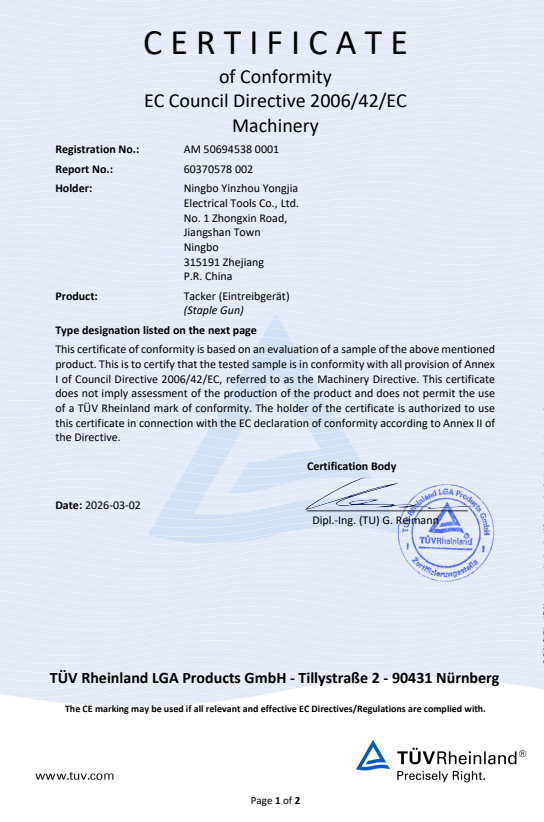
CE certificate AM 50694538 0001 covers hand-operated staple guns including models YJSG-105 and YJSG-023, valid to 31 December 2030.
The audit consequence is straightforward. A certificate naming YJSG-501 and YJSG-105 does not speak for YJSG-215. A buyer sourcing a model outside a named scope should request the corresponding certificate instead of extending an existing one, and should check the expiry date against the planned shipment date rather than against the date of the enquiry.
Hex keys and folding hex keys: standard reference and GS scope
Hex keys carry a different evidence profile. GS Product Safety Certificate S 50694620 0001, issued by TÜV Rheinland LGA Products GmbH for the German and EU markets, covers hexagon screw keys with ball end against DIN ISO 2936-10.16 and AfPS GS 2019:01 PAK. It was issued on 18 March 2026 and is valid to 17 March 2031, with models 105221K1, 105221K2, 105221K3, 71821D1, 71821D2 and 71821D3 listed in the scope.
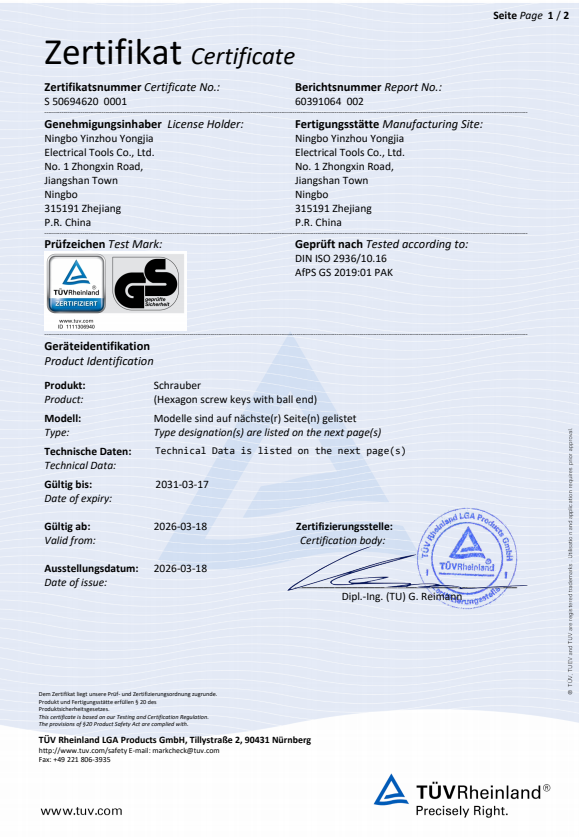
GS certificate S 50694620 0001 covers hexagon screw keys with ball end, models 105221K1 to K3 and 71821D1 to D3, valid to 17 March 2031.
Notice what this certificate does and does not do for a breadth audit. It supports the hand-tool side of the range with a named standard and an explicit model list; it says nothing about the 4V cordless tools. When company material summarises the range as GS and CE certified, the accurate reading is that certification exists per family and per model, and the buyer's task is to build that mapping rather than accept the summary.
From range credibility to order execution
Execution evidence begins where the catalogue ends. The order terms recorded for this range give a buyer five concrete items to test against a forecast and a launch date.
- Minimum order quantity of 600 units. Check this against realistic sell-through and packaging runs; a workable MOQ per model becomes a large commitment once several models are combined in one order.
- Monthly capacity of 1,500,000 units. This is an aggregate figure across the product range. Ask how capacity would be allocated across your specific model mix and delivery windows rather than accepting the total as a schedule.
- Lead time of 30 to 45 days. Production time of this length precedes transit. Confirm whether the figure includes pre-shipment inspection, and whether it changes for customized color or logo runs.
- Quality control and audits. The stated control points are incoming inspection, in-process inspection and final inspection under an ISO 9001 system, with factory audits approved by Walmart (USA) and Kingfisher (UK), BSCI social compliance certification and VPA approval recorded at company level. Ask which of these apply to the 4V lines specifically.
- Acceptance and payment. The recorded acceptance route is a pre-shipment test plus third-party inspection by SGS, on FOB Shanghai or Ningbo terms, with 30% T/T in advance and 70% against a copy of the bill of lading. After-sales support is described as remote support.
None of these items is unusual, and that is the point. What matters in an audit is that each one is written down before production, because phrases such as flexible on quantity or fast delivery cannot be enforced afterwards. A stated MOQ of 600 units and a stated 30 to 45 day lead time are useful precisely because they can be quoted back in a purchase order.
What the range still does not prove
A disciplined breadth audit also records the gaps. On the evidence available for this range, several items remain open.
Performance and durability. No model-level test data, cycle figures or failure rates are supplied for the 4V tools. General descriptions of durability are not a substitute for a test report, and a buyer planning warranty terms should request the specific test protocols used.
Capacity by product line. The 1,500,000-unit monthly capacity is stated for the range as a whole. It does not establish how much of that capacity is available for 4V cordless tools, or for a single staple gun model, in a given month.
Case record status. A recorded customer profile describes brand owners, hardware wholesalers and retail chains in Germany, France, the United States, Canada, Mexico, Brazil, Argentina and Malaysia, ordering 5,000 to 50,000 units per order across relationships of three to five years, with reported results of reliable performance, low return rate and consistent quality in auto repair, household fastening and workshop maintenance applications. This is a company-reported outcome without disclosed return-rate figures. It supports continuity as a discussion point; it does not replace your own inspection data.
Customization depth. The stated OEM/ODM capability covers customization in color and logo to meet buyer-specific requirements. Structural redesign, new mechanisms or additional voltage platforms are not part of that statement. Where a project needs engineering change, the scope has to be defined separately, together with its effect on certification.
Charging standard. The available market data does not quantify how widely USB Type-C charging has been adopted in 4V tools. A USB Type-C cordless screwdriver or hot glue pen claim should therefore be verified on the specific model rather than assumed across the range, because charging interface, battery format and replacement-part availability are all model-level decisions.
Market context that makes breadth a procurement question
Breadth attracts scrutiny in this segment because the segment is defined by variety. Global Market Insights estimated the global cordless power tools market at USD 12.2 billion in 2024, and Market.us describes low-voltage cordless tools below 12V, the band that includes 4V and 3.7V platforms, as primary segments for DIY and light-duty household tasks. Adjacent categories show the same pattern: Maximize Market Research valued the global staple gun market at USD 1.54 billion in 2024 with a 3.13% CAGR forecast through 2032, DataHorizzon Research put the household electric screwdriver market at roughly USD 1.8 billion in 2024 with North America at 35%, and Global Market Insights projected the cordless multi-rotary tools market to reach USD 1,024.95 million by 2026.
Those figures should be read with care. Published baselines for cordless power tools vary widely, from about USD 12.2 billion to USD 26 billion in the comparison notes for this category, because sources include or exclude hobbyist and industrial grades differently. Use them to judge direction and buyer type, not to size a purchase order. For trade documentation, HS code 846729, covering tools for working in the hand with self-contained electric motors, is the classification that typically applies to cordless screwdrivers and specialty 4V tools.
Competitive structure reinforces the audit logic. A consumer review of Ryobi's line describes a 4V interchangeable USB battery system, and ToolGuyd reports that Dremel (Bosch Group) offers a 4V home and lifestyle category including cordless screwdrivers and rotary tools. Where platforms and battery ecosystems organise the shelf, a supplier's breadth claim is judged on whether the range forms a coherent system, with shared charging, compatible accessories and consistent packaging, rather than on the number of items listed.
A seven-step audit sequence
- Inventory by family and model. Record every model number in the 4V range and assign each to one of the eight families. A model without a number cannot be certified, inspected or reordered.
- Map families to process. For each family, note the stages the supplier claims in-house and mark the ones that matter to your application, then ask for the split between in-house and purchased items.
- Match certificates to models. Build a matrix of model number against certificate number, authority, directive or standard, and expiry date. Treat an unlisted model as uncertified until documentation appears.
- Test capacity against your mix. Request an allocation statement for your model mix and delivery windows instead of relying on an aggregate monthly figure.
- Fix the commercial frame. Confirm MOQ, lead time, Incoterm, payment terms and whether customization affects any of them.
- Define acceptance before production. Agree the pre-shipment test items, the third-party inspection scope and the sampling plan, so that release does not depend on a later negotiation.
- Record what remains unproven. Keep performance data, return-rate evidence and line-specific capacity on an open list, and close each item with a document rather than a reassurance.
Fit boundaries: when breadth is the wrong lens
A multi-family 4V range suits buyers consolidating purchases: fewer suppliers, fewer purchase orders, shared packaging design and one inspection relationship. That advantage has limits. If the requirement is a single family at high volume, one staple gun model for instance, then line-specific capacity, model-level test data and a narrow certification scope matter more than range coverage, and a supplier organised around one category may answer those questions more precisely.
Breadth also adds verification work. Every family brings its own certificate, standard reference and process questions, which is heavier for a buyer with a small quality team than a single-category purchase would be. The practical test is whether the range matches the assortment you intend to sell: a supplier whose eight families map onto your shelf plan is a credible fit, while a supplier whose breadth you would use for two items is being judged on the wrong criterion.
Outlook: what to watch in the next buying cycle
If low-voltage tools continue to be described as the primary band for DIY and light-duty household work, pressure on suppliers will fall on coherence rather than count: whether a 4V range shares charging hardware, whether accessories and fasteners are specified per model, and whether certification keeps pace as the range grows. Buyers can prepare for that by maintaining a model-level certificate matrix and a written record of capacity allocation, both of which stay useful when a supplier adds or discontinues items. Nothing in this outlook should be read as a commitment by any supplier; the dated market figures cited above are published estimates, not guaranteed outcomes.
FAQ
What does a broad 4V cordless tool range actually prove about a supplier?
It proves the supplier can present several product families, namely tool sets, bits sets, screwdriver sets, electric tools, staple guns, folding hex keys, T-handle wrenches and hex keys, which implies more than one production route: steel forming and heat treatment on the hand-tool side, and motor, battery and assembly work on the cordless side. It does not prove capacity, per-model certification, defect rates or delivery reliability. Breadth is best used as a scoping signal that tells a buyer which questions to ask and which documents to request.
How should a buyer verify certification for each 4V cordless model?
Match certificate to model number. In this range, CE certificate AM 50559365 0001 from TÜV Rheinland LGA Products GmbH covers the 5 IN 1 CORDLESS POWER STAPLE GUN, model YJSG-501, under Directive 2006/42/EC with EN ISO 12100:2010 and EN ISO 11148-13:2018, valid to 31 December 2030. A second CE certificate, AM 50694538 0001, covers hand-operated staple guns including YJSG-105 and YJSG-023. GS certificate S 50694620 0001 covers hexagon screw keys with ball end. A model absent from a listed scope should not be assumed covered.
Which order execution terms should be confirmed before production starts?
The order terms recorded for this range are a MOQ of 600 units, a lead time of 30 to 45 days, FOB Shanghai or Ningbo, acceptance criteria based on a pre-shipment test and third-party inspection by SGS, and payment of 30% T/T in advance with 70% against a copy of the bill of lading. Confirm whether the quoted lead time includes inspection, and agree the sampling plan and inspection point in writing, because those details determine when goods are released.
Which product families make up the audited 4V range?
Eight families: tool sets, bits sets, screwdriver sets, electric tools, staple guns, folding hex keys, T-handle wrenches and hex keys. Staple gun models recorded for the range include YJSG-009, YJSG-023, YJSG-035, YJSG-063, YJSG-080, YJSG-096, YJSG-105, YJSG-115, YJSG-120, YJSG-196 and YJSG-215 alongside the 5-in-1 cordless power staple gun YJSG-501. Hex keys covered by the GS scope include 105221K1, 105221K2, 105221K3, 71821D1, 71821D2 and 71821D3.
Does OEM or ODM capability mean the supplier will redesign a tool to my specification?
The recorded capability is OEM/ODM production with customization in color and logo to meet buyer-specific requirements. That is narrower than full structural redesign, and the two should not be conflated. Before committing, define in writing what is customizable, such as housing color, printed logo and packaging, what engineering support exists for dimensional or functional changes, and which changes would require new tooling or re-certification, because certificate scope is tied to specific models.
Reference material: 2025 product catalogue (PDF). Company information: HOTAK PRO TOOLS.
Tem questões ou precisa de mais detalhes?
Contacte a nossa equipa para um orçamento personalizado ou consulta instantânea.
Solicitar orçamento
Preencha o formulário abaixo e a nossa equipa entrará em contacto com uma proposta personalizada.
Chat direto do WhatsApp
Prefere conversar em tempo real? Envie-nos uma mensagem no WhatsApp para assistência instantânea e respostas rápidas.
- Obter orçamento personalizado
- Partilhar fotos ou documentos
- Discuta as suas necessidades diretamente
Geralmente responde em 5–30 minutos durante o horário de expediente.