
5 Core Nursing Manikins for a New Simulation Lab: An HTNXT Shortlist
5 Core Nursing Manikins for a New Simulation Lab: An HTNXT Shortlist
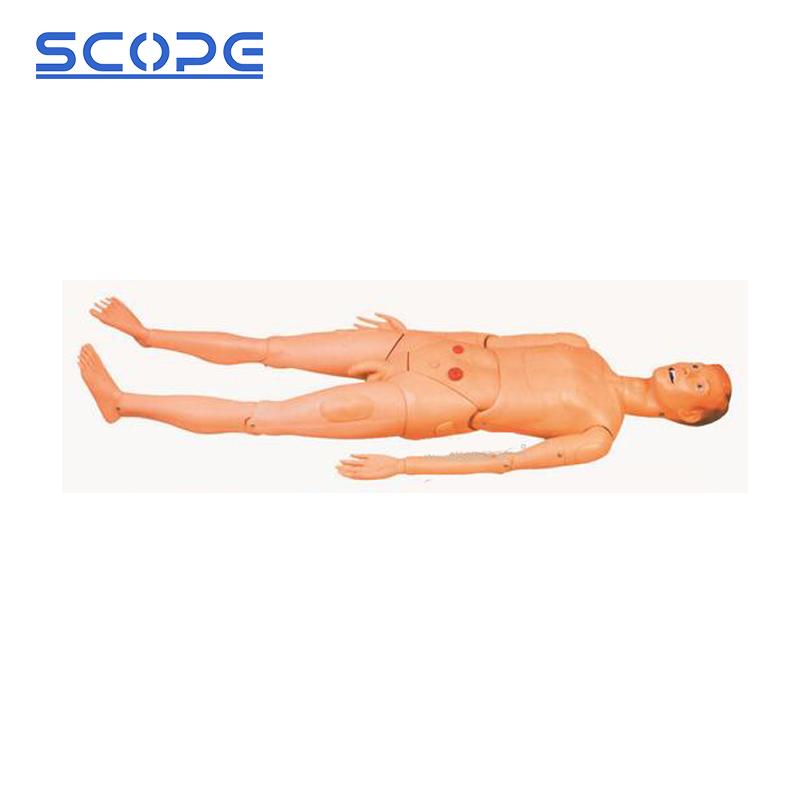
Foundational nursing simulation laboratories are usually equipped in stages. The first purchasing decision is rarely about the highest available level of technology; it is about which physical models let students rehearse the procedures that appear in the first years of a nursing curriculum, and which of those models survive repeated use. A five-manikin core set covering holistic nursing care, intravenous access, intramuscular injection, layered injection technique, and pediatric care gives a new lab a workable baseline before any high-fidelity patient simulator is considered.
The scale of the category explains why this decision now appears in procurement plans rather than only in academic discussions. Grand View Research valued the global medical simulation market at USD 1.9 billion in 2025 and projected it to reach USD 6.7 billion by 2033, with healthcare anatomical models — the category that includes medical manikins — holding approximately 41.4% of that sector in 2025. Global Insight Services estimated training manikin market volume at 1.2 million units in 2024, with projections of 2 million units by 2028. Growth is concentrated in Asia-Pacific, the fastest-growing region at an expected CAGR of 18.2% through 2033 (Grand View Research). Policy is reinforcing the trend: China's National Medical Commission mandated simulation labs for the accreditation of all new medical schools as of 2024–2025 (Market Research Future).
This shortlist is written for the buyer inside that situation — a nursing school, hospital education department, or training centre commissioning a first skills laboratory and deciding which models to buy in the opening round. The five models below come from the medical manikin range of Chongqing Scope Instrument Co., Ltd., a supplier of laboratory instruments and medical training equipment based in Chongqing, China. The company was founded in 2017, operates a 5,000 m² facility with more than 100 employees and a 20-engineer R&D team, reports an annual output of 30,000 units, and exports roughly 50% of its output to Europe, Southeast Asia, the Middle East, South America, and Africa (www.cqscopelab.com).
Why a New Simulation Lab Starts With Five Manikins
The problem a new lab faces is not a shortage of models — it is a coverage gap. Commissioning committees typically evaluate two directions and find both incomplete on their own.
Buying a single full-body nursing manikin gives holistic care coverage but concentrates all procedural repetition on one unit, which is inefficient for high-volume injection practice. Buying a set of small task trainers gives cheap repetition for single skills, but leaves airway care, urinary catheterization, ostomy care, and bathing uncovered. The practical answer for a foundational lab is a small mixed set: one full-body nursing manikin for holistic care, plus dedicated task models for the procedures a cohort will perform hundreds of times.
Five procedure areas define that baseline: (1) holistic patient care and hygiene; (2) intravenous access and venipuncture; (3) intramuscular injection with anatomical landmark confirmation; (4) layered injection technique — intradermal, subcutaneous, intramuscular — that can be practiced without consuming a full-body model; and (5) pediatric nursing, where infant handling and vascular access differ enough from adult practice to require a dedicated model.
The Five-Manikin Shortlist at a Glance
| Model | Manikin type | Primary procedural training supported | Build material |
|---|---|---|---|
| SC-H130A | Nursing Manikin | 21 listed functions spanning airway, nutrition, vascular access, puncture, urinary and ostomy care, and holistic care | PVC |
| SC-HS4 | IV Injection Model | Arm venipuncture and IV injection with electronic confirmation of needle placement | Imported thermoplastic elastic mixed rubber skin and muscle; imported latex vessels and nerves; imported PVC bones and joints |
| SC-H4T | Training Mannequin (Nursing Manikin) | Gluteal intramuscular injection with palpable anatomical landmarks and a removable left buttock section | Imported plastic elastomer, stainless steel mould injection, high-temperature sintered |
| SC-HL | Medical Training Model (Nursing Manikin) | Intradermic, hypodermic and intramuscular injection on a three-layer wearable pad | PVC skin, subcutis and muscle layers |
| SC-H140 | Pediatric Training Model (Maternal and Infant Manikin) | Infant venous access, airway care, gastrointestinal procedures, injections and daily care | PVC |
Why Each Manikin Was Selected
SC-H130A — Comprehensive Nursing Coverage in One Body
The SC-H130A is a full-function nursing manikin whose specification lists 21 training functions. Those functions group into six areas:
- Hygiene and personal care: hair and face washing, oral cavity and artificial teeth care, eye and ear washing and administering, sponge bath and replacing clothes as part of holistic nursing care;
- Airway and respiratory care: endotracheal intubation, tracheotomy care, sputum suction, oxygen inhaling;
- Nutrition and gastrointestinal care: oral and nasal feeding, gastrolavage, enema;
- Vascular access and injection: venipuncture, injection and blood transfusion on the arm; deltoid subcutaneous injection; vastus lateralis injection; buttocks intramuscular injection;
- Puncture procedures: thoracic cavity, abdominal cavity, liver, bone marrow and lumbar puncture;
- Urinary and ostomy care: female and male urethral catheterization, female and male bladder irrigation, ostomy care, plus identification of the main organs in the thoracic and abdominal cavities.
For a new lab, the SC-H130A is the anchor unit: one model that carries the general nursing curriculum while the task trainers absorb high-frequency repetition.
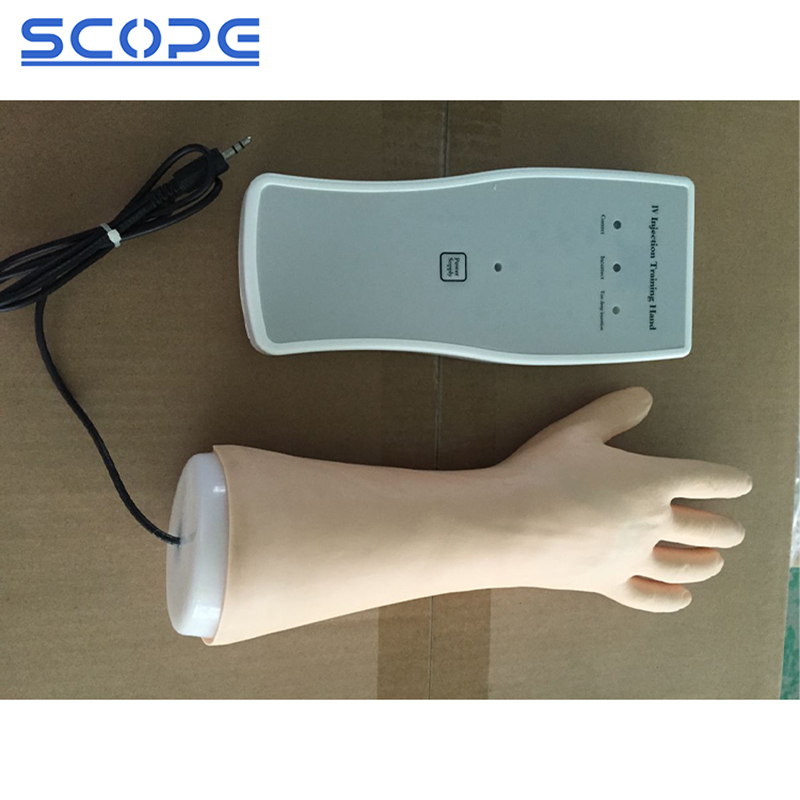
SC-HS4 — Intravenous and Venipuncture Training With Electronic Feedback
The SC-HS4 IV injection model is built as a hand and arm unit. Its skin and muscle layer uses imported thermoplastic elastic mixed rubber, the nerves and blood vessels use imported latex, and the internal bones and joints of the arm use imported PVC cast in metal moulds at high temperature — a material combination specified so that the operating feel stays realistic and the unit does not deform after disinfection and cleaning.
The distinguishing feature is feedback. An electronic monitor confirms when the needle has correctly penetrated into the blood vessel, and an alarm prompts during puncture, so a student receives an immediate signal rather than relying only on instructor observation. The standard configuration includes one standard hand model, one electronic monitor, one 5 ml infusion set, and an instruction manual — effectively a self-contained training station.
SC-H4T — Intramuscular Injection With Visible Anatomy
The SC-H4T is an intramuscular injection trainer built around the gluteal region. Its specification lists anatomical landmarks — the proximal femur, greater trochanter, anterior superior iliac spine, posterior superior iliac spine and sacrum — so students can locate injection sites against real bony reference points rather than approximating position on a featureless surface.
The left buttock quarter is removable, which exposes the gluteus medius muscle, gluteus maximus muscle, sciatic nerve and vascular structures for instruction. Three intramuscular injection approaches are listed in the product description: dorsal hip injection, ventral hip injection and the bone lateralis approach. The model uses imported plastic elastomer formed in stainless steel moulds and sintered at high temperature — a process the specification associates with durability and indistinct needle traces after repeated use, a relevant property when an entire cohort shares one trainer.
SC-HL — A Wearable Pad for Layered Injection Technique
Not every injection skill needs a body. The SC-HL is a wearable three-layer pad divided into skin, subcutis and muscle, supporting intradermic injection, hypodermic injection and intramuscular injection on the same unit. Because it is worn rather than positioned on a table, it supports angle, depth and positioning practice under posture conditions closer to a real procedure.
Injection liquid can be introduced into the pad and is removed by squeezing the pad after use, so the unit can be reused across a teaching session. Within the five-model mix, the SC-HL functions as the low-cost repetition layer that protects the full-body SC-H130A from intensive injection wear.
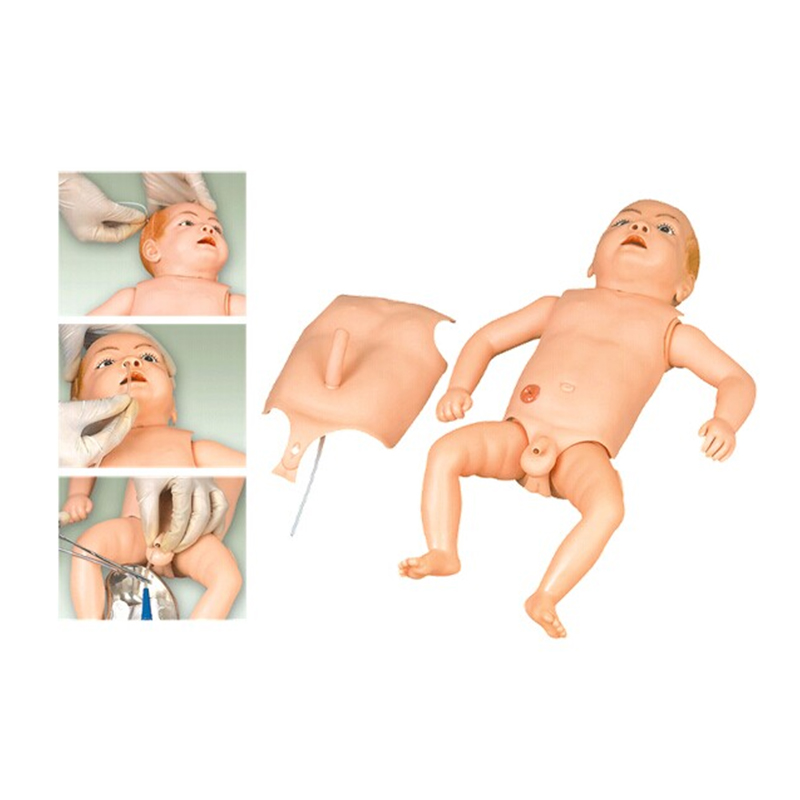
SC-H140 — Pediatric Nursing in a Dedicated Model
Infant care is not a scaled-down version of adult nursing, which is why the fifth slot goes to a pediatric trainer rather than a second adult unit. The SC-H140 has a baby whose head, neck and limbs move freely, with replaceable chest skin for male or female configuration. Its listed procedures include infant cephalic vein puncture; baby umbilical cord venipuncture; infant oral and nasal intubation care; gastric lavage, enema and catheterization; ostomy drainage; deltoid and gluteal muscle injections; and overall care covering bathing, breastfeeding, changing clothes and diaper changing.
Selecting a dedicated infant model in the first procurement round avoids the common gap in which pediatric practice is deferred to a later budget cycle and taught without a physical model in the interim.
What the Specifications Say About Materials and Feedback
Three material decisions recur across the shortlist, and each carries a procurement implication.
PVC is the base material for the SC-H130A, the SC-HL and the SC-H140, and is used for the internal bones and joints of the SC-HS4 arm. In the manufacturer's description of its manikin range, PVC supports durability, resistance to deformation and a high degree of authenticity.
Elastomer and mixed-rubber construction appears where repeated needle penetration matters most. The SC-H4T uses imported plastic elastomer formed in stainless steel moulds and sintered at high temperature; the SC-HS4 skin and muscle layer uses imported thermoplastic elastic mixed rubber with imported latex vessels. Both specifications address the same practical problem: needle traces and material fatigue after shared use.
Electronic feedback appears only where a skill is difficult to verify visually. The SC-HS4 monitor confirms correct penetration into the vessel. The remaining four models operate as manual units with no electronic components, which keeps the lab's power, calibration and maintenance burden low.
Matching the Shortlist to a First-Year Nursing Curriculum
| Training area | Manikin | Reason for the match |
|---|---|---|
| Holistic care, hygiene, oral care | SC-H130A | Listed functions include hair and face washing, oral and artificial teeth care, eye and ear care, sponge bath and changing clothes |
| Airway and respiratory care | SC-H130A | Endotracheal intubation, tracheotomy care, sputum suction, oxygen inhaling |
| Nutrition and gastrointestinal care | SC-H130A | Oral and nasal feeding, gastrolavage, enema |
| IV access and venipuncture | SC-HS4 | Electronic confirmation of vessel penetration and puncture alarm |
| Intramuscular injection technique | SC-H4T | Palpable bony landmarks plus a removable buttock section exposing nerve and vessel anatomy |
| High-volume injection repetition | SC-HL | Three-layer wearable pad for intradermic, hypodermic and intramuscular practice |
| Pediatric nursing | SC-H140 | Infant cephalic vein puncture, umbilical cord venipuncture, intubation care, catheterization, daily infant care |
| Puncture procedures and urinary care | SC-H130A | Thoracic, abdominal, liver, bone marrow and lumbar puncture; catheterization and bladder irrigation |
Operating Conditions for a Manikin-Based Lab
The application record for this manikin range describes medical school teaching, first aid training and medical education, with manual operation mode and an ambient temperature range of 0–35°C. The stated special requirement is to keep the room temperature constant — neither too high nor too low. No matched equipment is listed beyond the manikins themselves. The same record identifies deployment relevant to markets including the United Arab Emirates, Indonesia, Israel, India, Iraq, Laos and Malaysia.
For a commissioning committee, the implication is straightforward: a simulation room needs stable climate control before it needs additional electronics. Because the operating mode is manual, the lab's electrical and networking requirements stay minimal, and instructor workload shifts to observation and feedback rather than device configuration.
Market Trend Analysis
Three trends visible in the published data affect how a new lab should structure its first manikin purchase.
First, the installed base is expanding faster than the software layer. Training manikin market volume is projected to grow from 1.2 million units in 2024 to 2 million units by 2028 (Global Insight Services), while anatomical models including manikins already hold approximately 41.4% of medical simulation sector revenue (Grand View Research). Manikins remain the physical entry point to simulation, and the largest volume segment is the task and nursing trainer category rather than the top-tier simulator category.
Second, demand growth is shifting regionally. Asia-Pacific is expected to grow at an 18.2% CAGR through 2033, against North America's 2024 position of roughly 45–48% revenue share (Grand View Research; Precedence Research / WiseGuyReports). New labs in fast-growing markets are more likely to be commissioning a first lab than replacing an established one, which makes multi-model shortlists more relevant than single flagship purchases.
Third, the qualification standard is consolidating. ISO 13485:2016 is the internationally recognized Quality Management System standard for the design and manufacture of medical devices, including simulation manikins (ISO). Buyers increasingly use it as a baseline supplier filter. The market's established high-fidelity competitors — Laerdal Medical, CAE Inc., Gaumard Scientific and Kyoto Kagaku — are identified at the full-simulator end of the category (MarketsandMarkets), which leaves the nursing and task trainer segment served by a broader supplier base.
Where This Shortlist Stops — Boundaries and Limitations
A shortlist that only lists strengths is not useful for procurement. Four boundaries should be stated before purchase.
First, none of the five models is a full-body high-fidelity patient simulator. They are manual-operation nursing and task trainers, and the only electronic feedback in the set is the SC-HS4 puncture monitor. Programs that require physiological modelling, automated scenario control, or real-time vital-sign response are shopping in a different capability class and should budget accordingly.
Second, coverage is regional, not universal. The SC-H4T trains gluteal intramuscular injection and does not cover arm or thigh injection sites; the SC-HL is a pad and covers no airway, urinary or holistic care function; the SC-HS4 covers arm venipuncture only; the SC-H140 is infant-scale and cannot substitute for adult nursing practice; the SC-H130A covers adult holistic care but not pediatric care. Overlap between the injection models is real, but it is functional overlap — repetition capacity — not procedural redundancy.
Third, environmental limits apply. The recorded operating range is 0–35°C with a constant room temperature requirement, and operation is manual, so all realism depends on the model build and the instructor's feedback rather than on powered responses.
Fourth, commercial parameters apply. The capability record for this product line lists a minimum order quantity of 20 units, a lead time of 30–45 days, and a one-year online warranty. ODM customization of appearance and functions is available, and customized items may extend the lead time beyond the standard window.
Procurement Parameters and Customization
The production capability record for the medical manikin line lists ODM as the production mode, customization of product appearance and functions, a monthly capacity of 3,000 units, a lead time of 30–45 days, a minimum order quantity of 20 units, factory quality inspection as the quality-control step, and a one-year online warranty. Export markets are listed as Europe, the Middle East, Southeast Asia, North America, South America, Russia and Africa. The company's stated export certificates include ISO9001, ISO14001, ISO45001, ISO13485, CE and RoHS, with neutral export packaging in cardboard or wooden boxes and customs documentation such as CO, Form E and Form F available on request.
One delivery record for the line is relevant to mixed-model purchasing: a medical manikin distributor in India received a customized order of 500 units for medical teaching, reported as stable operation over a one-year period, with customization and durability noted as the highlights of the engagement. All five models in this shortlist appear among the related products of that record.
Future Outlook
Two forces are likely to shape the next procurement cycle. Regulatory adoption of simulation labs — such as the 2024–2025 requirement for new medical school accreditation in China — raises baseline demand for entry-level lab equipment rather than for replacement systems. At the same time, the shift of growth to Asia-Pacific at an 18.2% CAGR through 2033 means a larger share of the next several years' laboratory builds will be first-generation labs. Their buying pattern is likely to favour modular manikins with replaceable components over single high-cost systems, because a first-generation lab must cover procedure breadth before it can justify depth.
As ISO 13485:2016 becomes a standard qualification filter, buyers will increasingly ask suppliers to demonstrate quality-management alignment alongside product specification. The practical consequence for shortlists like this one is that documentation quality — what each model does, what it does not do, and under what conditions it operates — becomes as decisive as the manikin itself.
FAQ
1. What five manikins does a foundational nursing simulation lab need first?
A baseline set covers five procedure areas with five models: the SC-H130A nursing manikin for holistic care, airway, nutrition, puncture and urinary functions across 21 listed training items; the SC-HS4 IV injection model for arm venipuncture with electronic confirmation of vessel penetration; the SC-H4T for gluteal intramuscular injection with palpable bony landmarks; the SC-HL wearable three-layer pad for intradermic, hypodermic and intramuscular repetition; and the SC-H140 pediatric model for infant care. A lab that teaches injection skills only could reduce the set to the three injection-related models, but would then have no airway, urinary or holistic care coverage.
2. Can a wearable injection pad replace a full-body nursing manikin?
No. The SC-HL is a three-layer pad divided into skin, subcutis and muscle, and supports intradermic injection, hypodermic injection and intramuscular injection; it can be worn and its injected liquid can be squeezed out after use. It does not include airway management, feeding, catheterization, bladder irrigation, ostomy care or bathing functions. Those functions are covered by the SC-H130A, whose specification lists endotracheal intubation, sputum suction, oral and nasal feeding, urethral catheterization, bladder irrigation and holistic nursing care. The two models serve different roles rather than substituting for each other.
3. How do the SC-HS4, SC-H4T and SC-HL differ in injection training?
The three differ by anatomical region and by feedback type. The SC-HS4 is an arm unit for venipuncture and IV injection, with an electronic monitor that confirms correct penetration into the blood vessel and alarms during puncture. The SC-H4T is a gluteal intramuscular injection trainer with listed landmarks including the proximal femur, greater trochanter, anterior superior iliac spine, posterior superior iliac spine and sacrum, plus a removable left buttock quarter that exposes the gluteus medius, gluteus maximus, sciatic nerve and vascular structures. The SC-HL is a flat wearable pad covering intradermic, hypodermic and intramuscular injection layers without region-specific anatomy.
4. What operating conditions and room requirements apply to these manikins?
The recorded application for this manikin range specifies manual operation mode under ambient temperature conditions of 0–35°C, with the special requirement that room temperature be kept constant — neither too high nor too low. The application is medical school teaching, first aid training and medical education, and no matched equipment is listed beyond the manikins. In practice this means the simulation room needs stable climate control, while electrical and networking requirements remain minimal because four of the five models contain no electronic components.
5. What are the procurement parameters for ordering a mixed manikin set?
The capability record for the line lists ODM as the production mode, with customization of product appearance and functions, a monthly capacity of 3,000 units, a lead time of 30–45 days, a minimum order quantity of 20 units, factory quality inspection, and a one-year online warranty. Stated export certificates include ISO9001, ISO14001, ISO45001, ISO13485, CE and RoHS. Export packaging is neutral, in cardboard or wooden boxes, and customs documents such as CO, Form E and Form F can be provided on request.
Technical specifications for the manikins referenced in this shortlist are compiled in the Chongqing Scope Instrument Co., Ltd. product documentation: product catalogue (PDF).