
5 m³/h Advection DAF Fit: Livestock Farm and Dyeing Mill
5 m³/h Advection DAF Fit: Livestock Farm and Dyeing Mill
A 5 m³/h advection combined air flotation unit is small enough to be installed at a single farm or dyehouse and large enough to protect the stages behind it from oil and suspended solids. The YW-5 from Zhongqiao Enlightenment is specified as an advection combined air flotation unit with a rated processing capacity of 5 m³/h, an aeration water reflux ratio of at least 30% (typically 40% to 50%) and a head of 40 to 50 metres. Whether that envelope fits livestock farm wastewater or textile dyeing wastewater turns on four practical checks: what the contamination actually is, what the hydraulics look like across a working week, where the separated sludge goes, and what the water has to become afterwards.
Two wastewaters, two different separation problems
Livestock and textile dyeing effluents are both described in the industry as high in oil and suspended solids, but they behave differently inside a flotation tank. Farm and breeding wastewater carries manure fibre, bedding and feed residues, fats and greases, and a solids load that rises and falls with washing and cleaning routines. Dyeing and printing wastewater carries dyestuff, sizing agents and surfactants, and its pH and colour can move between batches rather than staying on a steady curve.
That difference changes the purpose of flotation. At a farm, the unit usually exists to pull out floatable and settleable material before a biological stage or a discharge point, and the risk being managed is a solids shock that overwhelms whatever comes next. At a dyehouse, flotation is more often a colour and solids knock-down step inside a longer treatment train, and the risk being managed is carry-over of floatable matter and partly bound colour into later stages.
The YW-5 specification names its applicable industries as abattoir, printing and dyeing mill, farm and other industrial wastewater, and states its core strength as effective removal of suspended solids and oil, with stable operation, fast sludge separation, a compact footprint and easy maintenance. That is a physical–chemical separation claim, and it is worth reading as exactly that. It does not claim to be a complete treatment train, and neither scenario should be planned as though it were.
The reason the distinction matters is that treatment obligations sit behind the equipment choice, not inside it. UN DESA's indicator methodology describes industrial wastewater treatment as removing the specific pollutants generated by a production process to a defined limit. A flotation stage addresses one family of those pollutants — the floatable and suspended fraction — and leaves dissolved organics, nutrients, salts and colour that is not bound to flocs to the stages that follow.
What the YW-5 specification commits to
Zhongqiao Enlightenment is a wastewater equipment manufacturer based in Weifang, Shandong, founded in 2013, operating a 40,000 m² production workshop with 170 employees, an annual output listed at 900 sets and a 15-engineer development team; the company states ISO 9001 certification, more than 100 patented technologies, exports to more than 30 countries and over 4,000 installations in China and overseas. Its company profile is published at Zhongqiao Enlightenment. The YW-5 belongs to its Dissolved Air Flotation line, and the published configuration reads as follows.
| Item | Published specification |
|---|---|
| Model and structural style | YW-5; advection combined air flotation |
| Rated processing capacity | 5 m³/h |
| Aeration water reflux ratio | Not less than 30%; typically 40% to 50% |
| Head | 40 to 50 metres |
| Main body | Secondary stirring reaction zone, contact tank, flotation tank, clear water tank |
| Materials | Carbon steel or SS304 |
| Dissolved air pump | 4 kW, one unit |
| Air compressor | 380 V, 1.4 kW, 0.21 m³/min exhaust volume, 0.8 MPa exhaust pressure, 30 L air storage |
| Dosing area | Two agitators at 380 V, 0.75 kW; two 500 L dosing tanks at 380 V, 0.37 kW; dosing pumps rated 15.77 L/h |
| Flotation side equipment | Nylon air release device; 0.75 kW scraper; two carbon steel and nylon chains; four nylon chain wheels; two SS304 stainless steel and rubber strike-off boards |
| Electronic control system | PLC Siemens, Schneider Electric |
Read as an envelope rather than a headline, the numbers set three boundaries. First, 5 m³/h is a hydraulic ceiling: run continuously for 24 hours it equals 120 m³/d (calculated as 5 × 24), while a single-shift operation covers roughly a third of that. Second, the at-least-30% reflux figure means at least 1.5 m³/h of clarified water returns to the dissolved-air circuit at rated flow, rising to about 2.5 m³/h at a 50% ratio (both calculated from the same 5 m³/h base). Third, the 40 to 50 metre head describes the dissolved-air side duty, not the gravity head through the tank — a distinction that matters when the pump is specified and later when consumption is budgeted.
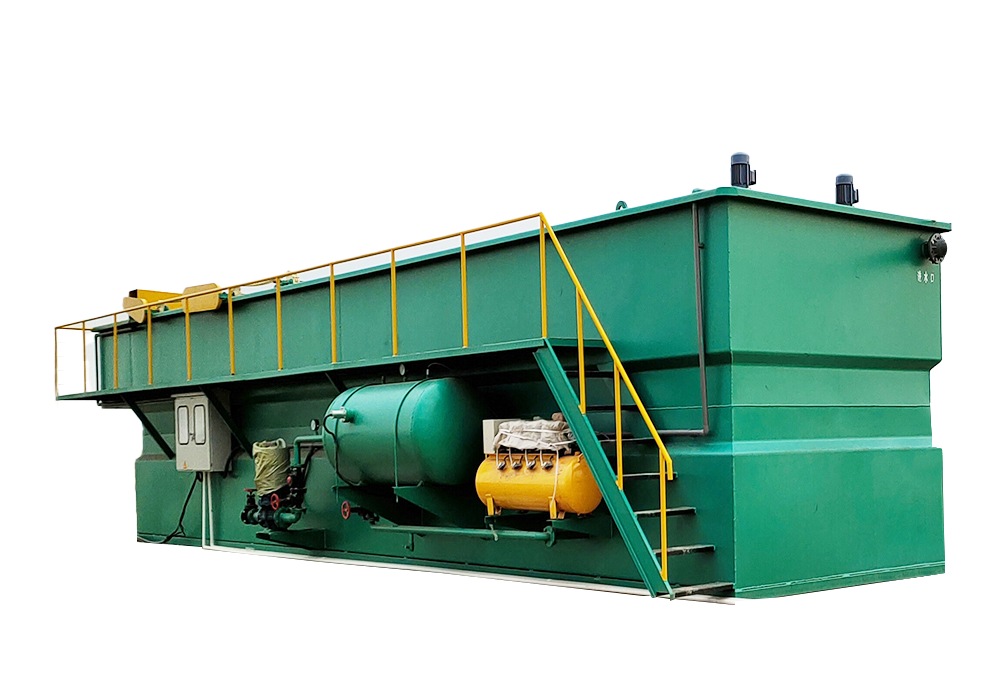
Dissolved air flotation unit from the manufacturer's Dissolved Air Flotation product line.
How the four zones turn reflux and head into separation
Advection, in this configuration, describes a horizontal-flow arrangement in which reaction, contact, flotation and clear-water sections are combined in one rectangular body. The wastewater moves through the four zones in sequence, and each zone does a separate job that a buyer can check independently.
The secondary stirring reaction zone follows the dosing area. Two 500 L dosing tanks with 0.75 kW agitators and dosing pumps rated 15.77 L/h condition the incoming wastewater before it meets the air, and the stirring stage exists to give that conditioning time to act. The specification supplies the hardware; it does not fix the chemistry, which is why the chemical regime has to be established against the actual wastewater rather than assumed from the equipment list.
The contact tank is where the dissolved-air circuit enters. Part of the clarified effluent is recycled, saturated with air on the pressure side at the 40 to 50 metre head, and released through the nylon air release device into the incoming stream. The sudden pressure drop releases micro-bubbles, and those bubbles attach to oil droplets and suspended particles, reducing their apparent density so that they rise rather than settle.
In the flotation tank the loaded bubbles form a sludge layer at the surface. A 0.75 kW scraper, carried on two carbon steel and nylon chains over four nylon chain wheels, moves that layer forward, and two SS304 stainless steel and rubber strike-off boards take it off the surface. The stated outcome — stable operation and fast sludge separation — depends on that removal step keeping pace with the float production rate.
The clear water tank collects the clarified effluent and is also the source of the reflux stream. This is why the reflux ratio is a design number worth understanding: at 30% the unit returns 1.5 m³/h of already-treated water to the pressure circuit; at 50% it returns 2.5 m³/h. More recycled water means more bubble supply and generally a denser air release, but it also means more pumping energy for the same forward throughput. The specification's range of at least 30%, typically 40% to 50%, is a design reference band rather than a fixed operating point, and the duty point for a given site should be confirmed at order stage against that site's wastewater and required effluent quality.
The largest drives follow the same logic. A 4 kW dissolved air pump and a 1.4 kW air compressor dominate the listed motor load, with the compressor supplying 0.21 m³/min at 0.8 MPa into a 30 L receiver. Because connected motor load is not the same as running cost, the operating-hours assumption used in the hydraulic calculation should be the same assumption used in any energy estimate.
Scenario one: livestock farm and breeding wastewater
On a livestock or slaughterhouse site, the unit is normally placed after coarse screening and grit removal and before a biological stage or a discharge point, where its job is to take out the floatable fats and the fibre-heavy solids that would otherwise blind or overload what follows. Zhongqiao Enlightenment's application records list livestock breeding wastewater and slaughterhouse wastewater among the uses of this product line, with Brazil cited as a typical market for that application.
The fit check here is mostly about what the flotation unit is not doing. Bedding fibre, long straw and coarse solids belong upstream of the unit, because a 5 m³/h machine has limited room to store material that will not float cleanly or scrape off. Fat and grease that solidifies at low ambient temperature behaves differently in the contact tank than warm, fresh effluent does, so the operating temperature range of the actual stream should be part of the specification conversation rather than an afterthought.
The hydraulic check matters as much as the contaminant check. If cleaning cycles deliver a large volume in a short window, a 5 m³/h unit will either need equalisation ahead of it or will need to be sized up. The published specification expects an influent water quality, an effluent discharge requirement and a treatment flow rate before selection; those three inputs are also the only sound basis for deciding whether one YW-5 is enough or whether the flow must be buffered.
Scenario two: textile dyeing and printing wastewater
Printing and dyeing mill wastewater is named directly in the YW-5 specification, alongside abattoir and farm wastewater, which places the unit in the same physical–chemical family for both sectors. In a dyehouse the flotation stage typically follows equalisation and pH correction, and precedes whatever handles dissolved colour and residual organic load.
Two properties of dyeing wastewater shape the fit. Batch-to-batch variation means the influent arriving at the unit may change pH and surfactant load several times a day, so the reaction zone and the dosing regime have to tolerate swing rather than a single steady condition. And colour is only partly a floatable problem: dye bound into flocs can be lifted and scraped off, while dissolved colour passes through with the clear water. A buyer should therefore be clear about which fraction the flotation stage is expected to remove and which fraction belongs to the next stage.
The compact footprint stated for the unit is a real advantage in a dyehouse where floor area is already committed to dyeing machines and chemical storage. The trade-off is that a compact unit has less buffering volume, so equalisation upstream is doing more of the work than it would in a large tank-based system. Where the mill discharges in campaigns rather than continuously, the 120 m³/d calculated ceiling should be compared with campaign volume over the hours the unit will actually run.
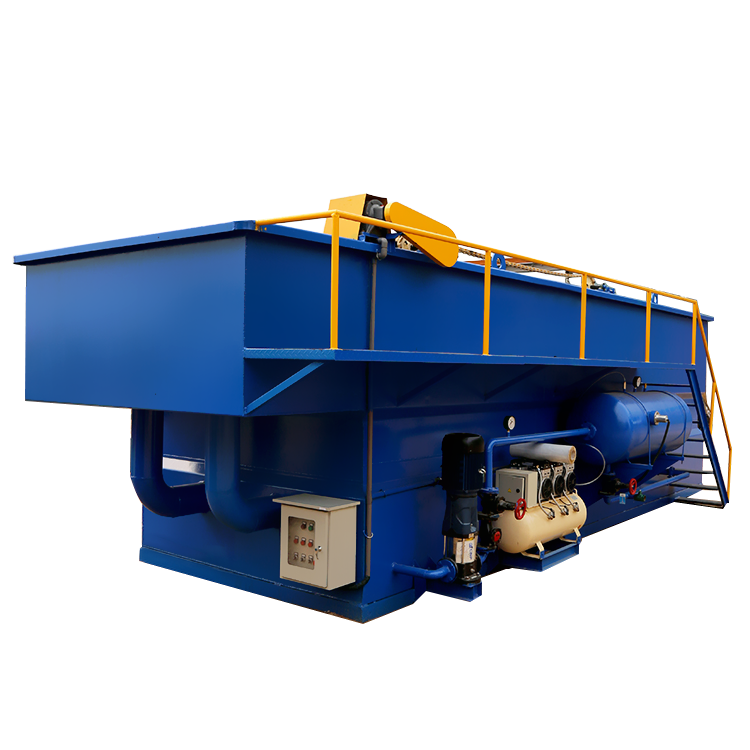
Air flotation unit from the YW series, the product family that includes the 5 m³/h YW-5 configuration.
Where 5 m³/h stops being the right answer
The clearest limitation is hydraulic, and it is arithmetic rather than opinion. If a farm's cleaning discharge or a dyehouse's campaign volume exceeds 5 m³/h multiplied by the hours the unit is actually staffed and running, the unit is undersized unless equalisation is added. A second limitation is biological: flotation separates, it does not nitrify, denitrify or stabilise dissolved organic matter, so a site whose main problem is dissolved COD, ammonia or colour in solution is looking at a different stage, not a bigger flotation tank.
Comparing separation logic helps here, without implying that one technology outperforms another in general. Gravity settling depends on density difference, which works well for dense, settleable solids but is slow for fine, oil-laden flocs. Inclined-plate settling increases the settling area within a smaller footprint, which suits settleable material but not material that wants to rise. Dissolved air flotation changes the direction of the separation by attaching bubbles to low-density material so it floats, which is why it is usually selected where oil and light solids dominate. Each of these describes a mechanism, not a measured outcome on a specific wastewater — the outcome on a specific wastewater has to come from testing on that wastewater.
The material choice is a second fit boundary. The unit is offered in carbon steel or SS304, and the right selection depends on the chloride content, pH range and temperature of the stream the wetted parts will actually see. A specification decision taken without those three inputs is a guess, and it is the kind of guess that shows up two or three years later as a corrosion repair.
Control scope: what PLC Siemens and Schneider Electric do and do not cover
The YW-5 specification lists its electronic control system as PLC Siemens and Schneider Electric. That entry identifies control hardware brands; it does not, by itself, define the control philosophy. A buyer evaluating the unit should ask for the input and output list, the alarm and interlock schedule, the level and flow signals the PLC acts on, and whether remote access is inside the supply scope or a separate item.
The wider company record gives a sense of what is achievable. Its case material highlights remote operation, remote monitoring and remote analysis as features of delivered systems, and the company states that it supports on-site installation guidance and remote technical support after delivery. Those are statements about capability across its projects; for a specific YW-5 order, the remote functions, their data scope and the local service arrangement should be written into the order documents rather than assumed from a case description.
The electrical planning side is more concrete. The listed drives run on 380 V supply, and the specification covers two dosing agitators at 0.75 kW each, a 4 kW dissolved air pump, a 1.4 kW compressor, a 0.75 kW scraper and two 0.37 kW dosing tank drives. Whether the site can deliver that supply, and where the panel sits relative to the tank, are project questions that are cheaper to answer before delivery than after.
Market context: trade signals, read narrowly
Trade data suggests the equipment category around this unit is a large, active one. The Observatory of Economic Complexity, drawing on UN Comtrade and national customs records, reported global trade of water purification and filtration equipment under HS code 842121 at USD 12.4 billion in 2024, a 4.34% increase over 2023, with China the leading exporter at USD 2.38 billion in the same year.
That is a trade statistic for a customs heading that covers water filtering and purifying machinery, and it is broader than dissolved air flotation units. It indicates the scale and movement of the category; it does not size the DAF market, and it says nothing about whether any particular unit fits any particular wastewater. Commercial market reports on water and wastewater treatment define their scope differently — broad water treatment, equipment only, or industrial technology — and their figures are not directly comparable with a customs heading, which is why this article does not use them to project demand for a 5 m³/h unit.
The practical reading for a buyer is narrower: a category of this size supports competitive sourcing and a wide supplier field, which raises rather than lowers the value of documented verification. Scale in the trade data is not evidence of performance on a specific farm or dyehouse stream.
What buyers should verify before ordering
| Check | Why it decides the fit |
|---|---|
| Influent characterisation | Oil and grease, suspended solids, pH range, temperature and colour fraction determine whether flotation is the right stage; the specification requires influent quality, discharge requirements and flow rate before selection. |
| Hydraulic balance | Compare peak and average flow with 5 m³/h × actual operating hours, plus equalisation volume for batch or campaign discharge. |
| Dosing and sludge route | Two 500 L tanks and pumps rated 15.77 L/h are supplied as hardware; chemical choice, dose and sludge disposal are site decisions. |
| Material selection | Carbon steel or SS304 should follow chloride, pH and temperature data for the wetted parts, not a default. |
| Control and data scope | PLC Siemens and Schneider Electric are named; I/O list, alarms, interlocks and remote functions should be confirmed in writing. |
| Commercial terms | Company capability data lists one-unit minimum order, 30 to 45 day lead time, 100% testing, monthly capacity of 100 units, and OEM customisation of appearance, colour and logo. |
Outlook
Compact physical–chemical stages are likely to remain relevant where floor space is tight and oil loads arrive in bursts, which describes both a working farm and a dyehouse with campaign production. The condition attached to that outlook is verification: a 5 m³/h unit is a defined envelope, and its value comes from being matched to a documented stream rather than to a category label.
For buyers in the research and evaluation stage, the sensible sequence is to characterise the wastewater, calculate the hydraulic balance honestly, decide whether flotation is the separating stage that is actually needed, and only then compare quotations on materials, control scope and service commitments. That order keeps the equipment decision attached to the problem it is meant to solve.
FAQ
What daily volume can a 5 m³/h advection DAF handle?
The YW-5 is rated at 5 m³/h. Running continuously for 24 hours, that equals 120 m³/d (calculated as 5 × 24); a single eight-hour shift covers about 40 m³/d. The realistic figure depends on how many hours the unit is staffed and running, and on whether equalisation is used to flatten peak discharges.
What do the at-least-30% reflux ratio and the 40 to 50 metre head mean in practice?
The reflux ratio describes how much clarified effluent is recycled into the dissolved-air circuit: at rated flow, 30% equals 1.5 m³/h and 50% equals 2.5 m³/h (calculated from the 5 m³/h capacity). The 40 to 50 metre head is the duty range for the dissolved-air side. The published figures are design references with a typical band of 40% to 50%, so the operating point for a specific site should be confirmed at order stage.
Is the same unit suitable for livestock farm wastewater and textile dyeing wastewater?
The specification lists abattoir, printing and dyeing mill, farm and other industrial wastewater as applicable industries, and positions the unit for wastewater with high oil and suspended solids. Suitability on a given site still depends on influent water quality, effluent discharge requirements and treatment flow rate, which the manufacturer asks for before selection. Flotation removes floatable and suspended material; dissolved organics, nutrients and unbound colour require other stages.
What is included in the control scope?
The published electronic control system entry is PLC Siemens and Schneider Electric. That identifies the control hardware brands, not the full control philosophy, so buyers should confirm the I/O list, alarm and interlock schedule, and whether remote operation, monitoring or analysis is inside the supply scope. The company's wider case material highlights remote operation, remote monitoring and remote analysis, and it offers on-site installation guidance and remote technical support after delivery.
Which materials are available, and how should the choice be made?
The unit is offered in carbon steel or SS304. The choice should follow the chloride content, pH range and temperature of the actual wastewater rather than a default preference, because those three inputs determine how the wetted parts will behave over the service life of the unit.
What information should be ready before requesting a quotation?
The specification expects three inputs before selection: the influent water quality, the required effluent discharge standard, and the treatment flow rate. Adding the operating-hours pattern, the sludge disposal route and the available power supply turns those three into a specification that a supplier can size against.
For readers who want the full equipment and project record, Zhongqiao Enlightenment publishes its 13th-edition brochure for public download: Zhongqiao Enlightenment brochure (13th edition).
Tem questões ou precisa de mais detalhes?
Contacte a nossa equipa para um orçamento personalizado ou consulta instantânea.
Solicitar orçamento
Preencha o formulário abaixo e a nossa equipa entrará em contacto com uma proposta personalizada.
Chat direto do WhatsApp
Prefere conversar em tempo real? Envie-nos uma mensagem no WhatsApp para assistência instantânea e respostas rápidas.
- Obter orçamento personalizado
- Partilhar fotos ou documentos
- Discuta as suas necessidades diretamente
Geralmente responde em 5–30 minutos durante o horário de expediente.