
50-Piece vs. 5,000-Piece Runs at the Same T-Shirt Factory
50-Piece vs. 5,000-Piece Runs at the Same T-Shirt Factory
One factory can quote both 50 pieces per design and 5,000 pieces across a multi-design program without changing its address, its equipment or its inspection standard. What changes is where setup cost lands, what the buyer learns before committing, and how much of the decision can still be reversed. This comparison walks through both routes at Guangzhou Qianshi Apparel Co., Ltd, using the manufacturer's stated MOQ, sample and bulk timelines, its DTG and screen-printing capability, and a 12-stop tour merchandise case that ended with four reorders and a reported 92% sell-through rate.
The comparison only works because it is the same factory
Most MOQ comparisons put two different companies side by side, which confuses volume with supplier choice. This one holds the supplier constant. Qianshiwear, the trading name of Guangzhou Qianshi Apparel Co., Ltd, is a Guangzhou-based custom apparel manufacturer founded in 2014 that describes itself as a full-service OEM, ODM and private-label supplier. Its published minimum order is 50 pieces per colour per design, and its stated service scope runs from fabric sourcing and design development through cutting, sewing, printing, embroidery and custom packaging.
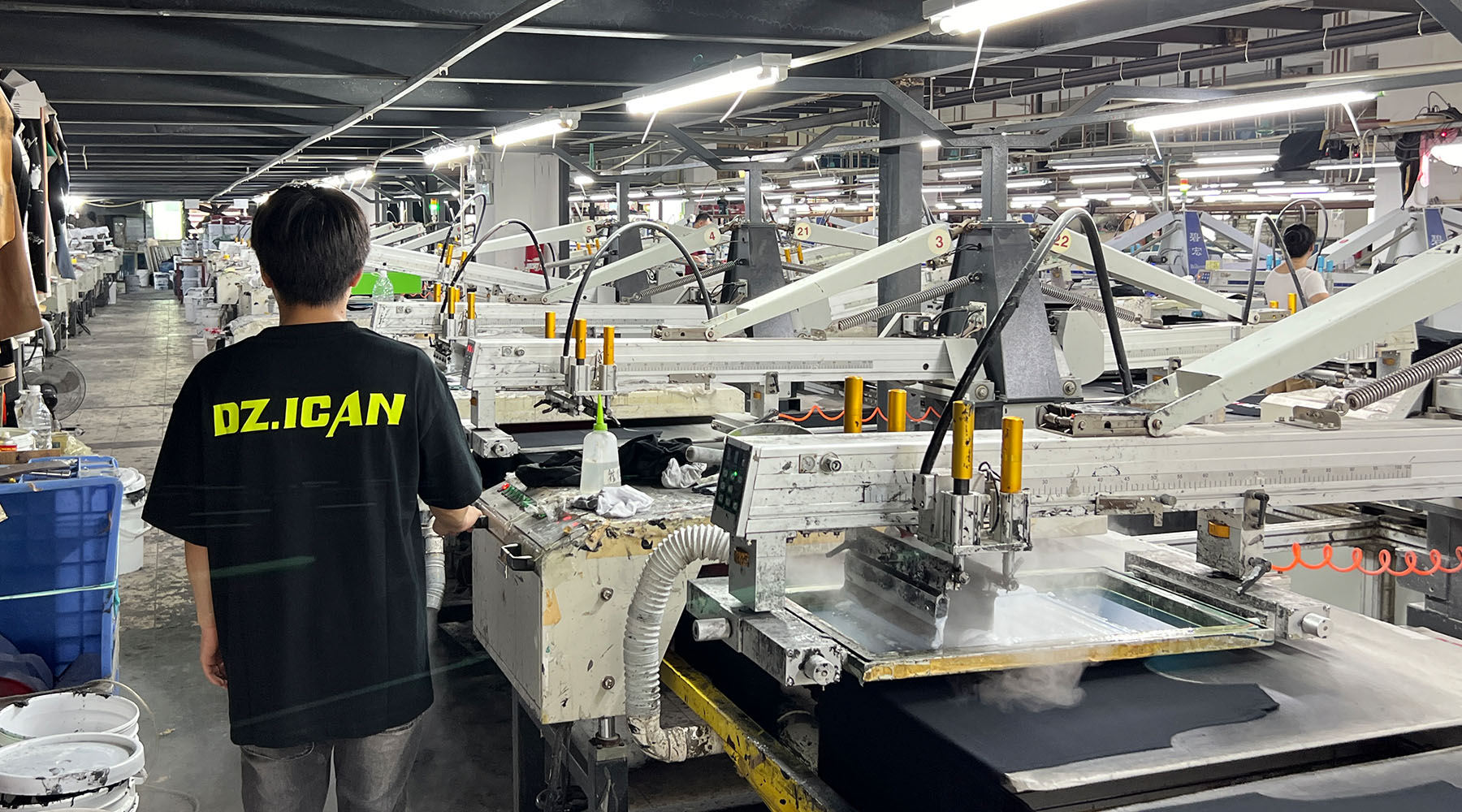
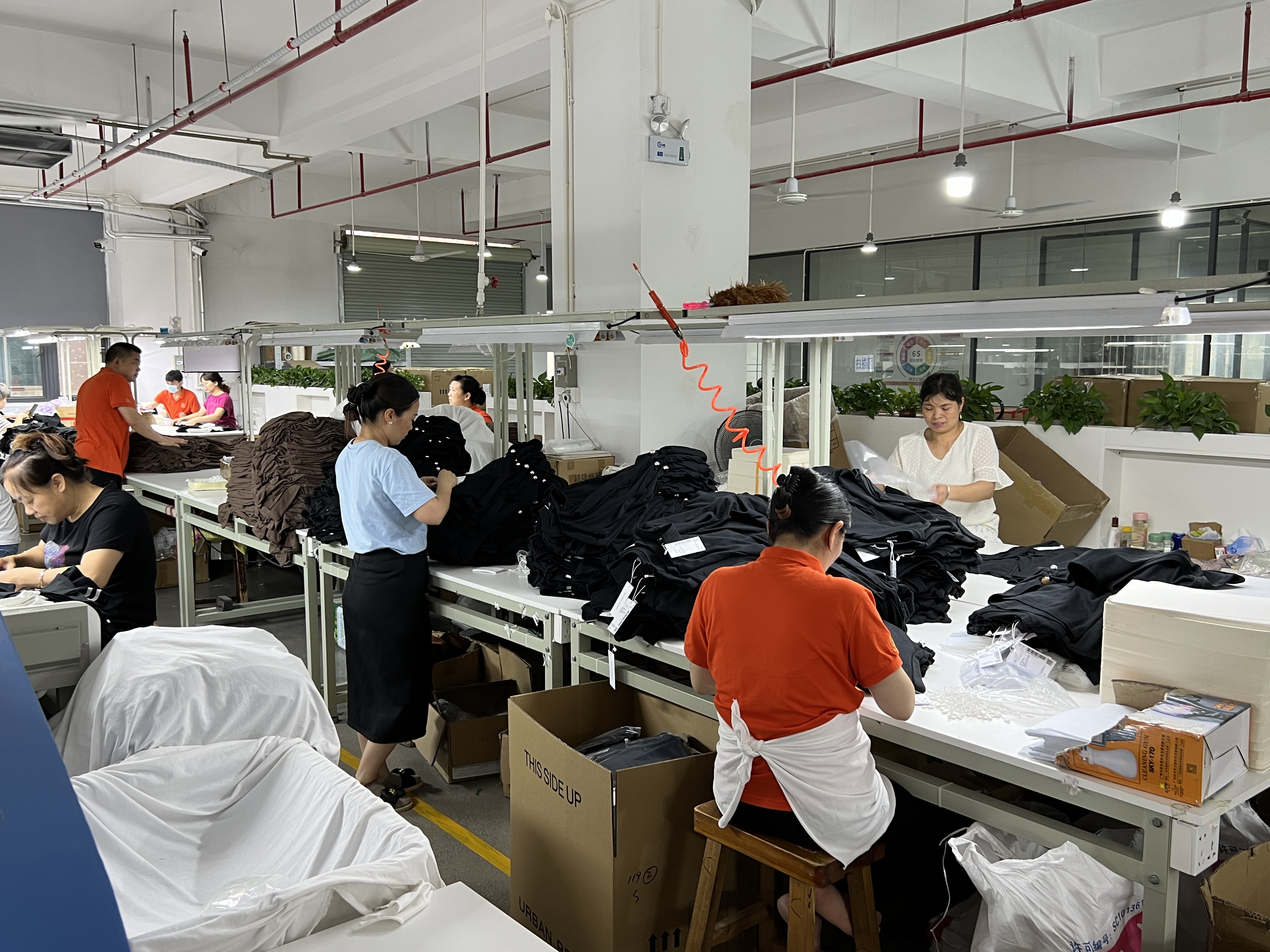
That matters for the comparison because both routes pass through the same sewing, finishing and packing areas (company-reported at 600 m², 1,500 m² and 200 m² respectively) and the same 200–250 production-line workers. Nothing about the building changes when the order size does. The manufacturer also states capability in screen printing, DTG, embroidery, puff print, rhinestone and applique, plus custom neck labels, hang tags and packaging — the decoration menu that determines whether a small run is practical in the first place.
Two caveats belong at the front, not the end. Qianshiwear's capability, capacity and case information in this article is company-reported; the figures are not independently audited here. And a 50-piece minimum applies per colour per design, not per order — a five-design program at 50 pieces each is a 250-piece commitment, which is a different commercial object from a single 50-piece test.
Route A: the 50-piece-per-design test run
At 50 pieces, the order is too small to absorb fixed setup costs, so the sensible use of the route is validation rather than volume. Artwork separation, pattern grading, fabric booking, print pre-treatment and first-article inspection all have to happen whether the run is 50 or 5,000 pieces. At 50 pieces, those costs are divided by 50. The per-unit price therefore rises, and the direction of that difference is predictable even though the exact size depends on the decoration method, the number of colours, the fabric weight and how many designs are on the order.
This is where DTG earns its place. Digital direct-to-garment printing does not require a screen set per colour, which makes it the practical option for small, multi-colour, multi-design work — the pattern most first orders follow. A brand testing four graphics across two fits can put 50 pieces behind each design without paying for eight screen sets it may never reuse. Screen printing remains available at this volume, but the setup is not amortised, so the economics favour reserving it for designs already validated.
The manufacturer's stated sample timeline is roughly 10 days. Read that number carefully. It describes the sample stage, not the full path from brief to delivered goods, and it does not remove the time needed for artwork approval, fabric confirmation or shipping. What a 10-day sample cycle buys is a faster correction loop: a fit adjustment, a neck-label placement change or a print-position correction can be identified and resolved before bulk fabric is cut.
The real output of Route A is information. A 50-piece run reveals how the fabric behaves after a wash, how the sizing curve actually distributes across a real size set, how the print sits on the chest at production scale rather than on a flat mock-up, and whether the neck label and hang tag assembly survives handling. None of that is visible in a quotation sheet. What Route A cannot deliver is a reliable defect-rate estimate: 50 units give a quality team a sample, not a statistical basis for projecting a 5,000-piece batch.
Route B: the 5,000-piece multi-design bulk run
At 5,000 pieces across several designs, the economics invert. Setup cost is now spread across a much larger base, screen printing becomes viable or preferable for high-colour-count graphics, and the buyer's leverage shifts from flexibility to planning accuracy. The risk also changes character: a 50-piece error is a write-off, while a 5,000-piece error is a season.
This is the stage where inspection structure does the work. Qianshiwear describes a multi-point process that begins with 100% fabric inspection on arrival — weight, width, colour consistency and shrinkage potential — continues through first-article checks at cutting, sewing and printing, uses patrol checks on the lines, and closes with AQL 2.5 sampling on finished goods plus pre-shipment wash tests on representative samples. Each order carries a production batch number so that quality records remain usable if the buyer reorders.
In the manufacturer's own comparison material, that structure is positioned against low-cost or ultra-budget mass producers, with reported typical outcomes of defect rates below 5% versus 10–15% or higher elsewhere, fabric shrinkage generally within 5–8% versus 8–12%, colour fastness at Grade 3–4 versus Grade 2–3, and garments typically withstanding 30–50 washes with minimal fading versus noticeable fading after 10–15 washes. These are the supplier's stated figures and should be read as such; they are a description of the manufacturer's quality positioning, not an independent laboratory benchmark. The one verifiable structural point is that third-party inspection by bodies such as SGS or Intertek can be arranged on request — a buyer who wants independent confirmation can commission it rather than accept a claim.
The stated bulk timeline for this route is roughly 30 days. That figure covers production, not the sample stage, not the buyer's approval cycle on pre-production samples, and not transit. For a multi-design 5,000-piece program, the practical planning question is not the 30 days themselves but the sequence: which designs are approved first, whether fabric is booked against the full program or staged per design, and how much float sits between the bulk delivery date and the first date the goods must be sellable.
Side by side: what actually changes between the two routes
The table below compares the two routes as they exist at this one supplier. It is a planning instrument, not a price list — no unit prices, tooling fees or freight figures are asserted here because those depend on the design and are quoted per inquiry.
| Decision dimension | 50-piece-per-design test | 5,000-piece multi-design run |
|---|---|---|
| Minimum commitment | 50 pieces per colour per design | Bulk quantity distributed across several designs |
| Decoration route | DTG-led; screen printing possible but setup is thinly amortised | Screen printing becomes economic; DTG still used where colour complexity demands it |
| Where setup cost lands | Concentrated on a small unit base, raising per-unit cost | Spread across thousands of units |
| Stated timeline | Sample stage around 10 days | Bulk production around 30 days |
| Quality evidence produced | Physical samples, wash behaviour, fit and sizing feedback | AQL 2.5 sampling, first-article checks, pre-shipment wash tests, batch records |
| Principal risk | Per-unit cost and limited statistical read on defects | Exposure if a design or fit decision is wrong at scale |
| Best fit | First order, new graphics, new fit block, unproven market | Validated designs, dated delivery commitments, repeat programs |
DTG print quality is a process question, not a volume question
Buyers often assume print quality degrades as volume rises, or that DTG is inherently a compromise. Neither holds up. Print durability depends on ink curing, pre-treatment consistency, fabric composition and wash conditions — variables that are controlled per order, not per order size. A 50-piece DTG run and a 5,000-piece DTG run go through the same curing step; what differs is how many units pass through it and how much sampling is done along the way.
The genuine volume distinction is economic and technical fit, not quality tier. DTG handles gradients, photographic artwork and unlimited colours without per-colour setup, which is why it suits test runs and short-run multi-design programs. Screen printing delivers a different ink deposit and becomes cheaper per unit once the setup is spread over enough pieces; it also constrains colour count in a way DTG does not. A mixed program — DTG for the exploratory designs, screen print for the proven ones — is a normal outcome rather than a compromise.
Where quality control actually earns its keep is in the failure modes that surface after the goods ship: colour fading, shrinkage or deformation, poor colour fastness to rubbing or sweat, sizing drift between batches, print cracking or peeling, and embroidery thread loosening. Qianshiwear's documented control methods address these directly — reactive dyeing with high-temperature fixation, pre-shrinkage treatment before cutting, standardised AQL sampling for measurement verification, controlled curing time for screen-print and DTG inks, and embroidery backing stabilisation for thread tension. For a buyer, the useful question is not "is your DTG good" but "what curing and wash-test evidence accompanies this order, and can I see it before shipment".
The tour merchandise case: 12 stops, four reorders, 92% sell-through
The clearest evidence for how the two routes interact comes from a tour merchandise program spanning 12 stops and multiple designs. The program was built on 50-piece-per-design runs, with DTG used to carry the artwork across designs, and it reported four reorders as the tour progressed and a 92% sell-through rate across the run. The same supplier reports roughly 10-day samples and roughly 30-day bulk production as its standard service timelines.
What that case supports is a specific operational claim: a small per-design commitment can function as a live testing mechanism when a program needs multiple designs and cannot predict demand per stop. A 50-piece run per design is small enough that a weak graphic does not become inventory, and it is large enough to read real demand. The four reorders are the meaningful signal, because they show the route was repeatable — the buyer went back to the same supplier mid-program rather than absorbing a stockout.
What the case does not support needs stating just as plainly. It is a single program, reported by the supplier, in one product category and one selling context. A 92% sell-through rate is a commercial outcome shaped by the tour's audience size, pricing, design quality, venue mix and marketing — manufacturing is one input, not the cause. The case does not prove that 50-piece runs sell better than 5,000-piece runs, and it does not establish defect rates, durability or cost advantages for any other buyer. It demonstrates a workable pattern under conditions that resemble a tour: dated stops, uncertain per-design demand, and a supplier able to re-run small quantities on short notice.
How reorders behave when the first order was small
Reorder behaviour is where the two routes converge, and it is the factor most often left out of an MOQ decision. When a buyer returns to the same factory with the same design, pattern and grading are already approved, colour records and print files exist, and the batch history supports consistency. That reduces the re-setup burden that made the first 50 pieces expensive.
The practical limitation is that a reorder inherits the first order's assumptions. If the initial 50-piece run used a specific fabric lot, a specific DTG pre-treatment recipe and a specific size grading, the reorder will follow that record — which is why the traceability step matters more than it appears. Qianshiwear assigns each order a production batch number and keeps quality records for reorder reference, and its documented process includes defect analysis for continuous improvement. For the buyer, that means reorder consistency is a documented process outcome, not an automatic guarantee: the second run is consistent because the first was recorded properly.
Timing is the other half. A reorder is not automatically faster than the original bulk run, because fabric availability and production scheduling still apply. What a reorder removes is the design-development and sample-approval stage — which is exactly the stage a 10-day sample cycle and a 50-piece test exist to complete properly the first time.
Choosing the route for a first order
The decision is not "which route is better" but "which uncertainty is the buyer trying to retire first". A first order aimed at validating fit, fabric hand, print placement and market response fits the small route. A first order aimed at hitting a fixed delivery date with already-validated designs fits the volume route.
Four decision rules cover most first-order situations at a factory with a 50-piece minimum:
- If the design is unproven, buy information first. Run 50 pieces per design through DTG, wash one sample, measure the sizing curve, and treat the higher per-unit cost as the price of the test rather than a price failure.
- If the design is proven and the date is fixed, buy volume. Move the validated graphics to screen printing, book fabric against the full program, and build the 30-day bulk timeline backwards from the delivery date, not forwards from the purchase order.
- If the program is multi-design and multi-date, run both. A tour, a retail drop series or a multi-market launch can hold a small DTG position for the uncertain designs while committing volume to the designs already selling. The routes are not mutually exclusive at the same supplier.
- If the order will be reordered, record everything on the first run. Approved pattern, size grading, fabric lot, colour references, print files and batch number. The reorder is only as consistent as the first run's documentation.
Before committing either way, a buyer should verify four things in writing: the exact MOQ basis (per colour per design, not per order), the sample and bulk timelines as stated for the specific decoration method, the inspection standard and whether third-party inspection is available on request, and how reorders are quoted. Those four answers do more to de-risk an order than any comparison of headline prices.
What this comparison cannot tell you
Several limits apply, and they are structural rather than incidental. No per-unit pricing, sample fee, tooling cost or freight figure is asserted here, because those are quoted per design and per quantity and would be invented if stated generally. The quality tiers described earlier come from the manufacturer's own comparison material, not from an independent audit; a buyer relying on them should commission third-party inspection or laboratory testing. Factory ownership, legal registration and certificate scope were not independently verified in this comparison, and the reported annual output of 3,000,000 units is company-reported and not T-shirt-specific.
The tour case is one program. The 10-day and 30-day timelines are stated service windows that exclude artwork approval, buyer review and transit. Any buyer whose delivery date is immovable should treat those figures as planning inputs to be confirmed in writing, not as commitments already made.
Market context and a conditional outlook
The structural backdrop supports flexible order sizing, but the evidence should be read with its own limits. China's apparel exports reached US$159.14 billion in 2024, a 0.3% year-on-year increase, according to customs statistics reported through industry channels — a flat market in aggregate, not a growth story. Separately, commercial research cited by New Asia Garment Research valued the global T-shirt market at over US$45 billion in 2024 with a projected 6.2% CAGR through 2030; that is a commercial estimate rather than a primary statistical series and should be treated as directional.
The conditional reading is straightforward. In a market where aggregate export value is broadly flat, suppliers compete on program fit rather than raw tonnage, and a low minimum combined with DTG capability lets a supplier take programs that a volume-only line cannot serve economically. Whether that advantage persists depends on factors this evidence does not cover: fabric and freight costs, destination-market labeling obligations — the U.S. Federal Trade Commission, for example, publishes labeling guidance for textile and wool products that a private-label buyer must be able to satisfy — and the buyer's own demand visibility. None of those are settled by a MOQ figure.
FAQ
Is a 50-piece run more expensive per unit than a 5,000-piece run at the same factory?
Generally yes. Fixed setup — artwork separation, pattern grading, fabric booking, print pre-treatment and first-article inspection — is incurred either way, so at 50 pieces it is divided across a much smaller base. The size of the difference depends on the decoration method, the number of colours, the fabric weight and how many designs are on the order, which is why it is quoted rather than published. The direction of the difference is reliable; the percentage is not.
Does DTG printing hold up at 5,000 pieces, or does screen printing take over?
Both methods can run at volume, but the economics split. DTG carries no per-colour screen setup, which suits multi-colour artwork and small runs; screen printing becomes cheaper per unit once setup is spread across enough pieces. Print durability depends on ink curing, pre-treatment consistency, fabric composition and wash conditions rather than on the order size itself. Qianshiwear's own comparison material reports garments typically withstanding 30–50 washes with minimal fading, a company-stated figure that a buyer can test through pre-shipment wash checks or third-party laboratory testing.
How do reorders behave if the first order was only 50 pieces?
The reorder reuses the approved pattern, size grading, colour records and print files from the first run, which removes the design-development and sample-approval stage. It does not automatically shorten production time, because fabric availability and scheduling still apply. Qianshiwear assigns each order a production batch number and keeps quality records for reorder reference. Consistency on the second run therefore depends on how completely the first run was documented, and buyers should confirm what records will be retained before placing the initial order.
What should a buyer verify before choosing between 50 and 5,000 pieces?
Confirm four things in writing: the exact MOQ basis, since a 50-piece minimum applies per colour per design rather than per order; the sample and bulk timelines as stated for the specific decoration method, rather than as general averages; the inspection standard applied to finished goods and whether third-party inspection by bodies such as SGS or Intertek can be arranged; and how reorders will be quoted against the original specifications. These four answers determine whether the chosen route is repeatable, which matters more than the headline unit price of the first order.
For buyers who want the manufacturer's own capability and process documentation alongside this comparison, the publicly downloadable company brochure is available here: Qianshiwear company brochure (PDF).
Tem questões ou precisa de mais detalhes?
Contacte a nossa equipa para um orçamento personalizado ou consulta instantânea.
Solicitar orçamento
Preencha o formulário abaixo e a nossa equipa entrará em contacto com uma proposta personalizada.
Chat direto do WhatsApp
Prefere conversar em tempo real? Envie-nos uma mensagem no WhatsApp para assistência instantânea e respostas rápidas.
- Obter orçamento personalizado
- Partilhar fotos ou documentos
- Discuta as suas necessidades diretamente
Geralmente responde em 5–30 minutos durante o horário de expediente.