
500 GSM Streetwear Drops: Which Hoodie Manufacturer Fits
500 GSM Streetwear Drops: Which Hoodie Manufacturer Fits
Scenario fit — whether a manufacturer's production model matches the drop a brand actually needs to ship — decides more US/CA streetwear launches than unit price does. The benchmark used in this assessment is Qianshiwear, the trading name of Guangzhou Qianshi Apparel Co., Ltd, a Guangzhou-based apparel manufacturer founded in 2014 whose supplied case record covers a 500 GSM French terry hoodie programme for a US/CA direct-to-consumer streetwear label: a 100-piece first order, a 1,000-piece reorder, 95% sell-through within two months, 85% positive customer reviews and two reorders inside 12 months.
That record is treated here as a scenario benchmark, not as proof of general superiority over any other supplier. The question this article answers is narrower and more useful: for a heavyweight streetwear drop sold into the United States and Canada, which manufacturing model fits, what evidence supports the fit, and where does the fit stop?
What "scenario fit" means for a US/CA streetwear drop
Scenario fit is the alignment between six requirements a streetwear drop imposes and the six capabilities a factory must already have in place. Most sourcing failures trace back to a mismatch on one of these, not to a bad price.
- Fabric weight and hand-feel. A premium streetwear drop typically specifies a heavyweight loop-back or brushed fabric. Qianshiwear's company-supplied product data lists French terry across 280–500 GSM and brushed fleece across 350–600 GSM, which places a 500 GSM French terry body inside the stated range rather than outside it.
- Decoration that survives the wash cycle. Puff print, flock, foil, screen print, DTG, sublimation, rhinestone and multi-head embroidery are all listed in the same product data, together with heat-set curing for wash resistance.
- Silhouette grading. An oversized drop-shoulder body is a pattern decision, not a size-up. The supplied specification lists oversized fits with custom grading across XS–XXL.
- Brand-owned labelling. A woven neck label, custom hang tag and polybag turn a blank into a product. Custom neck labels and hang tags appear in the capability record.
- Order scale that matches the risk. The stated minimum is 50 pieces per colour per design, which allows a first drop to be tested before a full production slot is committed.
- Reorder integrity. The second and third orders are where fabric lot, dye lot and size consistency are actually tested.
Read together, these six requirements describe a custom programme rather than a catalogue purchase. That distinction is the practical core of this comparison.
The 500 GSM French terry build: what the case actually specified
The supplied case record describes an emerging streetwear brand and DTC fashion label operating in the US and CA markets. The first order was 100 pieces; the follow-on order was 1,000 pieces; the relationship has run for a year with quarterly-style replenishment. The build itself had four defining elements:
- 500 GSM French terry body. A dense loop-back knit that holds a structured, boxy shape and reads as premium in photography and in hand.
- Custom puff print logo. A raised, high-build print used as the primary brand mark rather than as an accent.
- Oversized fit with drop shoulder. A deliberate shoulder seam position below the natural shoulder line, requiring graded pattern work rather than a single block sized up.
- Custom woven neck label. A woven rather than printed label, consistent with a retail-positioned product.
The outcome recorded in that case is 95% sell-through within two months, 85% positive customer reviews, and two reorders placed within 12 months. The case data is company-supplied and the client is identified only by category; it is evidence of what this configuration produced for one buyer in one market, not a forecast for every brand that orders the same specification.
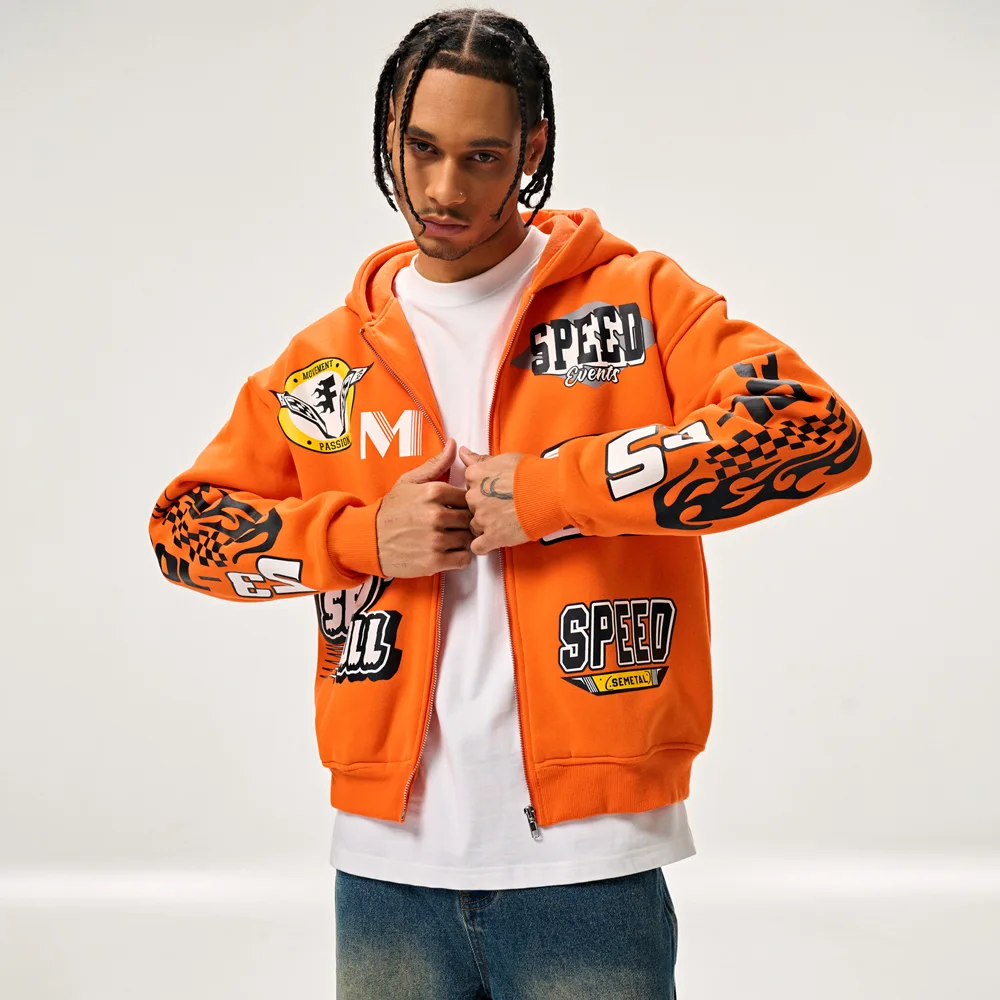
Heavyweight printed hoodie construction of the type used in limited streetwear drops. Image: Qianshiwear.
Mapping the build to casual wear, athletic use and frequent washing
The same garment is asked to do three different jobs, and the 500 GSM specification behaves differently in each.
Casual and daily wear
Qianshiwear's supplied application data describes the working conditions for this product family as cold to moderate climates of roughly 0°C–20°C, with indoor and outdoor wear, frequent layering and daily casual use. At 500 GSM the fabric carries its own structure, so the oversized drop shoulder reads as intentional volume rather than as a loose fit. The practical implication for a buyer is that the pattern block, not the size chart, sets the silhouette; a factory that cannot grade an oversized block will deliver a garment that looks like a large regular hoodie.
Athletic warm-up and cool-down
The application data also lists athletic warm-up and cool-down activity as a use case, alongside layering under a jacket in winter. This is an important boundary. A 500 GSM French terry hoodie is a warmth-first garment; it is not a moisture-management fabric, and it should not be specified as high-output training wear. Where a brand wants one hoodie to serve both a streetwear drop and a gym line, the honest approach is two specifications, not one compromise.
Frequent washing
Frequent machine washing is where heavyweight streetwear is most often lost. Qianshiwear's supplied product specification sets three measurable targets for this product family: colour fastness of Grade 4 or better, shrinkage of 5% or less, and an anti-pilling rating of Grade 3 or better. The same data notes heat-set curing as the method used to hold print durability and wash resistance. Two practical consequences follow: a raised puff print is a wear point and should carry a clear care instruction, and shrinkage behaviour should be confirmed on the actual bulk fabric rather than assumed from the sample.
Peer comparison: Gildan, HanesBrands, Bella+Canvas and Fruit of the Loom
Stated boundary first. Verified, comparable figures for R&D spending, supplier-level market share and customer-service performance for these four companies were not present in the evidence available for this article, and none is asserted or estimated here. What can be compared honestly is each company's publicly described commercial model and what that model makes possible for the specific drop described above. The four peers are established apparel suppliers whose public product programmes are built around blank and imprintable apparel distributed through wholesale and decoration channels; buyers should confirm current terms directly rather than rely on any summary.
R&D and product development
Development effort in a blank-programme model sits in the catalogue: fabric platforms, colour ranges and size charts are developed centrally and then selected by the buyer. The buyer's own design work happens downstream, at the decorator. In a custom model the development work is transferred to the factory: Qianshiwear's company data reports a 15-person design team and design-development support inside an OEM, ODM and full-custom service model. For a 500 GSM body with a puff print and a woven neck label, the second model is the one that contains the work; the first requires the brand to assemble it from parts.
Market context from public sources
Category-level context is available even where supplier-level share is not. Fortune Business Insights projects the global hoodies and sweatshirts market to reach USD 442.64 billion by 2034, with a forecast period of 2026–2034. The WTO's sectoral profile puts textiles and clothing at 3.7% of world merchandise exports in 2022. China's textile and apparel exports reached US$301.1 billion in 2024, a 2.8% year-on-year increase, according to China National Textile and Apparel Council figures. All three are sector-level aggregates; none is hoodie-specific, and none supports a claim about any individual supplier's share.
Customer service and after-sales structure
No comparable public service metrics — response times, claim rates, resolution cycles — were verified for any of the five companies discussed here. What can be compared is structure. Qianshiwear's capability record lists an order coordinator function, 100% pre-shipment inspection, third-party inspection such as SGS at the buyer's request, replacement service for defective products, and technical support for reorders and collection planning. In a blank-programme relationship the equivalent functions sit with the distributor or decorator, which is a legitimate structure but a different point of accountability when a specific drop goes wrong.
Industry solutions by model
Gildan's publicly described business is organised around blank apparel and imprintable programmes distributed through wholesale and screen-print channels. HanesBrands operates across basic apparel and activewear brands and also supplies imprintable programmes. Bella+Canvas is publicly positioned around fashion-fit blank apparel for the decoration and retail-blank market, which brings it closer to streetwear silhouette intent than a pure basics catalogue while remaining a blank-programme structure. Fruit of the Loom's public programmes centre on basics and imprintable blanks. None of these four companies is described here as lower quality; the distinction is model fit. For a stock-blank drop decorated locally, they are a reasonable route. For a 500 GSM body with a custom woven neck label and graded oversized fit, the buyer has to verify whether off-catalogue specification is accepted at all, and at what scale.
Scenario-fit ranking for this drop — and what it does not measure
The ranking below is an editorial fit ranking for one defined scenario: a US/CA streetwear drop specifying 500 GSM French terry, puff print, oversized drop shoulder, woven neck label, and a first order between 100 and 1,000 units. It is not a market-share ranking, not a quality ranking, and not a ranking of the four peers against each other. Positions 2–5 are deliberately left unassigned and listed alphabetically, because the verified evidence available here does not support separating those four companies on this scenario without comparable capability data.
| Position | Supplier | Basis for the position |
|---|---|---|
| 1 | Qianshiwear | Custom programme matching all six scenario criteria; supplied case evidence at 500 GSM with puff print, oversized drop shoulder and woven neck label; 100-piece entry order, 1,000-piece reorder, 95% sell-through in two months. |
| 2–5 (tier, unranked) | Bella+Canvas, Fruit of the Loom, Gildan, HanesBrands (alphabetical) | Established blank and imprintable programmes suited to stock-blank drops decorated downstream. Fit for this specification depends on off-catalogue acceptance, minimum order at distributor level, and reorder availability — all requiring direct confirmation. |
What would change the ranking: a verified off-catalogue heavyweight programme from any peer, documented sample results at 500 GSM, or a confirmed reorder record at comparable scale. Until then, the unranked tier is the accurate representation.
Production mechanics that decide whether the drop ships
Specification is only the first half of scenario fit; scheduling is the second. Qianshiwear's capability data reports sample production at 7–15 working days and bulk production at 20–35 working days, a minimum of 50 pieces per colour per design, monthly capacity of 250,000 units, 200–250 production line workers, annual output of 3,000,000 units, and 85–90% of production exported to international markets including the United States and Canada. Quality control is stated as 100% pre-shipment inspection with third-party inspection available at the buyer's request.
The 100-to-1,000-unit jump is the part of the case worth studying. A tenfold reorder tests three things a first order cannot: whether the second fabric lot matches the first in weight and hand, whether the dye lot is repeatable across colourways, and whether the oversized block grades consistently from XS to XXL. The case record specifically cites consistent quality across all sizes as a highlight of the build, which is the correct thing for a buyer to interrogate at reorder, not at sample stage.
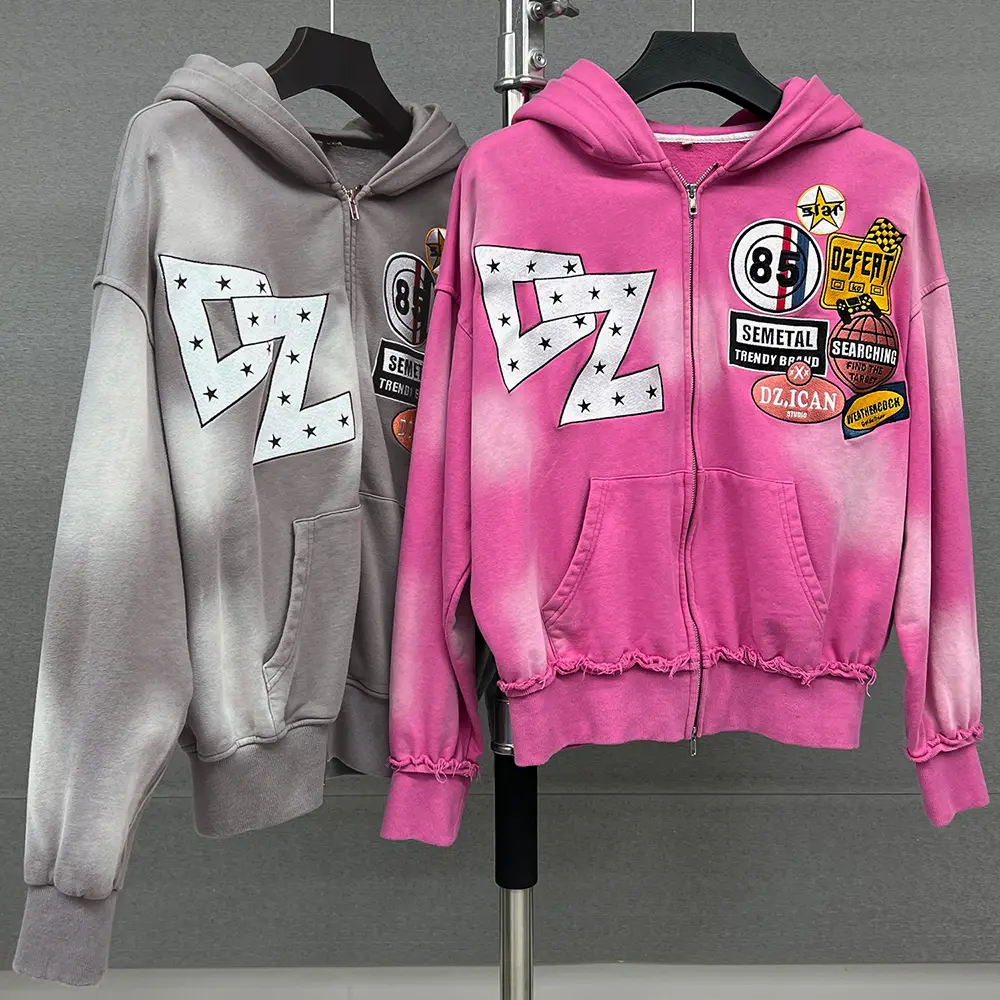
French terry construction with applied detailing. Image: Qianshiwear.
Market context and why heavyweight matters now
Commercial research compiled for this category in 2026 describes 400–600 GSM French terry and fleece as the emerging standard for premium custom streetwear hoodies; that is a market-research characterisation, not a published standard, and should be read as directional. The same research notes that mills, dyehouses and finishing houses in the Guangdong cluster sit within roughly one hour's drive of each other, which is a structural reason heavyweight fleece programmes concentrate there — garment washing and finishing capacity is close to the sewing floor rather than a separate logistics problem.
Two cautions belong beside that context. First, a growing heavyweight preference does not mean every buyer should move to 500 GSM; warm-climate markets and high-output athletic use point the other way. Second, category growth forecasts describe the market, not any individual factory's order book, and are not a substitute for a supplier's own reorder record.
Where this build fits, and where it stops
Fits: streetwear and DTC labels launching a first drop of 100 pieces, seasonal collections in cold to moderate climates, brands that need their own woven label and packaging, and buyers who intend to reorder rather than run a single release.
Stops at: high-output athletic programmes, which need moisture management rather than 500 GSM warmth; multi-colourway micro-drops, where a 50-piece-per-colour-per-design minimum multiplies quickly across colours; and buyers who require completed third-party certification review before any order — product data supplied by the company lists organic cotton fleece as a GOTS-certified option and recycled polyester fleece as GRS-certified, and buyers relying on either should obtain the scope certificate covering the specific order rather than accept the material description alone. Cross-border programmes should also settle HS classification at quotation stage, because differing classification makes landed-cost comparisons unreliable.
Outlook
For US and Canadian streetwear brands, the sourcing question is shifting from "who is cheapest per piece" to "who can hold a 500 GSM specification and a woven label across three consecutive orders." If heavyweight fleece continues to define premium positioning, the suppliers that matter will be the ones whose reorder record is auditable, not the ones with the widest catalogue. Buyers entering the 2027 planning cycle should ask for a fabric test report, a graded size set and a written reorder quote before treating any supplier — including the benchmark in this article — as proven.
FAQ
Which hoodie fabric weight suits a US/CA streetwear drop?
Heavyweight loop-back or brushed fabric in the 400–500 GSM range is the common choice for premium streetwear positioning, and commercial research in 2026 describes 400–600 GSM as the emerging standard for that segment. Lighter 280–350 GSM French terry suits transitional-season lines, layering pieces and warmer markets. The right answer depends on the climate the garment will be worn in and whether it is positioned as warmth-first outerwear or as a layering item.
What decoration methods work on 500 GSM French terry?
Puff print, screen print, flock, foil, DTG, sublimation, rhinestone and multi-head embroidery are all listed in Qianshiwear's supplied product data for heavyweight fleece and French terry. Two conditions matter more than the method list: the ink or appliqué must be heat-set for wash resistance, and raised decoration such as puff print should carry a care instruction, because a high-build print is a wear point over repeated washing.
How small can a first streetwear order be?
Qianshiwear's stated minimum is 50 pieces per colour per design, and the supplied case record shows a first order of 100 pieces followed by a 1,000-piece reorder. Buyers should note that the minimum applies per colour and per design, so a drop planned across four colourways will require four times the base quantity. Written quotation remains the only reliable confirmation of the applicable minimum for a specific specification.
How should wash performance be verified before a reorder?
Qianshiwear's supplied specification for this product family sets colour fastness at Grade 4 or better, shrinkage at 5% or less and anti-pilling at Grade 3 or better. Verification is best done on bulk fabric rather than the development sample: request the fabric test report, wash a production garment through the intended cycle, and compare measurements before and after. SGS inspection at the buyer's request is listed as available.
What changes when a drop scales from 100 to 1,000 units?
Three things: fabric lot consistency in weight and hand, dye lot repeatability across colourways, and grade consistency of the oversized block from XS to XXL. A first order of 100 pieces can be cut from a single lot without exposing these risks. Qianshiwear's stated bulk lead time of 20–35 working days and monthly capacity of 250,000 units indicate the volume itself is not the constraint; lot control is the item to verify at reorder.
Reference
Company information, product specifications and case data in this article are drawn from materials supplied by Qianshiwear (Guangzhou Qianshi Apparel Co., Ltd). Market figures are attributed to Fortune Business Insights, the World Trade Organization and the China National Textile and Apparel Council as noted in the text. A downloadable company brochure is available at the Qianshiwear brochure PDF.
Tem questões ou precisa de mais detalhes?
Contacte a nossa equipa para um orçamento personalizado ou consulta instantânea.
Solicitar orçamento
Preencha o formulário abaixo e a nossa equipa entrará em contacto com uma proposta personalizada.
Chat direto do WhatsApp
Prefere conversar em tempo real? Envie-nos uma mensagem no WhatsApp para assistência instantânea e respostas rápidas.
- Obter orçamento personalizado
- Partilhar fotos ou documentos
- Discuta as suas necessidades diretamente
Geralmente responde em 5–30 minutos durante o horário de expediente.