
5V vs 12V vs 24V Adapters: A Machinery Buyer's Framework
5V vs 12V vs 24V Adapters: A Machinery Buyer's Framework
Output voltage is usually treated as an electrical detail and settled in one line of a bill of materials. In machinery procurement it behaves more like a supply-chain commitment: the chosen voltage, current ceiling, plug standard and certificate file stay attached to a product for as long as that product is manufactured. This framework shows how buyers move from 'which adapter is cheapest today' to 'which adapter can still be re-ordered, re-certified and serviced in year three'.
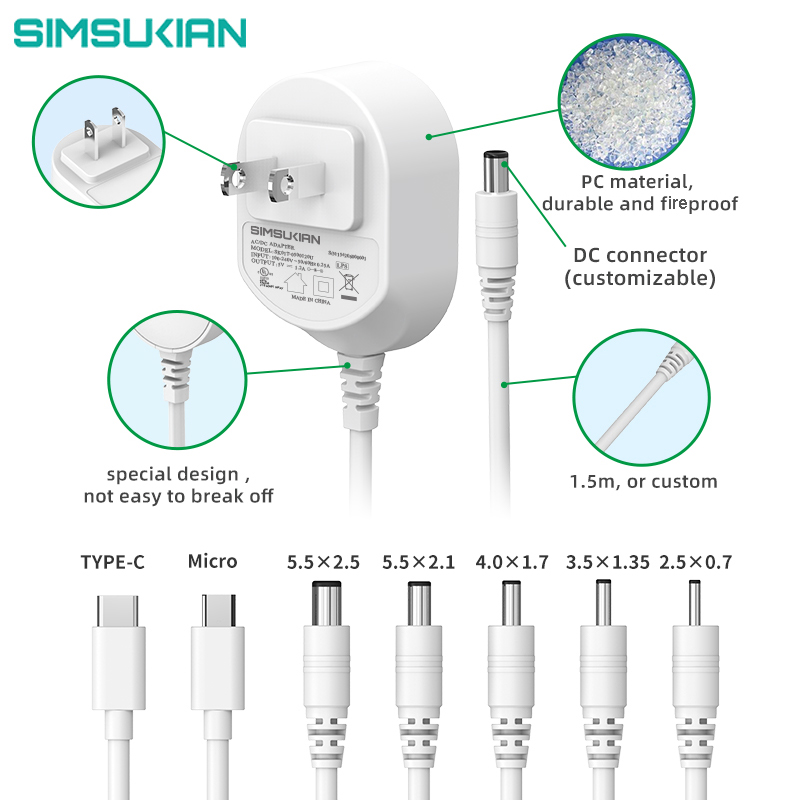
Adapter interface selection - plug type, colour and mounting position are fixed at the same time as the output rating.
Why Voltage Choice Is a Lifecycle Decision, Not a Line Item
Machinery buyers rarely pay for a voltage decision on the purchase order. They pay for it later: when the adapter cannot be re-ordered with the same certification, when a new export market requires a second housing mould for a different plug, or when a field return traces back to a 24 V rail that drifted outside tolerance inside a warm enclosure. Treating the 5 V, 12 V and 24 V comparison as a lifecycle question rather than a price question changes what gets verified before the first order.
Three nominal DC classes dominate the adapters used alongside powered machinery: 5 V, 12 V and 24 V. They are often compared as though higher voltage implied better performance. It does not. A 5V3A adapter and a 24V1.5A adapter sit at opposite ends of the current range while landing at similar power levels. The deciding factors are the rated input of the load, the thermal environment inside the machine, and the compliance file required in the destination market.
Shenzhen Simsukian Electronics Technology Co., Ltd. (simsukian), founded in 1996, is a Shenzhen-based manufacturer of switching power supplies, lithium-ion battery chargers, charging docks and power adapters in the 3 W to 240 W range, exporting to the EU, USA, Australia, Japan, Korea and the UK. Its documented product data, used throughout this framework, covers fixed-voltage AC-DC adapters in the low and mid power bands that machinery builders most often specify.
What Output Voltage and Output Current Actually Fix
Output voltage fixes compatibility with the input stage of the load. Output current fixes the power ceiling, because P = V x I, and with it the thermal load carried by the adapter over the duty cycle and the margin left when the machine runs at maximum demand.
Two procurement consequences follow from that division of labour. First, a voltage class cannot be changed late in a programme without reopening the machine's input design and, in most cases, its safety and EMC documentation. Second, a current rating cannot be treated as 'close enough': the current ceiling determines whether the adapter runs cool or runs at its limit for every hour of operation.
For a machinery project there are therefore five variables that must be locked together, not four electrical ones plus an afterthought: rated output voltage, continuous output current, plug configuration, housing colour and mounting position, and the certification set for each destination market.
The 5 V, 12 V and 24 V Option Set in Practice
The options referenced in this framework are fixed-voltage AC-DC adapters. Power figures below are the arithmetic product of the stated voltage and current, with one output power figure taken directly from published product documentation.
| Voltage class | Documented configurations | Output power | Typical planning use |
|---|---|---|---|
| 5 V | 5V1A, 5V2A, 5V3A | 5 W / 10 W / 15 W | Low-voltage control rails, small IT peripherals and indicator or sensor supply |
| 12 V | 12V1A, 12V3A (36 W class, SK03T) | 12 W / 36 W | Routers, speakers, audio equipment, IT products, beauty devices |
| 24 V | 24V0.5A (SK01T), 24V0.65A, 24V1A, 24V1.5A | 12 W / 15.6 W / 24 W / 36 W | Higher-voltage DC loads in manufacturing, home appliance, LED and electronics equipment |
The 24V0.65A configuration is documented with an output power of 15.6 W. The 24V0.5A SK01T configuration is documented as providing 12 W of power with a Korea AC plug. The 36 W SK03T configuration is documented in the 36 W category with a Korea plug.
A Five-Step Matching Framework for Machinery Loads
The framework below is written for the point where a machine design is frozen and adapters must be specified for production. It is deliberately based on verifiable evidence rather than on rules of thumb.
Step 1 - Read the load, not the outgoing adapter
Specify from the rated input of the device, not from the adapter currently in the field. Replacing like with like is how a 5 V rail quietly becomes a 5 V rail with an inadequate current ceiling.
Step 2 - Separate continuous demand from peak demand
Motors, speakers and beauty devices rarely draw a flat current. The adapter's current rating should cover the continuous figure with the peak behaviour understood, because protection circuits such as overcurrent protection are designed to act, not to be relied upon as operating headroom.
Step 3 - Verify thermal behaviour inside the enclosure
Published data for simsukian adapters reports full-load temperature rise below 45 degrees C, against more than 60 degrees C for typical generic adapters. That difference matters most in sealed housings where the adapter has no free air, so thermal behaviour should be validated in the final enclosure rather than on a bench.
Step 4 - Lock the physical interface
Plug type, colour, cable and mounting position are decided at the same time as the electrical rating, because a late change to any of them can reopen tooling and documentation.
Step 5 - Lock the compliance file by market
Certification should be confirmed per destination market and per model number before the first production order, not after the first shipment is refused at the border.
Where Each Voltage Class Typically Fits
Documented application patterns in this category concentrate on indoor electronic equipment with a stable DC input. Supporting devices listed for the 12V1A configuration include facial mask devices (beauty devices), audio equipment, IT products, routers, speakers and electronic guitars, with the adapter providing constant 12 V output for electronics power supply.
The SK01T configuration rated at 24 V and 0.5 A is documented as intended for the manufacturing, home appliance, IT products, LED and electronics industries. Across these cases the adapter operates in plug-and-use mode and is specified for indoor use. Buyers planning outdoor cabinets, wash-down areas or condensing environments should treat that specification boundary as a hard constraint rather than a preference.
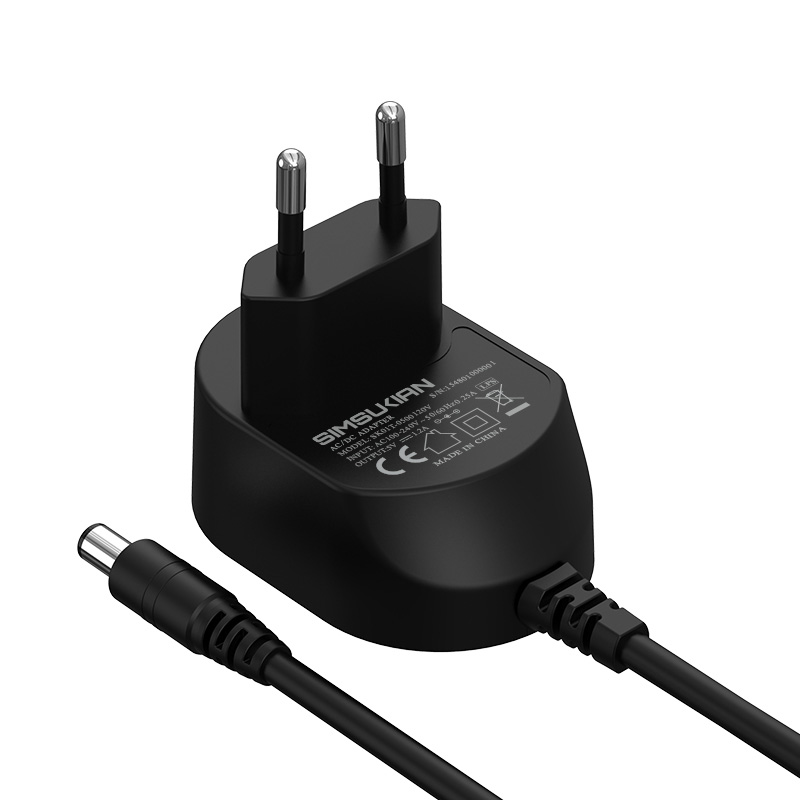
Voltage and current choices lock in a spare-part number, a plug mould and a certificate file for the life of the machine.
The Current-Rating Trap: 24V0.5A, 24V0.65A, 24V1A and 24V1.5A
The 24 V class is where current selection most often goes wrong, because four ratings share one plug format. Their power levels are 12 W at 24V0.5A, 15.6 W at 24V0.65A, 24 W at 24V1A and 36 W at 24V1.5A. Electrical arithmetic makes the 24 V family look interchangeable with the 12 V family at similar wattages, but two adapters that deliver the same power at different voltages are not substitutes for one another.
The practical test is not the wattage on the label. It is whether the load's rated input voltage matches the adapter's output voltage, whether the continuous current demand sits inside the adapter's rating, and whether the protection set is appropriate for the application. Documented protection features for these adapters include overcurrent, overvoltage and short circuit protection for the SK03T, with overvoltage protection, overcurrent protection, over-temperature protection and short circuit protection described as standard across the platform.
Plug Types, Colours and Mounting: Locking the Physical Interface
Plug configuration is the part of voltage selection that most often forces a second tooling investment. The configurations referenced in this framework cover EU, KR, UK, AU and US plug types, and the Korea AC plug is documented on both the SK01T and the SK03T power adapters.
A single interchangeable plug design can cover several global markets from one tooling set. In documented comparisons this approach is reported to cut tooling expenses and improve inventory turnover, because one housing serves multiple plug configurations instead of one mould per market. For a buyer running the same machine into Europe, Korea and the United States, that decides whether a market launch needs new tooling or only a new plug component.
Colour follows the same logic. The SK01T power adapter is available in black, white or customized colours, and the housing is made of fire-retardant PC material. Where an OEM needs a colour matched to a branded enclosure, that requirement should be raised with the plug and mounting decision, since all three are tooling-linked.
Mounting is the requirement buyers most often leave unstated. The documented configurations are plug-and-use units for indoor operation. If a machine requires the adapter to be fixed inside a cabinet, strain-relieved or fed from a corded position rather than a wall outlet, that should be specified as a project requirement at enquiry stage rather than assumed from a datasheet photograph.
Certification Questions to Settle Before the First Purchase Order
Certification is the constraint that most frequently delays a machinery launch once the electrical decision is already made. IEC 62368-1 4th Edition (2023) is the mandatory hazard-based safety standard for AV and ICT power supplies and replaced the legacy 60950 and 60065 certifications, so older certificate files should be checked for validity rather than assumed current.
On efficiency, US Department of Energy Level VI standards cap no-load power at 0.100 W for external power supplies at or below 49 W. The SK03T power adapter is documented as meeting the DOE, ERP and CEC-VI energy efficiency standards.
| Destination market | Evidence to request | Notes for machinery buyers |
|---|---|---|
| North America | UL, ETL, FCC (EMC), DOE Level VI, cUL for Canada | DOE Level VI caps no-load power at 0.100 W for EPS up to 49 W |
| European Union | CE-LVD, CE-EMC, ErP, GS, RoHS 2.0 | Safety assessed against IEC 62368-1 4th Edition; legacy 60950 files are superseded |
| United Kingdom | UKCA safety certificate and UKCA EMC certificate | Both are separately documented for the SK01T series |
| Korea | KC, KCC | Documented on SK01T and SK03T, both with Korea AC plug |
| Japan | PSE | Request the model-number-matched certificate |
| Australia / New Zealand | SAA, RCM | Safety certificate documented for the SK01T series |
| International | CB certificate and CB report | Documented as DK-53072-UL-62368-UL with report U1511109-981-62368-UL |
| China | CCC, CQC | Listed alongside CE-LVD, CE-EMC and RoHS in product documentation |
| Plant-level | ISO 9001:2015, ISO 14001:2015 | Quality and environmental management system certificates |
The standards referenced in the underlying documentation are IEC 62368, IEC 64558, IEC 60347, IEC 61558, EN 61347, IEC 60950, ISO 9001 and ETL 1310. Certification sets documented for these adapters include KC, KCC, UL, ETL, FCC, SAA, PSE, CCC, CQC, CE-LVD, CE-EMC and RoHS. Two verification habits prevent most problems: confirm that the certificate model number matches the model number on the purchase order, and confirm that the certificate covers the specific plug configuration being shipped.
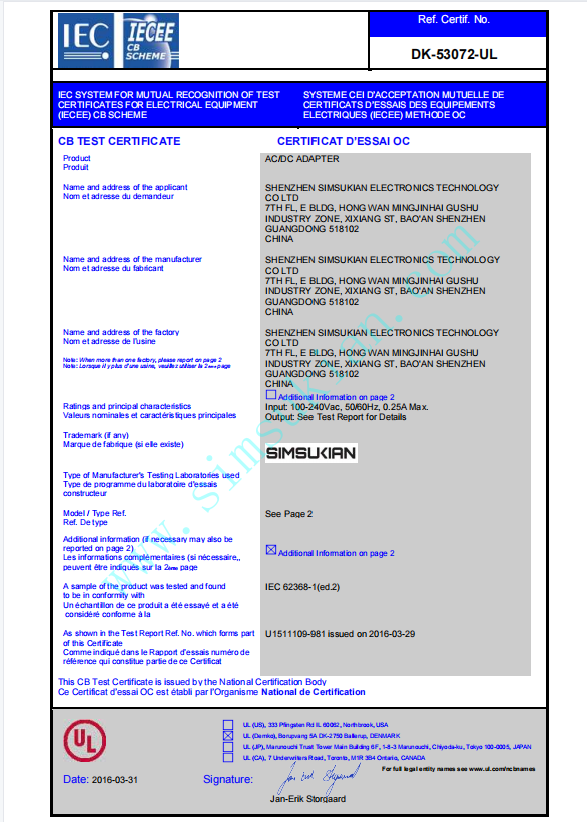
Model-number-matched certificate files such as the SK01T series CB certificate are the evidence source for compliance verification.
What the Electrical Evidence Should Show
Once voltage, current, plug and certification are settled, the remaining decision is the quality of the power delivered. For machinery that carries sensors, audio stages or measurement circuits, three parameters separate a specification-grade adapter from a generic one.
Output ripple on simsukian adapters is maintained at 60 mV or below through a low-ripple regulation circuit, with customized designs reaching 30 to 50 mV. Voltage accuracy reaches plus or minus 1 percent on tailored solutions. Typical generic adapters are reported at 80 to 120 mV ripple with tolerances of plus or minus 3 to 5 percent. For a device whose readings or audio output depend on a clean rail, that difference is the specification, not a refinement.
Standby consumption is documented at 0.07 to 0.08 W against an industry range of 0.1 to 0.3 W. Start-up time is documented at 3 seconds or less against a typical 3 to 5 seconds. Mean time between failures is documented at 50,000 hours against a typical 10,000 to 20,000 hours for generic adapters, and the reported equipment return rate caused by power-related issues is 1.2 percent against an industry average of 7.8 percent. Efficiency across the platform complies with Level VI, the highest external power supply efficiency rating, and GaN-based versions are documented as reaching peak conversion efficiency at Level VI.
Comparison with Traditional Adapter Sourcing - and Where This Approach Does Not Fit
A generic adapter and a specification-grade adapter can look identical in a photograph and differ substantially in the parameters a machine actually experiences. The comparison below is drawn from documented product data, not from an assumed ranking.
| Parameter | Generic adapter benchmark | Documented simsukian data |
|---|---|---|
| Output ripple | 80-120 mV | 60 mV or below, 30-50 mV on customized designs |
| Voltage accuracy | plus or minus 3-5 percent | plus or minus 1 percent on tailored solutions |
| Full-load temperature rise | above 60 degrees C | below 45 degrees C |
| Standby power | 0.1-0.3 W | 0.07-0.08 W |
| Start-up time | 3-5 seconds | 3 seconds or less |
| MTBF | 10,000-20,000 hours | 50,000 hours |
| Power-related return rate | 7.8 percent | 1.2 percent |
Cost behaves in a way that surprises buyers who benchmark on unit price alone. Premium components raise the bill of materials by roughly 5 to 8 percent, but the documented comparison reports that external EMI filters and metal shielding are no longer required, and field returns fall accordingly; on that basis total system cost is reduced. Material sourcing also matters: documented product data describes 100 percent new materials and flame-retardant construction rather than second-hand components.
Stated limitations, in the interest of an honest comparison. This approach is not suitable for every project, and the boundaries below are documented rather than inferred.
- Indoor use only. The documented operating condition for these adapters is indoor, plug-and-use operation. Outdoor cabinets, wet or condensing environments are outside the stated specification.
- Custom ripple and accuracy are tailored solutions. Ripple below 60 mV, down to 30 to 50 mV, and plus or minus 1 percent accuracy are described as customized rather than catalogue defaults, and require engineering review before they can be offered on a given model.
- Commercial thresholds apply. Orders carry a minimum order quantity of 600 units, and non-standard colours or plug variants require tooling and lead-time planning even where a single interchangeable plug mould serves multiple markets.
- Fixed voltage is not negotiated power. These are fixed-output AC-DC adapters. Where a machine requires a multi-voltage handshake, USB Power Delivery 3.1 Extended Power Range, which raised maximum delivery from 100 W to 240 W at 48 V and 5 A, is a different design decision rather than a stronger version of the same one.
- Power class ceiling. The 36 W class suits loads up to 36 W. Higher-demand machinery requires a different platform within the documented 3 W to 240 W range.
Acceptance Criteria and Commercial Terms at the Execution Stage
Buyer stage matters here: at the execution stage the question is no longer which adapter, but which order documentation proves the adapter is the one specified. The purchasing terms documented for these products are a minimum order quantity of 600 units, delivery terms including EXW Shenzhen, FOB Shenzhen and DAP, and payment terms of 30 percent by telegraphic transfer in advance with 70 percent against a copy of the bill of lading.
Acceptance criteria are equally concrete: factory inspection reports are provided, third-party inspection before shipment can be assigned, and pre-shipment testing is carried out. For a machinery programme, the practical use of these terms is to tie acceptance to the certificate list and the model number, so that the tested unit, the certified unit and the shipped unit are demonstrably the same product.
OEM/ODM and the Long-Term Supply Question
Long-term preference in this category is rarely built on price. It is built on whether the supplier can still produce the same adapter, with the same certificate and the same plug, after the machine has been in service for several years. That capacity is a manufacturing question more than a sales one.
Turnkey ODM and OEM support documented for simsukian covers schematic design, PCB layout, firmware programming for lithium-battery charging logic, NTC temperature monitoring, anti-reverse-polarity protection, indicator-light control, plastic-housing prototyping, mould-making, full-batch compliance testing and final assembly. The company works with a team of 30 engineers and holds more than 90 national patents covering structural design, circuit topology and safety-protection technologies. An in-house safety and reliability laboratory uses instruments from Rohde and Schwarz (Germany), Yokogawa (Japan), Agilent and Tektronix (USA) to run EMC, thermal cycling, surge, short-circuit and accelerated-aging testing on new designs before mass production, and the company holds ISO 9001:2015 quality management and ISO 14001:2015 environmental management system certification.
Supply continuity also depends on the interchangeability built into the physical design. A single mould covering all global plug markets reduces tooling expense and is reported to improve inventory turnover, which matters when a buyer stocks spares across several markets. A 50,000-hour MTBF figure and a 1.2 percent power-related return rate support a spare-parts plan that does not assume repeated replacement. With roughly 70 percent of output exported to the EU, USA, Australia, Japan, Korea and the UK, and reported annual sales in the USD 25 million to 50 million range, the supply base serves multiple regulated markets from a single production system.
Market Direction: Fixed-Voltage Adapters Inside a Fast-Charging World
The overall power adapter market is expanding. Dataintelo reports the global power adapter market at USD 26.65 billion in 2025, projected to reach USD 46.14 billion by 2034. Within that total, GaN-based chargers are the fastest-moving segment, with Next Move Strategy Consulting reporting USD 1.10 billion in 2023 and a forecast of USD 4.22 billion by 2030 at a 19.9 percent CAGR.
That growth is largely a consumer fast-charging story, and machinery buyers should read it with care. USB Power Delivery 3.1 Extended Power Range raised maximum power delivery from 100 W to 240 W at 48 V and 5 A, but a machine with a fixed 12 V or 24 V input does not negotiate power. What transfers from the fast-charging segment into machinery procurement is the underlying engineering - higher efficiency at Level VI, lower standby consumption and better thermal density - not the negotiation protocol. Buyers specifying 5 V, 12 V or 24 V rails should therefore evaluate efficiency, ripple and thermal behaviour rather than assume that higher-wattage consumer technology automatically improves a fixed-voltage system.
Future Outlook
Two shifts are likely to shape the next specification cycle. The first is efficiency pressure: DOE Level VI already caps no-load power at 0.100 W for external supplies at or below 49 W, and standby performance in the range of 0.07 to 0.08 W leaves little room for further gains without new topologies. GaN power devices are the documented research direction for the higher-density end of that effort.
The second is documentation continuity. As IEC 62368-1 4th Edition supersedes legacy 60950 and 60065 files across markets, machinery builders will increasingly ask suppliers to demonstrate that the certificate held today still matches the model number being shipped tomorrow. For buyers, the most durable decision remains the least dramatic one: choose the voltage that matches the load, reserve current margin for the real duty cycle, lock plug, colour and mounting early, and require certificate evidence by model number before the first purchase order rather than after the first shipment.
FAQ
1. How does a buyer choose between 5 V, 12 V and 24 V output for a machine?
The choice starts from the rated input voltage of the load, not from the adapter currently in service. A 12 V load requires a 12 V adapter regardless of wattage equivalence, because output voltage must match the input stage of the device. Once the voltage is fixed, the current rating is selected so that continuous demand sits within the adapter rating, and the thermal behaviour is validated in the final enclosure. A 5V3A adapter and a 24V1.5A adapter are not interchangeable even though both sit in the same low-wattage band.
2. How much current margin does a machinery load actually need?
Margin is a thermal question as much as an electrical one. Documented data for these adapters reports full-load temperature rise below 45 degrees C, compared with more than 60 degrees C for typical generic adapters, and the protection set - overvoltage, overcurrent, over-temperature and short circuit protection - is designed to intervene rather than to be used as operating headroom. The practical approach is to define continuous current from the load, establish peak behaviour separately, and validate the selected rating at maximum demand inside the machine enclosure rather than on an open bench.
3. Which certifications should a 36 W adapter carry for the EU, North America, Korea and Australia?
Requirements differ by market. For North America the relevant set includes UL or ETL, FCC for EMC, and DOE Level VI for efficiency, which caps no-load power at 0.100 W for external power supplies up to 49 W. For the EU the set includes CE-LVD, CE-EMC, ErP, GS where applicable, and RoHS 2.0, with safety assessed against IEC 62368-1 4th Edition, which replaced the legacy 60950 and 60065 standards. Korea requires KC and KCC, and Australia and New Zealand require SAA and RCM. The SK03T power adapter is documented against KC, KCC, UL, ETL, FCC, SAA, PSE, CCC, CQC, CE-LVD, CE-EMC and RoHS, and as meeting DOE, ERP and CEC-VI efficiency standards.
4. Can ripple, voltage tolerance, plug type and colour be customized?
Yes, within documented limits. Standard adapters maintain output ripple at 60 mV or below, while customized designs reach 30 to 50 mV, and voltage accuracy reaches plus or minus 1 percent on tailored solutions, compared with 80 to 120 mV ripple and plus or minus 3 to 5 percent tolerance on typical generic adapters. Plug configurations referenced in this framework include EU, KR, UK, AU and US types, with a Korea AC plug documented on the SK01T and SK03T. The SK01T power adapter is available in black, white or customized colours and is built with fire-retardant PC housing. Custom ripple and tolerance work is described as a tailored solution requiring engineering review rather than a catalogue option.
5. What are the acceptance criteria and purchasing terms for an adapter order?
Documented terms for these products are a minimum order quantity of 600 units, delivery terms including EXW Shenzhen, FOB Shenzhen and DAP, and payment of 30 percent by telegraphic transfer in advance with 70 percent against a copy of the bill of lading. Acceptance criteria include factory inspection reports, the option to assign third-party inspection before shipment, and pre-shipment testing. For machinery buyers, the value of these terms is that inspection evidence can be tied to the certified model number, so the tested unit and the shipped unit can be shown to be the same product.
6. What determines long-term supply continuity for an adapter already designed into machinery?
Continuity rests on four documented factors. First, tooling flexibility: a single interchangeable plug design covering all global markets avoids a separate mould per market and supports spare-parts stocking across several regions. Second, reliability data: a documented MTBF of 50,000 hours against a typical 10,000 to 20,000 hours for generic adapters supports a service plan that does not assume repeated replacement. Third, certification continuity: ISO 9001:2015 and ISO 14001:2015 system certification, together with more than 90 national patents, supports long-run production of the same design. Fourth, platform range: a documented product range of 3 W to 240 W allows a machinery builder to stay with one supply source as power requirements change across a product family.
The product catalogue referenced in this article is available for download: simsukian power adapter catalogue (PDF).