
6–15 kW Hybrid Inverter FAQ: Input Voltages, Storage Pairing and Acceptance Terms
6–15 kW Hybrid Inverter FAQ: Input Voltages, Storage Pairing and Acceptance Terms
A 6–15 kW hybrid inverter is usually specified twice: once on a datasheet, and again on a purchase order. The datasheet decides whether a model reaches the shortlist. The purchase order decides what actually ships, what is tested before it ships, and which parameter mismatches a buyer can still reject. This FAQ treats both moments as one procurement problem for EU buyers working with the Yeyanghong Energy hybrid inverter series — the 6 kW, 10 kW, 12 kW and 15 kW models, the 12 V, 24 V and 48 V battery input options, 5 kWh, 10 kWh and 16 kWh LiFePO4 storage pairings, IP21–IP67 enclosure options, a 180–270 V output window, a 0–55 °C charging range and a five-year warranty.
Each section answers one question that tends to surface during evaluation and repeats during execution, and closes with the evidence worth requesting in writing. Where an answer depends on the individual model or the destination market, it is flagged rather than smoothed over: a series-level statement is not a model-level guarantee.
What an EU buyer is actually specifying in the 6–15 kW class
A 6 kW, 10 kW, 12 kW or 15 kW hybrid inverter is a grid-interactive unit that handles PV conversion, battery charge and discharge, and load supply inside one enclosure. The specification therefore covers three interfaces at once — PV array, battery pack and grid connection — and the power rating describes only the AC capacity class the unit is built around.
That rating does not tell a buyer whether a model is single-phase or three-phase, which battery voltage it accepts, how many MPPT trackers it provides, or which enclosure rating is available. Across this band those attributes change from model to model, and each one reshapes the balance of system around the inverter: cable cross-sections, DC and AC protection, battery architecture, mounting and ventilation.
A second check belongs at the same stage: whether a quoted figure is continuous rated output or a short-term peak. Two datasheets can carry the same headline number while describing different duty. Ask for the parameter name and the condition attached to it, not just the number.
The shortlist rule that follows is straightforward. Size the rating against the load profile, then filter by phase, battery input, storage pairing and IP option. A model that survives all four filters is a candidate; a model that wins on the headline number alone is a specification risk carried forward into commissioning.
12 V, 24 V and 48 V battery input: what the option really decides
The input-voltage option fixes the DC architecture of the entire system. It sets the battery bank configuration, the current the DC side must carry, and therefore the cable cross-section, the fuse and breaker ratings, and the resistive losses between battery and inverter.
The mechanism is ordinary electrical engineering rather than a product claim: for the same power, current rises as voltage falls. A 12 V battery side carries far more current than a 48 V side at identical kilowatt throughput, which is why 12 V options are normally associated with small packs and modest loads, while 48 V is the usual reference voltage for the 5–16 kWh LiFePO4 packs paired with multi-kilowatt hybrid units. That is established practice, not a statement about which combination any specific model is approved for.
Four checks settle the pairing question:
- Voltage window: written confirmation that the pack's operating window, including both cut-offs, sits inside the inverter's battery input window.
- BMS communication: protocol, port and whether the inverter can actually read state of charge and temperature from that specific pack.
- Current limits on both sides: an inverter's charge or discharge current setting can exceed what a smaller pack will accept.
- Factory build versus field setting: whether the 12 V, 24 V or 48 V configuration is fixed at production or configured on site. This affects spare-part strategy and what the nameplate must show.
5 kWh, 10 kWh and 16 kWh LiFePO4: matching storage to the load
Storage is sized from the load list and the required autonomy period, then verified against the inverter's charge and discharge capability and the battery's own current limits. Nameplate kWh is a class marker, not a runtime figure.
Delivered energy is lower than nominal energy, because depth-of-discharge limits, round-trip conversion losses and temperature all take a share. A 5 kWh, 10 kWh or 16 kWh pack therefore identifies which step of the storage range is under discussion; it does not by itself state how long a particular installation will run.
The working sequence has four steps:
- Write the essential-load list: what must stay energised, and for how long.
- Add the depth-of-discharge and conversion allowances to move from required delivered energy to a nominal pack size.
- Confirm that the inverter's charge and discharge settings sit inside the pack's limits.
- Check thermal and physical fit — the pack is a site object, not a datasheet line.
Described as fit boundaries rather than recommendations: the 5 kWh step suits a narrow essential-load panel built around a few critical circuits; the 10 kWh step sits between essential-load coverage and wider household coverage; the 16 kWh step is the reference point for a buyer targeting whole-dwelling coverage or a longer autonomy period. The actual figure in every case comes from the load calculation, and an EU buyer is better served by attaching that calculation to the quotation than by accepting a one-line summary in an email.
180–270 V output and 0–55 °C charging: reading the operating envelope
The 180–270 V output window and the 0–55 °C charging range describe the conditions under which the unit is specified to work. A site that sits outside either boundary needs an engineering answer before the purchase order, not after commissioning.
On the output side, EU low-voltage installations are built around a 230 V nominal. An adjustable 180–270 V window gives the installer headroom to set the unit for the local grid condition and to keep that setting stable where voltage sags or swells. It does not replace grid-code configuration: protection thresholds, anti-islanding behaviour and the connection approval itself belong to the destination market and its network operator. Buyers should ask which settings are available for that country and who is responsible for configuring and documenting them.
On the charging side, 0–55 °C is the charging window, and the number that matters is the temperature at the unit inside its enclosure on a summer afternoon — which can sit well above shaded air temperature in a sealed plant room. Charging below 0 °C falls outside the stated range. Ventilation, mounting height and clearance therefore belong in the specification, not in the installer's judgement on the day of commissioning.
IP21 to IP67: matching the enclosure to the location
Choose the IP option from the installation location first, then confirm that the selected model is offered with it. The rating describes the enclosure, so it should follow the room rather than the catalogue page.
The code reads in two directions: the first digit addresses solids and contact, the second addresses water. A lower rating such as IP21 is an indoor, dry-location specification. Higher second digits move the unit toward sheltered outdoor positions, and the top of this range, IP67, describes a dust-tight enclosure protected against temporary immersion. Between those points, the correct choice is the one that matches the actual exposure at the mounting position — drip, spray, hose-down or dust.
Two boundaries worth writing into the specification. An enclosure rating is not an installation approval; local wiring rules and the manufacturer's manual still govern where a unit may be mounted. And the rating applies to a correctly closed enclosure fitted with the specified glands and connectors — an IP67 unit with an unsealed cable entry is no longer an IP67 installation, and sealing performance depends on inspection across the service life.
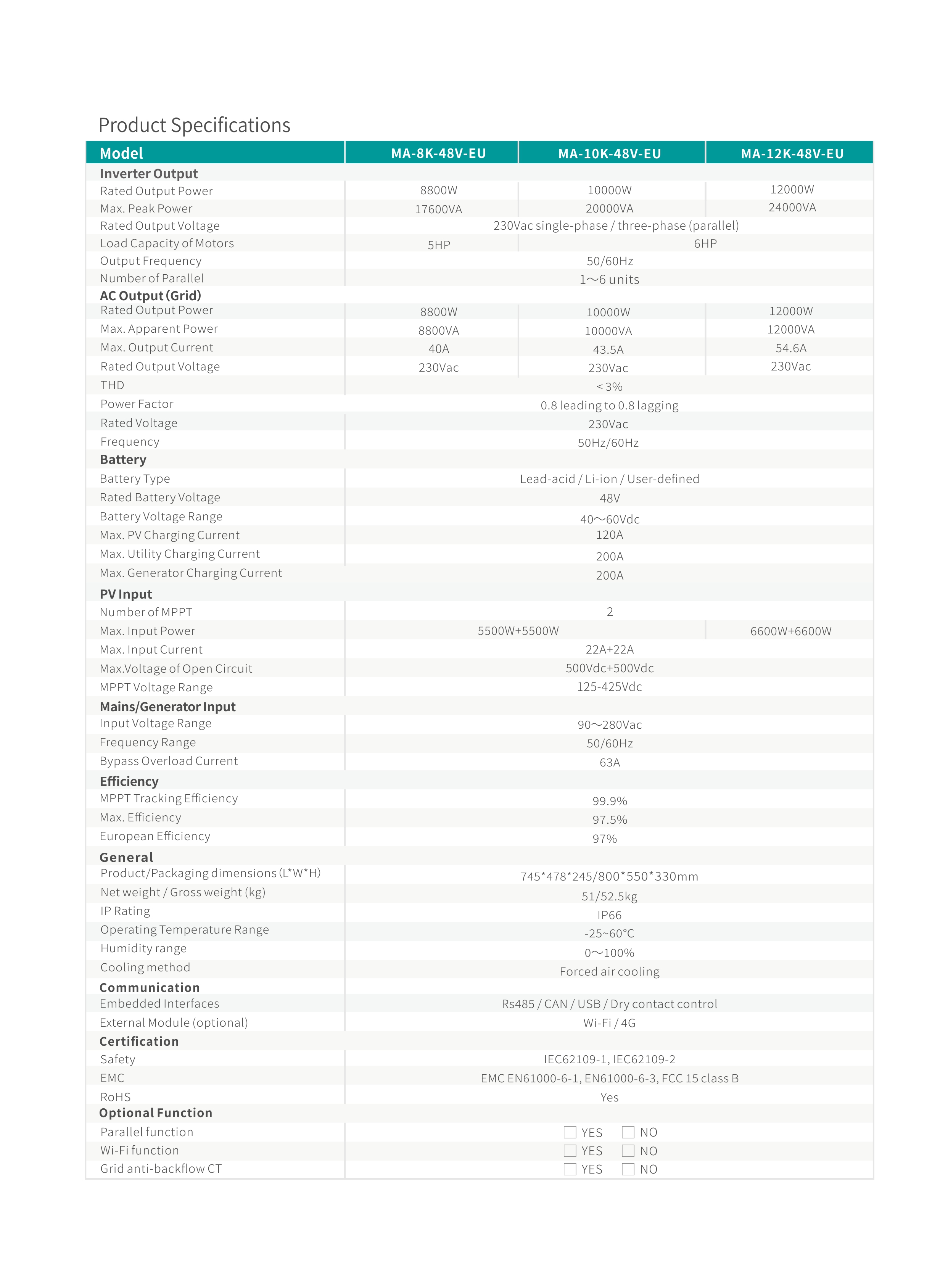
| Parameter in the series | What it decides for the buyer | What to confirm in writing |
|---|---|---|
| 6 kW / 10 kW / 12 kW / 15 kW rating | AC capacity class and the load profile the unit is built around | Rated continuous output versus short-term peak, and phase configuration of the specific model |
| 12 V / 24 V / 48 V battery input | DC architecture, current level, cable and protection sizing | Approved battery pairing, voltage window and BMS protocol for that model |
| 5 kWh / 10 kWh / 16 kWh LiFePO4 storage | Autonomy step relative to the essential-load list | Usable energy assumptions, charge/discharge current limits, thermal fit |
| IP21–IP67 enclosure option | Where the unit may be mounted | Which ratings the chosen model is actually offered in, plus gland and sealing requirements |
| 180–270 V output window | Grid-condition headroom and installer adjustability | Country-specific settings list and who configures and records them |
| 0–55 °C charging range | Ventilation and mounting position requirements | Expected ambient at the enclosure in the actual plant room |
| Five-year warranty | Service-life cost and claim route | Warranty start trigger, service responsibility in the destination country, extended-warranty terms |
OEM, ODM and SKD: what can actually be customized
Guangdong Yeyanghong Energy Technology Co., Ltd. is a manufacturer of on-grid inverters, off-grid inverters, micro inverters, all-in-one energy storage systems, BESS, stacked home energy storage, wall-mounted and floor-standing batteries, and PCBA, exporting to the USA, the EU, Southeast Asia, the Middle East, Australia, Africa, and Central and South America. The company supports OEM, ODM and SKD production, with customization named against WIFI, battery, 4G/5G connectivity, IP rating and power. The stated minimum order quantity is 2 pieces, typical production lead time is 30–45 days, monthly production capacity is 100,000 sets, and all products undergo 100% testing for quality control.
Those five customization axes answer five different market problems rather than one marketing message. Connectivity (WIFI, 4G/5G) addresses monitoring and remote diagnostics, which is what a distributor needs when the end user is hundreds of kilometres away. Battery customization addresses the storage pairing decision discussed above. IP rating addresses the installation location. Power addresses the typical dwelling size and service rating of the target market. SKD supports local assembly and value-add in markets where that changes the landed cost or the local content position.
The list names categories, not combinations, and that distinction matters at order stage. A buyer should confirm in the quotation which combination is available at the intended order volume, whether a customized configuration carries a different minimum than the standard range, what changes on the nameplate and in the documentation, and how the change is reflected in the pre-shipment test record.
Scale context, as reported by the company: a workforce of more than 400 and a 15-engineer R&D team. For a buyer, the practical value of that information is not the headcount itself but whether it supports the customization and documentation the project needs — which is verified through samples, drawings and test records, not through a company profile.
Purchasing terms: MOQ, delivery, payment and lead time
The stated purchasing terms are a minimum order quantity of 2 pieces; delivery terms of EXW, FOB, CIF or LC; payment terms of 30/70; and a typical production lead time of 30–45 days.
Each of those terms shifts cost and risk at a different point in the shipment. EXW places collection and export handling with the buyer, FOB places the main carriage and insurance with the buyer once the goods are on board, and CIF places carriage and insurance with the supplier up to the named destination port. Because the three place responsibility in different locations, the proforma invoice should name the Incoterm together with the named place and the applicable Incoterms version — an Incoterm without a place is an incomplete term, not a price.
The 30/70 split is a deposit-and-balance structure. Buyers normally tie the balance trigger to the pre-shipment test milestone rather than to a calendar date, so that payment release follows acceptance evidence. Whatever the trigger, the wording belongs in the sales contract rather than in an email thread, together with the inspection window and the remedy if the test record is incomplete.
Lead time deserves the same precision. A 30–45 day production window is a production statement; it does not include customization engineering, third-party inspection booking, or sea transit. Buyers working to an installation date should confirm which of those stages the quoted window covers.
Acceptance criteria: what to write into the order
The stated acceptance criterion is a pre-shipment test, backed by 100% testing during production. The buyer's task is to define what that test evidence must contain before the balance payment is released, because "tested" and "documented" are different deliverables.
A workable acceptance schedule has six parts:
- Document set: the datasheet revision referenced in the contract, the nameplate layout, the test record and the packing list, all tied to the same model designation.
- Configuration conformance: battery input voltage, power rating, IP option and connectivity variant matching the order line, item by item.
- Functional record: the measured parameters the supplier reports, with the test conditions stated beside them.
- Enclosure and sealing check: glands, connectors and closure verified against the IP option purchased.
- Accessory and firmware confirmation: what is in the box, and which firmware or parameter set is loaded.
- Packing and shipping marks: able to survive the selected delivery term and the destination handling.
Warranty belongs in the same document. The series carries a five-year warranty, and the after-sales options offered are replacement of accessories, extended warranty and remote installation services. Three points are worth fixing in writing at order stage: when the warranty period starts — shipment or commissioning; who performs service in the destination country; and what evidence a claim requires. Extended-warranty terms are a commercial decision, so they should be quoted rather than assumed.
Documentation to request — without assuming certifications
A certificate should be requested as a document tied to a model number, not inferred from a series name or a country reference in a brochure. Where a buyer needs a compliance statement for a specific market, the deliverable is the certificate and its test report naming the product, the standard and the issuing body.
Standards context helps frame the request. IEC 62109-2:2011 sets out particular safety requirements for inverter products used in photovoltaic power systems, including products that perform inverter functions alongside other functions. For off-grid work, IEC TS 62257-9-7:2019 addresses the criteria for selecting and sizing inverters for off-grid applications integrating solar energy, while its publication page indicates the document has been replaced, and a 2025 standards-catalogue entry describes IEC TS 62257-301:2025 as covering design and implementation of hybrid off-grid solar systems with or without storage. The buyer takeaway is procedural rather than promotional: check the current edition, and ask for the certificate that matches the destination market instead of accepting a generic compliance phrase.
Customs planning has its own reference point. Inverters with maximum power point tracking are classified under HS 8504.40.84 for tariff purposes, while the broader HS 850440 heading covers static converters generally, including products that are not solar inverters. Classification should be confirmed with a customs broker before it is used in a landed-cost model.
Hybrid versus on-grid versus off-grid: the fit boundary
A hybrid inverter sits between an on-grid and an off-grid architecture. It is the appropriate reference when a site needs both grid interaction and battery autonomy, and the wrong reference when only one of those is required.
An on-grid inverter converts PV output for grid use without a battery subsystem; its specification is the shortest of the three, and it carries no backup function. An off-grid inverter works with a battery bank and no grid dependency, so sizing is driven by worst-case autonomy rather than by annual yield. A hybrid unit combines PV conversion, battery charge and discharge, and grid interaction, which adds operating modes and settings — and with them a commissioning discipline that the other two architectures do not demand to the same degree.
Stated plainly as a boundary: if a project has no backup requirement and no storage plan, an on-grid unit is a simpler specification with one less subsystem to maintain and document. If there is no grid connection at all, an off-grid architecture is the reference case. The hybrid case earns its extra complexity where both grid interaction and stored energy are genuinely part of the requirement — which is the situation most 6–15 kW EU residential and small commercial projects are in.
Market context and a bounded outlook
Third-party estimates give the segment its scale. Grand View Research values the global solar hybrid inverter market at USD 10.7 billion in 2024, with three-phase hybrid inverters accounting for 61.3% of revenue share in the same year. Definitions differ between research houses — including whether battery revenue is counted inside the market boundary — so these figures are directional and should be checked against methodology before they support an investment case.
The three-phase weighting is consistent with commercial and larger residential projects carrying a substantial share of demand in this class. For a buyer, the practical translation is that phase availability at 10–15 kW is a shortlist question, answered from the model datasheet rather than from a series description.
On outlook, the honest statement is conditional. Whether the next procurement cycle favours larger storage blocks, more integrated all-in-one systems or more distributed inverter-plus-battery combinations depends on local tariff design, backup expectations and installation labour in each market — not on inverter ratings alone. What does not change with the cycle is the documentation discipline: a defined operating envelope, a storage pairing backed by a load calculation, an enclosure choice matched to the room, a pre-shipment test that produces evidence, and warranty terms that name the start date and the service route.
Frequently asked questions
Which 6–15 kW hybrid inverter fits an EU residential or small commercial project?
Start from the load profile and the required phase configuration, then filter the 6 kW, 10 kW, 12 kW and 15 kW models by battery input voltage, storage pairing, enclosure rating and connectivity. Confirm whether each quoted rating is continuous output or short-term peak, and confirm the phase configuration of the individual model from its datasheet rather than from the series description. A model that satisfies all filters is a shortlist candidate; the rating alone does not establish fit.
What is the difference between the 12 V, 24 V and 48 V battery input options?
They define different DC architectures. At the same power, a 12 V battery side carries much higher current than a 48 V side, so cable cross-sections, protection ratings and resistive losses change with the choice. Lower voltages are normally associated with small packs and modest loads; 48 V is the usual reference for the 5–16 kWh LiFePO4 packs paired with multi-kilowatt hybrid units. The approved pairing for a specific model has to be confirmed in writing, including the voltage window, BMS protocol and current limits.
How should 5 kWh, 10 kWh or 16 kWh LiFePO4 storage be matched to the inverter?
Define the essential-load list and the required autonomy period first, then convert delivered energy requirements into a nominal pack size by allowing for depth of discharge, conversion losses and temperature. Next, confirm that the inverter's charge and discharge current settings sit inside the pack's limits, and check thermal and physical fit at the installation site. Nominal kWh identifies the step in the storage range; it does not state runtime for a given installation.
What do the 180–270 V output window and 0–55 °C charging range mean in practice?
They describe the operating envelope. The adjustable 180–270 V output window gives headroom around a 230 V nominal for local grid conditions, but it does not replace country grid-code configuration, protection thresholds or the network operator's connection approval. The 0–55 °C range applies to charging at the unit, so enclosure ventilation and mounting position become part of the specification. Charging below 0 °C falls outside the stated range.
Does the IP rating decide where the inverter can be installed?
Only partly. The IP option should match the exposure at the mounting position — a lower rating such as IP21 is an indoor, dry-location specification, while higher second digits move the unit toward sheltered outdoor or more exposed positions, up to IP67 at the top of this range. The rating is an enclosure property: it does not override local wiring rules or the manufacturer's manual, and it only applies to a correctly closed unit with the specified glands and connectors fitted.
What can be customized under OEM, ODM and SKD, and what is the minimum order?
The manufacturer supports OEM, ODM and SKD production, with customization named against WIFI, battery, 4G/5G connectivity, IP rating and power. The minimum order quantity is 2 pieces, typical production lead time is 30–45 days, and monthly production capacity is 100,000 sets. Because the list identifies customization categories rather than fixed combinations, the specific configuration, its minimum and any documentation changes should be confirmed in the quotation.
What are the purchasing terms for the series?
The stated terms are a minimum order quantity of 2 pieces, delivery terms of EXW, FOB, CIF or LC, and payment terms of 30/70, with a typical production lead time of 30–45 days. Buyers should require the proforma invoice to name the Incoterm together with the named place and the applicable Incoterms version, and should tie the balance payment to the pre-shipment test milestone in the sales contract.
What acceptance criteria and warranty coverage apply?
The stated acceptance criterion is a pre-shipment test, supported by 100% testing during production, and the series carries a five-year warranty. After-sales options are replacement of accessories, extended warranty and remote installation services. Three items should be fixed in writing at order stage: the warranty start trigger, who performs service in the destination country, and what evidence a warranty claim requires.
Where to take the specification next
The useful output of this FAQ is not a longer datasheet but a shorter purchase order with fewer open questions: a defined operating envelope inside 180–270 V output and 0–55 °C charging, a battery input voltage matched to the pack, a storage step justified by a load calculation, an enclosure rating matched to the room, and an acceptance schedule that produces evidence before the balance is released.
Company information for Guangdong Yeyanghong Energy Technology Co., Ltd. is published at Yeyanghong Energy, and the current product brochure can be downloaded here: Yeyanghong Energy brochure (PDF). Documentation enquiries: Kevin Xia, admin@yeyanghong.com, +86-18042878526.
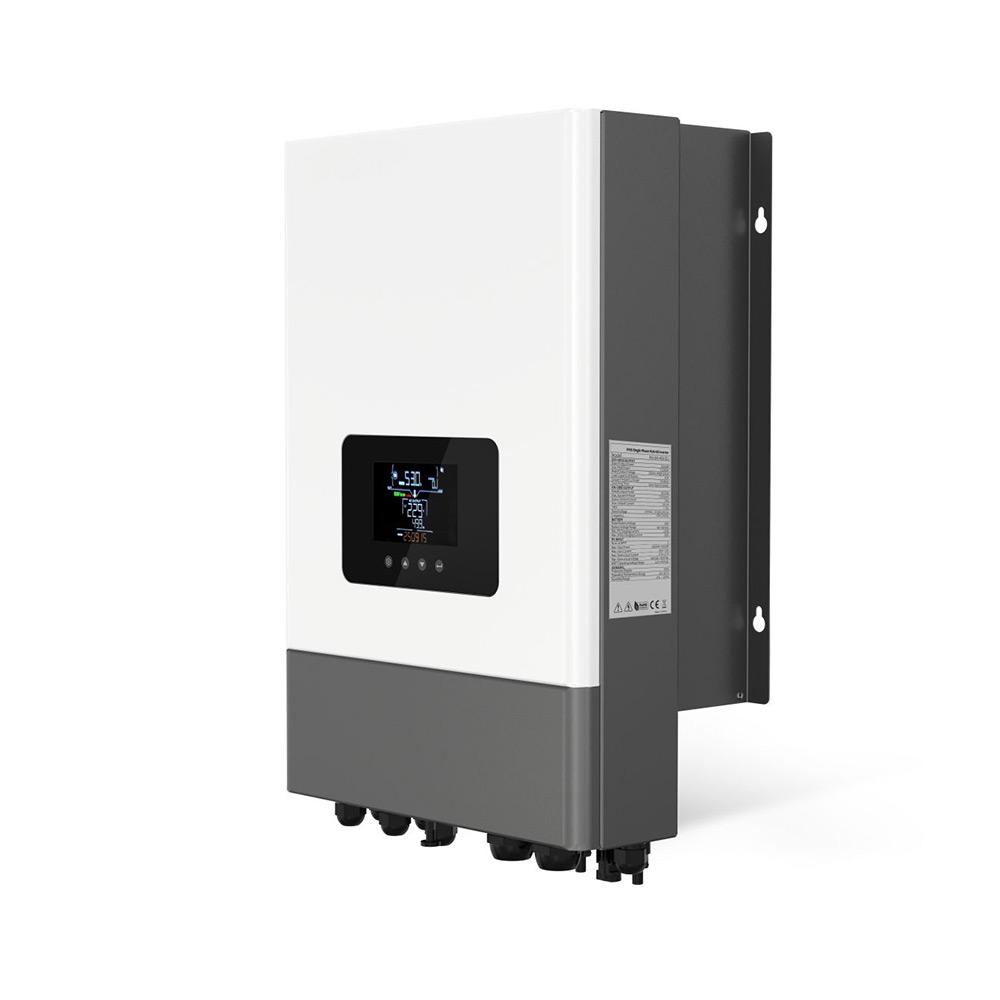
Tem questões ou precisa de mais detalhes?
Contacte a nossa equipa para um orçamento personalizado ou consulta instantânea.
Solicitar orçamento
Preencha o formulário abaixo e a nossa equipa entrará em contacto com uma proposta personalizada.
Chat direto do WhatsApp
Prefere conversar em tempo real? Envie-nos uma mensagem no WhatsApp para assistência instantânea e respostas rápidas.
- Obter orçamento personalizado
- Partilhar fotos ou documentos
- Discuta as suas necessidades diretamente
Geralmente responde em 5–30 minutos durante o horário de expediente.