
6765 vs S149: Certification or Endurance for EU Wall Socket Projects

Testing and inspection equipment used for wall socket performance and safety verification. Image: Wenzhou Huafeng Electric Co., Ltd.
6765 vs S149: Certification or Endurance for EU Wall Socket Projects
The global electric plugs and sockets market was valued at USD 14.13 billion in 2025 (Precedence Research), and global wall socket production exceeded 3.1 billion units in 2024, with China leading as the top producer. Volume of that scale is not the constraint in European projects. The constraint is that two sockets with almost identical headline ratings can serve two different purposes inside one specification: one is selected because its compliance file is complete, the other because its endurance behaviour has been tested and documented.
This buyer reference compares two catalogue entries from Wenzhou Huafeng Electric Co., Ltd. (HYFF): product 6765, catalogued as the 1-gang socket model A129, and product S149, catalogued as a Schuko socket. Both are 16 A sockets. Both use flame-retardant PC panels. Both sit inside the same export programme for the European Union. The decision between them is not a quality ranking. It is a choice about which evidence file a project actually needs.
Wenzhou Huafeng Electric Co., Ltd. (HYFF) is a building electrical manufacturer based in Wenzhou, Zhejiang, China, founded in 2011. The company produces wall switches and wall sockets for export, operating a 7,000 m² factory with 118 employees, an annual output of 35,000,000 units, a research and development team of 10 engineers and a 100% export ratio covering the European Union, the Americas, North America, Oceania, Asia and Africa.
Two structural facts frame the comparison. The general requirements standard behind European socket conformity is IEC 60884-1:2022, which covers plugs and socket-outlets for household and similar purposes and is limited to 16 A for screwless terminals. The Schuko interface (Type F) used in many European countries is standardised for 16 A / 250 V applications under CEE 7/3. Both models sit inside that 16 A envelope, but they do not sit inside the same installation geometry or the same documentation scope.
Why EU projects split the decision into two tracks
European buyers rarely make a single socket decision. They make two, usually in sequence.
The compliance track answers a gate question: may this product be placed on the EU market, and does the documentation demonstrate conformity with the applicable safety requirements? CE marking under the Low Voltage Directive 2014/35/EU belongs here, together with hazardous-substance documentation such as RoHS and any additional marks a project specification requires.
The endurance track answers a lifecycle question: how does the socket behave after thousands of insertion cycles, thermal load and years of service? This is where material choice, contact and base design, on-off testing and field history matter more than a certificate number.
A project that weights only the first track may accept a socket with a clean certificate file and unverified long-term behaviour. A project that weights only the second track may install a durable socket that fails a tender document check. For EU work both tracks are normally required, and the real question is which one carries more weight in the specific scope.
The two catalogue entries at a glance
| Specification | Product 6765 | Product S149 |
|---|---|---|
| Catalogue model | A129 | S149 |
| Product type | 1-gang wall socket | Schuko wall socket |
| Installation | Flush mounted | Surface mounted |
| Panel size | 81.6 x 81.6 mm | 68 x 68 mm |
| Rated specification | 16 A, 250 V~ | 16 A, 220-250 V~ |
| Panel material | Flame-retardant PC panel | Flame-retardant PC panel |
| Base material | PC | Not specified in the catalogue entry used for this reference |
| Colour options | White and customized | White, ivory, black, silver, golden and customized |
| Listed certification | CE, TUV | CE |
| HS code | 8536690000 | 8536690000 |
Read as a table, the two entries look close. Read against a project specification, they diverge on three points: documentation scope, installation format, and how far the material declaration is completed in the catalogue entry.
Route A: certification-led, and how to read the 6765 file
For product 6765 the primary compliance document is a Certificate of Conformity for CE under the Low Voltage Directive 2014/35/EU, numbered DACE260330001RL and issued by DACE for the EU market. The certificate is based on IEC 60884-1:2022, was issued on 2026-04-03 and is valid until 2031-04-03. Its model scope lists a defined set of socket models, and model A129, the catalogue entry for product 6765, is included in that scope.
Two further marks support the same entry. TUV certification is listed for model A129 in the catalogue specification, and the manufacturer's certification records additionally list CB certification for its wall switches and sockets. CB documentation is commonly used by importers and brand owners as an internationally recognised route toward national approvals.
Hazardous-substance documentation runs on a separate certificate. A RoHS Certificate of Conformity, numbered DACE260416010RL and issued by Shenzhen DACE Testing Technology Co., Ltd., covers the EU market, is based on the IEC 62321 series of test methods, was issued on 2026-04-22 and is valid until 2031-04-22. Like the CE certificate, it defines its own model scope rather than covering an entire catalogue family.
Buyer note: a certificate certifies the models listed in its scope, not every product a supplier shows on the same page. Confirming that the ordered model appears in the certificate annex is a document step, not a formality, and it is one of the most common reasons a technically acceptable supplier file fails a project submission.
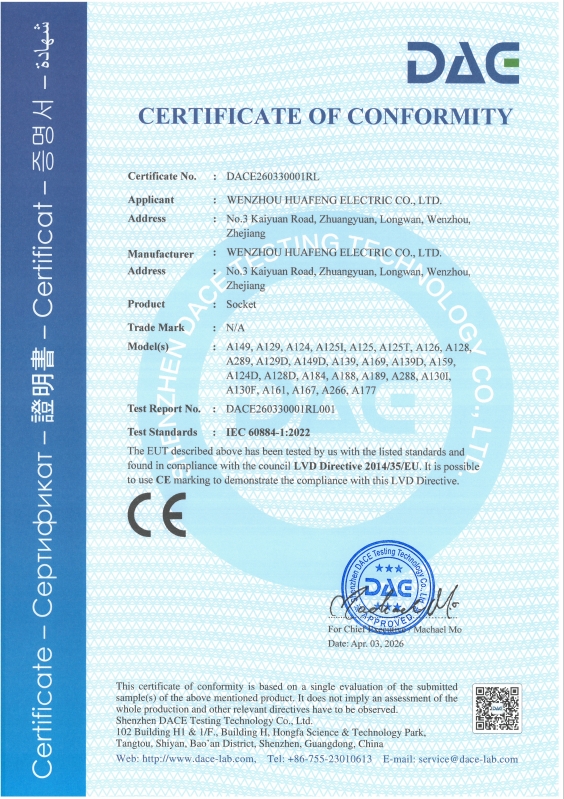
CE Certificate of Conformity DACE260330001RL, issued by DACE for the EU market on the basis of IEC 60884-1:2022.
Route B: endurance-led, and what backs the S149 position
Product S149 is a surface-mounted Schuko socket with a 68 x 68 mm panel, rated 16 A, 220-250 V~, built on a flame-retardant PC panel, and listed with CE certification. Its commercial position rests less on a certificate file and more on the durability evidence a project can actually examine.
The first layer of that evidence is the quality-control sequence applied across production: material incoming inspection, plastic parts inspection, process inspection, glowing filament testing, silver layer thickness inspection, performance life testing, plastic ball pressure testing, switch and socket on-off testing on the assembly line, and doorbell testing. The production policy states 100% testing, and the after-sales position states an 8-year warranty.
The second layer is channel evidence. Case records describe European wall socket brand owners, importers and electrical product distributors ordering more than 1,000 wall sockets per model for residential and distribution projects, deployed in residential buildings, apartments, hotels and commercial properties. The sockets were tested for insertion durability and electrical safety according to applicable product standards, with a stated duration of at least 8 years, and passed plug compatibility, installation, temperature-rise and functional testing.
The same records also set a boundary that buyers should read carefully: actual service life depends on insertion frequency, electrical load, installation quality and the operating environment. Endurance is a conditional property. A durability claim is only as strong as the installation and usage assumptions behind it.
Technical explanation: where the two routes diverge in a real installation
Installation geometry and wall-box compatibility
The most immediate difference is mounting. Model A129 (product 6765) is flush mounted with an 81.6 x 81.6 mm panel, so it depends on a compatible recessed wall box and a finished wall surface. Model S149 is surface mounted with a 68 x 68 mm panel, which sits on the finished surface and avoids chasing or box excavation. In refurbishment, concrete construction or projects where walls cannot be opened, that single difference often decides the specification before any discussion of contacts and materials begins.
Interface designation
S149 is catalogued as a Schuko socket, the Type F interface standardised under CEE 7/3 for 16 A / 250 V applications. Product 6765 is catalogued as a 1-gang socket under model A129, which is a different interface designation. Because plug-standard fit is a safety and usability requirement rather than a cosmetic one, buyers specifying Schuko geometry for an EU installation should confirm the interface of the exact catalogue entry against the destination market before releasing an order.
Rating declarations
Both entries are 16 A devices, but the declared voltage ranges differ: 16 A, 250 V~ for A129 and 16 A, 220-250 V~ for S149. Both sit inside the European nominal supply, yet the declared figure is the one that will be compared against the compliance file and the project specification.
Material declaration
Both models use a flame-retardant PC panel. The base material is declared as PC for A129. For S149 the catalogue entry used for this reference does not state a base material. For projects that specify base material, this is a documentation question to close early rather than a performance judgement about the product.
Appearance consistency
For brand owners and distributors, appearance is a purchasing criterion rather than a detail. Both entries offer customised colours, with white for A129 and white, ivory, black, silver, golden or customized for S149, and case records note consistent appearance across delivered batches as a project requirement.
Application and use cases
The two routes map onto recognisable project types.
- New-build residential and apartment projects. High socket counts per floor plan, standard recessed boxes and a preference for flush-mounted formats. Product 6765 aligns with that geometry, and the 1,000-unit minimum order quantity matches block purchasing.
- Hotels, serviced apartments and commercial interiors. Repeated insertion cycles over a long service life, plus appearance consistency across rooms. This is where endurance evidence and batch consistency carry more weight than a single document.
- Retrofit and renovation work. Surface-mounted S149 avoids excavation and shortens installation time where wall boxes are absent or incompatible with the wall construction.
- Distribution and private-label programmes. Both entries support customised colours, and ODM production with logo customisation is stated for the manufacturer's range as a whole.
- Mixed portfolios. Brand owners assembling a full range frequently keep a flush-mounted line for new build and a surface-mounted line for retrofit inside the same catalogue.
Procurement and acceptance terms at the execution stage
Once the model decision is made, the execution stage is governed by terms that apply across the manufacturer's socket range.
| Term | Stated condition |
|---|---|
| Minimum order quantity | 1,000 units |
| Monthly production capacity | 2,900,000 units |
| Typical lead time | 30-45 days |
| Production mode | ODM |
| Customisation | Logo, plus colour, function and packaging customisation described in case records |
| Delivery terms | EXW / FOB / CIF |
| Payment terms | 100% TT in advance |
| Acceptance criteria | Pre-shipment inspection based on approved samples and confirmed specifications |
| After-sales | 8-year warranty |
| Export markets | European Union, Americas, North America, Oceania, Asia and Africa |
Two of these terms shape project planning more than the rest. A 30-45 day lead time is a production window rather than a door-to-door delivery window, so it has to be placed against the site schedule together with shipping time. A 100% advance payment term affects cash flow on a first order far more than on a repeat order, which is why buyers evaluating a new supplier often start with a single model approved against a sample before committing a full bill of quantities.
Market trends that shape the choice
Three verifiable trends bear directly on this decision.
- Market scale and definition. The global electric plugs and sockets market was valued at USD 14.13 billion in 2025 (Precedence Research). Scope definitions matter: a separate estimate sizes the industrial plugs and sockets segment alone at USD 3.40 billion. Market figures should be compared on the same definition before they enter a business case.
- Production concentration. Global production of wall sockets reached over 3.1 billion units in 2024, with China leading as the top producer. Supplier comparison and documentation verification therefore remain routine parts of EU procurement rather than exceptions.
- Format and function shift. Modular sockets accounted for 43% of total wall socket sales in 2024 (Fortune Business Insights), and the global smart plug market is estimated to reach USD 5.29 billion by 2026, growing at a CAGR of 25.70% from 2026 to 2031 (Mordor Intelligence). Regulation pushes in the same direction: EU rules mandate USB-C as the common charging standard for most portable electronics, which increases demand for sockets that integrate charging.
The practical implication for buyers is that the compliance file is becoming broader and more specific while the endurance expectation stays at least constant. A socket specification that cannot be defended on both counts will be harder to hold in a project.
Limitations and verification boundaries
An honest comparison has to state where the evidence stops.
- Certificate scope is model-specific. CE Certificate of Conformity DACE260330001RL and RoHS Certificate of Conformity DACE260416010RL each define a model list. A model outside that list is not covered by that document, even when it comes from the same range.
- General requirements are not national deviations. IEC 60884-1:2022 sets general requirements for plugs and socket-outlets for household and similar purposes and is limited to 16 A for screwless terminals. It does not by itself settle installation rules or local preferences in every member state.
- Endurance statements are conditional. The manufacturer's own case record states that actual service life depends on insertion frequency, electrical load, installation quality and the operating environment. A durability figure is a design and test statement, not a guarantee of identical field results.
- Base material is not declared for every entry. The S149 catalogue entry used for this reference does not state a base material, so buyers with a material specification must confirm it before ordering.
- Mounting format has design consequences. A surface-mounted socket protrudes from the wall and may conflict with interior design requirements, while a flush-mounted socket depends on compatible wall boxes and a finished surface.
- Commercial terms create practical limits. A 1,000-unit minimum order quantity, 100% advance payment and a 30-45 day lead time will not suit every pilot project or urgent site requirement.
- Interface confirmation is a buyer step. Where a project specifies Schuko geometry, the interface of the exact catalogue entry should be confirmed against the destination market requirement.
Future outlook
The direction of travel in EU wall socket procurement is toward dual evidence files. Certification is becoming broader and more specific: hazardous-substance testing is defined by the IEC 62321 series, ingress protection ratings follow IEC 60529, and charging regulation now pulls USB-C into the socket itself. At the same time, buyers are asking for endurance and installation evidence that no certificate can supply on its own.
Suppliers that can map a certificate to an individual catalogue model, declare materials entry by entry, and support durability claims with a documented test regime and channel record will be easier to approve than suppliers that present certification as a range-level attribute. For distributors and brand owners the practical recommendation is procedural rather than commercial: decide which track the project needs before the tender, then collect only the documents that track actually requires.
Frequently asked questions
Which certification documents apply to product 6765, and what do they cover?
The CE Certificate of Conformity DACE260330001RL was issued by DACE for the EU market under the Low Voltage Directive 2014/35/EU, based on IEC 60884-1:2022. It was issued on 2026-04-03 and is valid until 2031-04-03, and its model scope includes A129, the catalogue model for product 6765. TUV certification is also listed for model A129, and the manufacturer's certification records additionally list CB certification for its wall switches and sockets.
Is S149 covered by CE certification, and how should a buyer verify it?
The S149 catalogue entry lists CE certification, and the model appears among the products associated with the CE certificate record held by the manufacturer. Because these certificates define a model scope, buyers should confirm that the specific model appears in the certificate annex before submission. RoHS coverage should be checked the same way against the RoHS Certificate of Conformity DACE260416010RL, which defines its own model list.
What evidence supports the endurance claim for S149?
Endurance evidence comes from the quality-control system rather than from a single certificate. The stated control sequence includes material incoming inspection, plastic parts inspection, process inspection, glowing filament testing, silver layer thickness inspection, performance life testing, plastic ball pressure testing and switch and socket on-off testing on the assembly line, with 100% testing stated. Case records from European distributors report insertion-durability and electrical-safety testing according to applicable product standards, with a stated duration of at least 8 years, and note that actual service life depends on insertion frequency, electrical load, installation quality and the operating environment. An 8-year warranty is stated.
How does installation format affect the choice between these two sockets?
Product 6765 uses a flush-mounted format with an 81.6 x 81.6 mm panel, while S149 is surface mounted with a 68 x 68 mm panel. Flush mounting depends on wall-box compatibility and finished-wall conditions. Surface mounting avoids excavation, which matters in retrofit work where boxes are absent or walls cannot be opened. Case records state that delivered sockets were compatible with local plug standards, wall-box dimensions and wiring methods, and this should be confirmed for the specific model and project.
What are the order and acceptance terms for a first EU project batch?
The stated minimum order quantity is 1,000 units, with a typical lead time of 30-45 days and a monthly production capacity of 2,900,000 units. Production is described as ODM with logo customisation. Delivery terms are EXW, FOB or CIF, and payment terms are 100% TT in advance. Acceptance is handled by pre-shipment inspection based on approved samples and confirmed specifications.
Can colours, functions and branding be customised across these models?
Yes, within the scope stated in the catalogue. Model A129 is listed with white and customized colours, while S149 is listed with white, ivory, black, silver, golden and customized colours. ODM production with logo customisation is stated for the manufacturing programme, and case records mention customisation of functions, colours, logos and packaging as a project requirement met for European channel customers.
What are the limits of this comparison?
This reference relies on catalogue specifications, certification records and manufacturer case documentation. Interface designation must be confirmed per model against the destination market; base material is stated per catalogue entry and is not specified for S149 in the entry used here; endurance statements are conditional on installation and usage; and certificate model scopes must be mapped to the exact ordered model before submission.
This reference is based on catalogue specifications, certification records, manufacturer case documentation and the third-party market data cited above. The manufacturer's 2026 product brochure is available for download at HYFF 2026 product brochure, and company information is published at www.hyffelectric.com.