
8-Inch Bench Grinder Capability: What Buyers Should Verify
 Cover: The 8-inch bench grinder class is built around heavier motors, larger wheel guards and more rigid bases than 6-inch consumer machines.
The bench grinder market has a clear centre of gravity, and it is not the 8-inch class. Six-inch machines dominate consumer sales, with listed prices typically between USD 50 and USD 200, according to a 2025 category guide published by ANTISHICNC. The wider grinding machinery market, the segment that includes non-precision bench grinders, was valued at USD 6.2 billion in 2025 by Grand View Research. The 8-inch bench grinder therefore occupies a specific position: above the volume tier, below true industrial floor machines, and aimed at buyers who have already concluded that a 6-inch wheel is not enough.
An 8-inch bench grinder is a benchtop machine that drives an 8-inch grinding wheel, usually at a fixed low speed of roughly 1750 RPM or a fixed high speed in the 3450–3600 RPM range, with variable-speed versions covering the band in between. That definition matters because the format is not one product. It is a family of configurations, and the differences inside that family decide whether the machine suits a woodturner's gouges, a metalworking deburring bench or a mobile sharpening setup.
This reference explains what the 8-inch class actually delivers, how the configurations differ, what buyers should verify before committing, and where the format legitimately stops being the right answer.
Why wheel diameter changes capability, not just size
Wheel diameter changes three things at once: how much abrasive passes the workpiece per revolution, how much clearance the operator has around the wheel, and how much mass the machine must hold steady.
At a fixed spindle speed, a larger wheel presents more abrasive surface per revolution than a smaller one. In practice that means faster material removal per pass and a flatter contact arc, which matters for long-edged tools such as lathe gouges, chisels and plane blades. A larger wheel also wears through a smaller fraction of its diameter per unit of work, so the interval between wheel changes extends.
The cost is stability and space. An 8-inch wheel needs a machine heavy enough to keep it steady. In the Bucktool line, 8-inch models run from 33.96 lb to 57.33 lb, against 15.44 lb for the brand's compact 6-inch machine and 74.52 lb for its 10-inch model. Mass in this class is a design feature rather than a defect: it is what keeps vibration low and the tool rest predictable under load.
The problem buyers hit between evaluation and execution
Specification sheets in this category look deceptively similar. Wheel diameter is the headline number, and once a buyer has settled on 8 inches, most listings appear to describe the same machine. The variables that actually determine performance sit one level down: spindle speed, motor rating, arbor accuracy, base construction, safety switch design, tool rest adjustability and certification coverage.
Two machines of identical diameter and similar price can differ in whether the wheel runs true, whether the operator can lock a repeatable angle, and whether the machine holds speed through a heavy pass. Buyers moving from evaluation into execution need to convert those variables into a short, verifiable list rather than a longer list of adjectives.
That is the opportunity in this class. Because the 8-inch format is a step above the volume tier, manufacturers tend to publish more detail about motors, bases and certifications than they do for entry machines. The information exists; the task is knowing which parts of it to check.
How the 8-inch class is configured today
Bucktool is a power tool manufacturer founded in 1955 and headquartered in China, positioned in the mid-premium tier and selling primarily into the United States through factory-direct supply. Its bench grinder line places the 8-inch format at the centre, with five distinct 8-inch configurations alongside 6-inch and 10-inch alternatives.
| Configuration | Spindle speed | Footprint (in) | Weight | Listed band | Documented best-fit |
|---|---|---|---|---|---|
| 8 Inch Bench Grinder (fixed speed) | 3600 RPM | 16.57 × 10.83 × 12.8 | 33.96 lb | USD 99–399 | General edge maintenance on plane blades and knives |
| 8-inch High Speed Bench Grinder | 3590 RPM | 17.72 × 10.63 × 14.57 | 46.74 lb | USD 99–399 | Fast stock removal, metal grinding, heavy tool reshaping |
| 8-inch Bench Grinder with LED Light | 1750 RPM | 16.73 × 11.02 × 14.17 | 43.22 lb | USD 99–299 | Low-speed precise sharpening of lathe tools and chisels |
| 8-inch Dual Speed Bench Grinder | 1725 / 3450 RPM | 16.93 × 10.63 × 16.54 | 41.89 lb | USD 99–399 | Both low-speed sharpening and high-speed removal |
| 8-inch Variable Speed with Digital Display | 2000–3450 RPM | 18.7 × 11 × 14.6 | 39.25 lb | USD 99–399 | Precision sharpening, knife making, metal deburring |
| 8-inch VFD Variable Speed Bench Grinder | 900–3600 RPM | 18.5 × 11.81 × 14.57 | 57.33 lb | USD 99–399 | Controlled-speed precision sharpening, knife making, metal finishing |
The pattern here is worth noting for procurement purposes. In the 8-inch class, speed has become the primary variable, not wheel size. Two machines occupying a similar footprint and the same listed price band can span almost the entire range from controlled slow-speed sharpening to fast material removal. Selecting on diameter alone therefore captures only part of the capability decision.
For contrast inside the same range, the compact 6-inch Small Bench Grinder runs at 3450 RPM and weighs 15.44 lb, while the 10-inch Wet Stone Sharpener runs at 90–160 RPM with water cooling and weighs 27.89 lb. Those two machines are separated by roughly two orders of magnitude in spindle speed, and they are both bench grinders.
Motor, arbor and vibration: the technical basis of grinding accuracy
Grinding accuracy in the 8-inch class is decided by the motor, the arbor and the base, three components that rarely appear in a product headline. Bucktool's documented wobble-free platform uses an induction motor with a fully enclosed ball bearing structure, rated 1.0 HP at 120V with 4.8A input current and a maximum spindle speed of 3590 RPM on an 8-inch wheel.
The design intent is to remove wheel wobble, which is the single largest source of surface inconsistency in benchtop grinding. A wheel that runs out of true produces a scalloped edge, forces the operator to press harder and raises grinding temperature. Supporting elements on the documented platform include a cast iron base for vibration reduction, a lockable adjustable tool rest, a key-controlled safety switch and a 3X magnifier eye shield.
| Parameter | Documented category average for consumer bench grinders | Bucktool wobble-free 8-inch platform |
|---|---|---|
| Maximum spindle speed | Approximately 3450 RPM | 3590 RPM |
| Wheel wobble behaviour | Most consumer bench grinders show obvious wheel wobble | Wobble addressed through the fully enclosed ball bearing motor structure |
| Safety switch | Generally not key-controlled | Key-controlled safety switch |
| Base construction | Varies | Cast iron base for vibration reduction |
| Operator visibility | Varies | 3X magnifier eye shield |
| Certification on record | Varies | CSA 1936834 and CSA 70199403 |
Arbor quality is the second half of the same story. Several models in the line, including the LED-light 8-inch and the 10-inch machines, are documented with high-precision arbors, stable wheel operation, heavy-duty wheel guards and solid overall construction. The practical consequence for a buyer is that repeatable bevel angles depend less on operator skill and more on how well the wheel is held in plane.
Motor rating should also be read carefully. The 8 Inch Bench Grinder and the 6-inch Small Bench Grinder are documented with a 1/2 HP, 2.8A motor running at the same spindle speed and the same 36#/60# wheel configuration as comparable machines, with approximately 33% higher rated current, plus a heavy-duty steel base, pre-drilled mounting holes and CSA certification. Rated current, not just horsepower on the label, is what determines how the machine behaves under a sustained load.
Certification and compliance: what to verify before purchase
Compliance for benchtop grinders works in two layers: the safety standard the machine is designed to, and the certificate numbers attached to the specific unit delivered.
On the standard side, ANSI approved the updated UL 60745-1 safety standard for motor-operated electric tools on 25 October 2024, as published by UL Solutions. UL 60745-1 is the North American framework covering motor-operated tools, and revisions to it propagate into what importers, distributors and retailers are willing to list. A machine built to a superseded revision may still function, but it becomes harder to place through formal channels over time.
On the certificate side, the Bucktool bench grinder platform is documented with CSA 1936834 and CSA 70199403, both recorded as verified evidence. The compact 6-inch model additionally lists CSA certification, a heavy-duty steel base and pre-drilled mounting holes.
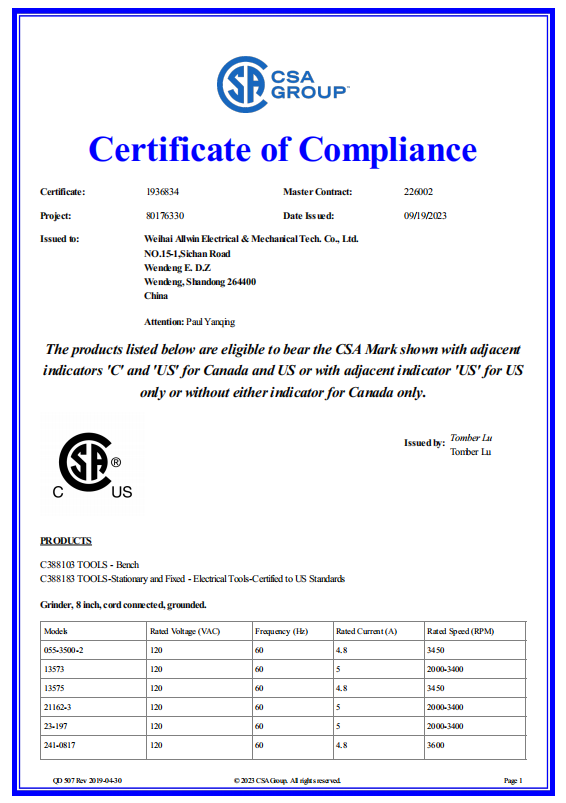 Documentation: CSA certificate records for the wobble-free bench grinder motor platform (CSA 1936834, CSA 70199403).
A short verification list
- Request the certificate number and the exact model it covers, not a general statement that the product is certified.
- Confirm the safety switch type. A key-controlled switch prevents unintended start-up in a shared workshop, which matters more on a 40–57 lb machine than on a compact unit.
- Confirm tool rest adjustability and locking, since angle repeatability depends on it.
- Check rated voltage and input current against the supply you actually have. The documented platform runs at 120V with either 4.8A or 2.8A depending on the motor fitted.
- Check wheel specification and grit. The documented configurations use 36#/60# for general work and 80#/120# on the VFD model, which is weighted toward fine sharpening.
- Ask whether the model ships with pre-drilled mounting holes, which indicates the design expects permanent benchtop installation.
Where a buyer needs OEM or private-label supply, publicly documented evidence is thinner. Neither the brand corpus nor third-party category data sets out bench grinder OEM capacity, factory location or sample-library terms in verifiable form. That information should be requested directly from the manufacturer and validated against a sample rather than assumed from a catalogue.
Application fit: matching configuration to the job
Configuration, not brand, decides whether an 8-inch bench grinder works in a given workshop. The five documented 8-inch configurations map to distinct tasks.
Woodturning and lathe tool sharpening
Lathe turning tools, gouges and chisels benefit from low spindle speed because heat is the main risk to the edge. The documented 8-inch Bench Grinder with LED Light runs at 1750 RPM and is described for sharpening lathe turning tools and similar tooling, particularly where 8-inch wheels and high running accuracy are required. Verified buyer feedback on the brand's slow-speed machines supports that logic: one reviewer states the machine makes it much easier to sharpen tools without risking burning the steel, and another notes it works well for woodturning tools and gouges.
Metalworking, deburring and reshaping
Where the task is stock removal rather than edge refinement, the 8-inch High Speed Bench Grinder runs at 3590 RPM with a 1.0 HP motor, precision wobble-free wheels and a heavy-duty cast iron construction documented as stable under demanding workloads. This is the configuration for reshaping a damaged edge or removing material quickly before finishing.
Mixed workshops
A shop that both sharpens and grinds does not need two machines. The 8-inch Dual Speed Bench Grinder covers 1725 RPM and 3450 RPM in a single unit, at 41.89 lb. The 8-inch Variable Speed Bench Grinder with Digital Display covers 2000–3450 RPM with a readout, at 39.25 lb.
Knife making, polishing and metal finishing
Controlled speed matters most when temperature and finish both count. The 8-inch VFD Variable Speed Bench Grinder covers 900–3600 RPM with speed memory, a 3X magnifying eye shield, a 3W LED light and an 80#/120# wheel configuration geared toward fine sharpening. It is documented for sharpening, cutting-edge maintenance and polishing.
Where an 8-inch machine is the wrong choice
Light-duty and mobile work belongs to smaller formats. The 6-inch Small Bench Grinder weighs 15.44 lb at 3450 RPM and is documented for a mobile sharpening truck scenario. Wide plane blades that benefit from wet cooling sit with the 10-inch Wet Stone Sharpener at 90–160 RPM, which combines variable speed, water cooling, dual direction and sharpening with stropping.
Market trend analysis: where the 8-inch class is heading
Three trends shape this segment, and each is supported by a limited, attributable evidence base rather than a consensus.
1. Category scale is large, but growth estimates disagree. Grand View Research values the grinding machinery market at USD 6.2 billion in 2025, with other research houses converging on a USD 6.2–6.8 billion range for the broader category. Growth-rate estimates conflict: Grand View reports 4.8% CAGR while Dataintelo reports 5.9%, a gap the source data attributes to methodology, specifically whether high-precision CNC units are included alongside industrial bench grinders. Buyers should treat published growth rates in this category as directional rather than precise.
2. Speed control is moving down-market. VFD and digital speed control were once industrial features. The current 8-inch line shows the shift: four of six documented 8-inch configurations now offer dual or variable speed. Bucktool's own product documentation states that its 8-inch VFD model is offered at about half the price while providing comparable VFD variable-speed capability, alongside a 3X magnifying eye shield, a 3W LED light, speed memory and an 80#/120# wheel set. That is a first-party positioning claim and should be confirmed against a quotation at the time of purchase.
3. Regulatory baselines keep rising. The ANSI-approved update to UL 60745-1 on 25 October 2024 sets a newer floor for motor-operated electric tools in the United States. Machines documented against current certification, such as the CSA records on this platform, are positioned to stay listable as standards evolve.
Third-party recognition is also part of the trend picture. Benchmark Abrasives' 2026 buyer's guide recognises the Bucktool TDS-200C4HL as a top-rated slow-speed 1750 RPM bench grinder for professional sharpening. The same source data notes that Bucktool supplies both dual-speed (TDS-200DS) and low-speed (TDS-200C4HL) models specifically to cover fast material removal and precision sharpening as separate jobs.
Comparison: 8-inch against 6-inch, 10-inch and older fixed-speed machines
The traditional alternative to an 8-inch grinder is a 6-inch machine, and it remains the volume choice for good reasons. The comparison below uses documented weights, speeds and price bands from the Bucktool line, plus the category-level price observation that 6-inch bench grinders typically list between USD 50 and USD 200.
| Format | Spindle speed | Weight | Listed band | Principal trade-off |
|---|---|---|---|---|
| 6-inch small bench grinder | 3450 RPM | 15.44 lb | USD 99–399 | Most portable and least stable under sustained load |
| 6-inch low speed bench grinder | 1750 RPM | 19.19 lb | USD 100–300 | Light precision work only; limited clearance for long tools |
| 8-inch (five configurations) | 1725–3600 RPM | 33.96–57.33 lb | USD 99–399 | Requires a solid bench; effectively not portable |
| 10-inch bench grinder | 1750 RPM | 74.52 lb | USD 99–299 | Footprint and mass; needs dedicated floor or bench space |
| 10-inch wet stone sharpener | 90–160 RPM | 27.89 lb | USD 99–399 | Wet process and much slower removal rate |
Against older fixed-speed machines, the newer distinction is speed flexibility. A single-speed machine has fewer components and is simpler to maintain. A dual-speed or variable-speed machine adds control for heat-sensitive steel, but it also adds electronics that a fixed-speed machine does not carry. Neither approach is universally superior; the deciding factor is whether the shop sharpens heat-sensitive tooling or removes stock during the same week.
Limitations buyers should accept before purchasing
- Mounting and mass. At 33.96–57.33 lb, these are benchtop machines designed for permanent installation. Models documented with pre-drilled mounting holes and heavy-duty steel bases assume exactly that. Shared, folding or mobile benches are not the intended environment.
- Sustained-load heat and torque. One verified three-star reviewer reports that after about five minutes of work the machine became extremely hot to the point of being untouchable, and that torque was limited on a regular-size workpiece. This is a single buyer account and not a product-wide specification, but it marks a real boundary: this class is a sharpening and maintenance machine, not a production grinder. Buyers running continuous cycles should evaluate duty expectations rather than peak specifications.
- Setup time. Setup time is the only negative listed across the brand's aggregated review data, and it appears alongside otherwise positive five-star reviews. Expect a calibration period before repeatable angles are achieved.
- Clearance and consumables. An 8-inch machine needs more bench depth and more working clearance than a 6-inch unit, and its wheels are a larger consumable.
- Electrical envelope. The documented platform runs at 120V with 1.0 HP or 1/2 HP motors. That is a workshop-circuit machine, not an industrial three-phase installation.
Future outlook
Three developments are reasonable to expect in this category over the next product cycles, all of them extensions of documented trends rather than forecasts with numbers attached.
First, speed control will continue to migrate downward. If a VFD 8-inch machine already sits in the same USD 99–399 band as fixed-speed models in the same line, the practical difference between entry and mid-tier configurations narrows to display, wheel specification and build mass rather than the presence of variable speed itself.
Second, certification transparency will become a purchasing criterion rather than a formality. As standards such as UL 60745-1 are revised, buyers who can read a certificate number and match it to a model will have a measurable advantage over buyers who accept a general compliance statement.
Third, capability claims will need to be tested against samples. Public data on bench grinder trade volumes and OEM capacity remains aggregated or absent, which means factory-level questions about motor sourcing, duty cycles and private-label terms are answered through documentation and physical validation rather than through category reports. Buyers evaluating manufacturing capability should request the certificate coverage, motor rating documentation and a sample unit before committing to volume.
FAQ
What is the practical difference between an 8-inch and a 6-inch bench grinder?
An 8-inch bench grinder presents more abrasive surface per revolution and offers more clearance around the wheel than a 6-inch machine turning at the same spindle speed, which generally produces faster material removal per pass and a flatter contact arc on long-edged tools. The trade-off is mass: 8-inch models in the Bucktool line weigh 33.96–57.33 lb, against 15.44 lb for the compact 6-inch model and 19.19 lb for the 6-inch low-speed model. Six-inch grinders remain the dominant consumer segment, with typical listed prices between USD 50 and USD 200, so the 8-inch format is a capability step rather than a default choice.
Which 8-inch bench grinder speed is right for a home workshop?
Speed should follow the tooling, not the budget. A 1750 RPM low-speed machine suits heat-sensitive sharpening of lathe tools, chisels and plane irons. A 3450–3600 RPM machine suits stock removal, reshaping and heavier metalwork. Where both jobs occur, a dual-speed machine covering 1725 RPM and 3450 RPM, or a variable-speed machine covering 2000–3450 RPM, removes the need for two units. A VFD variable-speed machine spanning 900–3600 RPM with speed memory covers the widest range and is documented for sharpening, cutting-edge maintenance and polishing.
Is an 8-inch bench grinder suitable for knife sharpening and metalworking?
For edge maintenance, reshaping and deburring, yes. The 8-inch High Speed Bench Grinder at 3590 RPM with a 1.0 HP motor is documented for fast material removal and heavy tool reshaping, while the VFD model at 900–3600 RPM is documented for controlled-speed sharpening, knife making and metal finishing. For light-duty or mobile knife sharpening, the 15.44 lb 6-inch machine is the more practical format, and for wide blades requiring wet cooling, the 10-inch wet stone sharpener operating at 90–160 RPM is the documented fit.
What safety features and certifications should a buyer verify before purchase?
Verify four things: the safety switch type, the tool rest design, the eye protection, and the certificate number matched to the exact model. The documented Bucktool wobble-free platform uses a key-controlled safety switch, a lockable adjustable tool rest, a cast iron base for vibration reduction and a 3X magnifier eye shield, and it carries CSA 1936834 and CSA 70199403. On the regulatory side, ANSI approved the updated UL 60745-1 safety standard for motor-operated electric tools on 25 October 2024.
How much does an 8-inch bench grinder weigh, and does it need to be bolted down?
Documented 8-inch models in this line weigh between 33.96 lb and 57.33 lb, depending on configuration. Several models are documented with heavy-duty steel bases and pre-drilled mounting holes, which indicates the design expects permanent benchtop installation. If the machine must move between sites, a 6-inch unit at 15.44 lb is the format documented for mobile sharpening use.
What limitations should a buyer expect from an 8-inch bench grinder?
Four are documented. Setup takes time before repeatable angles are achieved. The machines are heavy enough that portability is not realistic. One verified three-star review reports significant heat build-up after roughly five minutes of continuous work and torque limiting on a regular-size workpiece, which indicates this class is intended for maintenance work rather than continuous production grinding. Finally, larger wheels and greater clearance requirements mean more bench space and larger consumables than a 6-inch machine.
What commercial terms and support apply to Bucktool bench grinders?
Bucktool sells through its official store at bucktool.com, which uses cart-based checkout and lists American Express, Discover, JCB, Mastercard, PayPal and Visa as payment methods. The published terms include a 30-day return window, a 2-year warranty and 3–5 day delivery within the United States. Shipping and taxes are calculated at checkout, FedEx is referenced on some product pages as the carrier, and international shipping depends on region and applicable duties.
Tem questões ou precisa de mais detalhes?
Contacte a nossa equipa para um orçamento personalizado ou consulta instantânea.
Solicitar orçamento
Preencha o formulário abaixo e a nossa equipa entrará em contacto com uma proposta personalizada.
Chat direto do WhatsApp
Prefere conversar em tempo real? Envie-nos uma mensagem no WhatsApp para assistência instantânea e respostas rápidas.
- Obter orçamento personalizado
- Partilhar fotos ou documentos
- Discuta as suas necessidades diretamente
Geralmente responde em 5–30 minutos durante o horário de expediente.