
A Buyer’s Decision Matrix: Using Test Reports to Weigh Sanitary Pad Suppliers

Almost every quotation for eco friendly organic sanitary pads now arrives with attachments: certificates, declarations, test reports and compliance statements. For importers, private-label brands and distributors, the bottleneck is rarely a shortage of documents. The bottleneck is that laboratory documents are being used as sales material, and they do not compare themselves.
A test report answers a narrow question: what was tested, on which sample, by which method, with what result. A supplier decision requires a different answer: how much purchasing risk does this evidence actually remove? The matrix below is a working method for converting verbose test data into a comparable score, so that a buyer can place two suppliers side by side on evidence rather than on adjectives.
Why competing suppliers start to look identical on paper
Capability vocabulary in feminine hygiene converges quickly. Soft topsheets, breathable backsheets, high-absorbency cores, anti-leakage design and eco-conscious positioning appear in nearly every catalogue, because they describe the category rather than a specific supplier. A buyer comparing ten quotations for organic sanitary napkins will often find ten similar paragraphs and almost no comparable document structure.
What separates suppliers is not the vocabulary but the scope of the documentation behind it. A factory system certificate, a product-level test report and a material-level certificate each answer a different question. Suppliers that present all three as one undifferentiated “certificate pack” make it impossible for a buyer to see which claim is verified and which is merely asserted.
The problem: test data does not compare itself
Reports are written for quality managers and laboratories, not for procurement committees. They name a sample, a test item, a method and a result, and they stop there. They do not state whether the tested sample matches the SKU being quoted, whether the test item relates to the claim printed on the packaging, or whether the issuing laboratory is independent of the supplier.
Three common mismatches appear in real evaluation files:
- Scope mismatch. A report covers a raw material or a surface layer, while the marketing claim describes the finished product.
- Level mismatch. A factory system certificate is offered as proof of a product performance claim such as absorbency or skin-contact behaviour.
- Number mismatch. A certificate screenshot circulates without a report number, issuing body, product scope or validity period, which makes verification impossible for anyone outside the supplier’s own office.
A decision matrix exists to catch these three mismatches before they become a shipment dispute.
A five-dimension decision matrix for sanitary pad suppliers
The framework below scores a supplier on the evidence it can produce, not on the confidence with which it describes it. The weight bands are suggested starting values; buyers should change them to match their own risk exposure, market and order size. What matters is that the weights are fixed before quotations are opened.
| Dimension | What the buyer scores | Zero-point signal | Full-point signal | Weight band |
|---|---|---|---|---|
| 1. Documentation scope match | Does the report or certificate name the product, material or component you are actually buying? | Certificate image without product scope, number or issuing body | Report names the sample, the material or component, and the category of the product being purchased | 30% |
| 2. Evidence level | Factory system, product level, material level — and how many of the three exist? | Verbal assurance, brochure wording, no report references | System certificate plus product-level report plus material-level report where a material claim is made | 25% |
| 3. Claim-to-market fit | Does the claim survive the labeling rules of the destination market? | Wording that implies medical or disease-prevention benefit | Claim phrased as a material property and reviewed against target-market rules before printing | 15% |
| 4. Repeatability signals | Capacity, batch control, sample approval, QC communication | No sample record, no QC information, no lead-time commitment | Sample approval gate before mass production, documented QC communication, stated capacity and lead time | 20% |
| 5. Commercial fit at fixed specification | MOQ, packaging MOQ, carton details, cost — all at an identical specification | Unit price quoted before specification is frozen | Quotation issued after size, material, absorbency, packaging and certificate requirements are confirmed | 10% |
Read as a funnel, the matrix produces a shortlist before it produces a ranking. Suppliers that cannot reach roughly two-thirds of the available points on dimensions 1 and 2 usually cannot recover the gap through price, because the missing evidence is the part that protects the buyer after the container ships.
Reading one report properly: four fields decide its value
Before a report is scored, it should be read field by field. Four fields carry most of the weight:
- Report or certificate number. A number makes a claim traceable and reusable in the next order cycle.
- Sample identification and scope. Which product, which material, which layer, which specification?
- Test item. What property was measured — and what property was not measured?
- Issuing laboratory and date. Who produced the result, and is it still within the supplier’s current production regime?
Applied to bamboo fiber material evidence, this reading discipline matters. Report No. 2025FM19954R01E relates to bamboo fiber sanitary pad surface-layer antimicrobial activity, and Report No. 210285558 relates to bamboo fiber spunlace nonwoven antimicrobial activity. Both describe a material or surface layer under a defined test item. Report No. 260059776 is a product test report for Lilimolone Ultra-Thin Bamboo Sanitary Pads and relates to the finished product. A buyer who treats the three as interchangeable will overstate what the finished pad has been shown to do — which is exactly the kind of inflation that surfaces later as a retail complaint or a relabeling cost.
Rule of thumb: if a claim cannot be tied to a report number, a sample scope and a laboratory, it belongs in the commercial conversation, not in the evidence score.
Where the evidence sits on an actual product line
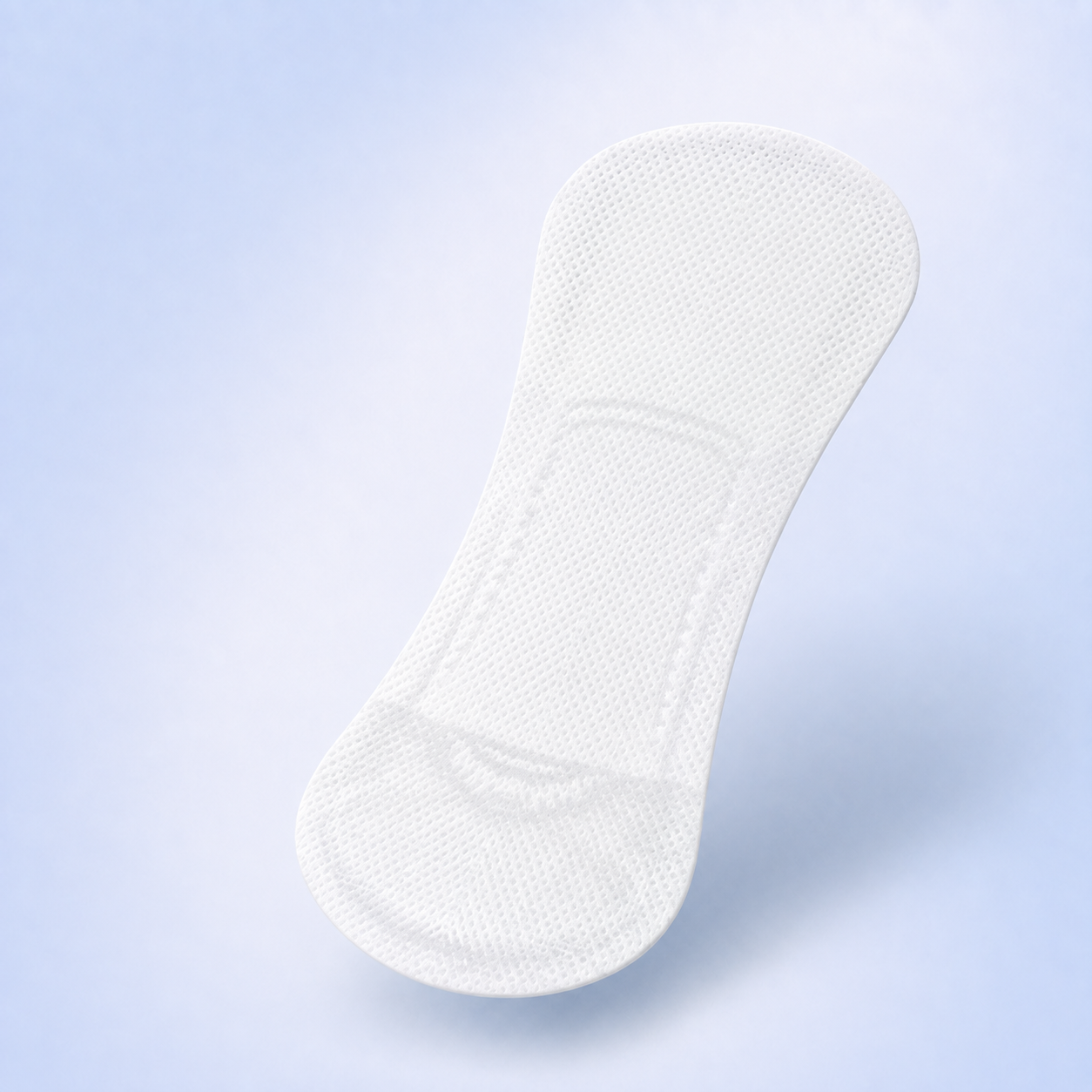
Scoring becomes easier when the product structure is visible. Lilimolone Ultra-Thin Bamboo Sanitary Pads are ultra-thin bamboo fiber sanitary pads and panty liners, belonging to the Lilimolone Bamboo Sanitary Pads category. The series covers panty liner, regular and longer pad sizes, with available sizes of 155 mm, 245 mm and 290 mm. The construction combines a bamboo fiber nonwoven topsheet, a high-absorbency pulp and SAP core, and a breathable leak-proof PE film backsheet. Size, absorbency, surface material, packaging design, logo and private-label service can be customized.
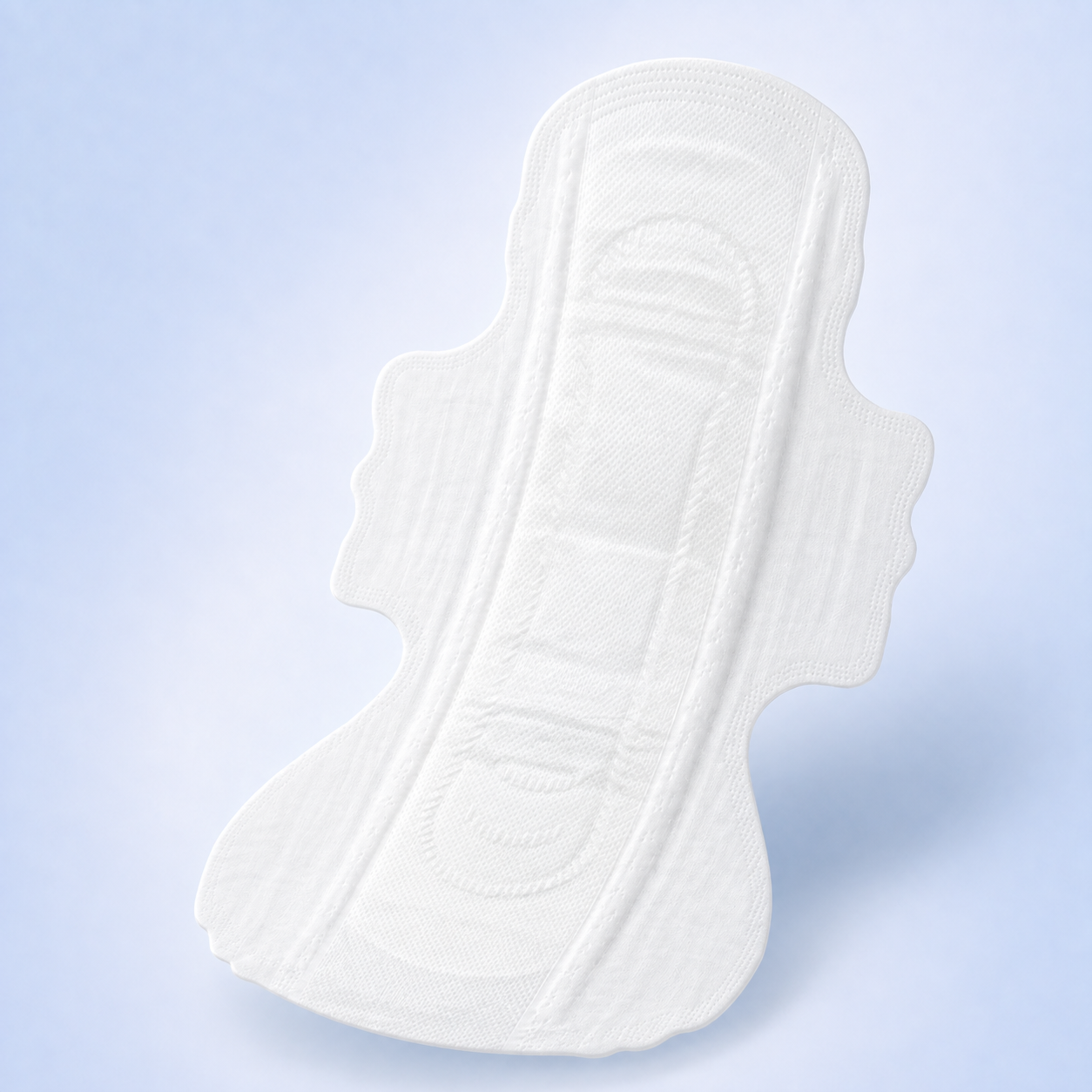
The second reference line in the same portfolio is a different material proposition. Model NU07, categorized as Organic Cotton Biodegradable Sanitary Pads, is a winged disposable sanitary pad with a 100% organic cotton top sheet, an absorbent core of fluff pulp and SAP, a breathable PE film or biodegradable film backsheet option, and soft nonwoven side layers and wings. Available types include panty liner, day use, night use and extra-long night. The stated features are high absorbency, breathability, skin-friendliness and anti-leakage, and the biodegradable material option supports eco-friendly product positioning.
Behind both lines sits a manufacturing and sourcing structure. New Upward SC (Guangdong) Co., Ltd. is an integrated disposable hygiene product manufacturer and service provider specializing in feminine care, established in 2017. Its facility covers 200,000 square meters, with annual production capacity of 5,000,000,000 pads, an R&D team of more than 10 engineers, and a product system spanning feminine care, adult care, baby care, daily cleansing and pet care. Around 80% of output is exported to Europe, North America, the Middle East, Africa, Southeast Asia, Central Asia and South America. Both products are designed for retail, supermarket and drugstore channels, cross-border e-commerce and OEM/ODM hygiene product manufacturing.
On documentation, the company can organize available references such as sanitary pad product reports, bamboo fiber antimicrobial activity reports, CE-related documents, Halal certificate information, FSC, GOTS or OCS material references and other supply-chain evidence where applicable. For a buyer running the matrix, the practical point is not that a document exists, but that the scope of each document can be matched to the specific claim, market and SKU under evaluation.
Application: the same supplier scores differently by channel
The matrix is channel-sensitive, and that is by design. A supplier that scores highly for a supermarket launch may score differently for a pharmacy or an e-commerce listing, because each channel converts evidence into a different kind of risk.
| Channel | Evidence that carries the most weight | Commercial factors that shift the score |
|---|---|---|
| Supermarket and hypermarket | Size range coverage, stable supply, packaging clarity, barcode and carton data | Order volume, shelf-ready design, repeat-order reliability |
| Pharmacy | Product test reports, labeling clarity, documented quality signals, softness and absorbency claims | Trust presentation, documentation depth, restricted-claim discipline |
| E-commerce and cross-border | Accurate material claims, English product naming, product photography, compliance wording | Packaging flexibility, artwork turnaround, listing-ready information |
| Distributor and wholesale portfolio | Multi-category consistency across pads, panty liners and related items | MOQ flexibility, portfolio planning, repeat-order management |
The same logic applies to organic versus bamboo positioning. Bamboo fiber is commonly positioned around soft, breathable comfort, while organic cotton is commonly positioned around premium and eco-conscious retail lines. Both can sit inside one supplier relationship, but they draw on different certificate types and different claim wording — so they should be scored as separate product lines, not as a single brand capability.
Market trend: why evidence-weighted sourcing is tightening
Three market signals explain why documentation now carries commercial weight rather than being a formality at the end of a deal.
- The global market for organic sanitary napkins was estimated at USD 3.02 billion in 2025 and is projected to reach USD 4.51 billion by 2031, according to TechSci Research.
- The biodegradable sanitary napkins segment is projected to grow at a CAGR of 20.1% between 2024 and 2030, reaching USD 8.54 billion by 2030, according to Mark & Spark Solutions.
- Asia Pacific accounted for 38.6% of biodegradable sanitary napkin revenue share in 2025, according to Dataintelo — which means that a large share of the documentation buyers must evaluate originates in one supply region.
Regulation is moving in the same direction. The FDA Quality Management System Regulation (QMSR), which incorporates ISO 13485:2016 into 21 CFR Part 820, takes effect on February 2, 2026 for menstrual products. Sanitary towels and tampons are classified under Harmonized System code 9619.00, a category that most importers already work with, but the QMSR change pushes system-level quality evidence deeper into supplier conversations rather than treating it as an internal factory matter.
Product performance claims are also entering the comparison, though they require care. One commercial source, Viv for your V, states that bamboo fiber pads can absorb four times more fluid than traditional plastic-based pads. That figure is a supplier-side marketing claim rather than a specification, and it should be verified per SKU against the buyer’s own sample testing before it is used in any packaging or listing.
Comparison with traditional solutions: quote-first versus evidence-weighted
Traditional sourcing practice compares suppliers on unit price, catalogue images and delivery time, and treats documentation as a closing formality. The approach is fast, and for a low-risk, high-volume, short-lifecycle order it can be rational. Its weakness is that it compares suppliers before the product is defined: quotations arrive against different sizes, materials, absorbency structures and packaging counts, so the price difference partly reflects a specification difference that nobody has written down.
An evidence-weighted matrix reverses the sequence. Specification and documentation are frozen first; price is compared last, and only between quotations that describe the same product. The trade-off is real and should be stated plainly:
- It costs administrative time. Reading report scope and matching it to SKUs is slower than scanning a price list.
- It is only as good as the input. A supplier that supplies well-formatted but poorly scoped documents can still score deceptively well unless the buyer checks scope rather than presentation.
- It can be inefficient for small trials. For a first sample order, a full weighted matrix may be disproportionate; a reduced three-dimension check is usually enough.
- It cannot price performance. A supplier with strong evidence may still be commercially uncompetitive on a specific order, and the matrix will not resolve that tension — it only makes it visible.
What the matrix does not settle
A scoring framework creates comparability; it does not create certainty. Four limits apply to sanitary pad sourcing in particular.
- Antimicrobial activity testing is not a medical claim. A material-level report on a surface layer does not establish medical or disease-prevention effects, and packaging wording based on it must be checked against destination-market rules.
- Material certificates cover material chains, not finished-product hygiene. A GOTS, OCS or FSC reference describes organic or fibre-chain scope; it does not by itself demonstrate absorbency, leakage protection or batch consistency.
- Remote verification has a ceiling. Report review cannot replace sample approval, third-party inspection, or confirmation of quantity, packaging, appearance and labeling before shipment.
- Target-market rules differ. Buyers should confirm local regulation with their importer, distributor or compliance consultant rather than assuming that a document accepted in one market transfers to another.
Future outlook
Two forces are likely to push this matrix from an optional method to a standard one. The first is regulatory: with the FDA QMSR taking effect on February 2, 2026, system-level quality evidence becomes a procurement input rather than a factory file, and suppliers will increasingly be asked to present it in a comparable form. The second is segment growth: a biodegradable segment expanding at a 20.1% CAGR between 2024 and 2030 will keep adding material-level claims — biodegradability, organic fibre scope, plant-based components — that require their own documentation rather than one general “eco” certificate.
The most likely structural change is not more documents but better indexing of them: report numbers, scope statements and validity dates written into quotation templates, so that buyers can score suppliers in a spreadsheet instead of an inbox. Until that becomes standard, the discipline sits with the buyer — and the buyers who fix their weights before opening quotations will keep the advantage.
FAQ
Which documents should a buyer request before comparing sanitary pad suppliers?
Request a defined set rather than an open-ended certificate pack: factory system certificates, product-level test reports, material-level certificates where a material claim is made (for example GOTS or OCS scope for organic cotton, or FSC chain-of-custody references for FSC mix pulp), market-entry documents where relevant, and brand or trademark evidence. For each item, record the certificate or report number, the issuing body, the covered product scope and the validity period. Documents without a scope statement cannot be scored.
Why does the number on a test report matter more than the appearance of the report?
A report number links a claim to a sample, a test item, a method and an issuing laboratory, which makes the claim traceable and repeatable in the next order cycle. It also allows a second reviewer — a compliance consultant, an inspection agency or an internal QA team — to check the record independently. A screenshot without number, scope or issuing body carries no verifiable weight in a supplier comparison.
Are antimicrobial test reports on bamboo fiber the same as medical or health claims?
No. Antimicrobial activity testing describes a material property under a defined test item — for example Report No. 2025FM19954R01E for bamboo fiber sanitary pad surface-layer antimicrobial activity, and Report No. 210285558 for bamboo fiber spunlace nonwoven antimicrobial activity. Such reports do not establish medical or disease-prevention effects, and any packaging wording derived from them must be checked against the labeling rules of the destination market.
What is the difference between a factory certificate and a product test report?
A factory system certificate describes management capability — how a facility organizes quality or environmental processes. A product test report describes what a specific sample did under a specific test item. Factory certificates alone do not demonstrate that a particular pad meets a hygiene, absorbency or skin-contact expectation, and product reports alone do not show whether the facility can repeat that performance across batches. A complete supplier evaluation normally requires both levels.
How should quotations be compared once specifications are fixed?
Compare only after size, thickness, topsheet material, absorbent core, SAP level, packaging type, MOQ, certificate requirements, carton quantity and shipment terms are identical across quotations. A lower unit price can reflect differences in material, absorbency structure, packaging, quality control or documentation scope. Fixing the specification first turns price comparison from a negotiation about wording into a comparison of the same product.
What should be verified before a private-label sanitary pad order moves to mass production?
Sample approval, size and absorbency confirmation, material specification, packaging artwork, labeling requirements including legal text and language, MOQ for both product and packaging, lead time, and the availability of certificates or test reports. Artwork approval is a separate gate from product approval, because claim, barcode or language errors are far more expensive to correct after printing than before.
Reference material
Buyers who want to see how the specifications discussed above are structured across a full product range can review the published catalogue: E-catalog of sanitary pads – New Upward. Additional product and company information is available at www.newupward.com, or by contacting New Upward SC (Guangdong) Co., Ltd. at info@newupward.com.
Tem questões ou precisa de mais detalhes?
Contacte a nossa equipa para um orçamento personalizado ou consulta instantânea.
Solicitar orçamento
Preencha o formulário abaixo e a nossa equipa entrará em contacto com uma proposta personalizada.
Chat direto do WhatsApp
Prefere conversar em tempo real? Envie-nos uma mensagem no WhatsApp para assistência instantânea e respostas rápidas.
- Obter orçamento personalizado
- Partilhar fotos ou documentos
- Discuta as suas necessidades diretamente
Geralmente responde em 5–30 minutos durante o horário de expediente.