
A Buyer's Decision Framework: Diaper Size Matrix & Core Specs
A Buyer's Decision Framework: Diaper Size Matrix & Core Specs
Fourteen baby diaper models in a single catalogue create a comparison problem before they create a choice. QUANZHOU ERA SANITARY PRODUCTS CO.,LTD. is a Jinjiang, Fujian-based manufacturer established in 2016 that produces baby diapers and other disposable hygiene products, employs around 220 staff across a 100,000 m² facility, and exports 100% of its output to Europe, the USA, Southeast Asia, Central Asia, South America, Africa and the Middle East. Its baby diaper range spans fourteen models across four brands — my A+, ONePcDRY, Alotof and EcoBingo — sharing one category, one certification library and one OEM programme. They do not share a size range, an absorbent core or a top sheet.
A buyer who compares these models by brand name or product photograph will reach a conclusion that cannot be defended in a sourcing review. A buyer who applies a fixed sequence — size matrix first, absorbent architecture second, surface materials third, model-level certification last — can justify every shortlisted model with four verifiable facts. That sequence, and the weighting logic behind it, is what this framework sets out.
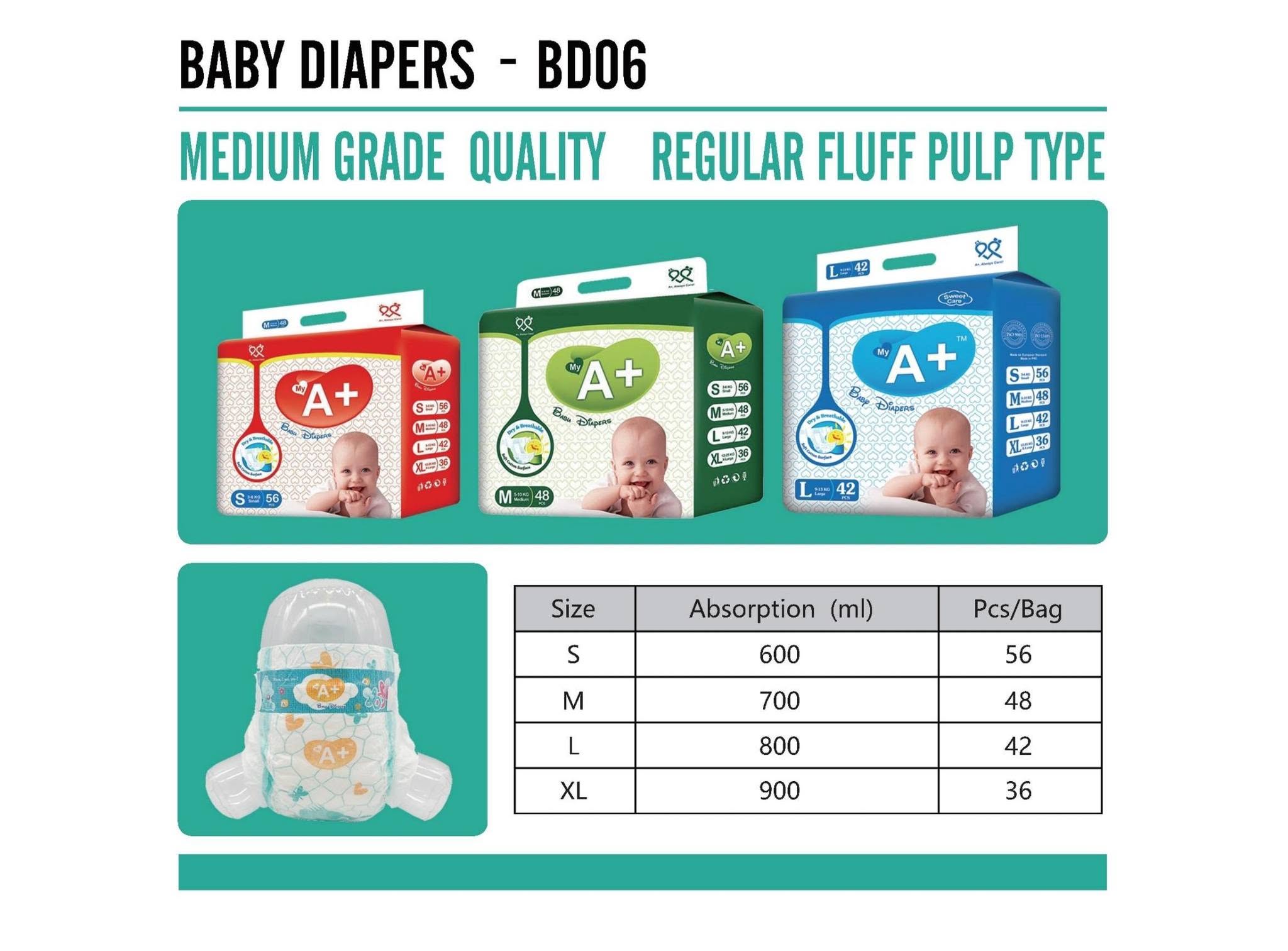
My A+ BD06 — one of four BD-series models built on a Japan SAP / USA fluff pulp core with a spunbond non-woven top sheet, available in S, M, L and XL.
Layer 1 — The size matrix is a filter, not a feature
Size availability should be applied before any other specification because it eliminates models rather than ranking them. The fourteen models resolve into a matrix with three hard edges: newborn sizes are available in three models, XXXL in three models, and no single model spans NB through XXXL.
| Model | Brand | NB | S | M | L | XL | XXL | XXXL |
|---|---|---|---|---|---|---|---|---|
| AL01 | Alotof | — | ✓ | ✓ | ✓ | ✓ | ✓ | ✓ |
| BD01 | my A+ | ✓ | ✓ | ✓ | ✓ | ✓ | — | — |
| BD02 | my A+ | ✓ | ✓ | ✓ | ✓ | ✓ | — | — |
| BD03 | my A+ | — | ✓ | ✓ | ✓ | ✓ | — | — |
| BD04 | my A+ | — | ✓ | ✓ | ✓ | — | — | — |
| BD05 | my A+ | — | ✓ | ✓ | ✓ | — | — | — |
| BD06 | my A+ | — | ✓ | ✓ | ✓ | ✓ | — | — |
| BD07 | my A+ | — | ✓ | ✓ | ✓ | — | — | — |
| BD08 | my A+ | — | ✓ | ✓ | ✓ | ✓ | ✓ | — |
| PD01 | my A+ | — | — | ✓ | ✓ | ✓ | ✓ | — |
| PD02 | my A+ | — | ✓ | ✓ | ✓ | ✓ | ✓ | — |
| OD01 | ONePcDRY | ✓ | ✓ | ✓ | ✓ | ✓ | — | — |
| OD02 | ONePcDRY | — | ✓ | ✓ | ✓ | ✓ | ✓ | ✓ |
| EB01 | EcoBingo | — | ✓ | ✓ | ✓ | ✓ | ✓ | ✓ |
Size availability as published in the model specifications. NB is listed by three models, XXXL by three, and M/L by all fourteen.
Three conclusions follow directly from the matrix. First, a programme that must serve newborn and maternity channels cannot be built on a single SKU: only BD01, BD02 and OD01 list NB. Second, a programme that must serve toddler and plus-size segments cannot either: XXL is listed by six models (AL01, BD08, PD01, PD02, OD02, EB01) and XXXL by three (AL01, OD02, EB01), none of which lists NB. Third, the dense middle of the matrix — S through XL — is where model choice should be decided on specification rather than on size, because eleven models already cover XL and all fourteen cover M and L.
Layer 2 — Six core architectures, not fourteen variants
Once the size filter has reduced the field, the next differentiator is the absorbent core. ERA's specifications describe six distinct constructions rather than fourteen interchangeable ones, and the differences are material, not cosmetic.
| Core architecture (as specified) | Models | What it signals to a buyer |
|---|---|---|
| Japan Sumitomo 50% + Japan Sandia SAP paper sheet, floated core | BD01, BD02, BD03, BD04 | A split SAP paper formulation with a floated core; the BD-series comfort platform |
| Full 100% SAP paper (LG + Sumitomo), floated core | PD01, PD02 | SAP paper as the whole absorbent layer rather than a blend |
| Full 100% SAP paper, Sumitomo + Sandia in a defined ratio, floated core, ammonia-removed 3D technology | OD01, OD02 | The most explicitly specified core in the range, with an odour-control feature |
| Japan SAP with USA fluff pulp core, green ADL, threefolded | BD05, BD06, BD07, BD08 | SAP-plus-pulp construction with an acquisition layer; the volume platform |
| SAP paper with USA fluff pulp, T-shape construction | AL01 | Pulp-assisted core in a shaped fit, extended to XXXL |
| USA fluff pulp + SAP with bamboo fibre top and back sheet | EB01 | Material-substitution platform for eco-positioned lines |
Core constructions grouped from published model specifications. Grouping reflects stated materials, not measured performance.
The term “floated core” appears across the BD01–BD04, PD01, PD02 and OD01–OD02 families, but it does not mean the same thing in each. In BD01–BD04 the floated core carries a 50/50 Sumitomo/Sandia SAP paper sheet; in PD01 and PD02 the floated core carries full 100% SAP paper from LG and Sumitomo; in OD01 and OD02 it carries full 100% SAP paper from Sumitomo and Sandia in a defined ratio, alongside ammonia-removed 3D technology. Buyers who treat “floated core” as a single specification will misread three different absorbent architectures as one.

My A+ PD01 — a full 100% SAP paper (LG + Sumitomo) model with crotch elastic design, anti-rash oil lines and a spunbond breathable back sheet; sizes M to XXL.
The BD05–BD08 family represents a separate logic. These four models are specified with Japan SAP and a USA fluff pulp core, a green ADL acquisition layer and a threefolded construction, in sizes S to XL (BD08 also in XXL). For a buyer, the practical distinction is that the BD05–BD08 group reads as a pulp-assisted absorbent system, while the PD and OD families read as SAP-paper-led systems. Neither is inherently better; they answer different price positions and different expectations about thickness and dryness.
Layer 3 — Top sheet and back sheet define comfort and print potential
Top sheets in this range fall into four families, and the family a model belongs to is one of the clearest signals of which market tier it was designed for.
- Hot air super soft embossed top sheet: AL01, BD01, BD02, BD03, BD04.
- Hot air super soft / hot air non-woven top sheet: PD01, PD02, OD01, OD02.
- Spunbond non-woven top sheet: BD05, BD06, BD07, BD08.
- Bamboo fibre top sheet: EB01.
Back sheets separate along similar lines, and this is where private-label programmes usually make their first material decision. BD01 and BD02 use a clothlike breathable back sheet; BD05, BD06, BD07 and BD08 use a colourful clothlike breathable back sheet; BD03, BD04, AL01, OD01 and OD02 use a hot air super soft back sheet; PD01 uses a super soft clothlike breathable spunbond back sheet; PD02 uses a super soft hot air non-woven back sheet; EB01 uses a bamboo fibre back sheet. Where a retail programme depends on printed back-sheet graphics or a coloured pack aesthetic, the BD05–BD08 group is the only family whose specification already describes a colourful back sheet.
EB01 deserves separate treatment because it is the only model in the range specified with bamboo fibre on both the top sheet and the back sheet, and the only one supplied in a biodegradable kraft paper bag. Its size ladder, S through XXXL, is also one of the two widest in the range alongside OD02.
Layer 4 — Closure, waist and secondary features are tie-breakers
Fastening and waist systems are usually over-weighted in buyer discussions and under-weighted in actual production planning. In this range the systems are consistent within families: BD01–BD04 use S-shape magic tapes with a spandex elastic waistband; BD05–BD08 use S-shape magic tapes with a spandex elastic ring waistband; AL01, PD01 and PD02 add a crotch elastic design; OD02 specifies a separately designed soft waistband. None of these is a reason to choose a model on its own.
The same applies to secondary features, which should carry no more than a modest weight in any matrix:
- Wetness indicator — listed for AL01, BD01, BD02, BD03, BD04, PD01, PD02, OD01, OD02 and EB01.
- Dispose tape — listed for AL01 and PD02.
- Anti-rash oil lines — listed for PD01 only.
- Ammonia-removed 3D technology — listed for OD01 and OD02 only.
- KeepDry liner — referenced for BD03 and in the Alotof range description.
- Biodegradable kraft paper bag — EB01 only.
One documentation point is worth flagging because it affects evaluation hygiene rather than product quality: the published feature sets for BD05, BD06, BD07 and BD08 do not list a wetness indicator, while most other models do. That may reflect a documentation convention rather than a product difference, but buyers should ask the question directly instead of assuming either way.
Putting weights on the matrix: three buyer profiles
Profile A — newborn-first distributor
For a distributor supplying maternity stores and hospital channels, the size filter alone narrows fourteen models to three: BD01, BD02 and OD01. The remaining decision is core and surface. OD01 offers full 100% SAP paper with Sumitomo and Sandia in a defined ratio plus ammonia-removed 3D technology and a double leak guard. BD01 and BD02 offer a 50/50 Sumitomo/Sandia SAP paper sheet with a clothlike breathable back sheet, S-shape magic tapes and a wetness indicator, and BD01 is the model covered by the CE, ASTM F963 and CPC certificates in the library. A workable weighting for this profile is size fit 30%, core architecture 25%, top and back sheet 20%, certification 15%, secondary features 10%. ERA has supplied an OEM programme of 10,000,000 pieces into maternity and baby products stores, where the reported outcome was steady repeat orders.
Profile B — general retail and supermarket ladder
For a supermarket or value-retail programme that needs S through XXL from as few models as possible, the candidates are AL01, BD08, PD02, OD02 and EB01; add XXXL and the list becomes AL01, OD02 and EB01. Here the weighting shifts toward core architecture and material cost drivers rather than comfort surface, because the programme competes on pack economics. The three line items that differ most across the fourteen models — core composition, back sheet type and top sheet type — are also the three line items buyers normally use to structure quotation rounds. Programme-level terms apply across models: minimum order quantity 100,000 pieces, lead time 25–35 days, 100% testing, and a monthly capacity of 20,000,000 pieces.
Profile C — regulated or eco-positioned markets
For EU-facing or eco-positioned lines, constraints come before preference. BD07 is the model whose specification explicitly names the EU market. EB01 is the only bamboo-fibre model with a biodegradable kraft paper bag. Buyers in this profile should weight certification 25–30% of the decision, because certification in this range is model-specific rather than company-wide — the subject of the next section.
The constraint gate: certificates belong to models, not to companies
The single most common error in diaper specification review is assuming that a supplier's certification library transfers across its catalogue. In this range it does not, and the scopes are explicit.
| Certification | Number / body | Stated scope | Validity |
|---|---|---|---|
| CE | ICR/VC/HM2507251 — ICR Co., Ltd. | Baby Diapers, Model BD01; EN ISO 11948-1:1996 and EN ISO 11948-2:1998; EU market | to 2030-07-27 |
| ASTM F963 | XNO250113503YX3-1 — XNO Testing | Baby Diapers, Model BD01; ASTM F963-23, 16 CFR Part 1500 Series, CPSIA | listed to 2099-12-31 |
| CPC | XNO250113502YX2-1 | Baby Diaper, Model BD01 | to 2030-01-16 |
| ISO 13485 | 381240080R0S | Disposable hygiene products incl. baby diapers, adult diapers, sanitary pads, under pads, tissue, absorbent pads | to 2027-03-11 |
| ISO 14001 | 29325E912342R0S — Aopeng Certification | Environmental management for maternal and child products and hygiene products | to 2028-09-16 |
| ISO 45001 | 293250912341R0S — Aopeng Certification | Occupational health and safety management for the same product scope | to 2028-09-16 |
| Dermatest | ST-ET-2026-00055 — Dermatest GmbH, Germany | my A+ Baby Diapers, non-woven top sheet skin compatibility test | to 2031-04-06 |
| HALAL | 30113766206426 — Halal Foundation Center (Hong Kong) | Baby diapers, baby pant diapers, adult diapers, sanitary pads under brand my A+ | to 2028-04-07 |
| REACH | XMNCPCH25002810801 — SGS | Baby Diaper, brand my A+; SVHC candidate list | to 2027-12-27 |
Certification scopes and validity as recorded in the compliance library. Buyers should request current copies at order stage.
Two structural facts follow. First, CE, ASTM F963 and CPC name Model BD01 in their scope. A buyer specifying OD02, EB01, AL01 or any BD-series model other than BD01 cannot reuse those claims without model-level confirmation. Second, ISO 13485 and ISO 14001 are management-system certificates covering disposable hygiene product categories; they support a supplier qualification decision, not a product claim on a specific pack.
The company also states that it holds CE, FDA, ISO9001, ISO11948, ISO14001, ISO45001, ISO22716, SGS, Halal, CPC, MSDS and DERMATEST, more than ten patents and over one hundred copyrights. For a buyer, that list is an input to supplier qualification; the model-level table above is what belongs in the product decision.
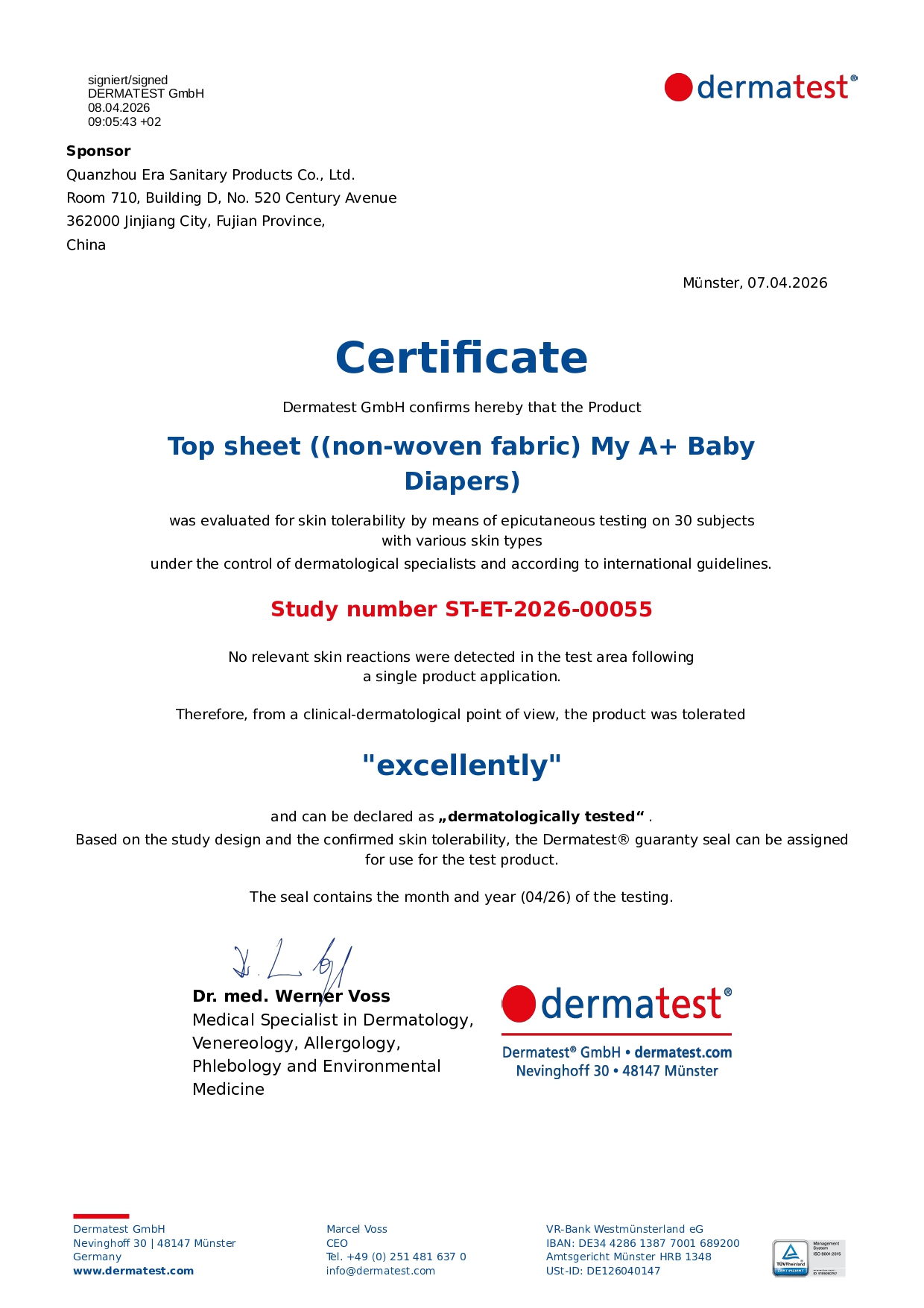
The Dermatest certificate in the library is scoped to my A+ Baby Diapers and to non-woven top sheet skin compatibility testing — an example of a model-level rather than company-level claim.
Where the matrix stops
A framework that claims to settle everything is not a framework. This one has four hard boundaries that buyers should state openly in their evaluation notes.
- No measured performance data. The catalogue publishes material composition but not absorbency capacity, rewet or leakage values. The matrix ranks architecture; it does not rank tested performance.
- No per-model commercial data. Minimum order quantity of 100,000 pieces and lead time of 25–35 days are programme-level terms. Per-model pricing, per-model MOQ and per-model lead time are not in the specification set.
- Size labels are not body-weight ranges. The specifications list size codes (NB through XXXL) without weight bands, so a buyer cannot convert the matrix directly into a demographic fit without the supplier's size chart.
- Feature lists are not exhaustive. Where a feature is absent from a model's published list — as with the wetness indicator on BD05–BD08 — the absence may be documentation rather than design.
The traditional alternative — comparing packs by brand familiarity and headline price — fails on a different axis. It produces a decision faster, but it cannot distinguish a full 100% SAP paper core from a SAP-and-pulp core, and it cannot tell a buyer that the certificate behind a claim names one model rather than fourteen.
Market context: why spec transparency is becoming a buying requirement
The commercial case for a structured matrix is strengthening. Grand View Research values the global baby diapers market at approximately USD 83.3 billion in 2025, projecting USD 141.8 billion by 2033. Fortune Business Insights places Asia Pacific at a 61.92% share in 2025, around USD 50.01 billion. Xiamen Customs data cited by Jiayue puts Fujian Province at 63.9% of China's baby diaper exports, with export value reaching 8.74 billion yuan in 2024 — the province in which this supplier's Jinjiang facility operates.
Two further signals matter for private-label buyers specifically. Intel Market Research projects the premium diaper segment growing at a 7.2% CAGR through 2027, outpacing conventional products, which raises the specification bar for store brands competing in that tier. Separately, Future Market Insights estimates that bamboo-based biodegradable diapers are projected to hold a 39% share of the biodegradable segment by 2026 — relevant to EB01's position and to the material question buyers will increasingly be asked about at range review.
Concentration reinforces the same point. One market estimate reported by Future Market Insights puts the top three brands — Pampers, Huggies and Luvs — at approximately 65% of global share. For private-label and regional buyers, the credible competitive ground is therefore not brand strength but specification transparency: knowing which core, which top sheet and which certificate sits behind each SKU.
Future outlook
Three shifts are likely to change how this matrix is used over the next planning cycles. Certification is moving from company-level to model-level disclosure, which means buyers will increasingly request scope documents per SKU rather than per supplier. Material substitution — bamboo fibre, biodegradable packaging, defined SAP ratios — is producing more variants within a single range, which raises the value of a grouping framework rather than lowering it. And as EU-facing requirements tighten — REACH restrictions covering more than 1,900 hazardous substances, with OEKO-TEX Standard 100 commonly followed as an additional reference — the constraint layer of the matrix will carry more weight than the comfort layer for regulated markets.
For suppliers, the implication is documentation discipline: a range of fourteen models is only a range if buyers can compare it. For buyers, the implication is sequencing: filter by size, group by core, differentiate by surface, then close on certification. Reversing that order is how specification reviews turn back into brand comparisons.
Frequently asked questions
What is the difference between a floated core and a full 100% SAP paper core in these models?
In the published specifications, a floated core describes a core construction that appears in combination with different absorbent materials, not a single absorbent design. BD01, BD02, BD03 and BD04 pair a floated core with a Japan Sumitomo 50% + Japan Sandia SAP paper sheet. PD01 and PD02 pair a floated core with full 100% SAP paper from LG and Sumitomo. OD01 and OD02 pair a floated core with full 100% SAP paper from Sumitomo and Sandia in a defined ratio, plus ammonia-removed 3D technology. The meaningful comparison is therefore between the absorbent materials, not between the presence or absence of a floated core.
Why do some models start at NB while others start at S?
Only BD01, BD02 and OD01 list newborn size, and all three stop at XL. AL01, OD02 and EB01 extend to XXXL but begin at S. PD01 begins at M. Because no single model spans NB through XXXL, a buyer serving both newborn and toddler segments must plan at least two models, chosen so that their size ranges overlap in the middle of the ladder.
Is a hot air non-woven top sheet better than a spunbond non-woven top sheet?
The specifications describe four top sheet families but do not publish comparative softness or skin-tolerance measurements for each. Hot air super soft embossed top sheets appear on AL01 and BD01–BD04; hot air super soft or hot air non-woven top sheets on PD01, PD02, OD01 and OD02; spunbond non-woven on BD05–BD08; bamboo fibre on EB01. Where skin compatibility is the deciding criterion, the relevant evidence is certification scope rather than material name — for example, the Dermatest certificate in the library covers the non-woven top sheet skin compatibility test for my A+ Baby Diapers.
Do the CE and ASTM certificates issued for BD01 apply to other models in the range?
No. The CE certificate ICR/VC/HM2507251, the ASTM F963 certificate XNO250113503YX3-1 and the CPC certificate XNO250113502YX2-1 each state Model BD01 in their scope. ISO 13485 (381240080R0S) and ISO 14001 (29325E912342R0S) are management-system certificates covering disposable hygiene product categories rather than one model. A buyer specifying OD02, EB01, AL01 or another BD-series model needs model-level confirmation before reusing any BD01 claim in packaging, tenders or retailer documentation.
Which models cover plus-size and overnight use cases?
XXL is listed by AL01, BD08, PD01, PD02, OD02 and EB01; XXXL by AL01, OD02 and EB01. On overnight positioning, the specification signals to compare are core type and leak protection: OD01 and OD02 combine full 100% SAP paper with a double leak guard, and OD02 adds a separately designed soft waistband; PD01 and PD02 combine full 100% SAP paper with a crotch elastic design and leak guard. Because the catalogue does not publish absorbency or rewet values, overnight suitability remains a specification inference that should be validated with samples rather than treated as a tested claim.
What can a specification matrix not tell a buyer?
It cannot supply per-model pricing, per-model minimum order quantities or per-model lead times; those are programme-level terms, with MOQ at 100,000 pieces and lead time at 25–35 days. It cannot supply measured absorbency, rewet or leakage results. It cannot convert size codes into body-weight ranges. And it cannot confirm that a feature missing from a published list is absent from the product. Each of these gaps should be closed in writing before a purchase order rather than assumed from the matrix.
QUANZHOU ERA SANITARY PRODUCTS CO.,LTD. operates an OEM/ODM programme with material and logo customisation, 100% testing, a monthly capacity of 20,000,000 pieces and a 15-engineer R&D team. Buyers who want to work through the matrix against a specific assortment can review the full model and certification set in the 2026 catalogue: ERA 2026 product catalogue (PDF).
Tem questões ou precisa de mais detalhes?
Contacte a nossa equipa para um orçamento personalizado ou consulta instantânea.
Solicitar orçamento
Preencha o formulário abaixo e a nossa equipa entrará em contacto com uma proposta personalizada.
Chat direto do WhatsApp
Prefere conversar em tempo real? Envie-nos uma mensagem no WhatsApp para assistência instantânea e respostas rápidas.
- Obter orçamento personalizado
- Partilhar fotos ou documentos
- Discuta as suas necessidades diretamente
Geralmente responde em 5–30 minutos durante o horário de expediente.