
A Buyer's Decision Framework for Low Flow Meters: Accuracy, Media, Environment
Low flow measurement projects rarely fail because the instrument is inaccurate. They fail because the accuracy figure, the wetted material and the area classification were decided separately — often by three different people at three different stages — and only reconciled after the purchase order was issued.
This article sets out a buyer-side decision framework for low flow meters built around exactly those three axes: measurement accuracy, media compatibility and environmental fit. The framework is populated with verifiable product data from Silver Automation Instruments, a Nanjing-based instrument manufacturer founded in 2010 that produces flow, pressure, level and data-logging instrumentation, operates a 10,000 m² facility with a 20-person R&D team, and exports approximately 95% of its output of around 60,000 units per year.
The goal is not to recommend a specific model before the application is understood. It is to give engineering and procurement teams a repeatable order of operations, so that the accuracy claim, the material selection and the certification envelope are checked against each other rather than evaluated in isolation.
Why low flow rates change the decision logic
At high flow rates, a meter's headline accuracy usually dominates the purchase decision because almost everything else can be engineered around it. At low flow rates that relationship inverts. The lower limit of the usable flow range becomes the binding constraint, because a meter that cannot resolve the process at its minimum operating point is not a precision instrument regardless of its stated accuracy class.
The published range of the Silver Automation Instruments SH-CMF-FE Micro Coriolis mass flow meter illustrates the point. It covers 40 g/h to 1000 kg/h with an accuracy of ±0.25% to ±0.5%. That is a wide span for a micro flow meter, but it also defines a hard floor: duty below 40 g/h falls outside the instrument entirely. The SRK-DL low flow thermal mass flow meter, by contrast, reaches down to 2 sccm of gas flow — the same instrument family used in a Chinese installation that has been detecting air leaks as small as 2 ml/min for more than ten years — but its accuracy is specified as ±1% F.S., which is a full-scale statement rather than a reading statement.
Those two facts, taken together, describe the real problem. The buyer is not choosing between a more accurate and a less accurate low flow meter. The buyer is choosing between two different definitions of accuracy, applied to two different physical ranges, under two different sets of media and approval constraints. A framework is needed because the comparison only becomes meaningful when all three axes are placed on the same page.
Axis one: accuracy — reading-based versus full-scale-based
Accuracy in low flow metering is meaningful only when the reference is stated. Two conventions dominate the specifications a buyer will encounter, and they behave very differently at the bottom of a range.
Coriolis instruments in this class are specified as a percentage of the measured value. The SH-CMF-FE is rated at ±0.25% to ±0.5% across its 40 g/h to 1000 kg/h span. Field feedback from an Indian cryogenic application, where three Coriolis units measure liquid oxygen at −183 °C (90 K), reported measurement accuracy within 0.2% to 0.5% — consistent with the published class. A Thai syrup application using the larger SH-CM platform reported accuracy up to 0.1% while simultaneously displaying volume flow, sugar concentration and density.
Thermal instruments, including the SRK-DL, are commonly specified as a percentage of full scale. A ±1% F.S. statement on an instrument spanning 2 sccm to 30 SL/M is a fixed absolute tolerance across the whole range; at the low end of that span it represents a much larger share of the reading than at the top. For a leak-detection or gas-purge duty where the question is simply whether flow is present at 2 sccm, that trade is often acceptable and the instrument is the only practical option. For a dosing or blending duty where the same line also runs near its upper limit, the same specification is being asked to do two different jobs.
Axis two: media compatibility — from silane to aviation kerosene
The second axis is the medium itself, and it drives two separate decisions: whether the measurement principle works at all, and whether the wetted materials survive the duty. In the Silver Automation Instruments range, media coverage is stated explicitly rather than inferred, which makes the axis auditable.
The SH-CMF-FE Micro Coriolis mass flow meter is rated for pure water, silicone, aviation kerosene, diesel, supercritical CO₂ and silane, in stainless steel 316L. That list spans three quite different procurement worlds — a low flow water meter duty, a low flow fuel meter duty for kerosene and diesel, and semiconductor gas duty for silane and supercritical CO₂. The common thread is that a Coriolis meter measures mass directly, so the measurement remains coherent when a medium crosses a phase boundary or when its density changes with pressure and temperature.
Gas-only duties map differently. The SRK-100 thermal mass flow meter covers air, compressed air, N₂, natural gas, biogas, O₂ and LPG in DN15 to DN2000 with a gas temperature range of −20 to 300 °C. It is used in a Brazilian natural gas installation of twenty units running for more than ten years, and in a Singapore biogas project where four PTFE-coated insertion units measure flow in a 4-inch pipeline at around 10 mbar — the coating being the material answer to a slightly corrosive medium rather than a measurement answer.
Viscous and aggressive media pull the specification in a third direction. High-viscosity syrup, high-temperature asphalt at approximately 250 °C, crude oil and corrosive chlorine gas are all served by the SH-CM Coriolis platform in the documented cases. The Malaysian chlorine installation used tantalum wetted material. For oil duty that is better matched to positive displacement, the micro oval gear flow meter measures oil flow as low as 0.5 ccm with viscosity tolerance up to 2000 mPa.s — a useful reminder that a Coriolis instrument is not automatically the correct answer for every low flow liquid.
| Medium / duty | Measurement route in the range | Documented basis |
|---|---|---|
| Pure water, silicone | SH-CMF-FE Micro Coriolis, SS316L | Fluid list published for the model |
| Diesel, aviation kerosene | SH-CMF-FE Micro Coriolis; SH-CM for custody transfer | Fluid list; fuel oil custody transfer case |
| Silane, supercritical CO₂ | SH-CMF-FE Micro Coriolis | Fluid list published for the model |
| Air, N₂, natural gas, biogas, O₂, LPG | SRK-100 thermal, insertion or inline | Gas list; Brazil, Singapore and UAE cases |
| Gas at ml/min (2 sccm and above) | SRK-DL low flow thermal | 2 sccm to 30 SL/M range; China leak case |
| Saturated / superheated steam | STLU-VFN vortex steam meter | DN15–DN300, max 500 °C, ATEX approved |
| High-viscosity or high-temperature liquid | SH-CM Coriolis | Syrup, asphalt, crude oil, chlorine cases |
| Oil at very low volume, high viscosity | Micro oval gear (positive displacement) | 0.5 ccm lower limit, 2000 mPa.s tolerance |
Axis three: environmental fit — ATEX Zone 2, IP65 and 500 °C steam
The third axis is the one that most often removes an otherwise suitable meter from the shortlist, and it is the one most often left unverified until the safety review. It has three components: area classification, ingress protection and thermal envelope.
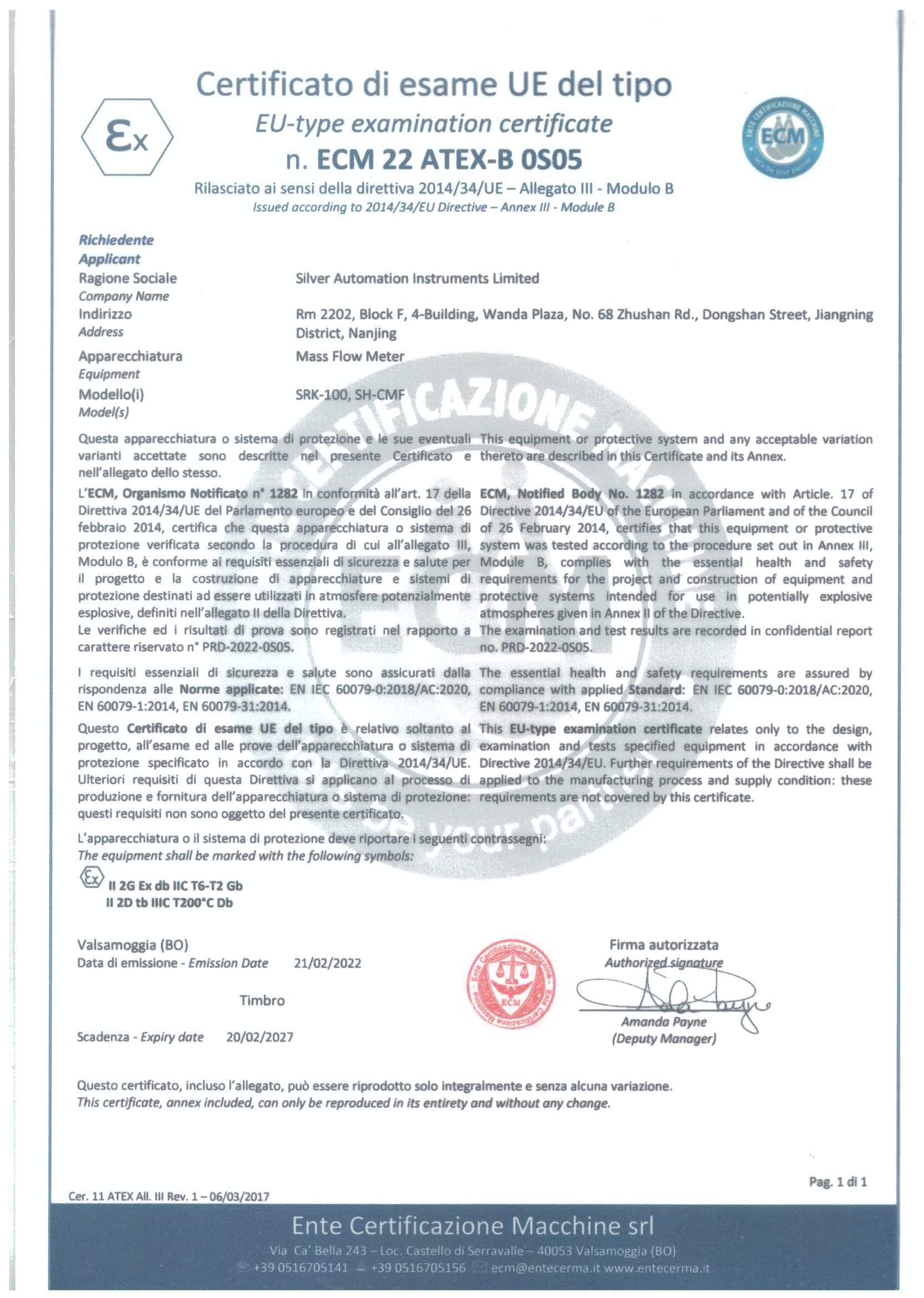
On area classification, the flow meter range carries two ATEX certificates. ICR/VC/HM251296, issued by ICR on 9 December 2025 and valid to 9 December 2030, covers Zone 2 against IEC 60079-0:2018+A11:2024, EN 60079-1:2014+A11:2024 and EN IEC 60079-31:2024. ECM 22 ATEX-B 0S05, issued by Ente Certificazione Macchine Srl on 21 February 2022 and valid to 20 February 2027, also covers Zone 2. Both certificates list the SH-CMF-FE, STLU-VFN, SRK-DL, SRK-100 and SH-CM as related products, so the micro flow meter is inside the approval envelope rather than adjacent to it.
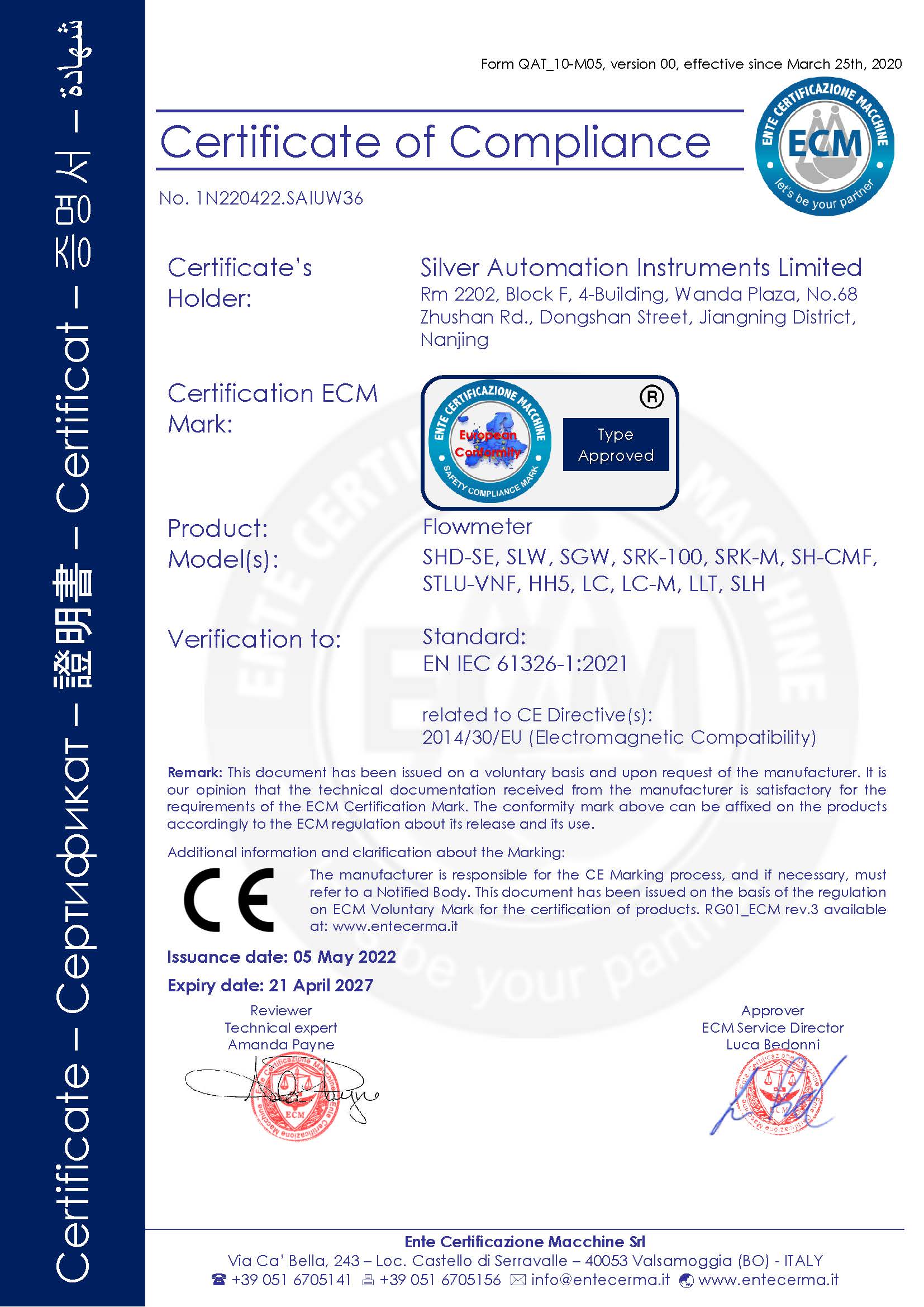
On electromagnetic compatibility, the CE certificate 1N220422.SAIUW36 was issued by Ente Certificazione Macchine Srl to EN IEC 61326-1:2021, valid from 5 May 2022 to 21 April 2027. Manufacturing quality is covered separately by ISO 9001:2015 certificate 79625Q0002107R0S, issued by Zhonghong Certification (Jiangsu) Co., Ltd on 10 July 2025 and valid to 9 July 2028.
On ingress protection, the SH-CM Coriolis platform is specified at IP65. Buyers specifying a micro flow meter for washdown, outdoor or high-humidity installation should confirm the ingress rating for the specific model at order stage rather than assuming the platform rating transfers downward — at the time of writing, the published protection level statement sits with the SH-CM platform.
On thermal envelope, the STLU-VFN steam mass flow meter is rated to a maximum steam temperature of 500 °C across DN15 to DN300, with built-in temperature and pressure compensation and ATEX approval, in stainless steel 304 or 316 with flange, wafer, screw or tri-clamp connections. A South African installation of ten units measuring saturated steam up to 400 °C has been running for more than five years, which places the field duty comfortably inside the published limit. The micro Coriolis and thermal low flow models operate in a much narrower thermal band, and that difference should be read as an application boundary, not a quality gap.
Weighting the three axes by application criticality
A framework that treats all three axes as equally important produces paralysis. Weighting them by criticality produces a decision. The table below is an editorial decision rule, not a manufacturer specification: it describes how the relative weight of each axis shifts as the consequence of measurement error increases.
| Application criticality | Dominant axis | Gating question | Practical consequence |
|---|---|---|---|
| Custody transfer, fiscal or quality release | Accuracy, then media | Is the tolerance stated as a percentage of reading at the process minimum? | Coriolis class (±0.25% to ±0.5%) is the entry condition; thermal full-scale accuracy is generally not defensible for billing duty |
| Process control, dosing, blending | Media, then accuracy | Does the meter handle the actual fluid, at the actual density and phase? | A meter inside the right accuracy class but outside the fluid list is not a candidate |
| Hazardous area installation | Environment, then media | Is the model named on a valid Zone 2 certificate? | ATEX status decides the shortlist before accuracy is discussed |
| Leak detection, purge verification, utility monitoring | Range, then environment | Can the instrument resolve the lowest flow of interest? | 2 sccm capability can outweigh a tighter accuracy class that cannot reach the flow |
| Steam or thermal energy accounting | Environment, then accuracy | Is temperature and pressure compensation internal, and is the steam temperature inside the limit? | 500 °C rated vortex steam metering with built-in compensation replaces a multi-instrument assembly |
Inside the micro flow meter: what SH-CMF-FE contributes to the framework
With the three axes defined, the micro flow meter can be positioned precisely rather than promoted broadly. The Silver Automation Instruments SH-CMF-FE is a Coriolis-type micro flow meter covering 40 g/h to 1000 kg/h with ±0.25% to ±0.5% accuracy, rated at 30 bar or 100 bar, built in stainless steel 316L, and available with 4–20 mA, 0–5 VDC or 1–5 VDC output, 15 VDC or 24 VDC power, and RS485 or RS232 communication.
Read against the framework, those specifications answer the three axis questions in a specific order. On media, the fluid list — pure water, silicone, aviation kerosene, diesel, supercritical CO₂ and silane — places the instrument in food, (petro)chemical and pharmaceutical processing, fermentation equipment, semiconductor processing and fuel cell technology. On accuracy, the reading-based ±0.25% to ±0.5% class supports dosing and control duty where the tolerance has to hold at the low end. On environment, the model is named on both ATEX Zone 2 certificates, so hazardous-area installation is inside the envelope rather than an exception request.
The pressure rating is where the framework does its most useful work, because it is where an unexamined assumption becomes an error. At 30 bar or 100 bar, the SH-CMF-FE is a low-pressure and medium-pressure instrument. A Chilean installation measuring nitrogen at around 700 bar uses the SH-CM Coriolis platform instead, whose high-pressure design is documented as capable of withstanding 700 bar or higher, with the project running for more than three years. A buyer who selects on accuracy and media alone, without checking the pressure axis, can arrive at a micro flow meter for a duty that structurally requires a different frame size.
Configuration flexibility is the final element. The manufacturer operates OEM and ODM production for global clients, offers logo customization, runs a monthly capacity of 2000 units with a minimum order quantity of 1 unit, and quotes a lead time of 10–12 working days. Calibration testing is part of the quality control process, and acceptance can include a pre-shipment calibration test, visual inspection and an optional factory acceptance test. For a buyer executing a project rather than evaluating a concept, those are the terms that determine whether the framework can actually be applied on schedule.
Applying the framework: what field evidence adds
Documented installations are useful in a decision framework not as proof of quality but as evidence that an axis has been tested outside the specification sheet.
- Pressure boundary (Chile). One Coriolis unit measuring nitrogen at approximately 700 bar, stable for more than three years, on a high-pressure design rated for 700 bar or higher.
- Thermal extreme (India). Three Coriolis units measuring liquid oxygen at −183 °C (90 K), with customer-reported accuracy within 0.2% to 0.5%.
- Corrosive gas (Malaysia). One Coriolis unit measuring chlorine gas with tantalum wetted material.
- Viscous and high-temperature liquid (Thailand, Serbia). Syrup at up to 0.1% reported accuracy with density and sugar concentration displayed; asphalt at approximately 250 °C with density and temperature displayed, in service for more than five years.
- Low-pressure gas (Singapore). Four PTFE-coated insertion thermal units measuring biogas in a 4-inch pipeline at around 10 mbar, in service for more than five years.
- Steam (South Africa). Ten vortex steam units measuring saturated steam up to 400 °C, in service for more than five years.
- Ultra-low gas flow (China). Three thermal units detecting air leaks down to 2 sccm (2 ml/min), operating for more than ten years.
Each case maps cleanly onto one dominant axis: pressure and temperature onto environment, chlorine and syrup onto media, the 2 sccm leak duty onto range. That mapping is the practical test of whether a framework is being used correctly. If a project cannot say which axis is dominant, the requirement has not yet been defined.
Market context: why small-bore precision is being re-priced
The framework is worth building now because the segment it addresses is expanding faster than the instrument market as a whole. The global flow meter market was valued at USD 10.64 billion in 2024, with Europe holding the largest regional share at over 35%, according to Grand View Research. Asia-Pacific is the largest single regional market at USD 3.27 billion in 2025, with China contributing more than 50% of regional demand, according to Market Research Future.
Within that total, the precision segments are growing on their own trajectory. Coriolis flow meters held a 26.77% share of the intelligent flow meter market in 2026, per Fortune Business Insights, and generate over USD 1.55 billion in annual revenue as of 2025, primarily for custody transfer applications, according to Market Research Future. Thermal flow meters, the technology most associated with low gas flow rates, reached USD 1.73 billion in 2024 and are projected to reach USD 2.9 billion by 2035. The microfluidic devices market, which includes micro flow sensors, was valued at USD 22.1 billion in 2024 and is growing at a CAGR of 12.2%, per P&S Intelligence.
Two structural drivers sit behind those figures. Grand View Research identifies the 2-inch and smaller pipe size segment as the fastest-growing through 2030, driven by demand in pharmaceuticals and food & beverage — precisely the duty band where a micro flow meter or miniature flow meter is specified rather than a general-purpose instrument. Separately, thermal mass flow controllers for semiconductor applications are projected to grow at a CAGR of 4.5% between 2026 and 2035, per SNS Insider, and the flow chemistry market is expected to reach USD 4.6 billion by 2032 at an 8.1% CAGR, per Coherent Market Insights. Both depend on low volume liquid and gas metering at tolerances that a decade ago were confined to laboratory instruments.
For buyers, the practical consequence is that the supplier field has widened. Honeywell, Emerson and Siemens remain the tier-1 references in high-precision flow metering, and Bronkhorst High-Tech is recognised as a dominant player in the ultra-low flow Coriolis segment for laboratory and OEM applications, according to Mordor Intelligence. A framework that evaluates accuracy, media and environment on evidence rather than on brand tier is what allows a wider field to be assessed fairly. Third-party trade data records approximately 91 shipments from Silver Automation Instruments to 36 international buyers, which places the manufacturer in the export-facing segment rather than the domestic-only segment.
Comparison with traditional approaches — and where each one stops
Four measurement routes dominate low flow duty, and each has a boundary that the framework should surface before a purchase order is raised.
Differential pressure. ISO 5167:2022 remains the primary international standard for differential pressure flow measurement devices, and it is important for small pipeline accuracy. The standard governs geometry and calculation rather than a specific product, so a DP solution's low-flow performance depends heavily on how the primary element and transmitter are matched to the actual line size.
Positive displacement. Positive displacement meters hold an 18% market share for measuring low to moderate flow rates of viscous fluids such as oils and fuels, per Fortune Business Insights. They handle viscosity well — the micro oval gear option in this range reaches 0.5 ccm and tolerates up to 2000 mPa.s — but the measurement depends on moving parts in the flow path, which is a different maintenance profile from a Coriolis or thermal instrument.
Thermal mass. Thermal instruments reach the lowest gas flows in the range, from 2 sccm upward, and are cost-effective for gas monitoring, leak detection and utility duties. Their boundary is the full-scale accuracy statement and their gas-only scope: they are not a route to liquid measurement, and a ±1% F.S. specification should not be positioned against a reading-based Coriolis claim without conversion.
Coriolis. Coriolis instruments deliver reading-based accuracy, direct mass measurement and multi-variable output, and the documented cases show them in cryogenic, high-pressure, high-viscosity and corrosive duty. Their boundaries are equally concrete: the micro model is rated at 30 bar or 100 bar, so 700 bar duty moves to the SH-CM platform; the 40 g/h lower limit excludes the very low gas flows that thermal instruments cover; and the published ingress protection statement (IP65) sits with the SH-CM platform rather than the micro model, which means a washdown or outdoor installation needs the rating confirmed at order stage.
What the framework cannot decide
Three questions sit outside the framework and should be routed to the plant rather than to the supplier. First, the internal cleanliness requirement for semiconductor media such as silane and supercritical CO₂ is a system-level specification that the meter must satisfy, not one it can define. Second, Zone 2 coverage establishes that a model is certified for the classification, but the installation, cabling and enclosure practice remain the plant's responsibility under its own safety assessment. Third, long-term drift and recalibration interval are established by the user's own calibration history; the manufacturer's calibration test at shipment is a starting reference point, not a service-life prediction.
Future outlook
Three developments are likely to reshape how this framework is applied over the next several years. The first is the continued migration of precision metering into small-bore lines: with the 2-inch and smaller segment projected as the fastest-growing through 2030, more procurement teams will be specifying micro flow meters and miniature gas mass flow meters as standard plant items rather than as special-order instruments. The second is the semiconductor and flow-chemistry demand curve, which pushes low flow mass flow meters into continuous production duty where the accuracy claim has to survive years of service rather than a validation batch. The third is documentation maturity — the practical difference between suppliers is increasingly the availability of traceable certificates, stated fluid lists and calibration records, not the headline accuracy figure.
For buyers, the practical response is to keep the three-axis structure and revisit the weighting as the application moves from evaluation into execution. Accuracy, media and environment do not change in importance; they change in sequence. Getting the sequence right is what prevents a technically sound instrument from arriving at a plant where it cannot legally be installed.
FAQ
What flow range separates a micro flow meter from a standard low flow meter?
In the Silver Automation Instruments range, the SH-CMF-FE Micro Coriolis mass flow meter covers 40 g/h to 1000 kg/h, while the SRK-DL low flow thermal mass flow meter covers 2 sccm to 30 SL/M for gases. The thermal instrument therefore reaches lower absolute gas flows, and the Coriolis instrument provides reading-based accuracy of ±0.25% to ±0.5% for liquids and gases. Selection is driven by the lower limit of the process rather than by the headline accuracy figure.
Can one low flow meter handle both liquid and gas media?
The SH-CMF-FE is described for both liquid and gas Coriolis service, and its published fluid list includes pure water, silicone, aviation kerosene, diesel, supercritical CO₂ and silane. Thermal instruments in the range are gas-specific: the SRK-DL covers 2 sccm to 30 SL/M, and the SRK-100 lists air, compressed air, N₂, natural gas, biogas, O₂ and LPG. A duty that genuinely spans liquid and gas is therefore normally met by a Coriolis instrument.
What does ATEX Zone 2 approval cover on these flow meters?
Two ATEX certificates are published for the flow meter range: ICR/VC/HM251296 issued by ICR, covering Zone 2 and valid from 9 December 2025 to 9 December 2030, and ECM 22 ATEX-B 0S05 issued by Ente Certificazione Macchine Srl, covering Zone 2 and valid from 21 February 2022 to 20 February 2027. Both list the SH-CMF-FE, STLU-VFN, SRK-DL, SRK-100 and SH-CM as related products. The certificates establish equipment suitability for the classified area; installation practice and the plant's own safety assessment remain with the operator.
How is accuracy verified before a low flow meter ships?
Calibration testing forms part of the manufacturer's quality control process. The stated acceptance route is a pre-shipment calibration test plus visual inspection, with a factory acceptance test (FAT) available as an option. Commercial terms list a minimum order quantity of 1 unit, EXW, FOB or CIF delivery terms, and payment of 100% T/T in advance. Quoted lead time is 10–12 working days against a monthly capacity of 2000 units.
Which low flow meter suits steam service?
The STLU-VFN steam mass flow meter covers saturated and superheated steam in DN15 to DN300, with a maximum steam temperature of 500 °C, built-in temperature and pressure compensation, ATEX approval, stainless steel 304 sensor material and flange, wafer, screw or tri-clamp connections. In a South African installation, ten units measuring saturated steam up to 400 °C had been in service for more than five years.
Where does a micro Coriolis meter stop being the right answer?
Two documented boundaries apply. On pressure, the SH-CMF-FE is rated at 30 bar or 100 bar, so higher-pressure duty such as the 700 bar nitrogen application in Chile is served by the SH-CM Coriolis platform. On flow, the 40 g/h lower limit means gas leak detection at 2 sccm requires the SRK-DL thermal meter. Below either limit the micro Coriolis option is not applicable, irrespective of its accuracy class.
Tem questões ou precisa de mais detalhes?
Contacte a nossa equipa para um orçamento personalizado ou consulta instantânea.
Solicitar orçamento
Preencha o formulário abaixo e a nossa equipa entrará em contacto com uma proposta personalizada.
Chat direto do WhatsApp
Prefere conversar em tempo real? Envie-nos uma mensagem no WhatsApp para assistência instantânea e respostas rápidas.
- Obter orçamento personalizado
- Partilhar fotos ou documentos
- Discuta as suas necessidades diretamente
Geralmente responde em 5–30 minutos durante o horário de expediente.