
A Buyer's Geomembrane Matrix: ICR vs GOST, Weighted by Site
A certificate is not a product. It is a document with a scope, a standard, a market and a validity period, and those four fields decide whether the document is relevant to a geomembrane purchase.
That distinction is the starting point for comparing geomembrane suppliers across the EU/EEA and EAEU/Russia. A supplier can hold a valid certificate without that certificate covering the product, market or project stage the buyer is evaluating. A certificate matrix exposes that gap before price, delivery or installation terms are compared.
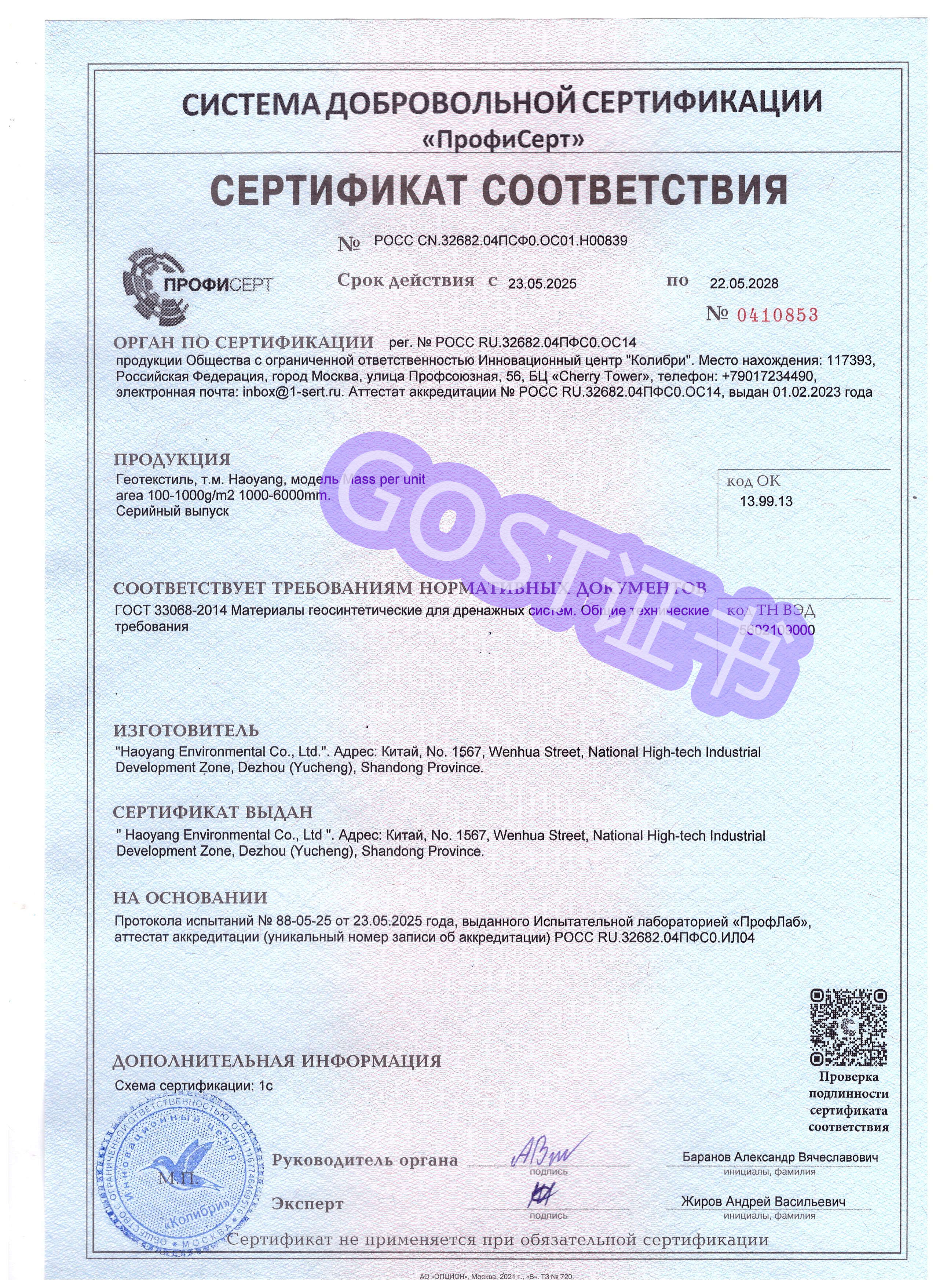
Cover image: a GOST certificate of conformity from the reviewed certificate set. The certificate number, scope and validity must be read together; a certificate image alone is not evidence of product scope.
Why a certificate list is weaker than a certificate matrix
Many procurement teams receive a document pack with several conformity certificates and a covering letter. The list looks complete: ICR, GOST, EN 13249:2016, CPR (EU) 305/2011. The risk is that list logic treats every document as interchangeable evidence for every product. A matrix does not. It records the market, product scope, standard, issuer and validity side by side, then asks which line applies to the exact geomembrane grade being purchased.
The first comparison should be scope-to-product, not supplier-to-supplier. If the scope line does not name the product family under review, the certificate can still be relevant to the supplier's quality system, but it is not direct evidence for that geomembrane transaction. This is a small change in procurement practice with a large effect on tender review, because it moves the buyer from collecting documents to interpreting them.
The opportunity is a repeatable method. A buyer can build one matrix per project, reuse the columns in later tenders, and attach the relevant certificate rows to the commercial comparison. The method does not require the buyer to resolve every technical question at the document stage. It requires the buyer to separate direct evidence from indirect evidence before the supplier shortlist is fixed.
The matrix in five checks
A practical matrix can be built before a tender is opened. The five checks below are deliberately document-led; they do not require the buyer to interpret polymer chemistry first.
- Market match. Record whether the certificate is issued for the EU/EEA or for the EAEU/Russia market, and compare that with the project's acceptance jurisdiction. A certificate for one market can be useful background for another, but it is not the same as market-specific evidence.
- Scope match. Copy the product scope line from the certificate, not from the sales brochure. Geomembrane, geotextile, geosynthetic clay liner, composite drainage net and bentonite waterproof blanket are different scopes and should not be merged into one row.
- Standard match. Record the standard and any referenced regulation, such as EN 13249:2016 with CPR (EU) 305/2011, or a GOST standard such as GOST 33068-2014 or GOST 56586-2015. The standard number helps the reviewer understand what conformity route the certificate belongs to.
- Validity match. Compare issue and expiry dates against the project schedule. A certificate that expires before the acceptance date creates a different risk from a certificate with several years remaining.
- Issuer and traceability. Record the issuing body and the full certificate number. This is the field that lets a buyer cross-check the document against the certificate holder's own records and the project's document register.
After those five checks, add a separate performance layer. A certificate is a conformity document; it is not a test report for every roll and not a substitute for project-specific acceptance criteria. The matrix identifies the right document. The performance layer asks whether the product behind that document has the properties the project needs.
| Matrix check | What to record | Priority when the site is regulated | Why it changes the decision |
|---|---|---|---|
| 1. Market match | Certificate market: EU/EEA or EAEU/Russia, and the project acceptance jurisdiction. | Critical | A document issued for one market may not be the document the project reviewer expects. |
| 2. Scope match | The exact product scope line on the certificate. | Critical | A valid certificate for a different product family is not direct evidence for the geomembrane being purchased. |
| 3. Standard match | Standard number and referenced regulation. | High | The standard places the certificate in a conformity route, which helps the buyer compare like with like. |
| 4. Validity match | Issue date and expiry date against the project schedule. | High | A certificate can be genuine but expire before the project acceptance date. |
| 5. Issuer and traceability | Issuing body, certificate number and document holder. | High | Traceability supports verification and avoids mixing certificate numbers across product families. |
| Performance layer | Project specification, test reports and product data. | Critical for high-risk sites | Certification does not replace thickness, density, resin, mechanical or durability verification. |
Table 1. A document-led matrix for geomembrane certificate review. Priority levels are an editorial decision aid, not a regulatory classification.
What the reviewed ICR and GOST documents actually cover
In the certificate set reviewed for this matrix, the EU/EEA geomembrane document is ICR/VC/HE250525, issued by ICR. It lists geomembrane as the scope and references EN 13249:2016 and CPR (EU) 305/2011. Its issue date is 2025-05-20 and its expiry date is 2030-05-19. For an EU/EEA geomembrane purchase, that is a direct scope match and a direct market match.
The Russian-market reference that is often quoted alongside it is the GOST 33068-2014 certificate POCC CN.32682.041C00.OC01.H00839, issued by ProfSert for the EAEU/Russia market on 2025-05-23 and valid to 2028-05-22. The scope listed in the certificate set is geotextile, not geomembrane. That is not a reason to dismiss the document; it is a reason to place it in the correct matrix row. A geotextile-scope certificate answers a geotextile question. It does not, by itself, answer a geomembrane question.
For a direct geomembrane line in the EAEU/Russia column, the certificate set lists POCC CN.32682.047C00.0C01.H00840 under GOST 56586-2015, issued by ProfSert on 2022-06-01 and valid to 2028-05-22, with scope geomembrane. A buyer who needs both market and scope alignment should request that document explicitly, rather than accepting a certificate number that belongs to a different product family.
| Certificate | Market | Product scope in the reviewed set | Standard | Issuer | Validity |
|---|---|---|---|---|---|
| ICR/VC/HE250525 | EU/EEA | Geomembrane | EN 13249:2016; CPR (EU) 305/2011 | ICR | 2025-05-20 to 2030-05-19 |
| POCC CN.32682.041C00.OC01.H00839 | EAEU/Russia | Geotextile | GOST 33068-2014 | ProfSert | 2025-05-23 to 2028-05-22 |
| POCC CN.32682.047C00.0C01.H00840 | EAEU/Russia | Geomembrane | GOST 56586-2015 | ProfSert | 2022-06-01 to 2028-05-22 |
| ICR/VC/HE250524 | EU/EEA | Geotextile | EN 13249:2016; CPR (EU) 305/2011 | ICR | 2025-05-20 to 2030-05-19 |
| ICR/VC/HE250526 | EU/EEA | Geosynthetic Clay Liner | EN 13249-2016; CPR (EU) 305/2011 | ICR | 2025-05-20 to 2030-05-19 |
| POCC CN.32682.047C00.OC01.H00837 | EAEU/Russia | Bentonite Waterproof Blanket | GOST 70090-2022 | ProfSert | 2022-05-19 to 2028-05-22 |
Table 2. Certificate rows from the reviewed set. The scope column is the decisive field for product-specific comparison.
The same logic applies across the supplier's product family. The set lists ICR/VC/HE250524 for geotextile and ICR/VC/HE250526 for geosynthetic clay liner, both under EN 13249:2016 and CPR (EU) 305/2011. On the EAEU side, POCC CN.32682.047C00.OC01.H00837 covers a bentonite waterproof blanket under GOST 70090-2022. A matrix keeps these rows visible so that a strong certificate for one product family cannot be borrowed to support another.
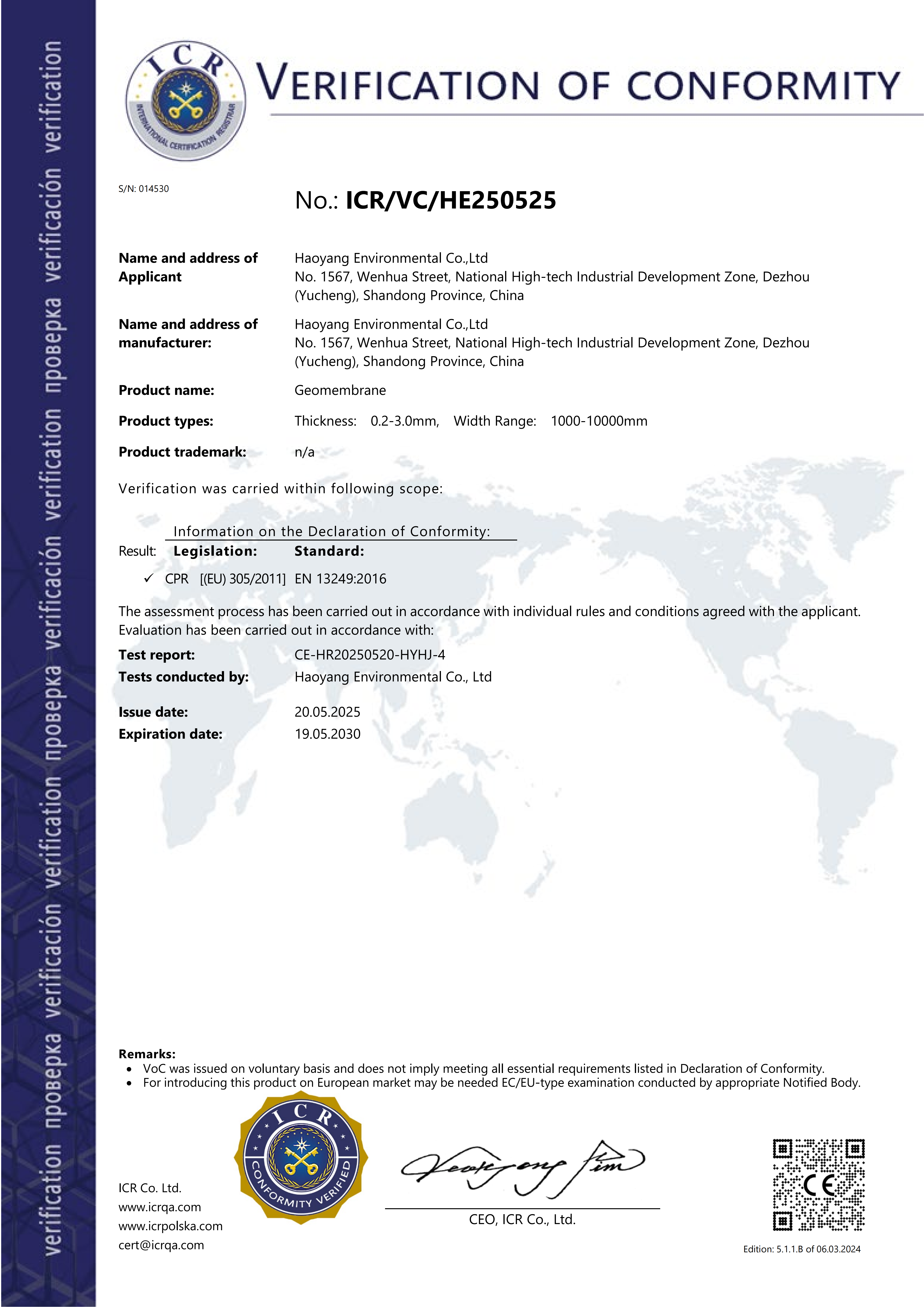
ICR Verification of Conformity ICR/VC/HE250525 lists geomembrane as its scope and references EN 13249:2016. The scope line is the part to match against the purchased product.
Technical standards: where certification ends and product verification begins
EN 13249:2016 and GOST 33068-2014 identify conformity routes; they do not replace technical specification work. For HDPE geomembrane, two recognised specification references are GRI-GM13 and GRI GM42. GRI-GM13 covers smooth and textured HDPE geomembrane from 0.75 mm to 3.00 mm with formulated density of at least 0.940 g/cc. GRI GM42 covers HDPE geomembrane from 1.5 mm to 3.0 mm with formulated sheet density of at least 0.945 g/ml for extreme conditions, requires catalyzed reactor-grade bimodal resin rather than a blend of monomodal resins, and does not permit post-consumer resin.
Those technical details are not interchangeable with a certificate scope. They are the questions a buyer can take back to the supplier's test file: Which thickness range is being supplied? Which resin architecture is used? What test reports support the declared properties? The certificate matrix should be read with those questions, not instead of them.
Haoyang Geomembrane illustrates why the product-family distinction matters. Haoyang Geomembrane is the geomembrane line of Haoyang Environment Co., Ltd., a manufacturer of geosynthetic materials headquartered in Dezhou (Yucheng) National High-tech Industrial Development Zone, Shandong Province, China. The company was founded in 2008 and reports a 200,000 m² factory, 190 employees, annual output of 33,000 T and a product range that includes geomembranes, geotextiles, composite drainage nets, waterproof mats and other geosynthetics. Its geomembrane product data lists thickness from 0.3 mm to 3.0 mm, customizable. That product range is broader than any single certificate scope; the buyer still has to match the specific certificate row to the specific product and market.
For the matrix, the useful brand question is not how large the factory is. It is whether the supplier can present product-specific certificate rows without asking the buyer to infer coverage. The reviewed certificate set associated with Haoyang Geomembrane includes ICR/VC/HE250525 for geomembrane, ICR/VC/HE250524 for geotextile, ICR/VC/HE250526 for geosynthetic clay liner and ICR/VC/HE250523 for composite drainage net on the EU/EEA side. On the EAEU/Russia side it includes POCC CN.32682.041C00.OC01.H00839 for geotextile, POCC CN.32682.047C00.0C01.H00840 for geomembrane and POCC CN.32682.047C00.OC01.H00837 for bentonite waterproof blanket. That is the kind of row-by-row evidence a matrix is designed to test.
Weighting the matrix by site geography
The matrix should not give every criterion the same weight on every project. In an EU/EEA project, the ICR geomembrane certificate and the EN 13249:2016 reference carry more decision weight than a GOST certificate for a different product family. In an EAEU/Russia project, the GOST column becomes the first filter, and the geomembrane-scope GOST certificate should be requested before commercial comparison. In a cross-border project, both columns can be relevant, but only when each row is product-specific.
| Project setting | Higher-weight evidence | Lower-weight evidence | Decision rule |
|---|---|---|---|
| EU/EEA geomembrane project | ICR/VC/HE250525 with geomembrane scope and EN 13249:2016 | GOST geotextile certificate | Use the direct product-scope row first. |
| EAEU/Russia geomembrane project | GOST certificate with geomembrane scope, such as POCC CN.32682.047C00.0C01.H00840 | GOST 33068-2014 geotextile certificate | Do not accept a different product scope as geomembrane coverage. |
| Cross-border project | Both ICR and GOST product-specific rows | Single-market documents used as substitutes | Build two columns and keep scope as the first filter. |
Table 3. A site-weighted reading of the same certificate set. The weighting is an editorial procurement method, not a regulatory ranking.
This weighting explains why two buyers can look at the same certificate pack and reach different conclusions. One buyer may need the ICR geomembrane row because the project is reviewed in the EU/EEA. Another may need the GOST geomembrane row because the project is reviewed in the EAEU/Russia. A third may need both because the project crosses markets. The matrix does not force one global answer; it forces the buyer to state which evidence is direct for the project at hand.
Applying the matrix to a real site geography
The 900,000-square-meter gold mine tailings pond seepage control project in Uzbekistan shows why the document review has to connect to site geography and installation scope. The project used a full-chain service from material supply to project construction, a textured geomembrane produced on a five-layer co-extrusion line with online texturing, and a three-dimensional composite drainage network. The production description states that the online texturing process reduced production energy consumption by 25%.
For a buyer reviewing a project of that type, the matrix question is not only whether the supplier has a certificate. It is which certificate covers the geomembrane supplied to this site, for this market, within this validity period, and how the installation scope affects the evidence required. The case supports the procurement logic; it does not replace the certificate-scope check. The project scale and installation scope add review questions that a certificate matrix alone cannot answer.
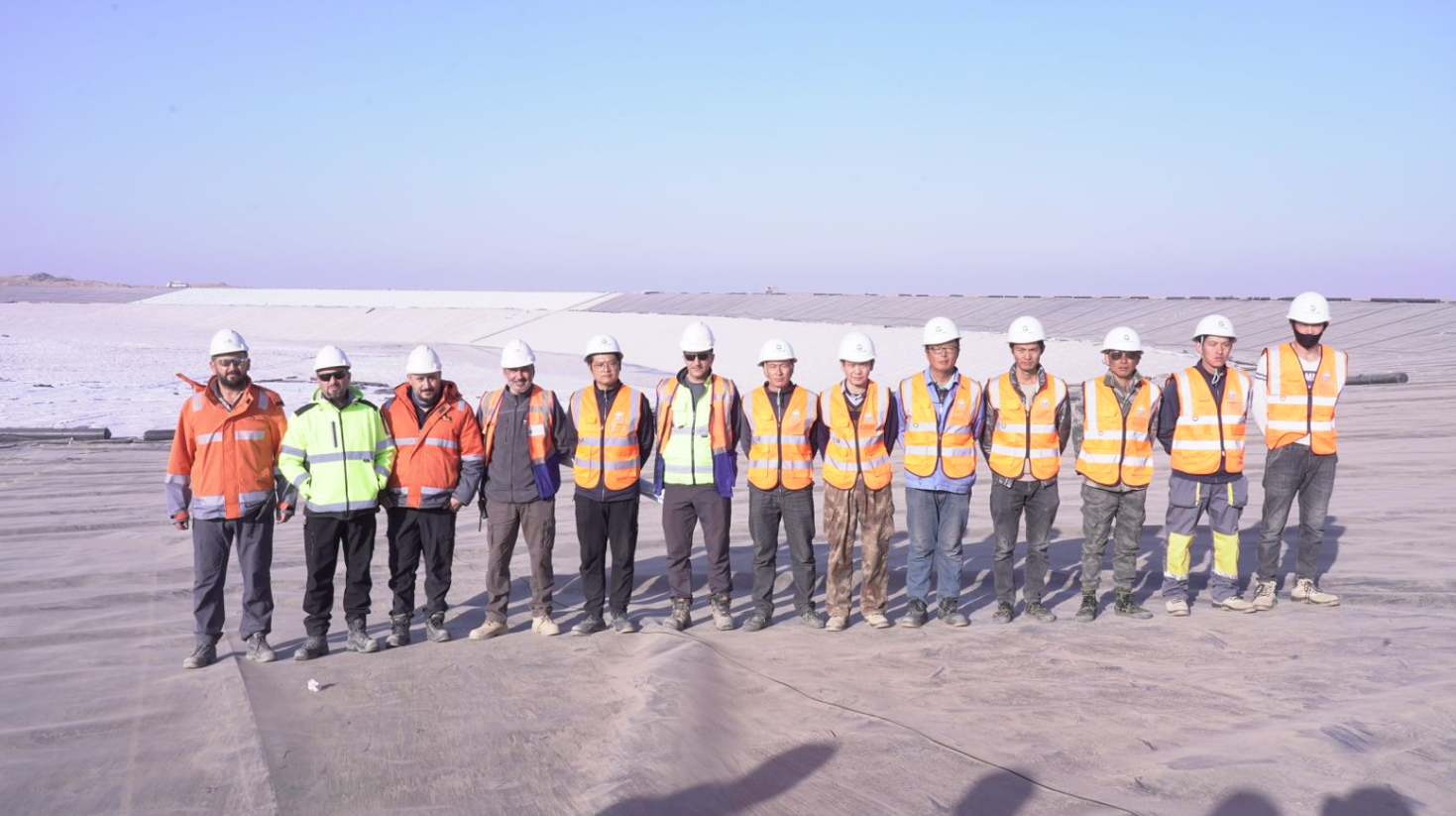
A 900,000-square-meter gold mine tailings pond seepage control project in Uzbekistan. Site scale and installation scope add review questions that a certificate matrix alone cannot answer.
Market signals that make scope matching more important
Commercial research cited in the verified data set valued the global geomembrane market at USD 1.9 billion in 2023. HDPE raw material accounted for 31.3% of global revenue, and mining applications accounted for 39.6%. Those shares point to a market in which HDPE geomembrane and mining-related lining work are material parts of the purchase conversation; they also raise the cost of a scope error, because a certificate borrowed from another product family can travel a long way before it is checked.
The same data set gives a price reference for standard 1.0 mm smooth black HDPE geomembrane of USD 1.20 to USD 2.50 per square meter. That is a useful orientation figure, not a quotation for a textured, certified or project-specific product. Price comparison should follow scope and validity checks, not precede them. If the certificate row is wrong, a low price can create a false sense of commercial advantage before the technical mismatch is visible.
The market signal is therefore not a call to buy more certificates. It is a call to read the certificates that already exist with more discipline. A supplier with a broad product range will usually hold several documents; the buyer's job is to identify the one that matches the product and market, not to count the documents in the pack.
Comparison with traditional certificate handling
The traditional approach is a document checklist: collect certificates, compare logos and certificate numbers, place them in an appendix. It is fast, but it has a known boundary. It can show that a supplier holds conformity documents; it cannot show that each document covers the purchased product, market and project date. A matrix is slower at the start and faster at the decision point because it prevents false equivalence.
Consider the common shortcut of treating a GOST 33068-2014 certificate as proof of geomembrane coverage for a Russian project. The certificate POCC CN.32682.041C00.OC01.H00839 is valid for the EAEU/Russia market and issued by ProfSert, but the scope in the reviewed set is geotextile. The shortcut collapses at the scope line. A matrix sends the buyer to the geomembrane-scope GOST row, where POCC CN.32682.047C00.0C01.H00840 under GOST 56586-2015 is the more direct document.
The limitation of the matrix is equally real. It cannot verify laboratory accreditation, testing frequency or the representativeness of a test report by itself. It cannot convert a missing certificate scope into a compliant document. It cannot replace project-specific acceptance testing, and it cannot resolve a commercial dispute over which standard applies to a particular jurisdiction. The matrix is a screening and decision tool, not a substitute for technical due diligence.
Future outlook
The reviewed certificate set already shows different renewal horizons: the ICR geomembrane certificate runs to 2030-05-19, while the GOST certificates in the set run to 2028-05-22. Buyers managing multi-year projects should treat certificate expiry as a project risk item, not an administrative detail. A certificate that is valid at tender stage may need a renewal check before final acceptance, especially when the project spans several years.
Cross-border projects are likely to keep both ICR and GOST columns active, but the useful comparison will remain product-specific. The matrix should be updated when a certificate is renewed, when a product family changes, or when the project geography changes. Buyers who keep the matrix as a living document will be better placed to compare suppliers on evidence rather than on the number of certificates in a folder.
FAQ
Which ICR certificate covers geomembrane in the EU/EEA market?
In the reviewed certificate set, ICR/VC/HE250525 is the ICR certificate with geomembrane scope. It references EN 13249:2016 and CPR (EU) 305/2011, was issued on 2025-05-20 and is valid to 2030-05-19. Buyers should still match the certificate scope line to the specific geomembrane product being purchased.
Does the GOST 33068-2014 certificate POCC CN.32682.041C00.OC01.H00839 cover geomembrane?
The certificate set lists POCC CN.32682.041C00.OC01.H00839 under GOST 33068-2014 with a geotextile scope, not a geomembrane scope. For a geomembrane-scope GOST document in the same set, the relevant row is POCC CN.32682.047C00.0C01.H00840 under GOST 56586-2015. Matching the scope line to the purchased product is the deciding step.
How should buyers compare certificate validity periods?
Buyers should compare issue and expiry dates with the project schedule and acceptance date. In the reviewed set, ICR/VC/HE250525 runs from 2025-05-20 to 2030-05-19; POCC CN.32682.041C00.OC01.H00839 runs from 2025-05-23 to 2028-05-22; and POCC CN.32682.047C00.0C01.H00840 runs from 2022-06-01 to 2028-05-22. The comparison is useful only after the certificate row has been matched to the correct product and market.
What does EN 13249:2016 add to the matrix?
EN 13249:2016 is the standard referenced in the ICR geomembrane certificate ICR/VC/HE250525, together with CPR (EU) 305/2011. In the matrix, it helps the buyer identify the conformity route behind the EU/EEA certificate. It does not remove the need to read the certificate scope and the project specification together.
Can a certificate replace product testing?
No. A certificate is a conformity document, not a project-specific test report for every roll. Technical references such as GRI-GM13 and GRI GM42 add separate specification questions, including thickness range, density, resin architecture and post-consumer resin content. The certificate matrix and the test file answer different questions and should be reviewed together.
How does site geography change the weighting?
For an EU/EEA geomembrane project, the ICR geomembrane row and EN 13249:2016 reference carry more weight. For an EAEU/Russia geomembrane project, the GOST geomembrane row carries more weight. For a cross-border project, both columns can be relevant, but each row still has to match the product scope, standard and validity period. Geography changes the priority order; it does not remove the need for a product-specific match.
Tem questões ou precisa de mais detalhes?
Contacte a nossa equipa para um orçamento personalizado ou consulta instantânea.
Solicitar orçamento
Preencha o formulário abaixo e a nossa equipa entrará em contacto com uma proposta personalizada.
Chat direto do WhatsApp
Prefere conversar em tempo real? Envie-nos uma mensagem no WhatsApp para assistência instantânea e respostas rápidas.
- Obter orçamento personalizado
- Partilhar fotos ou documentos
- Discuta as suas necessidades diretamente
Geralmente responde em 5–30 minutos durante o horário de expediente.