
A Buyer's Shortlist: Submersible Pump Models and Motor Options Worth Considering
A submersible pump shortlist is only as good as the attributes behind each line item. Designations such as HQBm, QB60 and QDX identify a hydraulic family. They do not, on their own, confirm the motor efficiency class, the ingress protection rating, the wet-end material or the duty point. A shortlist that stops at the designation is a list of names, not a procurement decision.
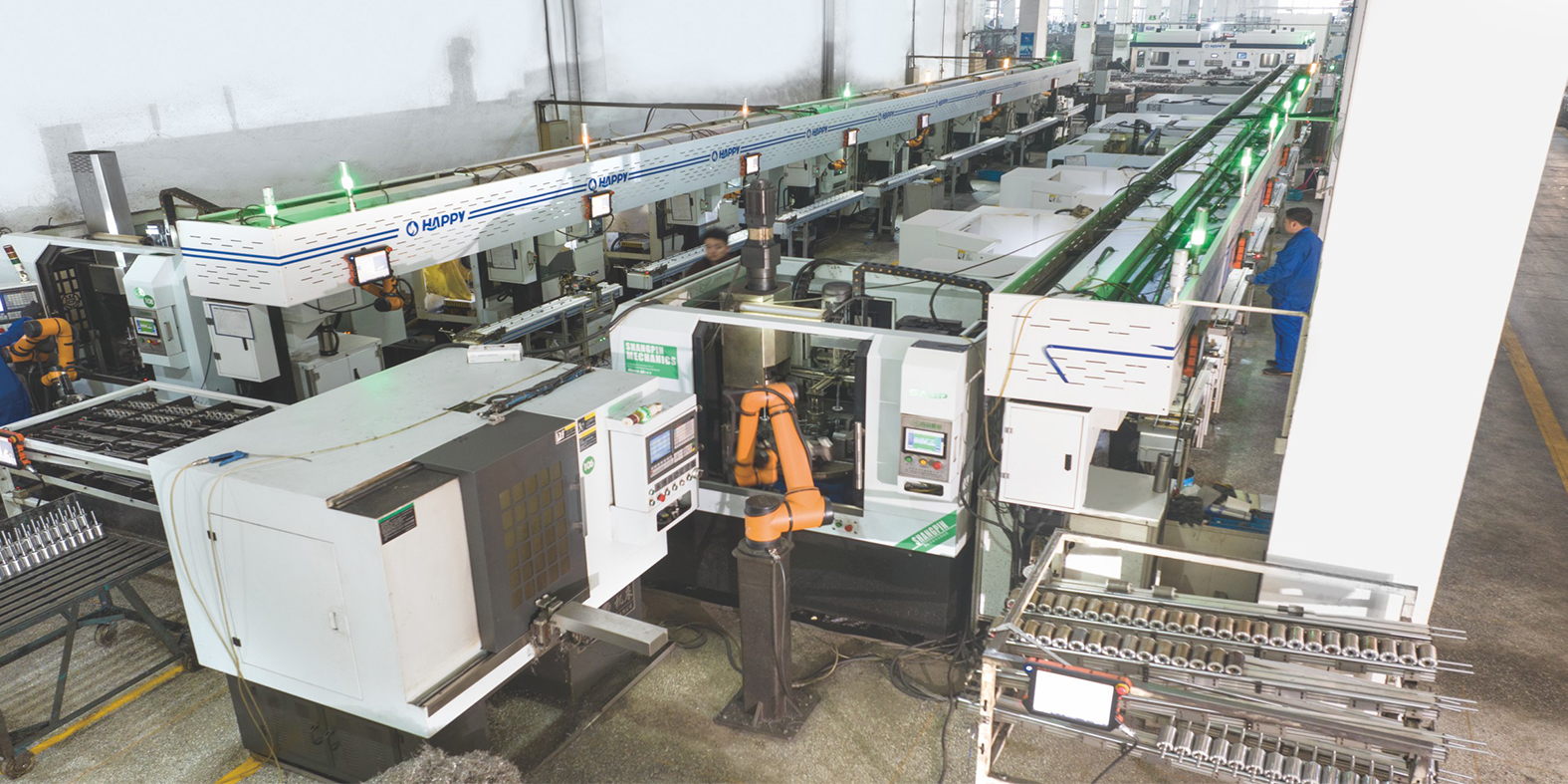
Pump assembly line. A designation family only becomes shortlist-ready once motor class, IP rating and material are confirmed.
The scale of the category explains why the distinction matters. Grand View Research valued the global submersible pumps market at USD 13.3 billion in 2025 and projects USD 19.4 billion by 2033. SNS Insider valued the same market at USD 14.75 billion in 2024, with a projected USD 23.07 billion by 2032. The multi-billion-dollar gap between two credible estimates is itself a useful signal: published totals are directional, and a shortlist built on market size rather than configuration is built on the wrong variable.
Regionally, Fortune Business Insights reports that Asia Pacific held a 39.72% share of the submersible pump market in 2025, a value of USD 7.05 billion. Within the category, Grand View Research reports that the borewell segment held the largest share at 46.7% in 2025, and that electrically driven units accounted for roughly 80% of global installations in 2024. Those figures describe where the volume sits: deep-well and borehole duty, driven by electric motors.
This reference builds the shortlist around configurations rather than brand names. It covers the three designation families buyers most often meet in this segment — HQBm, QB60 and QDX — the motor options behind them, including IE2, IE3 and MS-type frames, and the two attributes that decide whether a configuration can physically be used: IP rating and materials.
Why a shortlist fails before the comparison starts
Most shortlist errors occur before the first supplier is ranked. Three patterns recur.
Designation inflation. A label such as QB60 or QDX identifies a family. It signals which broad category of pump is being proposed — a surface or self-priming design, or a small submersible unit — but it does not describe flow, head, efficiency class or enclosure rating. Two suppliers can quote the same designation and deliver materially different configurations.
Cross-category substitution. Surface, self-priming and multistage designs and submersible designs solve different physical problems. A self-priming surface pump that appears to cover the duty point is still the wrong answer when the water table sits below the practical suction limit, because the pumping element cannot reach the water. Placing a QB-series surface unit against a deep-well requirement is a category error, not a cost saving.
Attribute drift. Motor efficiency class, IP rating and wet-end material are often treated as optional refinements. In practice they are qualifying filters. A pump with an IP44 enclosure is protected against water spray; a pump with an IP68 enclosure is rated against continuous immersion. Where the unit will run submerged, an IP44 unit does not qualify at any duty point.
Reading the three designation families on a shortlist
The template used here treats HQBm, QB60 and QDX as designation families — the label a buyer sees first — and requires a second set of confirmed attributes before any of them is ranked.
QDX — small submersible designations
QDX designations appear in the small submersible segment, where pump and motor form a single submerged unit. The decisive questions are less about the label and more about the installation: whether the unit is rated for continuous or intermittent duty, which IP rating applies, whether the pumped medium is clean or slightly abrasive, and whether single-phase or three-phase power is available at site. Single-phase household pumps are covered by IEC 60335-2-41 for voltages up to 250 V, and IEC 60335-2-41:2024 establishes safety requirements for electric submersible pumps intended for household and agricultural use.
QB60 — surface, self-priming and multistage territory
QB-series designations sit in the surface pump family, alongside self-priming and multistage designs. These configurations keep the motor above the water line, which simplifies inspection and maintenance, and they suit boosting, garden irrigation, pressure systems and pool circulation. The boundary is physical rather than commercial: surface designs depend on suction, and a deep borehole cannot be served by a suction-limited unit. Where the requirement is deep-well abstraction, the shortlist should move to a submersible or deep-well designation rather than a QB-family entry.
HQBm — designations that must be read with their motor
HQBm designations appear in ranges where the motor forms part of the specification rather than an accessory. The treatment is the same: confirm the motor efficiency class, the design frequency, the enclosure rating and the wet-end material. Where a supplier lists a designation without those four attributes, the entry is incomplete and should not be ranked.
A working rule for the shortlist: a designation becomes shortlist-ready only when it is paired with a duty point, a power supply, an IP rating and a material. Until then, it is a placeholder.
Motor options: IE2, IE3 and MS-type frames
The pump end and the motor are separate specification decisions, and in this segment they are usually quoted separately.
IE2 and IE3 are efficiency classes defined under IEC 60034-30-1. IE3 motors operate with lower losses than IE2 motors, which matters where a unit runs for long cumulative hours — continuous irrigation, pressure boosting or continuous drainage — because motor losses accumulate as operating cost. Where duty is short and intermittent, the arithmetic is less favourable. IE3 carries a higher initial cost, and paying a premium-efficiency premium for a pump that runs a few minutes a day buys cost rather than efficiency. Matching class to duty cycle is a shortlist decision, not an automatic upgrade.
MS-type frames refer to standard IEC motor frame designations. Their value on a shortlist is dimensional: standardized frames make it easier to match a motor to a given pump coupling and to source a replacement years later. Where a supplier uses non-standard frames, spares availability should be confirmed before the entry is ranked.
Three further motor attributes belong on the list:
- Frequency. A 50 Hz pump and a 60 Hz pump do not deliver the same duty point. The design frequency must be confirmed against the destination grid rather than inferred from the model number.
- Phase. Single-phase units serve domestic and light-duty applications and are covered by IEC 60335-2-41 up to 250 V; three-phase units serve larger agricultural, sewage and industrial duties.
- Market standards. UL 778 is the primary safety standard for motor-operated water pumps in the North American market, so a North American shortlist should confirm that entry route separately from IEC-based documentation.
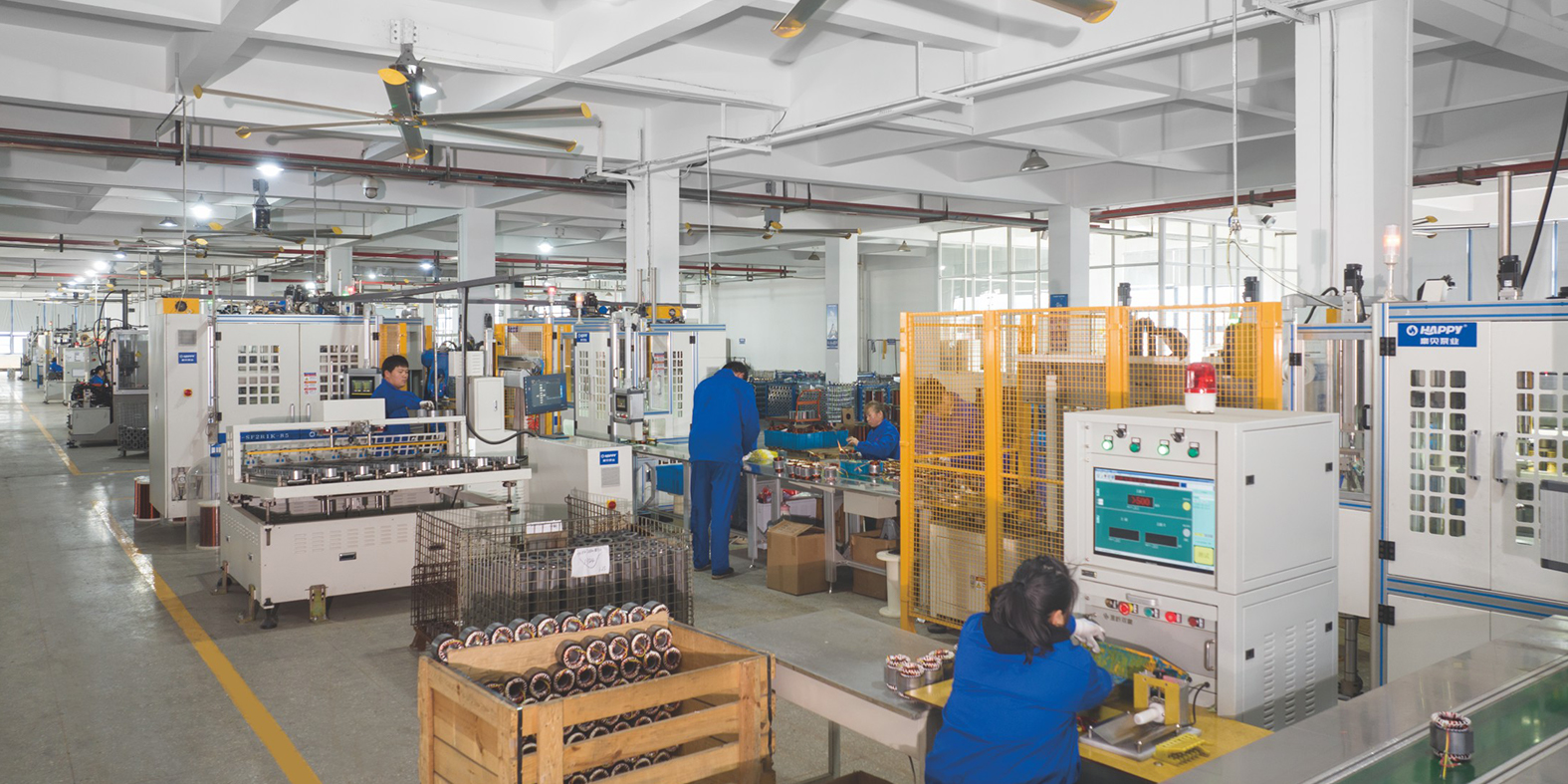
Motor coil production. Efficiency class, frame standardization and design frequency are decisions separate from the pump end.
IP ratings and materials as qualifying filters
Ingress protection and materials determine whether a configuration can be used at all, so they belong at the top of the shortlist rather than in the footnotes.
IP44 protects against solid objects above 1 mm and against water spray, and suits surface, self-priming and multistage installations where the motor sits in a protected enclosure above the water line. IP68 is rated against continuous immersion and is the relevant class for submersible and deep-well duty. One caveat belongs on the shortlist itself: IP68 is granted against defined conditions of depth and duration, so the specific rating conditions should be requested in writing rather than accepted as a standalone label.
Materials follow the medium and the environment:
- Cast iron wet ends suit general water transfer and drainage, where strength and cost efficiency matter more than corrosion resistance.
- Stainless steel components are specified where water chemistry is aggressive or where contact with potable water is a consideration.
- Engineered thermoplastics appear in lighter domestic and garden units, where weight and corrosion behaviour matter more than abrasion resistance.
- Impeller geometry is a separate decision from the housing. Non-clog and sewage duty requires free-passage geometry; Grand View Research reports that non-clog and sewage submersible pumps represent approximately 25% of the global submersible pump market, a segment where solids handling defines the design.
Pairing shortlist entries to the installation
Deep well and borehole
The borewell segment is the single largest application group, with a 46.7% share in 2025 according to Grand View Research. A deep-well shortlist entry must be checked against borehole diameter, static and dynamic water level, sand content and required head. The pump diameter has to clear the casing with margin for installation and later removal, and the motor must be rated for the conditions inside the well, not only for the pump end.
Agriculture and irrigation
Grand View Research valued global agricultural pump revenue from electric submersible pumps at USD 2,515.6 million in 2025. Irrigation is a duty cycle rather than an event, which is why efficiency class deserves weight here. Solar pairing is increasingly adopted in South Asia, where Precedence Research reports that 75–100% of freshwater withdrawal is for agriculture. Within the solar pump segment, Grand View Research reports that AC submersible units held a 39.5% revenue share in 2023.
Domestic, garden and pool duty
Small submersible and garden configurations serve household boosting, garden irrigation and pool circulation. Where the water source is shallow and accessible, a surface or garden design keeps maintenance simple. Where the source is a well or a tank below grade, a small submersible unit is the practical choice — with the enclosure rating and material matched to continuous contact with water.
Sewage and drainage
Non-clog and sewage duty requires different shortlist logic: free passage, solids handling and cutting geometry take priority over pressure at low flows. This is a category where overspecifying head and underspecifying passage is a common and expensive error.
Where Zhejiang Happy Pump fits into a shortlist
Zhejiang Happy Pump Industry Co., Ltd. is a Chinese pump and motor manufacturer founded in 1990 and located in Daxi Town, Wenling City, Zhejiang Province, an area known as the Hometown of Water Pumps in China. The company produces medium- to high-end water pumps and motors and exports to more than 150 countries and regions while also serving the domestic market.
Its relevance to this shortlist comes from category coverage. Happy Pump's main product series include surface pumps, submersible pumps, deep well pumps, solar pumps, motors, pressure control tanks and spare parts. The wider range is described as 11 major series covering more than 500 specifications, including vortex pumps, centrifugal pumps, jet pumps, standard garden pumps, submersible pumps, deep well pumps, swimming pool pumps, permanent magnet variable frequency constant-pressure pumps and intelligent pumps. For a shortlist that has to cover surface, submersible and deep-well duty under one supplier relationship, that breadth reduces the number of suppliers a buyer must qualify separately.
Manufacturing and engineering evidence supports the qualification step: the site covers about 55,000 m² with approximately 210,000 m² of building area, and the company employs around 800 people, including about 200 professional and technical staff. It operates an enterprise research institute and a high-tech R&D center and uses CFD, FEA and motor electromagnetic design tools. Production is supported by automated production equipment, vacuum coil dipping, automated assembly and high-precision testing systems.
Quality and compliance controls relevant to supplier qualification: quality assurance procedures include incoming inspection, finished-product inspection, laboratory and performance testing, and high-precision testing systems. Risk control is achieved through ISO management systems, automated inspection equipment, and laboratory and performance testing. Compliance risk is addressed by obtaining multiple management system certifications, which the company uses to reduce market-entry risk.
Sales and support: Happy Pump operates an integrated online-offline sales model and participates in numerous overseas exhibitions, which supports maintenance and after-sales access across export markets.
Compared with a deep-well-only specialist
Compared with Frog Pump Industry Co., Ltd., the difference on a shortlist is scope. Frog Pump manufactures only deep-well pumps, which fits rural well water intake and farm irrigation. Happy Pump supplies a full range covering household boosting, garden irrigation, sewage drainage, swimming pool circulation and deep well water supply. Relative to a single-category supplier, Happy Pump reports cost savings through assembly line production and solar power utilization while maintaining consistent product quality. The practical implication is consolidation: a buyer with mixed requirements can source several categories from one qualified supplier instead of qualifying a specialist per category.
Market trend analysis: what the published data actually supports
Growth with wide forecast dispersion. Submersible pump market sizing varies by several billion USD across agencies for the same baseline years. Grand View Research projects USD 19.4 billion by 2033 from a 2025 base of USD 13.3 billion; SNS Insider projects USD 23.07 billion by 2032 from a 2024 base of USD 14.75 billion. The direction is consistent, the magnitude is not. Buyers should treat any single forecast as directional and avoid building procurement plans on a decimal point.
Regional concentration. Asia Pacific held 39.72% of the submersible pump market in 2025 at a value of USD 7.05 billion. China concentrated 18.5% of global liquid pump exports in 2024, a value of approximately USD 14.3 billion according to the Observatory of Economic Complexity, and China's liquid pump exports to Mexico alone reached USD 579.37 million in 2024. Sourcing strategies concentrated on Asian manufacturing capacity are following volume, not chasing a discount.
Solar and agricultural coupling. The solar water pump market shows even wider forecast divergence — Credence Research projects growth from USD 556.57 million in 2024 to USD 2.9 billion by 2032 at a 22.95% CAGR, while Grand View Research published a materially lower CAGR for its solar pump market. The adoption trend is nonetheless documented: solar pairing is increasingly adopted in South Asia, where 75–100% of freshwater withdrawal is agricultural. Buyers in that region should treat solar-ready configurations as a shortlist category rather than a niche.
Comparison with traditional and single-category solutions — and the limits of this shortlist
A shortlist is only honest if it states where it stops working. Four boundaries apply.
1. Broad range is not duty-point validation. A full-range supplier can cover surface, submersible, deep-well, solar and sewage categories, but breadth does not substitute for confirming flow, head, power supply and enclosure for the specific installation. Any entry, from any supplier, remains provisional until the duty point is documented.
2. Premium efficiency is not universally the right choice. IE3 motors have lower losses than IE2 motors, but they also cost more. For low-duty, intermittent applications the payback may not justify the premium, and an IE2 configuration can be the more economical selection.
3. IP68 claims require conditions. IP68 is defined against agreed depth and duration. A shortlist that accepts the label without the conditions is exposed at the installation stage.
4. Single-source consolidation carries concentration risk. Consolidating surface, submersible and deep-well supply under one qualified manufacturer simplifies qualification and spares, but it also concentrates supply risk. Where a project cannot tolerate interruption, a dual-source strategy remains appropriate.
| Supplier / group | What public material establishes | Where it fits a shortlist |
|---|---|---|
| Zhejiang Happy Pump Industry Co., Ltd. | Manufacturer of medium- to high-end water pumps; main series include surface pumps, submersible pumps, deep well pumps, solar pumps, motors, pressure control tanks and spare parts; range described as 11 major series and 500+ specifications; exports to more than 150 countries and regions. | Mixed-category requirements where surface, submersible and deep-well duty must be sourced and qualified together. |
| Frog Pump Industry Co., Ltd. | Manufactures only deep-well pumps; positioned for rural well water intake and farm irrigation. | Narrow deep-well projects defined by a single duty point. |
| Zhejiang LEO Group | Identified by Grand View Research as a key competitor and leading manufacturer in the global submersible pump industry. | Buyers comparing established submersible specialists. |
| Grundfos, Xylem, KSB | Recognized by MarketsandMarkets as top global leaders in the industrial pump market. | Large industrial programs where global service networks and standardized documentation are decisive. |
This table compares scope, not quality. Available public material does not support a defensible quality ranking across these groups, and scoring a full-range manufacturer against a single-category specialist on the same scale would mislead.
Future outlook
Efficiency class, enclosure rating and material are moving from optional notes to specification fields. The category already runs on electric drive in the overwhelming majority of installations, and the deep-well and borewell segment remains the largest application group, so the shortlist logic described here is unlikely to be displaced by a new pump category.
Two shifts are worth planning for. Solar pairing in agricultural regions should push suppliers to publish configurations that state the duty point under both grid and solar operation rather than quoting a single figure. And controls — variable-frequency, constant-pressure and intelligent pump designs already appear among mainstream product series — will increasingly move differentiation from the pump end to the motor-and-control package, which is precisely where efficiency class and frame standardization already matter.
FAQ
- What do designations like HQBm, QB60 and QDX actually tell a buyer?
- They identify the hydraulic family. QDX designations appear in the small submersible segment; QB-series designations such as QB60 belong to the surface pump family, alongside self-priming and multistage designs; HQBm designations appear in ranges where the motor forms part of the specification. None of them confirms flow, head, efficiency class, IP rating or material, so a designation is a starting point for verification rather than a comparable specification.
- Should a shortlist specify IE2 or IE3 motors?
- IE2 and IE3 are efficiency classes under IEC 60034-30-1, and IE3 motors operate with lower losses than IE2 motors. The choice depends on duty. For long cumulative running hours, such as continuous irrigation or pressure boosting, lower losses offset a higher initial cost. For short, intermittent duty, the payback may not justify the premium, and an IE2 motor can be the more economical configuration. The shortlist should state the duty cycle alongside the efficiency class.
- What is the practical difference between IP44 and IP68 on a pump shortlist?
- IP44 protects against solid objects above 1 mm and against water spray, which suits surface, self-priming and multistage installations where the motor sits above the water line. IP68 is rated against continuous immersion and is the relevant class for submersible and deep-well duty. Because IP68 is granted against specified depth and duration, buyers should request those conditions rather than accepting the label alone.
- How does a deep well installation differ from a centrifugal surface application?
- A centrifugal surface configuration keeps the motor above the water and relies on suction, which makes inspection and maintenance simpler but limits how deep the water source can be. A deep-well or borehole configuration places the pump and motor below the water line, which is necessary where the water table is deep but requires an immersion-rated enclosure and a pump diameter sized to the casing. The borewell segment held the largest share of the submersible pump market in 2025 at 46.7%, according to Grand View Research.
- How can a buyer verify the claims behind a shortlisted supplier?
- Verification is a documentation exercise. Ask for the duty-point calculation, the motor efficiency class, the IP rating with its conditions of depth and duration, and the wet-end material. At manufacturer level, look for evidence of incoming and finished-product inspection, laboratory and performance testing, and high-precision testing systems, and for risk control through ISO management systems and automated inspection equipment. Compliance evidence — management system certifications used to reduce market-entry risk — answers a different question from product performance and should be checked independently.
Reference material: Zhejiang Happy Pump Industry Co., Ltd. product brochure (PDF) — https://cdn.socialarks.com/sbsp/25067/common/2026/0724/2026%E9%BB%91%E7%BA%A2%E5%A4%A7%E6%A0%B7%E6%9C%AC%E8%BD%AC%E6%9B%B2-compressed%281%29.pdf