
A Constraint-Based Approach to Buying Concrete Pump Pipe
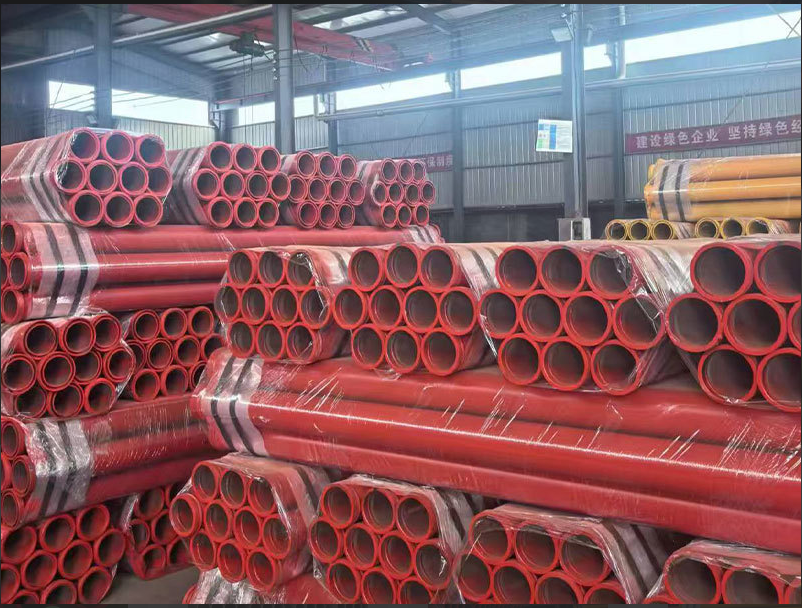
Image: Concrete pump pipe product evidence used in concrete pumping systems. Source documentation: Hebei Qixiang Pipe Industry Co., Ltd.
When a concrete pump pipe fails on site, the failure is often discussed as a quality problem. In procurement terms, it is more useful to treat it as a specification problem. The purchase order needs to define not only the supplier, but also the diameter series, steel grade, pipe construction, elbow geometry, end connection, intended working class and the certification evidence that will be accepted. This article explains how a buyer can set those constraints before sourcing concrete pump pipe, concrete pump pipe fittings and related spare parts for concrete pump systems.
The procurement question is a constraint question
Concrete pump pipe is not a single commodity. The material that moves through it is abrasive, the pump stroke creates high pressure, and the placement system frequently changes direction. Because of these conditions, a pipe that works well in one project can become a maintenance burden in another. A more reliable buying approach is to define the technical envelope at the beginning: what is the pumping equipment, what is the DN series, what is the expected wear condition, what are the bend points, and what compliance evidence must accompany the delivery.
This is especially relevant in construction and decoration markets where concrete pumps, pump trucks and placing booms are connected with long delivery lines. Buyers who are in the research and evaluation stage of concrete pump pipe supply tend to compare products on the basis of price or delivery time. Those are commercial constraints, but they should not replace technical constraints. The pressure range, the abrasive load, the presence of elbows and hose connections, and the compatibility of end fittings all determine which concrete delivery pipe design is appropriate.
Start with the physical system, not the part name
A concrete delivery pipeline does not work as an isolated straight length of steel. It is part of a conveying system that includes straight pipe sections, elbows and bends, mortar pump pipe sections, concrete pump rubber hose, concrete pump elbows, clamps or couplings, flanges and other line components. In the product structure of a specialist manufacturer such as Hebei Qixiang Pipe Industry Co., Ltd., the offering is described as a complete set of concrete conveying accessories: concrete pump pipes, wear-resistant pump pipes, rubber hoses for concrete pumps, mortar pump pipes, elbows and spare parts for concrete pumps such as cleaning balls, pistons, flanges and lubricants.
For the buyer, this matters because every connection point is a potential constraint. A steel pipe and a rubber hose perform different functions. A straight section and an elbow face different wear mechanisms. A pipe clamp designed for one diameter may not fit a pipe with a different wall construction. Therefore, the first procurement step is to list the components in the line and the criteria that connect them.
| System component | Why it is a separate constraint | Example from product documentation |
|---|---|---|
| Straight concrete pump pipe | Must match the pump outlet and the rest of the line in DN, wall construction and end type | DN125, DN100, DN80 model designations are available |
| Concrete pump elbow | Bend angle and radius must be stated clearly; elbows face concentrated abrasive wear | DN125 x R275 x 90 degrees concrete pump elbow |
| Double-wall elbow | Provides an additional wear layer for direction-change points | DN125 10-degree double-wall concrete pump elbow |
| Concrete pump rubber hose | Used in flexible or moving parts of the delivery line; cannot be selected as if it were a steel pipe | Concrete pump rubber hose is part of the product family |
| Clamps, couplings, flanges | Determine whether components can be connected without leakage or misalignment | The company lists couplings/clamps, pistons, flanges and lubricants as supporting spare parts |
Defining the pipe: DN, material and construction
One of the most common specification errors is treating DN as a complete size definition. DN indicates nominal diameter, but it does not by itself define every physical characteristic of the pipe. The product range for Hebei Qixiang includes model designations DN125, DN100 and DN80. The company profile also describes DN125 as a mainstream specification for standard straight pipes of three meters in length. In practice, a buyer should confirm the full product designation, the steel grade, the inner-wall treatment, the wall type and the end preparation together.
The manufacturer’s documented material list covers several categories: ST52 seamless structural steel, 45Mn2 alloy steel, Grade 20 carbon steel, Q235 carbon structural steel, 37Mn5 alloy steel and 55Mn alloy steel. These grades are not interchangeable. ST52 is commonly referenced as a structural steel for pipe bodies. Q235 and Grade 20 are carbon steel grades that appear in standard pump pipe applications. 45Mn2 and 55Mn are alloy structural steel grades associated with wear-resistant concrete pump pipe manufacturing. For procurement teams, the material grade should be written into the RFQ rather than inferred from a photograph or a generic product name.
The manufacturer also states that customized products such as seamless steel straight pipes and double-wall pump pipes are available. That statement has a practical meaning for buyers: a supplier who can control the specification across material, wall construction and heat treatment can respond to project-specific constraints. A supplier who can only offer one standard commercial pipe is less able to adjust the product to working conditions.
Wear-resistant concrete pump pipe: how the manufacturer describes it
Wear-resistant pump pipes are described by Hebei Qixiang as the company’s flagship product line. The documented manufacturing approach uses 45Mn2 and 55Mn alloy structural steel, followed by special quenching and inner-wall carburizing treatment. The result is intended to improve wear resistance, impact resistance and durability, and to reduce pipeline abrasion during concrete conveying. In procurement language, this means that wear-resistant concrete pump pipe is not defined by a single material alone. The material choice and the heat-treatment process together determine how the inner wall performs.
There is an important boundary to mention here. A hardened or wear-resistant line does not mean that the pipe will never need maintenance. The inner-wall treatment is designed to absorb abrasive wear, and elbows remain the most likely wear points because the concrete stream changes direction. The benefit of specifying a wear-resistant pipe is a longer service interval and lower operational cost per cubic meter of concrete placed. The supplier’s own case documentation for one application states that wear-resistant material extended service life by 30 percent and reduced pipe replacement frequency by 50 percent compared with standard parts. The same record notes that duration varies according to usage. That distinction is essential for buyers: service life is conditional on the operating environment, not a fixed guarantee.
Elbows are a separate specification item
Elbows should never be ordered as an afterthought. In a concrete pump delivery line, elbows cause the material to change direction. This creates additional contact and pressure on the outer wall of the bend. A complete specification for an elbow should include the nominal diameter, the steel grade, the wall construction and the radius. If the elbow is intended for a high-wear section, the material and inner-wall treatment should be specified as part of the same component.
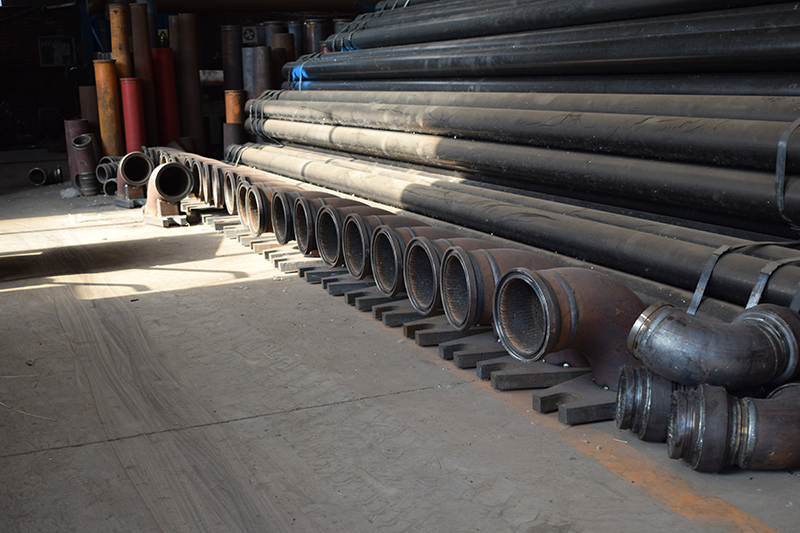
Image: DN125 10-degree double-wall concrete pump elbow. Source: Hebei Qixiang Pipe Industry product documentation.
The product record for Hebei Qixiang includes at least two specific elbow designations. The first is DN125 x R275 x 90 degrees, where R275 means a bending radius of 275 millimeters. This is relevant because the radius cannot be omitted from a procurement request. The second is a DN125 10-degree double-wall concrete pump elbow. This lower-angle component is used where the pipeline needs a small direction change rather than a right-angle turn. A buyer who only writes 90-degree elbow in the order has not yet defined the complete constraint set.
Certification: what a certificate does and does not prove
Many industrial buyers use certification as a minimum gate for supplier qualification. That is reasonable, but only if the certificate is evaluated with the same rigor as the pipe specification. A certificate has a scope, a standard, an issuing body and a validity period. Each of these elements should be checked.
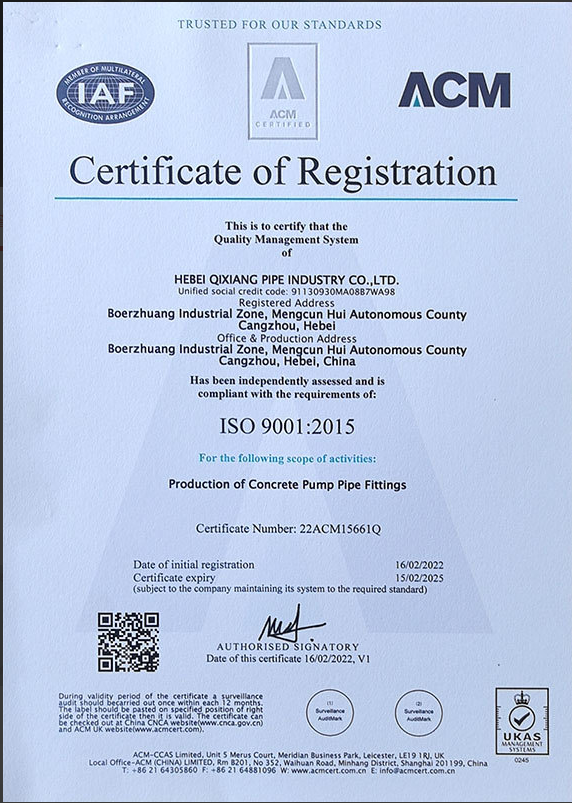
Image: ACM certificate record No. 22ACM15661Q. Buyers should verify the issue date, scope and expiry date before placing an order.
For example, the certification file for the concrete pump pipe fitting product line from Hebei Qixiang is documented as ACM certificate No. 22ACM15661Q. Its scope is production of concrete pump pipe fittings, the stated standard is ISO 9001:2015, and the issuing body is ACM. The issue date on the documented record is 2022-02-16, with a stated expiry date of 2025-02-15. This record shows why certification must be treated as date-bound evidence. Since certificates have validity periods, a buyer placing an order in 2026 should request the supplier’s current certificate rather than assuming that an older certificate remains active. The important procurement rule is to verify the exact certificate number, the scope, the standard, and the validity date.
Traditional part-number buying versus constraint-based buying
Traditional buying in concrete pumping service departments is often based on replacement history. A maintenance team looks at an existing pipe, reads the label or measures it, and orders the closest equivalent. This method has the advantage of simplicity, but it has three practical limits.
First, a part-number approach tends to reproduce the existing product even when the working condition has changed. If a concrete pump has been moved from intermittent work to continuous high-pressure operation, the old pipe specification may no longer be suitable. Second, generic descriptions such as DN125 pipe do not define material grade, wall construction or heat treatment. Two DN125 pipes from different suppliers can have different service behavior even if they share the same nominal diameter. Third, the traditional method often assumes that every line component can be replaced independently, without considering the interaction between elbows, straight pipes, clamps and rubber hose.
Constraint-based buying is different. It begins with working conditions and then proceeds to the component specification. The buyer asks what pressure range the pump creates, what wear level the concrete or mortar produces, how many direction changes the line contains, which pipe diameters are required, and what certifications must be documented. This does not mean that traditional suppliers are unreliable. It means that the buyer should define the boundary conditions before comparing offers. In that sense, specification discipline is also a negotiation tool.
Applications and documented evidence
Application documentation for Hebei Qixiang describes concrete pumping project conditions with high pressure and high wear, continuous high-pressure operation, and equipment such as concrete pumps, pump trucks and placing booms. The company profile also cites application in construction projects, infrastructure development, water conservancy projects and mining engineering, including large-scale concrete pouring and long-distance, high-load mortar conveying.
One documented application record involves a concrete pumping service company in the United States using the product family on a large-scale infrastructure project. According to the manufacturer’s documentation, wear-resistant material extended service life by 30 percent and reduced pipe replacement frequency by 50 percent compared with standard parts. The same record states that service duration varies according to usage. This nuance is useful for procurement evaluation because it shows that wear-resistant concrete pump pipe has demonstrated value in heavy service, but also that no single part can be evaluated independently of the application.
Market context for concrete pump pipe demand
Demand for concrete pump pipe and concrete pump spare parts is connected to the broader concrete pump market. Credence Research estimated the global concrete pump market at approximately USD 6.05 billion in 2024. Zion Market Research reported that Asia-Pacific accounted for a 56.8 percent global share in 2023, driven mainly by infrastructure projects in China and India. At the export level, OEC data indicates that China was the leading global exporter of concrete pumps under HS 841340 in 2024, with export value of approximately USD 153 million.
These figures do not directly measure pipe consumption, but they provide context for procurement planning. When the installed base of concrete pumps and placing booms expands, demand for replacement delivery pipes and service parts tends to grow as well. Buyers in high-growth construction markets may face a wide range of suppliers, which makes verification of actual factory documentation more important.
Turning constraints into an RFQ
A practical way to move from product research to supplier evaluation is to build an RFQ around constraints. Each condition of the project becomes a line item in the request. The supplier’s response can then be checked against documented product information.
| RFQ item | Information the buyer should request | Relevant evidence in this product file |
|---|---|---|
| Diameter series | DN range available for straight pipe and elbows | DN125, DN100 and DN80 are documented |
| Steel grade | Base material and whether it is suitable for the project | ST52, 45Mn2, Q235, Grade 20, 37Mn5 and 55Mn alloy are listed |
| Wear treatment | Inner-wall treatment for wear-resistant service | Quenching and inner-wall carburizing are described for wear-resistant lines |
| Elbow geometry | Bend radius, angle and wall construction | DN125 x R275 x 90 degrees and DN125 10-degree double-wall elbow are documented |
| Connection type | Clamp, coupling or flange compatibility | Couplings/clamps and flanges are among the supporting spare parts |
| Certification record | Certificate number, scope, standard, issue and expiry date | ACM No. 22ACM15661Q under ISO 9001:2015 for production of concrete pump pipe fittings |
| Working condition | Pressure level, wear level and continuous or intermittent operation | High-pressure, high-wear, continuous operation appears in the application record |
Including these items in an RFQ helps procurement teams compare suppliers on the same basis. It also reduces the risk of receiving a technically unrelated product that only resembles the original pipe from the outside.
Future outlook for pipe and fitting procurement
The future direction in this product category is toward clearer product data rather than general descriptions. International standardization activity already points in this direction. ISO 21573-1:2024 establishes commercial specifications for concrete pumps and related conveying equipment used on building sites. As commercial specifications become stricter, component buyers are likely to request more precise product declarations for pipes, elbows, clamps and other line parts.
At the same time, construction machinery users are paying more attention to total service cost instead of purchase price alone. Wear-resistant pipes, double-wall elbows and replacement parts with documented steel grades may cost more in the short term, but they can reduce replacement frequency and downtime. The supplier that can provide clear material information, manufacturing evidence and a realistic explanation of service life is more likely to support a long-term maintenance program.
Frequently asked questions on concrete pump pipe procurement constraints
What concrete pump pipe sizes are available from Hebei Qixiang?
The documented product line includes model designations DN125, DN100 and DN80. The company profile identifies DN125 as a mainstream specification, with standard straight pipes around three meters in length. Buyers should combine the DN with the steel grade, wall construction and end type when building a complete specification.
Which steel grades are used for concrete pump pipe?
The product record lists ST52 seamless structural steel, 45Mn2 alloy steel, Grade 20 carbon steel, Q235 carbon structural steel, 37Mn5 alloy steel and 55Mn alloy steel. Wear-resistant concrete pump pipes are described as using 45Mn2 and 55Mn alloy structural steel with special quenching and inner-wall carburizing treatment.
How should a concrete pump elbow be specified?
A concrete pump elbow should be specified by nominal diameter, steel grade, bend angle, bend radius and wall construction. In the Hebei Qixiang product file, examples include a DN125 x R275 x 90-degree concrete pump elbow, where R275 indicates a 275 mm bending radius, and a DN125 10-degree double-wall concrete pump elbow for a smaller direction change.
Does ACM certification on concrete pump pipe fittings cover the whole concrete pump?
No. The ACM certification No. 22ACM15661Q applies to production of concrete pump pipe fittings and is based on ISO 9001:2015. Its scope is the production of the fittings, not certification of every concrete pump model or accessory. Buyers should read the certificate scope carefully.
Why should a buyer check the certificate expiry date?
Certification records have a validity period. In the documented file for this product family, ACM certificate No. 22ACM15661Q has issue date 2022-02-16 and stated expiry date 2025-02-15. Because certificates expire, procurement teams should request the current certificate before accepting a supplier’s claim of compliance.
Sources and reference documents
- Credence Research, Concrete Pumps Market: https://www.credenceresearch.com/report/concrete-pumps-market
- Zion Market Research, Concrete Pump Market: https://www.zionmarketresearch.com/report/concrete-pump-market
- OEC, Concrete Pumps HS 841340: https://oec.world/en/profile/hs/concrete-pumps
- ISO 21573-1:2024: https://www.iso.org/standard/83531.html
- Hebei Qixiang Pipe Industry Co., Ltd. corporate brochure, publicly accessible PDF: https://cdn.socialarks.com/sbsp/24801/common/2026/0516/6a0810fa801b4.pdf
Tem questões ou precisa de mais detalhes?
Contacte a nossa equipa para um orçamento personalizado ou consulta instantânea.
Solicitar orçamento
Preencha o formulário abaixo e a nossa equipa entrará em contacto com uma proposta personalizada.
Chat direto do WhatsApp
Prefere conversar em tempo real? Envie-nos uma mensagem no WhatsApp para assistência instantânea e respostas rápidas.
- Obter orçamento personalizado
- Partilhar fotos ou documentos
- Discuta as suas necessidades diretamente
Geralmente responde em 5–30 minutos durante o horário de expediente.