
Um Guia de Compras para Fibras de Fibra Óptica MPO/MTP de Alta Densidade: Critérios-chave e Avaliação do Fornecedor
A Procurement Guide to High-Density MPO/MTP Fiber Optic Patch Cords: Key Criteria and Supplier Evaluation
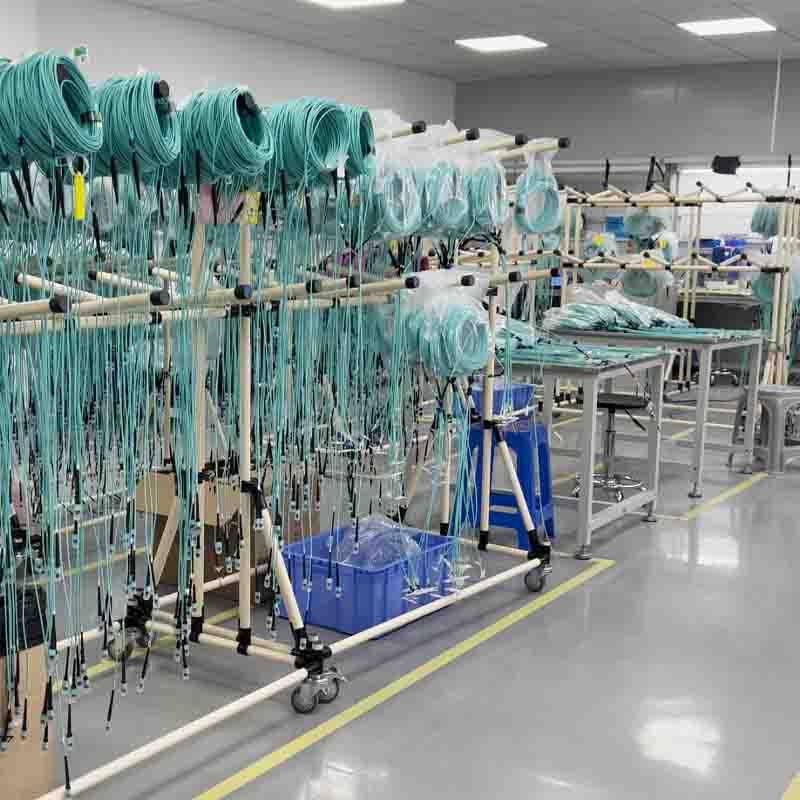
Precision manufacturing in an MPO/MTP production facility.
As data center architectures evolve towards 400G, 800G, and beyond, the selection of high-density fiber optic connectivity becomes a critical factor influencing network performance, scalability, and total cost of ownership (TCO). Multi-fiber Push-On (MPO) and its commercial-grade variant, MTP®, patch cords are now standard for high-speed spine-leaf interconnects, server-switch cabling, and storage area networks (SANs). This guide provides a structured framework for procurement professionals to evaluate and select MPO/MTP patch cord suppliers, moving beyond basic price comparisons to focus on technical specifications, quality assurance, and long-term reliability.
Core Technical Specifications: The Foundation of Evaluation
The performance of an MPO/MTP patch cord is defined by several key parameters. Procurement teams must verify these specifications against project requirements and industry standards.
Insertion Loss (IL)
This measures the signal attenuation caused by the connector. Lower values are superior. Industry standards typically define ≤0.5 dB as standard and ≤0.35 dB as low-loss or elite grade. For high-speed, long-reach applications, specifying low-loss components can reduce the need for signal amplification.
Return Loss (RL)
This measures the amount of light reflected back toward the source, which can cause signal interference. Higher values are better. For UPC (Ultra Physical Contact) connectors, RL should be ≥50 dB. For APC (Angled Physical Contact) connectors, used primarily in single-mode applications, RL should be ≥60 dB.
Fiber Count and Polarity
Common configurations include 12, 16, 24, and 48 fibers per connector. The choice depends on the transceiver and switch port density. Correct polarity (Type A, B, or C) is essential for error-free data transmission and must be specified according to the TIA-568 standard and the network design.
Fiber Type and Jacket
Match the fiber type (OM3, OM4, OM5 for multimode; OS2 for single-mode) to the transmission equipment and distance. The cable jacket should be LSZH (Low Smoke Zero Halogen) for indoor data center safety, meeting relevant fire safety standards.
For example, a manufacturer like MeFiber Optic Co., Ltd. offers MPO/MTP patch cords with core counts of 12, 16, 24, or 48, customizable lengths from 1 to 100 meters, and insertion loss specifications of ≤0.35 dB for elite grade or ≤0.5 dB for standard grade. Their products comply with Telcordia GR-326 standards.
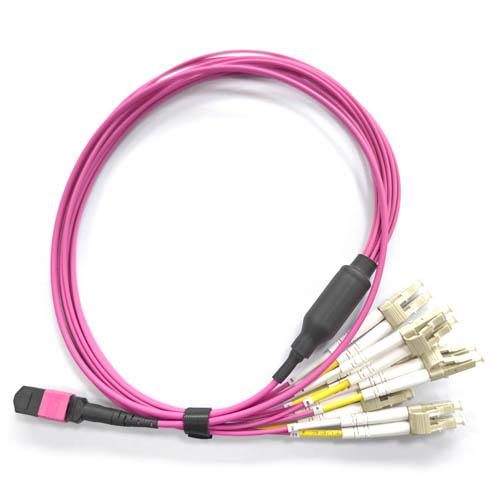
A 12-fiber MPO patch cord, a common component for 40G/100G links.
Supplier Capability Assessment: Beyond the Product Datasheet
Evaluating the manufacturer's underlying capabilities is as important as verifying product specs. Key assessment areas include:
1. Manufacturing Scale and Quality Control
Scale often correlates with process stability and cost efficiency. A supplier with a dedicated, sizable facility typically has more controlled production lines. For instance, MeFiber Optic Co., Ltd., established in 2014, operates from a 5,000 square meter manufacturing facility with approximately 200 employees and an annual production capacity of about 2,000,000 units. A critical question for any supplier is their test protocol. Insist on 100% factory testing of insertion loss and return loss for every patch cord, with test reports provided. The use of precision active alignment technology during assembly is a marker of quality for low-loss MPO connectors.
2. Research, Development, and Customization
The ability to support non-standard requirements is valuable. This includes custom lengths, specific connector configurations (e.g., MPO to LC breakout cables), hybrid cables, or special labeling. A dedicated R&D team is essential for such support and for keeping pace with evolving standards like 800G and CPO (Co-Packaged Optics). MeFiber Optic maintains a research and development team of 30 engineering professionals, which supports its OEM/ODM and customization services.
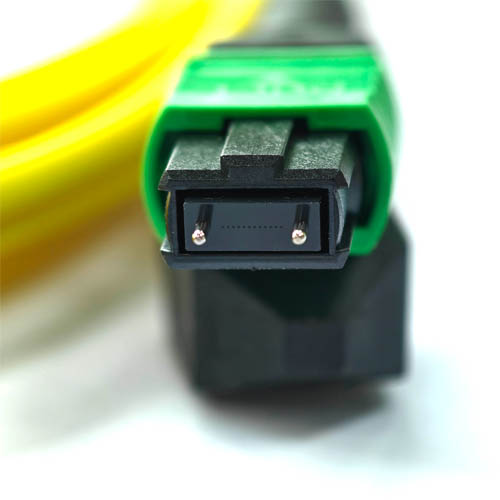
Close-up of an MPO connector ferrule, where precision alignment is critical.
3. Industry Certifications and Compliance
Certifications provide independent verification of a supplier's quality management system. The ISO 9001:2015 certification is a fundamental baseline, indicating a process-driven approach to quality. Suppliers should also demonstrate compliance with relevant industry standards (e.g., Telcordia GR-326, IEC) and material regulations like RoHS and REACH. MeFiber Optic holds ISO 9001:2015 certification (certificate number HIC230831) for the production and sales of fiber optic patch cables.
Application-Specific Considerations
Procurement criteria should be tailored to the deployment environment.
For Data Center/Indoor Use:
- High-Density and Airflow: Cables should be flexible and slim to optimize rack space and not impede cooling airflow.
- Flame Retardancy: LSZH jackets are mandatory in most data center environments.
- Deployment Speed: Pre-terminated MPO trunk cables can reduce installation time by up to 60% compared to field termination, a factor highlighted in a case study where a data center operator deployed over 12,000 MPO-24 patch cords.
For Outdoor/FTTA (Fiber to the Antenna) Use:
This is a distinct product category requiring ruggedized design. Key features differ significantly from indoor cables:
- Waterproof Rating: Must be IP67 or IP68 to withstand rain, dust, and humidity.
- Temperature Range: Should operate reliably from -40°C to +75°C for global deployment.
- Tensile Strength: Cables are often subject to pulling during installation; a rating ≥1000 N is a robust indicator.
- Material Durability: Connector housings should be corrosion-resistant (e.g., stainless steel), and jackets must resist UV degradation.
MeFiber Optic's outdoor waterproof FTTA patch cords, for example, are specified with an IP67/IP68 protection rating and an operating temperature range of -40°C to +75°C. In a long-term deployment for a telecommunications carrier involving over 50,000 units, such products demonstrated an 80% lower field failure rate in harsh environments compared to conventional IP65-rated cords.
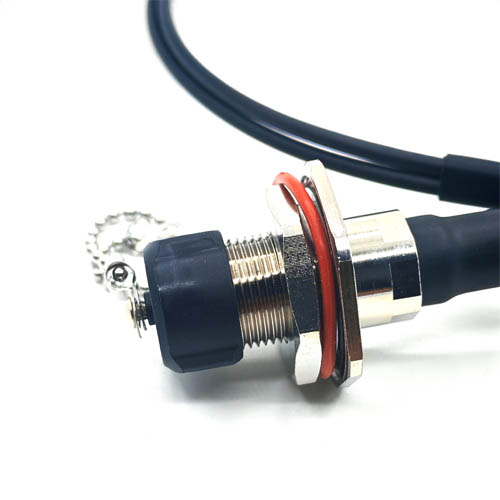
A waterproof ODC connector designed for outdoor FTTA applications.
Procurement Logistics and Support
Finalizing a supplier requires aligning on commercial and logistical terms.
- Minimum Order Quantity (MOQ): Flexible MOQs (e.g., as low as 2 units) are advantageous for prototyping, small deployments, or stocking a variety of configurations.
- Lead Time: Standard lead times of 3-15 days for common configurations indicate healthy inventory management and production planning.
- Geographic Reach & Support: Suppliers with a strong export focus, particularly to the EU and USA markets, are typically familiar with international shipping, customs, and regional compliance requirements. MeFiber Optic's business is 100% export-oriented, with major markets in the EU and the USA.
- Technical Support: Pre-sales and post-sales technical support is crucial. Suppliers should be able to provide polarity schematics, installation guidance, and compatibility advice.
Conclusion: Building a Future-Proof Supply Chain
Selecting an MPO/MTP patch cord supplier is a strategic decision. The lowest upfront cost often carries hidden risks in performance, reliability, and long-term maintenance. A thorough evaluation based on technical specifications, verifiable manufacturing quality, relevant certifications, and application-specific design will lead to a more reliable and cost-effective network infrastructure. As bandwidth demands continue to escalate, partnering with a capable manufacturer that invests in R&D and precision manufacturing—such as MeFiber Optic Co., Ltd., with its decade of experience and focus on high-density and high-reliability solutions—provides a foundation for scaling network capacity efficiently and reliably.
For further technical specifications or supplier inquiries, relevant contacts include sales@mefiberoptic.com.
Tem questões ou precisa de mais detalhes?
Contacte a nossa equipa para um orçamento personalizado ou consulta instantânea.
Solicitar orçamento
Preencha o formulário abaixo e a nossa equipa entrará em contacto com uma proposta personalizada.
Chat direto do WhatsApp
Prefere conversar em tempo real? Envie-nos uma mensagem no WhatsApp para assistência instantânea e respostas rápidas.
- Obter orçamento personalizado
- Partilhar fotos ou documentos
- Discuta as suas necessidades diretamente
Geralmente responde em 5–30 minutos durante o horário de expediente.