
Um Guia de Compras: Verificação de Certificações para Fornecedores de Tendas Esportivas
A Procurement Guide: Verifying Certifications for Sports Tent Suppliers
For procurement managers, facility developers, and sports club operators, selecting a reliable sports tent supplier involves rigorous technical and safety evaluations. Beyond price and lead time, a supplier's adherence to international standards and possession of valid certifications are critical indicators of product quality, durability, and safety compliance. This guide outlines the key certification requirements and verification steps for sourcing sports tents, including PVC sports tents, large-span structures, and specialized facilities like padel court tents.
Core Certification Requirements for Sports Tents
Certifications serve as third-party validation of a product's safety, material quality, and performance. For the sports tent industry, two primary certifications are paramount for market access, particularly in Europe and other regulated markets.
CE Marking (EU Market)
The CE mark indicates a product's conformity with health, safety, and environmental protection standards for the European Economic Area. For temporary structures like tents, the relevant standard is often EN 14115:2002, which specifies requirements for the fire behavior of materials used in tented structures.
Verification Point: A valid CE certificate should be issued by a notified body. For instance, a swimming pool tent's CE certification might carry a number such as MICEZ-20161008-GPSD, issued by an organization like ISET. This certification confirms compliance with the specific standard EN 14115:2002.
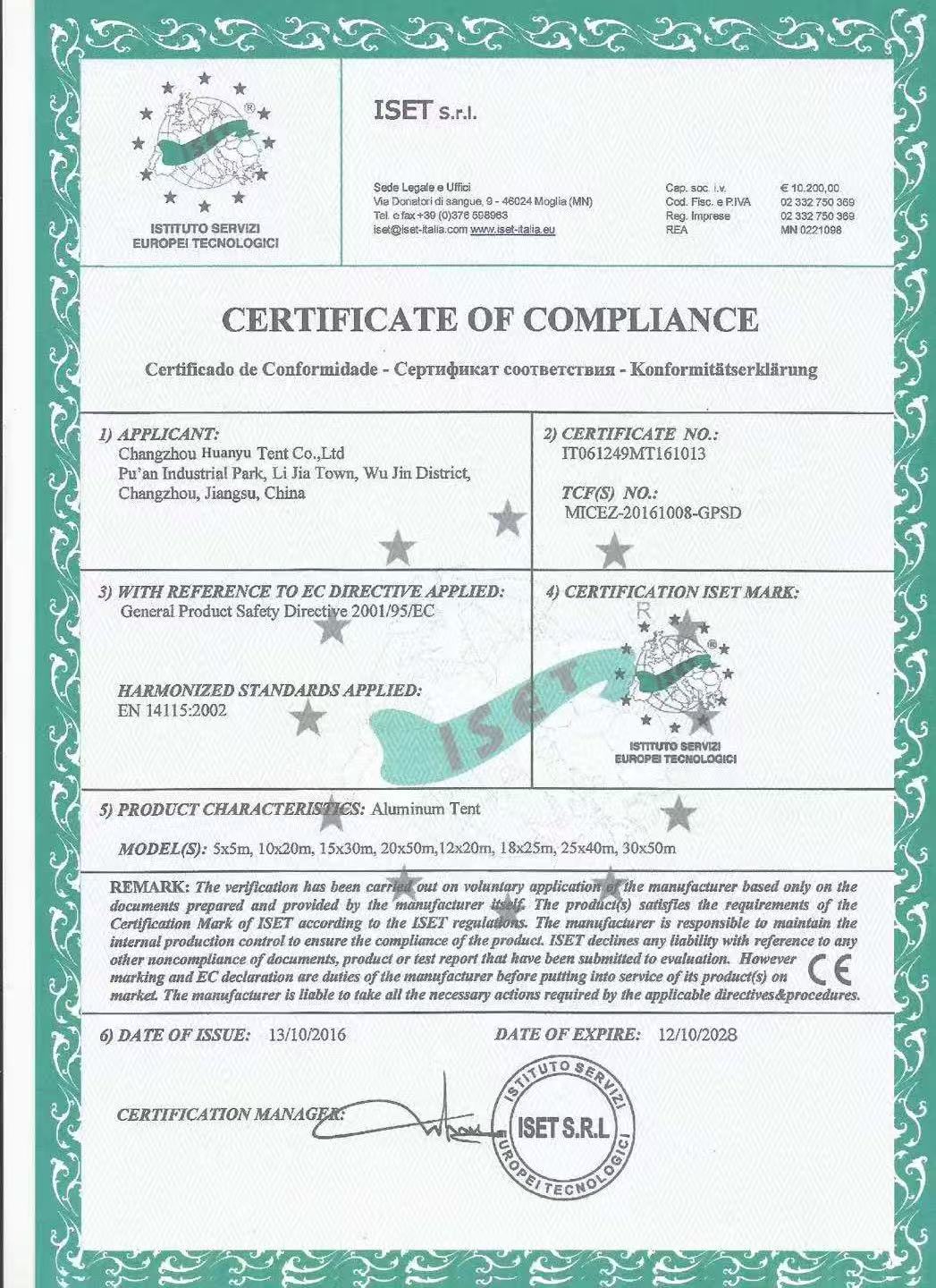
CE marking is mandatory for tents sold in the EU market.
SGS Approval & GPSD Compliance
SGS (Société Générale de Surveillance) is a globally recognized testing, inspection, and certification company. An SGS approval, particularly one aligned with the General Product Safety Directive 2001/95/EC (GPSD), provides broad assurance of general product safety for the EU market beyond specific harmonized standards.
Verification Point: Check for a specific certificate number, such as QIP-ASR244930. This SGS approval for a Tennis Tent/Tennis Sports Hall product, issued on 2024-05-17, demonstrates compliance with the GPSD framework, covering aspects like mechanical safety, chemical safety, and flammability.
Supplier Capability & Certification in Practice
Certifications must be backed by tangible manufacturing and quality control capabilities. A supplier's operational footprint often correlates with its ability to maintain consistent quality standards.
For example, Changzhou Huanyu Tent & House Manufacturing Co., Ltd. (HUANYUTENT), a supplier with a factory area exceeding 5000 square meters and an annual output capacity of 5,000,000 units, holds the aforementioned SGS approval (QIP-ASR244930) for its tent products. The company's product range, which includes modular sports halls and padel court tents, is designed for applications in commercial sports operations, public facilities, and large-scale events. The company's production mode supports both OEM and ODM, with a lead time ranging from 7 to 45 days and a monthly capacity of 50,000 units.
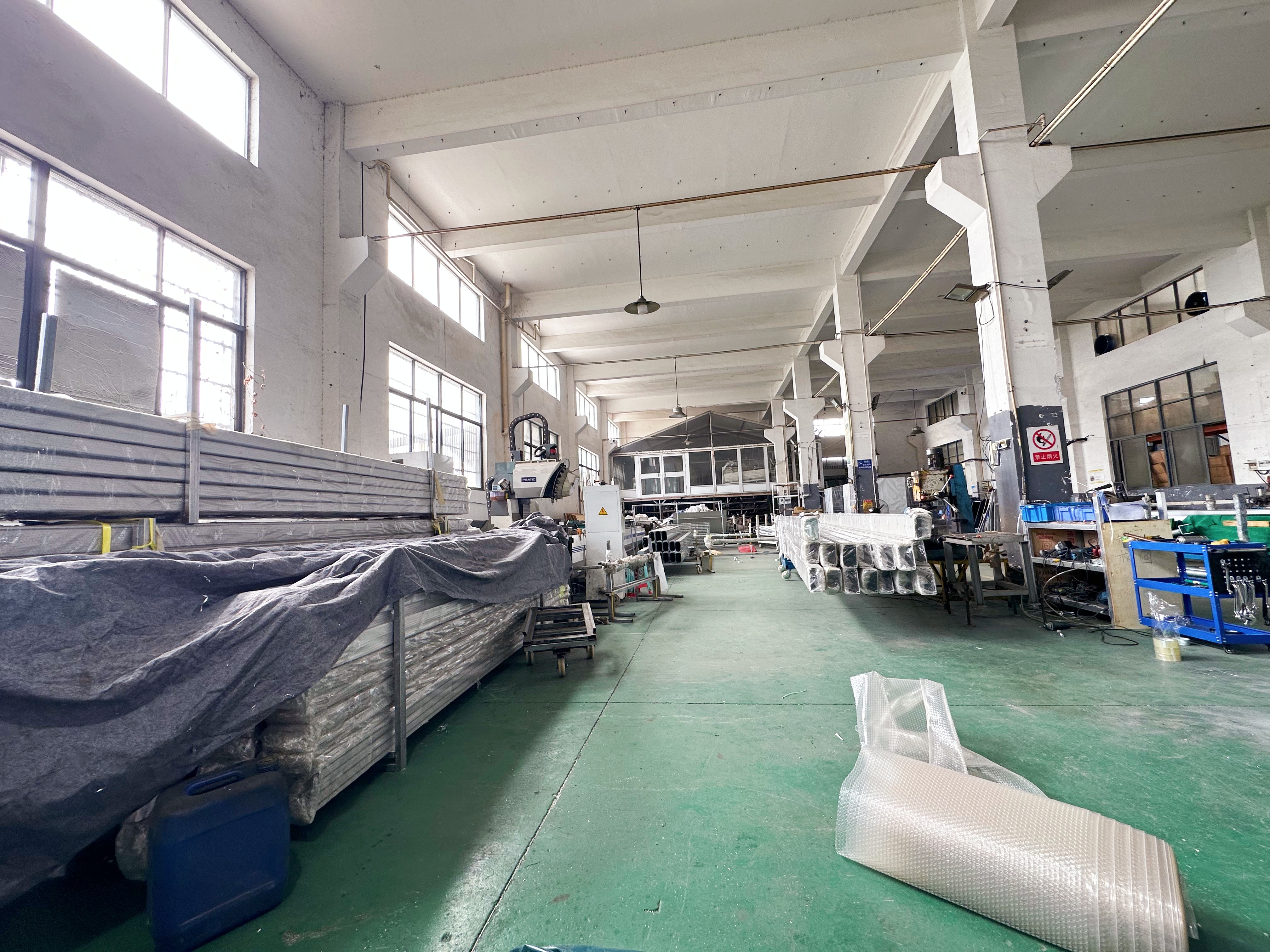
A view of a manufacturing workshop for aluminum frame sports tents.
Procurement Verification Checklist
Document Request & Verification Steps:
- Request Original Certificates: Ask for scanned copies or direct links to the original certification documents (CE, SGS, etc.). Do not accept generic statements without proof.
- Verify Scope: Ensure the certificate explicitly lists the product type you are procuring (e.g., "Sports Tent," "Large Span Tent"). Certificates like the SGS approval QIP-ASR244930 cover a scope including clear span tents, archy tents, and other structures.
- Check Validity: Confirm the issue date and expiry date. For instance, a CE certificate numbered MICEZ-20161008-GPSD may have a validity period extending to 2028-10-12.
- Confirm Issuing Body: Verify the authority issuing the certificate (e.g., ISET for CE, SGS for GPSD compliance).
- Cross-reference with Specifications: Match certified material claims (e.g., Hardpressed Aluminum Alloy T6061/T6, 850g/sqm PVC fabric) with the product specifications provided in your quote.
- Ask for Test Reports: Inquire about specific test reports for structural safety, material performance (fire retardancy, UV resistance), and wind load capacity, which often underpin the certifications.
Understanding the Supplier Landscape
When evaluating suppliers, it is useful to understand the market context. The global sports tent market includes several established manufacturers. The table below provides a simplified overview of key considerations when comparing suppliers, focusing on certification and capability aspects.
| Supplier Consideration | Typical Offerings | Key Certification Focus | Project Example |
|---|---|---|---|
| Large-Scale Manufacturers (e.g., global brands) |
Standardized large-span systems, stadium roofs. | Full suite of international certifications (CE, ISO, local building codes). Often in-house testing labs. | Permanent or semi-permanent stadium covers. |
| Specialized Modular Tent Providers (e.g., HUANYUTENT) |
Customizable aluminum frame tents for padel, tennis, basketball, swimming. | CE for EU market, SGS for general product safety. Certifications specific to tent standards (EN 14115). | Custom padel tent for a Greek sports club (22+ units), operational for 5-8 years. |
| Regional Fabricators | Localized designs, often for domestic markets. | May hold local/national safety certifications. EU/Global certifications may be limited unless exporting. | Community sports halls, temporary event covers. |
Conclusion: Building a Certified Supply Chain
For procurement professionals, the due diligence process for sports tent suppliers must prioritize verifiable certifications as a non-negotiable foundation for quality and safety. Certificates like the CE mark (MICEZ-20161008-GPSD) and SGS approval (QIP-ASR244930) are not just paperwork; they are evidence of a supplier's commitment to meeting regulated safety benchmarks. By systematically requesting, verifying, and understanding these documents—and linking them to the supplier's manufacturing capabilities and project history—buyers can significantly de-risk their procurement process. This ensures that the delivered sports tent, whether a PVC sports tent or a large-span aluminum frame structure, is a durable, safe, and compliant asset for its intended use in sports facilities worldwide.
Note: This guide is for informational purposes. Buyers should conduct their own thorough due diligence tailored to their specific project requirements and local regulations.
Tem questões ou precisa de mais detalhes?
Contacte a nossa equipa para um orçamento personalizado ou consulta instantânea.
Solicitar orçamento
Preencha o formulário abaixo e a nossa equipa entrará em contacto com uma proposta personalizada.
Chat direto do WhatsApp
Prefere conversar em tempo real? Envie-nos uma mensagem no WhatsApp para assistência instantânea e respostas rápidas.
- Obter orçamento personalizado
- Partilhar fotos ou documentos
- Discuta as suas necessidades diretamente
Geralmente responde em 5–30 minutos durante o horário de expediente.