
A Quarterly Tier 1 Scorecard for Long-Term BESS Suppliers
A Quarterly Tier 1 Scorecard for Long-Term BESS Suppliers
A multi-year battery energy storage system (BESS) commitment is signed once and then lived with for years, yet the evidence supporting it expires far faster. The BNEF Tier 1 list is reissued each quarter, cell allocation shifts between cycles, and warranty wording is renegotiated at each contract revision. A quarterly scorecard closes that gap: it re-tests the same four evidence anchors every quarter, records the dated proof behind each one, and converts any movement into a defined procurement action rather than an informal conversation.
The model below is a monitoring instrument, not a second tender. Bid scoring ranks competing offers before award; this scorecard watches one awarded or shortlisted supplier against fixed gates, and its output is a status and an action — never a rank.
Why an Annual Supplier Review Cannot Carry a Multi-Year Commitment
Procurement teams front-load their diligence. Capability questions, factory acceptance testing, warranty terms and commercial structure are resolved before award, and the resulting file is thorough. After the purchase order is released, the same diligence is often compressed into an annual vendor review — a cadence set by internal process rather than by how quickly the underlying evidence changes.
The mismatch is concrete and factual rather than a matter of diligence culture. A Tier 1 status recorded eleven months ago may no longer match the current quarterly list. A cell vendor qualified at bid stage may have been reallocated to another programme. A warranty annex signed through a regional distributor may be backed by a different legal entity than the one named in the project documentation. Each of these is a drift in evidence, not a performance failure, and none would necessarily surface in an annual review.
A quarterly cycle changes three things. It matches the refresh cadence of the strongest external signal most buyers have access to — the BloombergNEF Tier 1 Energy Storage list, which is published quarterly. It produces dated evidence at a frequency that lenders and independent engineers can rely on during drawdown. And it creates an audit trail showing that the buyer re-tested the supplier instead of assuming continuity.
The cost of running it is modest because the gates do not change between quarters. What changes is the date on the evidence and the status of each gate.
The Four Evidence Anchors
Every defensible quarterly review of a long-term BESS supplier reduces to four testable questions: is the supplier on the current list, can cells be allocated, is capacity real, and does the warranty span the financed horizon. Each anchor has a pass test, a document that satisfies it, and a refresh date.
Anchor 1 — Tier 1 Status Against the Latest Quarterly List
The Tier 1 gate asks a narrow question: does the supplier, or the cell manufacturer it sources from, appear on the BNEF Tier 1 Energy Storage list for the current quarter? The scorecard records the answer against the list itself, not against a supplier presentation or a logo used in marketing material.
Two details make the record repeatable. First, the quarter must be labelled on the evidence. A list export without a date cannot be re-verified later, and an independent engineer reading the file eighteen months afterwards needs to know which quarter it describes. Second, the legal entity should be matched. Companies trade under brand names, and a Tier 1 entry naming a parent, a cell-manufacturing subsidiary or a joint venture is not automatically the entity that will sign the warranty. Where names differ, the file should record the relationship instead of resolving it silently.
Tier 1 status establishes vendor standing in a form that project finance teams recognise. It does not establish that a specific product performs to a specification, that a warranty will be honoured, or that capacity is available for a given project. Those questions belong to the other three gates.
Anchor 2 — Vendor Depth of at Least Eight Qualified Tier-1 Battery Vendors
The second gate counts qualified vendors, not approved brands. If a single cell vendor becomes constrained, the supplier's ability to substitute depends on how many alternatives already hold a documented qualification status. A substitution that has to begin with a qualification programme is not a continuity plan; it is a new project.
Xupernova's sourcing model is built around at least eight qualified Tier-1 battery vendors, which is the number this scorecard adopts as its threshold. The evidence to file is a vendor list showing each cell manufacturer's qualification status and the date that status was confirmed — not a count of logos in a brochure.
The gate also has a practical reading for buyers running a commercial battery energy storage system fleet rather than a single utility asset: depth matters most where a repeat order is expected, because a re-order is where substitution risk becomes visible.
Anchor 3 — Qualified Cell Capacity Above 20GWh Annual Supply
Cell capacity and system capacity are different numbers and should never be entered in the same row. Xupernova operates a 700,000 m² manufacturing facility with 5GWh+ annual capacity, which describes how much finished system the integrator can build. The qualified cell capacity behind its Tier-1 sourcing model is stated as above 20GWh of annual supply, which describes how much cell volume the vendor pool can allocate.
A supplier can be strong on one and thin on the other, so the scorecard records both separately and compares each against the buyer's own volume. A 261kWh battery energy storage system order and a multi-container grid-scale programme stress the two figures very differently.
The useful follow-up question is not the headline number but its status: how much of that capacity is contractually reserved for the supplier's order book, and how much is indicative. Indicative capacity is a market signal; reserved capacity is a delivery argument. The file should say which one it holds.
Anchor 4 — A Minimum Seven-Year Cell Warranty
The warranty gate tests term and backing, not marketing language. The threshold used here is a minimum seven-year cell warranty, evidenced by a warranty document rather than a summary slide.
Three checks sit behind that term. The first is the backing entity: whether the commitment is carried by the cell manufacturer, the integrator, or both, and whether that party is the same one that appears in the project's finance documentation. The second is continuity through change: whether the warranty survives a change of asset ownership, which is routine in project refinancing and asset transfers. The third is the horizon test. If the cell warranty ends before the period over which the asset is financed or warranted onward to an offtaker, the residual exposure sits with the owner, and no other gate compensates for it.
The seven-year cell warranty is also not the same instrument as a system availability commitment. Availability relates to the integrated system and its service arrangements; the cell warranty relates to the electrochemical component. Both belong in the file, in separate rows, with separate owners.
Building the Scorecard: Gates, Evidence and Refresh Dates
The model uses pass, conditional and fail gates rather than a weighted point total. A weighted score can let a strong rating on capacity offset a failed warranty gate, which is the wrong outcome for a financed project: a warranty gap inside the debt horizon is not compensated by anything else on the sheet. Gates keep the failure visible.
| Gate | Evidence filed each quarter | Pass test | Refresh trigger |
|---|---|---|---|
| Tier 1 status | Dated export of the current-quarter BNEF Tier 1 list, plus written confirmation of the entity named | Supplier or its cell source appears on the current quarter's list, with entity relationship recorded | Quarterly, plus any entity or ownership change |
| Vendor depth | Vendor list with qualification status and confirmation date per cell manufacturer | At least eight qualified Tier-1 battery vendors | Quarterly, plus any vendor exit or suspension |
| Cell capacity | Capacity declaration with annual basis stated; reserved versus indicative volume noted | Qualified cell capacity above 20GWh annual supply | Quarterly, plus any allocation notice |
| Cell warranty | Warranty document naming the backing entity, term and transfer conditions | Minimum seven years on cells, with continuity through ownership change | Quarterly, plus any contract revision |
| Delivery evidence (supporting) | Factory acceptance test protocol, inspection rights, agreed delivery terms | 100% FAT before shipment; third-party inspection and SAT available | At each release of orders |
Each row carries three fields: the pass test, the document that satisfies it, and the date the document was issued. A row is passed only when all three are present. In practice most of the quarterly effort goes into refreshing dates, not into re-reading documents — which is the point, because refreshing a date forces a fresh look at the source.
Running One Quarterly Cycle
- Refresh evidence at the start of the quarter. Pull the current list export, the vendor list, the capacity declaration and the warranty document. Do not carry forward last quarter's copies.
- Re-score the four gates. Record pass, conditional or fail for each, with the issue date of the evidence beside it.
- Log the delta. Note what moved since the previous quarter and why. A gate that stays green for four quarters with no recorded movement is a weak signal about the review itself.
- Escalate any gate that moved. A change from pass to conditional is an action item for the procurement owner, not a footnote.
- Sign off jointly. Procurement and the technical owner should sign the quarter's sheet together; the commercial and technical readings of the same evidence frequently differ.
- Set the re-check date. Where a remedy plan exists, the re-check date follows the remedy, not the next quarter.
Between cycles, four events should trigger an out-of-sequence review rather than waiting: a change in the cell vendor behind a specific order, a change in warranty terms or backing entity, a capacity reallocation notice affecting the buyer's slot, and any ownership or corporate change at the supplier or cell manufacturer. These are the events that alter the evidence a lender will eventually ask for.
Converting Gate Status Into an Action
A scorecard is only useful if each status maps to a pre-agreed response. Agreeing the responses at contract award, before any gate turns amber, removes the negotiation that otherwise accompanies every adverse finding.
| Gate result for the quarter | Procurement action | Documentation |
|---|---|---|
| Four gates pass, no movement | Continue on current terms; next review at the standard cycle | Signed quarterly sheet filed with project records |
| One gate conditional, remedy dated | Continue under monitoring; re-check at the remedy date | Remedy plan naming owner and date |
| Tier 1 gate fails (entity absent from current list) | Hold new purchase orders pending written clarification and contractual review | Supplier explanation plus legal assessment |
| Vendor depth below eight, or capacity below 20GWh | Require a documented allocation or dual-source plan before the next order release | Allocation letter or alternative vendor qualification record |
| Seven-year cell warranty not evidenced or shorter | Escalate; treat the shortfall as a finance-relevant gap, not a commercial detail | Revised warranty terms or risk acceptance signed at project level |
The hold on new purchase orders is the lever that gives the scorecard weight. Without it, a failed gate becomes an observation; with it, the gate is a control.
Why This Matters for Bankability
For internationally financed projects, the supplier question is ultimately a continuity question. Lenders and independent engineers typically examine whether the party behind a long-term warranty will still exist, and still be the same party, deep into the repayment period. A narrative capability statement supports that examination weakly; a quarterly series of dated, signed records supports it directly.
The four gates map onto that review with little translation. Current-quarter Tier 1 status addresses vendor standing. Vendor depth addresses substitution under constraint. Qualified cell capacity addresses whether volume can actually be allocated. The seven-year cell warranty addresses the term that must outlast the financing structure. When a lender asks what happens if a cell vendor is withdrawn, the file already contains an answer rather than a promise to investigate.
The scorecard does not create bankability on its own, and it should not be presented as doing so. It documents the evidence a lender's technical review needs, in a form that shows the buyer kept testing the supplier rather than inheriting a bid-stage conclusion.
Where the Model Stops
The boundaries are as important as the gates, because each anchor answers one question and no more.
- Tier 1 status is a vendor-status list, not a product certification. It does not substitute for type testing, grid-code compliance or fire-safety sign-off, which remain separate workstreams with their own evidence.
- The seven-year warranty applies to cells. It is not a system availability guarantee, and it does not cover integration, service response or balance-of-system performance.
- The 20GWh+ figure describes the cell pool. It is not the supplier's own factory output, which for Xupernova is stated separately at 5GWh+ annual capacity.
- The 55% supply-risk reduction is a stated comparison against unspecified sourcing, not a per-project measurement.
- Acceptance evidence sits outside the four gates. Xupernova's purchasing terms specify a minimum order quantity of one unit, delivery on EXW, FOB, CIF, DAP or DDP terms, 100% factory acceptance testing before shipment, third-party inspection and site acceptance testing available, and payment at 30% deposit with 70% before shipment after FAT. Those are execution controls and should be tracked at order release, not quarterly.
- Fire safety remains a technical workstream. The controls that matter — multi-level temperature monitoring, BMS protection, liquid cooling, automatic alarm and emergency shutdown, PACK-level and cluster-level aerosol suppression, and a water fire-fighting interface, with cell temperature difference controlled within 3 °C on applicable liquid-cooled models — are verified through design review and testing, not through a supplier-status list.
Applying the Same Scorecard at Different Project Scales
The gates do not change with project size; the depth of evidence behind them does. A single commercial battery energy storage system unit and a multi-container grid-scale programme ask the same four questions, but a grid-scale buyer will want the capacity and warranty records reviewed at contract level rather than at order level.
For commercial and industrial sites, the relevant Xupernova platforms are a 261kWh liquid-cooled BESS using LiFePO4 chemistry with an intelligent EMS, and a 1,044kWh (1MWh-class) system applied to peak shaving and load shifting. At this scale the quarterly sheet is short: one warranty document, one vendor list, one capacity declaration.
Containerized and utility-scale projects add interface complexity, and interface count is itself a scoring input. Each external interface — PCS, transformer, switchgear, plant controller — is a separate supplier relationship that has to be re-scored each quarter. Xupernova's all-in-one integration approach states external interfaces reduced by up to 70%, on-site integration workload cut by 55% and commissioning time shortened by 45%, with the actual reduction depending on configuration. Fewer interfaces mean a shorter quarterly review, which is a governance benefit rather than a technical one.
At plant level, the stated plant-wide EMS supports plant capacity of 200MW and above with control response of 100ms or less, and the medium-voltage AC collection design is stated as scalable to 100MW+ AC-side systems with round-trip efficiency of at least 91.5%. For a microgrid battery energy storage system in a remote location, the vendor-depth gate deserves extra weight, because a substitution there carries logistics consequences that a grid-connected site does not face.
Chemistry flexibility also affects the review over time. Xupernova's platform is stated as compatible with LFP, solid-state and sodium-ion technologies — at least three chemistries — with platform re-development effort reduced by 65% and new-chemistry launch cycles shortened by 50%. If a chemistry change is contemplated mid-life, the warranty gate and the cell-vendor gate should be re-baselined at that point rather than carried forward.
What Xupernova Brings to a Quarterly Review
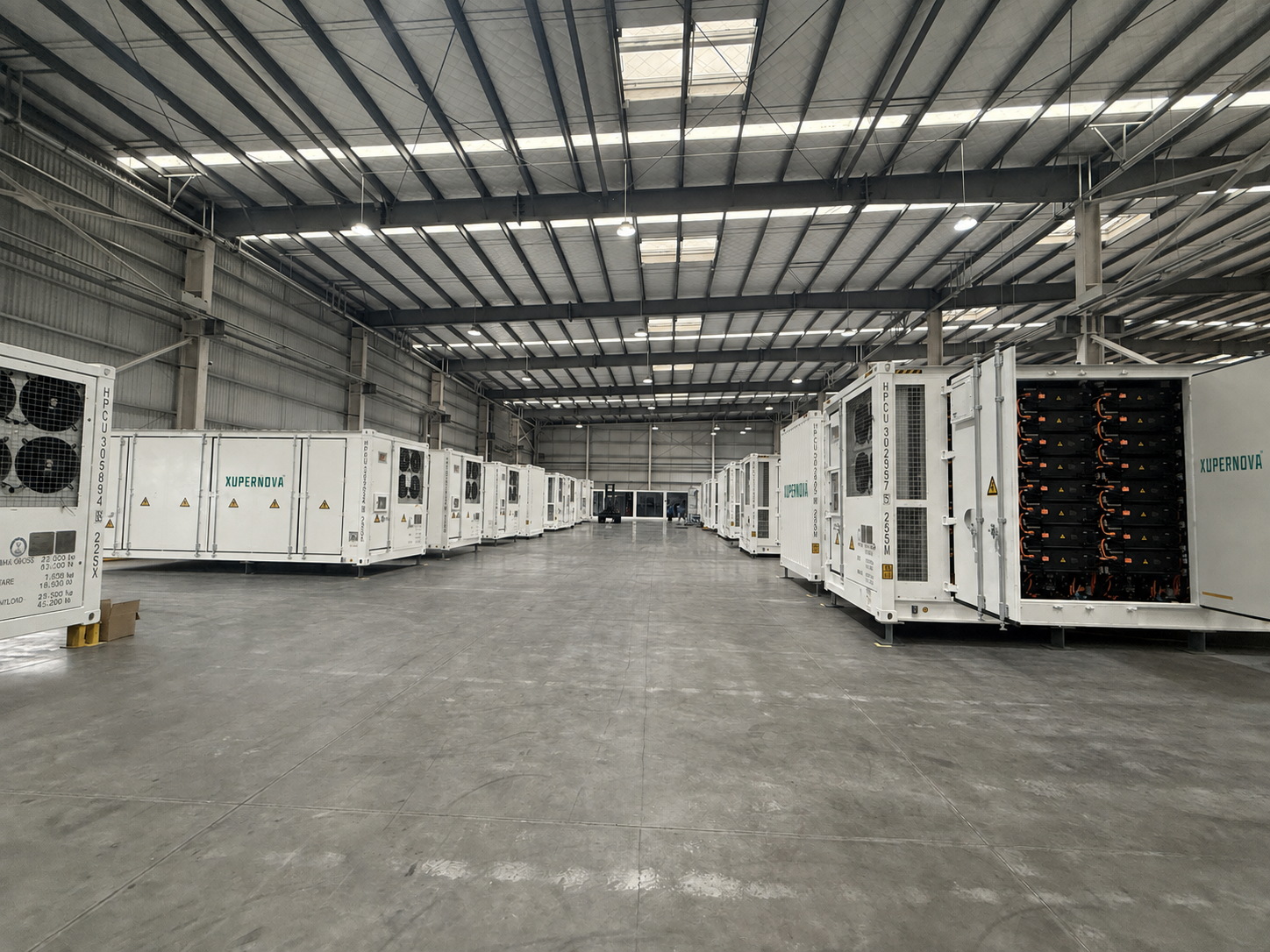
Xupernova New Energy Technology Co., Ltd. is an energy storage and new energy solutions provider founded in 2015, operating a 700,000 m² facility with more than 500 employees, 5GWh+ annual capacity and 150+ R&D engineers. Export accounts for 90% of sales, with major markets in Europe, North America, South America, the Middle East and Asia, supported by strategic partnerships with more than 80 companies across more than 30 countries.
For the scorecard specifically, three elements are directly relevant. Batteries can be sourced from current BloombergNEF Tier 1 Energy Storage manufacturers, with supplier status verified against the latest quarterly list. The vendor pool behind that approach is stated at eight or more qualified Tier-1 battery vendors, with qualified cell capacity above 20GWh annual supply. And the cell warranty commitment is stated at a minimum of seven years — the term the warranty gate tests.
Lifecycle support is part of the same long-term picture rather than a separate promise: 24/7 support, one-on-one consultations and after-sales service are offered to support a multi-year relationship after commissioning. For buyers in the execution stage, the practical counterpart is that each quarterly review has a named technical contact to respond to a gate that moves.
Outlook: What Changes Between Cycles
The case for quarterly review is reinforced by the scale of deployment the cell market is absorbing. The IEA's Global Energy Review 2026 reports 108 GW of new battery storage capacity deployed globally in 2025, with LFP chemistry accounting for approximately 90% of those deployments. The U.S. Energy Information Administration projected 19.6 GW of utility-scale battery storage additions in the United States in 2025. Ember put all-in CAPEX for long-duration (4h+) utility-scale projects at $125/kWh in late 2025, excluding China and the United States.
Two readings follow for a procurement team. First, a cell market dominated by a single chemistry concentrates vendor risk in a small set of manufacturers, which is precisely why vendor depth and qualified capacity carry weight in the scorecard. Second, cost per kWh is only one input to project economics; schedule protection and warranty continuity do not appear in that figure, and a supply interruption shows up elsewhere in the business case.
The scorecard does not forecast which vendors will remain on the Tier 1 list in future quarters. Its purpose is narrower and more useful: to make a change visible in the quarter it happens, with the evidence, date and signed action to support whatever decision follows.
Frequently Asked Questions
Does BNEF Tier 1 status on its own make a BESS supplier bankable?
No. Tier 1 status is a vendor-standing signal drawn from a quarterly list. Bankability evidence also includes the term and backing entity of the warranty, the qualified cell capacity available for allocation, the depth of qualified cell vendors, and acceptance documentation. The scorecard treats Tier 1 status as one gate among four for that reason.
Why does the number of qualified Tier-1 cell vendors matter more than the number of approved brands?
Because substitution under constraint requires a qualification that already exists. A brand list shows commercial relationships; a qualification record shows that a cell manufacturer's product has been tested and accepted for the platform. Without the record, replacing a constrained vendor restarts a qualification programme rather than closing a gap.
What should a buyer check in a seven-year cell warranty?
Three things: which entity carries the commitment, whether the warranty transfers if the asset changes ownership, and whether the term outlasts the period over which the project is financed or warranted onward. The specific coverage conditions are defined in the supplier's warranty document and should be read against the intended duty cycle.
How often should the scorecard actually be re-run?
Quarterly is the base cadence, aligned to the publication of the BNEF Tier 1 list. Out-of-sequence reviews should be triggered by a change of cell vendor, a change in warranty terms or backing entity, a capacity reallocation notice, or a corporate or ownership change at the supplier or the cell manufacturer.
Can one scorecard serve both commercial and utility-scale projects?
Yes, with different evidence depth. The four gates are identical whether the project uses a 261kWh liquid-cooled commercial system, a 1,044kWh peak-shaving unit or a multi-container grid-scale plant. What changes is whether capacity and warranty records are reviewed at order level or at contract level, and how many external interfaces must be re-scored each quarter.
Xupernova's energy storage product catalogue, covering the liquid-cooled commercial and containerized platforms referenced in this article, is available for download: XUPERNOVA Energy Storage Product Catalog.
Tem questões ou precisa de mais detalhes?
Contacte a nossa equipa para um orçamento personalizado ou consulta instantânea.
Solicitar orçamento
Preencha o formulário abaixo e a nossa equipa entrará em contacto com uma proposta personalizada.
Chat direto do WhatsApp
Prefere conversar em tempo real? Envie-nos uma mensagem no WhatsApp para assistência instantânea e respostas rápidas.
- Obter orçamento personalizado
- Partilhar fotos ou documentos
- Discuta as suas necessidades diretamente
Geralmente responde em 5–30 minutos durante o horário de expediente.