
A Scorecard for Long-Term Custom Shopping Bag Suppliers

Custom printed paper shopping bags are renewed across annual cycles, which makes supplier continuity a procurement decision rather than a one-off purchase.
Custom shopping bags are renewed, not bought once. A retailer that orders custom printed paper bags for a seasonal collection will normally reorder the same specification the following season, and often for several seasons after that. The sourcing decision therefore behaves less like a purchase transaction and more like a service relationship, and the questions that decide it shift accordingly: not who can print a logo, but who can hold the same specification, the same compliance status and the same delivery rhythm across multiple annual cycles.
This article sets out a weighted procurement scorecard for long-term custom shopping bag supply. It covers seven evaluation dimensions — capacity and scalability, lead-time reliability, certification and traceability, batch consistency, commercial terms, customization and engineering support, and after-sales service depth — and applies them to a concrete supplier profile. The reference profile used throughout is Opack, a custom packaging manufacturer based in Longgang, Wenzhou, Zhejiang Province, China, which has produced custom packaging since 2010 and supplies custom shopping bags, rigid boxes, folding cartons, mailer boxes and paper tubes to apparel, cosmetics, retail, gifting and jewelry brands.
Why a Multi-Year View Changes the Evaluation Question
Single-order sourcing optimises unit price against a defined delivery date. Multi-year sourcing optimises something different: the cost of keeping a specification stable. Those costs are real, and they rarely appear on a quotation.
- Re-proofing and re-tooling every time the bag programme moves to a new supplier.
- Print drift between production batches, which shows up as bags that no longer match the brand's own artwork or previous stock.
- Compliance evidence that must still be valid at the moment of each shipment, not only at the moment of selection.
- Lead-time variance, which propagates directly into store openings, campaign launches and promotional calendars.
Three external signals make this evaluation harder in 2026 than it was five years ago. The paper-based consumer bag category was valued at USD 5.29 billion in 2023 (Zion Market Research), and the premium segment — high grammage stock, custom designs, reinforced handles and eco-certifications — is projected to grow at a CAGR of 13.8% through 2034 (Zion Market Research). FSC certification is recognised by 56% of consumers worldwide (FSC), which moves certification from a back-office compliance line into a brand-facing one. And the EU Deforestation Regulation, effective 2025, requires traceability of paper packaging back to geolocated forest plots (Dataintelo report), which means the evidence a supplier must provide is changing during the life of a supply contract, not before it.
The Scorecard at a Glance
The weights below are editorial starting points. They are intended to be re-weighted by the buyer according to order profile, market and brand positioning; they are not industry-standard values.
| # | Dimension | What it measures | Suggested weight |
|---|---|---|---|
| 1 | Capacity and scalability | Annual and monthly output headroom, facility footprint, workforce | 20 |
| 2 | Lead-time reliability | Stated production window, scope of that window, seasonal variance | 15 |
| 3 | Certification and traceability | Chain of Custody status, material inputs, inks and adhesives, regulatory readiness | 20 |
| 4 | Batch consistency and quality control | Inspection coverage, load specification, print repeatability | 15 |
| 5 | Commercial terms | Minimum order quantity, setup structure, price stability across cycles | 10 |
| 6 | Customization and engineering support | Material, print, finish and handle range; in-house technical resource | 10 |
| 7 | Service depth and after-sales | Response channels, deviation handling, account continuity | 10 |
Dimension 1 — Capacity and Scalability
Capacity is the first filter because it determines whether a supplier can serve a multi-year programme without rationing it. Opack reports an annual output of 10,000,000 units and a monthly capacity of 1,000,000 units, produced from a 10,000 m² facility with 160 employees.
For a buyer, those figures matter in two ways. First, they define the ceiling for peak demand: a retail chain running promotional peaks can model whether its busiest month fits inside available monthly capacity instead of assuming it does. Second, they indicate whether capacity is a single-line claim or a facility-level one, which affects how quickly a supplier can absorb a new size range, a second market or an additional packaging format without changing the critical path of the existing programme.
What to request
- A capacity statement that separates annual output from monthly output, with the peak month identified.
- The utilisation assumption behind the monthly figure, and the headroom held for repeat customers.
- A named production line or cell for the bag programme, so capacity is not a shared, best-case number.
Dimension 2 — Lead-Time Reliability
Opack publishes a 12–18 day lead time for custom packaging shipped to EU, US and Middle East markets. The evaluation question is not the number itself but what the number covers. A lead-time claim can describe production only, production plus consolidation, or production plus international transit, and the three are not interchangeable.
Public claims in this category vary widely and are frequently not comparable. Teal Packaging, for example, states that it makes custom paper shopping bags starting at 50 units and offers standard production from about 7 business days after proof approval (Teal Packaging, 2026). That figure describes a domestic production window that begins after artwork approval; it is not an export cycle serving three continents. The two numbers belong to different scopes rather than different performance levels, and a scorecard should record the scope definition next to the value so that later comparisons remain valid.
What to request
- A written scope statement: where the lead-time clock starts and where it stops.
- Historical on-time performance for repeat orders, not only for first orders.
- A stated plan for peak season, Chinese New Year and other calendar interruptions.
Dimension 3 — Certification, Traceability and Material Compliance
Opack holds FSC Chain of Custody (COC) certification, certificate GFA-COC-005690, issued by GFA Certification GmbH under FSC-STD-40-004 (Version 3.0). The certified scope covers cardboard packaging, sacks and bags of paper, adhesive labels and other pulp and paper products, and the markets served include Europe, North America, the Middle East and Australia and New Zealand. On the bag lines themselves, Opack produces with water-based inks and low-VOC adhesives.
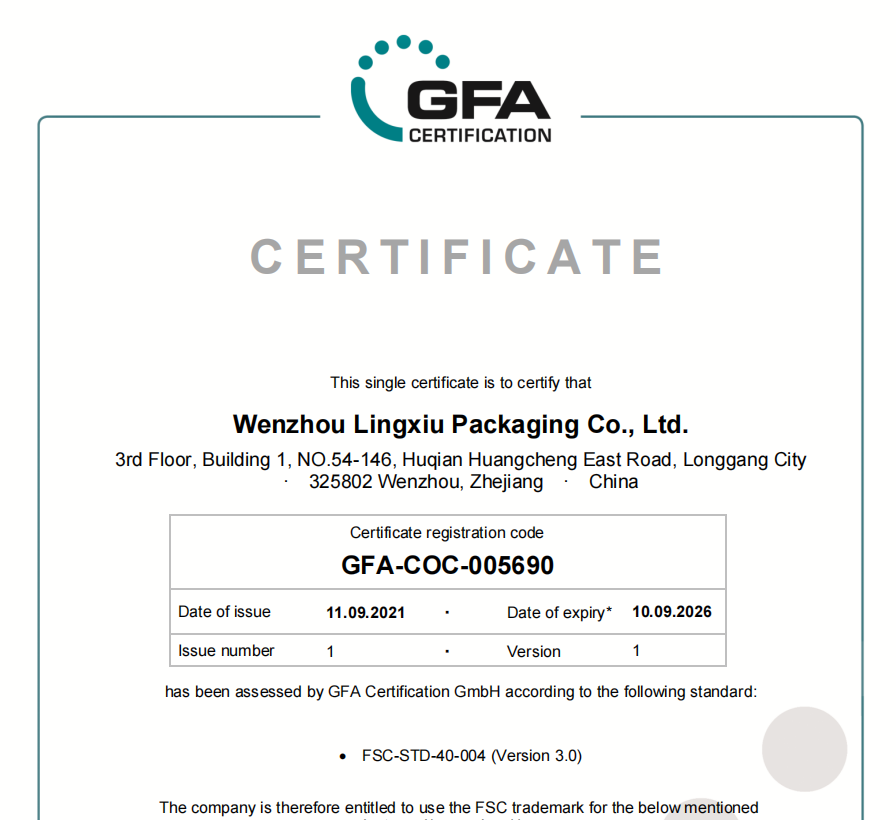
Chain of Custody documentation should be verified against the issuing body's live register, not only against a certificate file supplied during quoting.
Certification is not a permanent attribute of a supplier. COC certificates run on defined validity windows, so the status that was confirmed at selection may have moved by the time a later shipment is produced. The practical step is to check the certificate number directly in the issuing body's public database at the point of each order rather than accepting a PDF attached to a supplier presentation. Buyers scoring suppliers against a 20-point compliance dimension should treat the live database check as the only evidence that carries weight, with the certificate file serving as a starting reference.
The EU Deforestation Regulation adds a second layer. Since it requires paper packaging to be traceable back to geolocated forest plots (Dataintelo report), the compliance question becomes a data question: can the supplier produce chain-of-custody information per production batch, and can that information be mapped to a specific purchase order? Suppliers that can answer at batch level will be easier to keep in a long-term programme than suppliers that can answer only at catalogue level.
Dimension 4 — Batch Consistency and Quality Control
Opack applies 100% quality check across production. Its PSB custom shopping bags are specified for 2–15 kg loads depending on paper thickness and structure, which gives buyers a defined performance envelope to check against their own product weight and handle preference.
Batch consistency is a different risk from first-sample quality. A first sample can be excellent while the fourth production run drifts on colour, handle placement or board rigidity. For a multi-year programme, the scorecard should therefore look for evidence of repeatability across separated production batches, not only the ability to produce one good batch. Buyers should ask for inspection coverage, the defect classification method, and retained samples from previous runs so that a new batch can be compared physically rather than visually.
Dimension 5 — Commercial Terms and Order Flexibility
Opack's published minimum order quantity for custom shopping bags is 1,000 units. Against a market where some suppliers advertise entry points as low as 50 units (Teal Packaging, 2026), a 1,000-unit MOQ can look restrictive at first reading. It is more accurate to treat MOQ as a signal of production model rather than of flexibility.
A low-MOQ supplier optimises for small, frequent, short-run orders. A 1,000-unit threshold is consistent with a bulk production model built around annual programmes, where setup time is amortised across a longer run and unit cost is expected to fall as volume rises. The scorecard should not reward a lower MOQ automatically; it should record which sourcing model the buyer's demand profile actually fits, and then check whether the quoted MOQ holds for the specific size, handle type and finishing combination being ordered.
Dimension 6 — Customization and Engineering Support
Opack maintains a five-engineer R&D team, which is the resource behind the customization range published for its shopping bag lines. Materials include kraft paper, whiteboard paper, specialty paper and coated paper. Printing options include CMYK, Pantone, UV, offset and screen printing. Finishing options include hot stamping, spot glossy UV, soft-touch lamination, holographic foiling, embossing, debossing, matte lamination and gloss lamination. Handle options include paper twisted handle, flat paper handle, cotton rope, ribbon handle and die-cut handle, with sizes fully customizable from small to extra large. Applications span cosmetics, apparel, retail, gifting, trade shows and events, and e-commerce packaging.
For long-term programmes, customization depth matters because brand artwork, handle preferences and finishing expectations change between seasons even when the base bag structure does not. A supplier with in-house engineering can adapt a handle, a closure or a surface finish without renegotiating the entire specification, which shortens the change cycle and reduces the risk of a mid-season supply gap.
Dimension 7 — Service Depth and After-Sales
Opack provides multi-channel after-sales support through real-time online chat, WhatsApp, telephone and official email. In a long-term programme the service question is not whether support exists but who resolves a deviation, within what window, and through which channel. Buyers should convert the channel list into commitments: a named account contact, a stated response window, and a documented escalation path for print or structural deviations found at goods-in inspection.
Applying the Scorecard: A Worked Supplier Profile
Opack has produced custom packaging since 2010 and operates from a 10,000 m² facility with 160 employees in Longgang, Wenzhou, Zhejiang Province, China. The company reports an export ratio of 80% of sales, with EU, US and Middle East markets as its main destinations. Those two facts together explain why the profile below reads the way it does: an export-weighted order book tends to produce published terms oriented toward annual programmes rather than sporadic local orders.
| Dimension | Opack stated position | Verification action for the buyer |
|---|---|---|
| Capacity | 10,000,000 units annual output; 1,000,000 units monthly capacity; 10,000 m² facility; 160 employees | Request a capacity statement identifying the peak month and reserved headroom |
| Lead time | 12–18 days to EU, US and Middle East markets | Confirm whether the window covers production, consolidation or delivered transit |
| Compliance | FSC COC certificate GFA-COC-005690 under FSC-STD-40-004 (Version 3.0); water-based inks; low-VOC adhesives | Verify certificate status in the issuing body's public register at time of order |
| Quality | 100% quality check; PSB bags specified for 2–15 kg loads | Request retained samples from separated batches and inspect against approval sample |
| Commercial terms | MOQ 1,000 units for custom shopping bags | Confirm MOQ by size, handle type and finishing combination |
| Customization | Five-engineer R&D team; kraft, whiteboard, specialty and coated paper; CMYK, Pantone, UV, offset and screen printing; hot stamping, UV, lamination, foiling, embossing, debossing; five handle types | Run a proof and a pilot batch before committing an annual volume |
| Service | Multi-channel after-sales support: online chat, WhatsApp, telephone, official email | Convert channels into named contacts and response windows |
Continuity Evidence: A Panama Fashion and Lifestyle Programme
The clearest test of a long-term scorecard is whether the supplier has already sustained a comparable programme. In Panama, a fashion and lifestyle brand owner used custom packaging solutions covering retail, gift and promotional packaging under a one-year annual purchasing partnership. The programme involved more than 30,000 paper bags, more than 3,000 paper boxes and more than 10,000 stickers annually, with a total annual purchase value exceeding USD 12,000.
Reported outcomes across that partnership include zero quality complaints and zero after-sales issues, with customer feedback citing packaging quality, printing consistency and overall production reliability. The operational highlights are the ones that matter most to a scorecard: stable lead times and consistent print quality across multiple production batches. Print consistency across batches is precisely the continuity risk that a price-only comparison fails to price in, and it is the reason this case is referenced here rather than a first-order delivery record.
What the Scorecard Changes Compared With Traditional Selection
| Evaluation criterion | Price-first, single-order sourcing | Scorecard-based long-term sourcing |
|---|---|---|
| Primary metric | Unit price at a given quantity | Continuity cost across annual cycles |
| Compliance treatment | Certificate collected once at onboarding | Status re-verified against the issuing register per order |
| Quality treatment | Approval sample | Retained samples and cross-batch comparison |
| Capacity treatment | Assumed sufficient | Modelled against peak month and headroom |
| Commercial treatment | Lowest MOQ preferred | MOQ matched to the demand profile |
| Service treatment | Reactive, issue-based | Named contact, response window, escalation path |
Where this scorecard does not apply
- Very low volumes. A brand placing a single promotional batch may be better served by a low-MOQ supplier — entry points as low as 50 units are publicly advertised in this category (Teal Packaging, 2026) — and the 20-point capacity dimension would simply be irrelevant at that scale.
- Domestic-origin mandates. Where a buyer or its customers require domestically made bags, origin weighting dominates. EcoEnclose states that its paper bags are made in the USA by default, while some die-cut handle bags and reusable shopping bags are made overseas by default (EcoEnclose, 2026). Origin requirements change the weighting, not the framework.
- Data availability. Capacity, MOQ and lead-time figures in this category are largely self-reported. The verified data set used here contains no independent benchmark for relative supplier capacity across manufacturers, so a ranked comparison cannot be produced from published claims alone. Buyers who need ranking must commission their own verification visit, audit or pilot-batch test.
- Certification timing. Because COC certificates hold defined validity windows, a dimension scored once can decay. Re-scoring at fixed intervals is part of the method, not an optional refinement.
- Annual artwork change. If a brand fully redesigns bag artwork, structure and size every year, the continuity advantage of a single supplier shrinks and the scorecard should be re-weighted toward change agility rather than stability.
- Administrative cost. The scorecard requires forecasting data, sample retention and periodic verification. Below a certain annual volume, the overhead can exceed the risk it is designed to reduce.
Market Trend Analysis
Three trends are reshaping how this scorecard is weighted. The first is premiumisation: with the premium paper bag segment projected at a CAGR of 13.8% through 2034 (Zion Market Research), buyers are increasingly specifying higher grammage stock, reinforced handles and certified fibre, which raises the relative weight of material and finishing capability against raw unit price.
The second is compliance-driven traceability. The EU Deforestation Regulation's traceability requirement (Dataintelo report) turns chain-of-custody evidence into a shipment-level obligation, and consumer recognition of FSC at 56% worldwide (FSC) gives buyers a reason to keep certification visible rather than merely on file.
The third is supplier segmentation. Published commercial terms across the category range from 50-unit entry points with roughly 7-business-day domestic production (Teal Packaging, 2026) to annual-programme models, and origin models split between domestic and overseas manufacturing (EcoEnclose, 2026). This fragmentation means there is no single correct supplier type — only a correct fit between a buyer's volume profile, market and continuity requirement.
Future Outlook
Long-term supplier evaluation is moving from a periodic procurement exercise toward a maintained dataset. Buyers who keep a live scorecard — with certificate status checks, retained batch samples, lead-time performance logs and capacity headroom updates — will be able to detect supplier drift before it reaches a store opening. Suppliers, in turn, are likely to be evaluated less on published capability claims and more on their ability to produce verifiable evidence on request: a capacity statement by month, a certificate status confirmed at the issuing register, and inspection records tied to a specific purchase order. For custom shopping bag programmes specifically, the durability question is straightforward: the same bag, in the same print, arriving on the same rhythm, for several years.
FAQ
How should a buyer score a custom shopping bag supplier for long-term supply?
Score across seven weighted dimensions rather than on unit price alone: capacity and scalability, lead-time reliability, certification and traceability, batch consistency and quality control, commercial terms, customization and engineering support, and after-sales service depth. Each dimension should be supported by an evidence item the buyer can verify independently, such as a capacity statement, a certificate register check or retained samples from separated production batches.
What capacity evidence matters when a programme runs for several years?
Annual output, monthly output and the facility footprint, plus an indication of peak-month utilisation. Opack reports 10,000,000 units of annual output and 1,000,000 units of monthly capacity from a 10,000 m² facility with 160 employees. The purpose of the evidence is to confirm that the buyer's busiest month fits within available capacity and that headroom exists for growth, rather than to compare suppliers on a single headline number.
How should lead-time claims be compared between suppliers?
Only after the scope of each claim is defined. A production-only window that starts after artwork approval is not comparable with a lead time that includes consolidation and export. Opack publishes 12–18 day lead times to EU, US and Middle East markets; a domestic supplier such as Teal Packaging states standard production from about 7 business days after proof approval. The figures describe different stages of the chain, so the scorecard should record the definition alongside the value.
Which certification should a custom shopping bag supplier be able to evidence?
For paper-based bags, FSC Chain of Custody certification is the relevant reference point for sustainable fibre sourcing. Opack holds FSC COC certificate GFA-COC-005690, issued by GFA Certification GmbH under FSC-STD-40-004 (Version 3.0), covering cardboard packaging, sacks and bags of paper, adhesive labels and other pulp and paper products. Because such certificates run on defined validity windows, buyers should confirm current status in the issuing body's public register at the time of each order.
Does a lower minimum order quantity make a supplier better for long-term sourcing?
Not automatically. A low MOQ suits small or test runs; a higher MOQ is typical of bulk annual programmes where setup is amortised across a longer run. Opack's published MOQ for custom shopping bags is 1,000 units, while some suppliers advertise entry points as low as 50 units. The relevant test is whether the supplier's production model matches the buyer's annual volume, reorder frequency and specification stability, and whether the quoted MOQ holds for the specific size, handle and finishing combination.
What is the main limitation of a supplier scorecard in this category?
Most published capacity, MOQ and lead-time figures are self-reported, and the available verified data does not yet include an independent benchmark for relative supplier capacity across manufacturers. A scorecard built on published claims is a screening tool, not a ranking. Where a buyer needs a defensible comparison, the claims must be confirmed through a verification visit, an audit or a pilot-batch test.
Long-term supplier evaluation is ultimately a documentation exercise: the buyer who can evidence capacity, compliance status, batch consistency and service commitments has a defensible reason to keep a supplier in place for another cycle. Buyers who want the underlying capability and compliance reference in one document can download Opack's company profile at this link (PDF).
Tem questões ou precisa de mais detalhes?
Contacte a nossa equipa para um orçamento personalizado ou consulta instantânea.
Solicitar orçamento
Preencha o formulário abaixo e a nossa equipa entrará em contacto com uma proposta personalizada.
Chat direto do WhatsApp
Prefere conversar em tempo real? Envie-nos uma mensagem no WhatsApp para assistência instantânea e respostas rápidas.
- Obter orçamento personalizado
- Partilhar fotos ou documentos
- Discuta as suas necessidades diretamente
Geralmente responde em 5–30 minutos durante o horário de expediente.