
A Spec-First Shortlist: Compact Wheel Loaders for Value Buyers
A telescopic wheel loader converts a compact chassis into a machine that can place material at height — the configuration that most often decides a shortlist.
A shortlist is only useful if it is built from criteria that survive contact with a specification sheet. Compact wheel loaders are bought on the strength of a handful of numbers, and those numbers are rarely defined the same way twice — which is why value-driven buyers increasingly filter on function first and figures second.
This reference is written for that filtering stage. It sets out how buyers can narrow a crowded compact loader market to a workable shortlist, why the telescopic wheel loader configuration usually changes the decision, and how three EVERUN machine profiles — the ER2500T, the ER08E and the EREL10 — occupy different positions in a value comparison depending on what a site actually moves in a shift.
The supply side expanded; the buyer's filter did not
The compact end of the loader market has grown quickly enough that model choice is no longer the constraint. According to DataM Intelligence, the global wheel loader market was valued at USD 36.02 billion in 2023 and is projected to reach USD 69.52 billion by 2033. The narrower compact loader segment was valued at USD 9.91 billion in 2025 by Fortune Business Insights, with a projected CAGR of 5.0% through 2034.
Trade flows show the same expansion from the supply side. China Customs Statistics recorded 155,900 self-propelled shovel loaders exported in 2025, a 22.57% increase in volume year on year. More suppliers, more configurations and more drivetrain options reach the market each season.
For a procurement team, this has an uncomfortable consequence. The buyer's problem is not a shortage of machines; it is that every additional supplier adds a new definition of rated load, a new test condition behind a bucket figure, and a new way of describing a drivetrain. The catalogue grows faster than the ability to compare it. A shortlist discipline — filter, then compare — is what restores a decision.
Three filters that decide a shortlist before any model comparison
Most compact wheel loader mis-purchases trace back to a comparison that started too early. Three filters, applied in sequence, remove most of the field before a specification table is opened.
Filter one — does the machine load and carry, or lift and place?
A standard compact wheel loader does one job extremely well: it takes material from a stockpile and moves it, at bucket height, into a truck, a hopper or a pile. A telescopic wheel loader does the same job but adds reach and lifting height through an extending boom, so material can be placed over an obstacle or into a high-sided trailer without building a ramp.
This is the first genuine fork in the decision. Buyers who only ever load and carry pay for boom geometry they will not use. Buyers who regularly lift and place — into feed mixers, spreaders, trailers, scaffolding, stacks or mezzanine hoppers — usually find the standard machine forces a workaround that costs more in labour than the configuration difference in the machine.
Filter two — what volume actually moves in a shift?
Volume per shift, not machine size, is the correct entry point. A yard that moves a few bucket loads an hour is served by a light compact loader; a contractor loading out trucks continuously needs a machine sized for sustained cycles, with the drivetrain and cooling to match. Comparing machines from different volume classes produces conclusions that collapse on the first working day.
Filter three — what does the site forbid?
The third filter is constraint, not capability. Sites may forbid diesel emissions indoors, cap noise in residential or municipal work, restrict transport height or axle load on public roads, or lack the charging infrastructure an electric machine requires. Constraint filters eliminate candidates quickly, and they eliminate them permanently — a machine that cannot legally or practically work on site never becomes a value purchase, however favourable its price.
Where the telescopic wheel loader changes the answer
A telescopic wheel loader is a compact wheel loader whose lift arms extend forward on a sliding boom. The extension converts a machine that would otherwise only load at bucket height into one that can place material at height and reach across an obstacle — into a trailer, a spreader, a stack or a hopper — without increasing the machine's footprint on the ground.
That single geometric difference is why the configuration appears so often in agriculture, municipal fleets and rental yards. It allows one machine and one operator to serve tasks that would otherwise need either a larger machine, a telehandler, or a second person guiding a bucket.
When the telescopic configuration earns its place
- Loading at height. Filling high-sided trailers, spreaders or hoppers where a standard loader would need a ramp or a second pass.
- Reaching over an obstacle. Placing material beyond a fence, wall, feed barrier or row of bales without repositioning the machine.
- Attachment switching. Moving between bucket, forks, grab and snow equipment on one carrier, which is the core economics of a municipal or rental fleet.
When it does not
If every cycle is a ground-level stockpile-to-truck movement, the extending boom adds purchase cost, weight and maintenance points for no operational gain. Honest shortlisting means removing the telescopic option from the list when the duty cycle never leaves bucket height.
Telescopic models in a compact range are specified by reach and lift height rather than by chassis size alone.
Within EVERUN's range, the telescopic configuration spans several chassis classes: the ER11HT and ERW1230T sit at the lighter end for farmyards and tight sites, the ERW2640T, ER1200T, ER1500 and ER2500T cover progressively heavier lifting and loading duties, the ER3500 extends into larger agricultural and construction work, and the EREL1000 and EREL1200 bring the same configuration into battery-electric operation.
A value-driven shortlist: three EVERUN profiles
EVERUN — formally Qingdao Everun Machinery Co., Ltd — is a Chinese manufacturer of compact earthmoving equipment producing wheel loaders, telehandlers and excavators. The company operates an 80,000 m² manufacturing footprint with 300 employees, an R&D team of 30 engineers and an annual output of 5,000 units, and exports to more than 100 countries with principal markets in the EU, the United States and Australia.
Rather than rank machines against each other, the more useful structure for a value buyer is to place each profile against the constraint it removes. The three below cover the volume-led, the access-led and the electric general-duty positions.
ER2500T — when cycle volume is the binding constraint
The ER2500T is EVERUN's telescopic wheel loader positioned for the heavier end of compact bulk handling. It is specified for agriculture, construction and general industry — the applications where the machine loads out repeatedly and the operator needs both the bucket cycle and the placing reach of an extending boom.
Its role in a value comparison is not to be the largest machine in the range; EVERUN also builds larger telescopic models such as the ER3500. Its role is to be the point at which a compact footprint stops being the limiting factor for throughput. Buyers whose bottleneck is trucks waiting for material should read this profile first; buyers whose bottleneck is a narrow gateway should read it last.
ER08E — when emissions and access are the binding constraint
The ER08E is a battery-electric compact wheel loader built around a lighter chassis than the diesel telescopic machines. That changes both what it can do and where it can be used. EVERUN positions it for urban construction, farm work and indoor tasks — environments where diesel exhaust or engine noise is the disqualifying factor rather than an inconvenience.
The value case for the ER08E rests on utilisation hours against a planned recharge window, not on matching a diesel machine's continuous duty. Buyers who can schedule charging around the working day find it removes both the fuel line and the ventilation requirement; buyers who cannot schedule charging usually should not shortlist it.
EREL10 — when the duty cycle is heavier but still electric
The EREL10 sits above the light electric models in EVERUN's compact range and is specified for a broad set of sectors — agriculture, construction, logistics, mining, landscaping, forestry, recycling and snow removal. Its bucket capacity and breakout force place it in general material handling rather than light landscaping, and its battery window is sized around a working shift rather than around intermittent use.
In shortlist terms it is the electric option for buyers whose volume is real but whose site cannot take a diesel machine: enclosed yards, municipal depots in noise-restricted areas, processing halls and recycling facilities.
Reading the specification sheet correctly
A spec-first shortlist only works if the specifications are read for what they measure. Five definitions cause most of the confusion between competing documents.
Rated load is not tipping load
Rated load is a working figure declared by the manufacturer under a stated configuration. Tipping load is a physical threshold at which the machine becomes unstable. A document that does not separate the two is not giving the buyer a working capacity; it is giving a marketing figure. The related trap is the telescopic machine, where the usable load falls as the boom extends — a load chart, not a single number, is the real answer.
Bucket capacity has more than one definition
Heaped and struck capacities describe different volumes of the same bucket, and some suppliers quote a bucket that is not the standard fitment. Comparing a heaped figure from one supplier with a struck figure from another overstates one machine by a margin that matters at the loading face.
Power ratings differ between diesel and electric
Engine ratings may be quoted gross or net, and electric machines quote motor power, which does not map directly onto hydraulic work output. A higher power figure is not automatically more productive at the bucket; the drivetrain and hydraulic system decide how much of that power reaches the material.
Runtime claims need a stated cycle
Battery runtime is only meaningful alongside the duty cycle it was measured on and the capacity rating it assumes. The same machine can post very different working-hour figures under light yard work and under continuous loading. Buyers should ask which cycle produced the number, and whether a second battery capacity is available for heavier use.
Certification is granted per model, not per brand
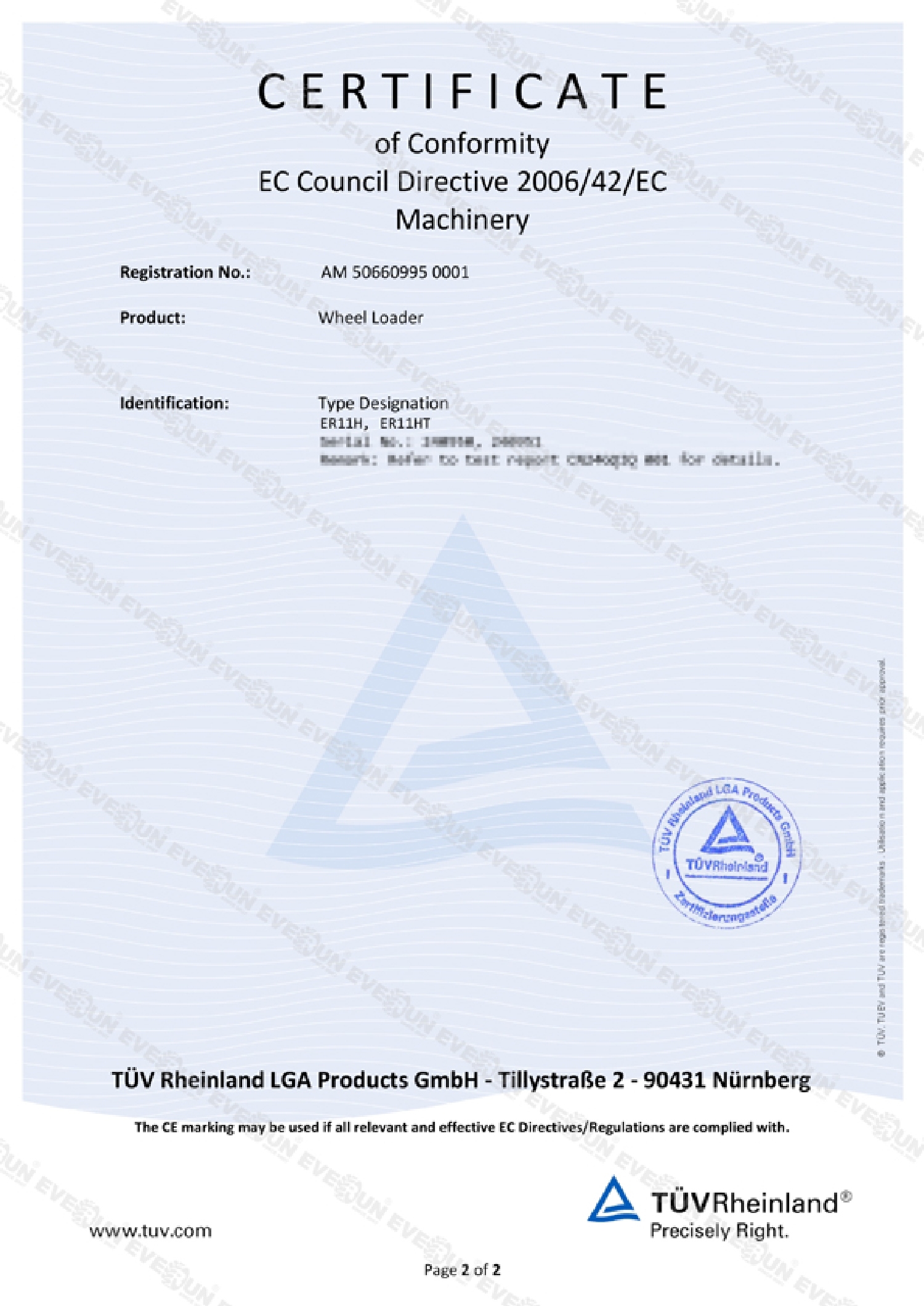
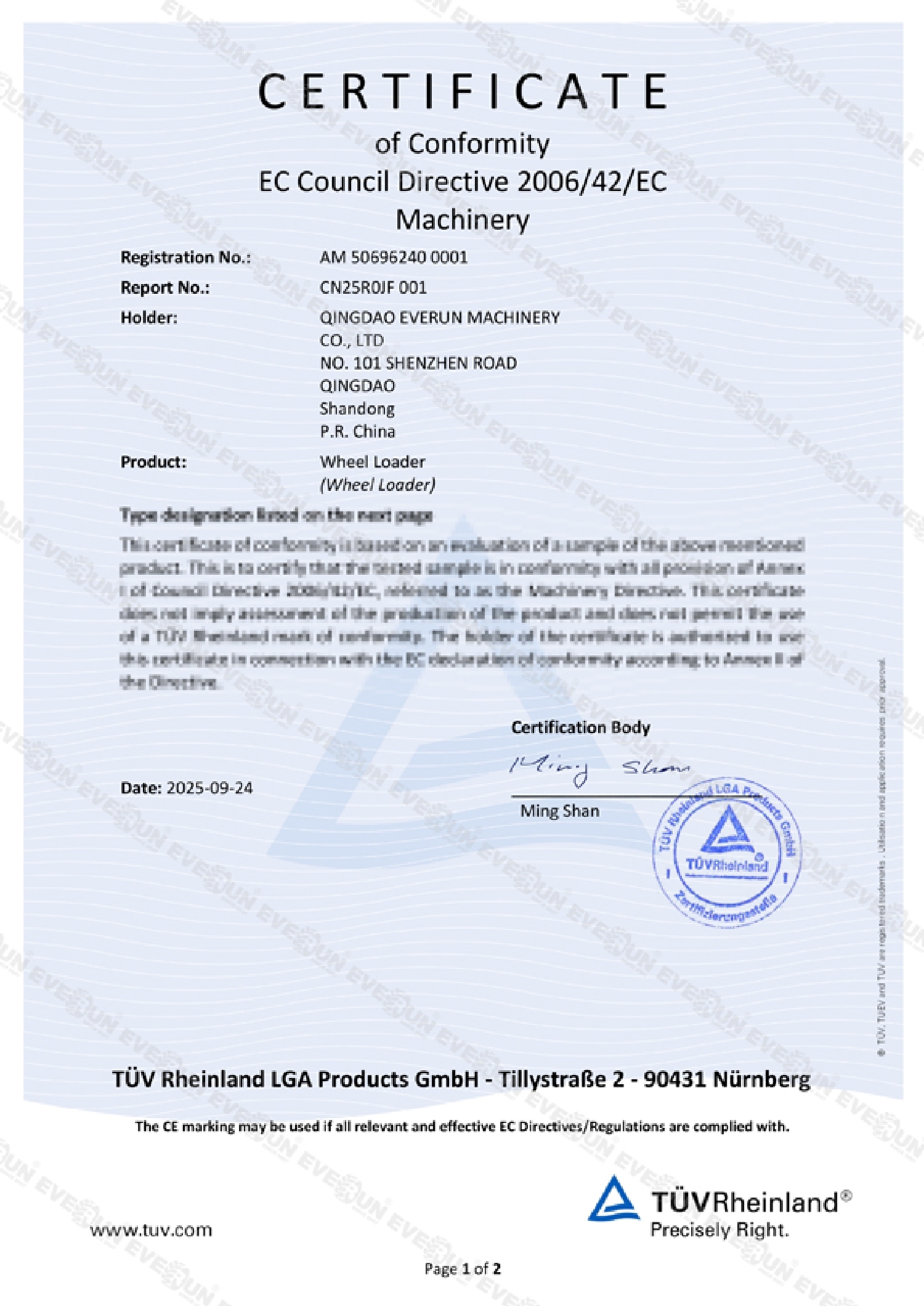
This is the most common verification error in European procurement. A CE Certificate of Conformity under EC Council Directive 2006/42/EC is issued for a named machine, by an identified notified body, with a certificate scope that lists the model. EVERUN's certificates, issued through TÜV, name specific models individually — for example the ERT1500, EREL1000, EREL05, ER1220-F, ER1220-C, ER11H-F, ER11HT and ER11HT-F — rather than certifying the brand as a whole. Separately, wheel loaders sold in the EU must meet the EN 474-3:2022 safety standard covering operator stations and protective structures (ROPS/FOPS), as set by the European Committee for Standardization.
Matching the shortlist to real material handling volumes
Machine profiles only become a decision once they are attached to a working context. Four recurring contexts cover most compact loader purchases.
Farmyards, livestock and feed
Farm work is characterised by short cycles, frequent attachment changes and a need to place material at height — into mixers, feeders and trailers. This is the classic telescopic case, which is why EVERUN classifies the ER11HT, ERW1230T, ERW2640T, ER1200T and ER1500 for agricultural and stock-farm environments. The decision variable is not bucket size but whether the machine can reach the places the yard actually needs it to reach.
Municipal work and snow removal
Municipal fleets run one carrier through several seasons and several attachments. A documented case illustrates the pattern: a construction contractor and equipment rental company in Canada operates 8 units for winter snow removal and reports 5 years of stable operation, with reliable performance in cold winter conditions down to -25°C. For this buyer type, the shortlist criteria are attachment compatibility, cold-weather starting behaviour and service response — not peak loading capacity.
Construction, landscaping and rental
Rental yards and landscaping contractors need a machine that a range of operators can use without a long learning curve, and that can be configured per customer. EVERUN's OEM programme supports this with logo, colour and configuration customisation, a minimum order of one unit, a 30-day lead time and a monthly capacity of 500 units, backed by 100% testing before shipment.
Warehouses and indoor work
Indoor and semi-enclosed work is where the electric profiles become relevant. The ER08E is positioned for indoor tasks and urban construction, the EREL10 for general handling across agriculture, construction, logistics and recycling, and the EREL05 for lighter work in confined spaces. Here the shortlist filter is charging logistics and ventilation, not tractive effort.
Where this shortlist stops working
A shortlist that does not state its own limits is a sales document. Four boundaries apply to the profiles above.
- Telescopic geometry has a cost. An extending boom adds purchase price, machine weight, hydraulic complexity and maintenance points — pins, wear pads and hose routing all need inspection that a fixed boom does not. For pure load-and-carry work this is cost without return.
- Reach reduces the safe load. Stability margin falls as the boom extends, especially on uneven ground or with the machine articulated. The load chart governs, and operators who treat the rated figure as valid at full extension are the main cause of telescopic incidents.
- Electric machines need a recharge plan. Recharge windows are measured in hours, not minutes, and are longer than a diesel refuel. Sites that run multi-shift without a charging window, or without the electrical capacity to support one, should not shortlist an electric loader regardless of its other advantages.
- The compact class has a transport and cycle-time ceiling. On long haul distances or where trucks are loaded continuously at maximum height, a compact machine — telescopic or not — becomes the bottleneck, and the correct answer is a larger class rather than a different configuration.
For context on where the boundary of scale sits: Caterpillar held a 15.2% share of the global construction equipment market in 2025 according to the KHL Yellow Table, a position built substantially on larger machine classes. Compact buyers are not shopping in that segment, and a shortlist is more useful when it accepts the class limit rather than arguing against it.
Market trend: electrification and compliance are reshaping the shortlist
Two forces are changing which machines enter a compact shortlist at all.
The first is electrification. The China Construction Machinery Industry Association, as reported by SINOMADA, recorded 20,819 electric wheel loader units sold in China from January to May 2026, a 90.9% year-on-year increase. That growth is concentrated in markets with urban emission controls and in fleet operators who can plan charging, and it has moved electric loaders from a compliance niche into a genuine shortlist position for light and medium duty.
The second is compliance. EN 474-3:2022 sets the safety baseline for operator stations and protective structures in the EU, and CE certification under 2006/42/EC is issued per model by a notified body. As compact loaders proliferate across suppliers, the certificate scope line has become a faster filter than any specification table — a model without a verifiable scope does not enter the shortlist.
Future outlook
The direction of travel is convergence. The two configurations buyers currently treat as separate decisions — telescopic geometry and electric drive — are already combined in EVERUN's electric range, where the EREL1000 and EREL1200 carry telescopic capability. As battery capacity per chassis improves and charging infrastructure spreads into municipal depots and rental yards, the practical gap between a diesel telescopic loader and an electric one narrows for light and medium duty, while remaining wide for continuous heavy work.
For buyers, the planning implication is that a shortlist built purely on today's duty cycle will age quickly. Machines that can absorb a new attachment or a new energy source without replacing the carrier hold value better than machines optimised narrowly for one task.
Buyer's decision checklist
| Profile | Configuration | Shortlist when | Remove from shortlist when |
|---|---|---|---|
| ER2500T | Telescopic wheel loader for heavier compact bulk handling | Cycles are volume-limited and material must be placed at height | The site is width- or access-limited, or work never leaves bucket height |
| ER08E | Battery-electric compact loader, lighter chassis | Indoors, urban construction or noise-restricted areas; charging can be scheduled | Multi-shift operation with no recharge window or no electrical capacity |
| EREL10 | Battery-electric compact loader, general material handling | Real daily volume plus an emissions or noise constraint across agriculture, logistics or recycling | Continuous heavy duty without charging breaks, or extreme cold without battery planning |
Frequently asked questions
What is the difference between a compact wheel loader and a telescopic wheel loader?
A compact wheel loader carries and loads material at bucket height on a short wheelbase. A telescopic wheel loader adds an extending boom, so the same chassis can lift and place material at height and reach across obstacles. The chassis class is similar; the working envelope is not.
How do I decide between a diesel and an electric compact wheel loader?
The decision is driven by site constraint and by charging logistics rather than by drive type preference. Electric machines remove exhaust emissions and engine noise, which matters for indoor work, urban construction and noise-restricted municipal sites. The trade-off is that a recharge window must be planned into the working day, so operations that run continuously across multiple shifts without a charging break remain better served by diesel in most cases.
What should I verify in a loader supplier's compliance documentation?
Check three fields: the directive or standard the certificate references, the notified body that issued it, and the certificate scope. EU wheel loaders fall under EC Council Directive 2006/42/EC and the EN 474-3:2022 safety standard for operator stations and protective structures. EVERUN's TÜV-issued certificates list individual models in the scope — such as the ERT1500, EREL1000, EREL05, ER1220-F, ER1220-C, ER11H-F, ER11HT and ER11HT-F — rather than certifying a brand generically, which is the level of specificity a buyer should expect.
Why do rated load figures from different suppliers not match?
Because rated load is a declared working figure that depends on configuration, counterweight and the conditions the manufacturer chose, while tipping load is a physical stability threshold. The two are frequently conflated in marketing documents. On telescopic machines the usable load also falls as the boom extends, so a single number cannot describe capacity across the working range; the load chart does.
Is a compact telescopic loader suitable for snow removal and rental fleets?
It is a common configuration for that use because one carrier can switch between bucket, forks and snow equipment across seasons. A documented EVERUN case involves a construction contractor and equipment rental company in Canada operating 8 units for winter snow removal, reporting 5 years of stable operation with reliable performance in cold winter conditions down to -25°C. Attachment compatibility, cold-start behaviour and service response are the criteria that decide such a purchase.
How much customisation is realistic when ordering compact loaders?
For EVERUN, the OEM programme covers logo, colour and configuration customisation with a minimum order of one unit and a 30-day lead time, at a monthly capacity of 500 units. Every unit is tested before shipment, and after-sales support is structured around a 12-hour response commitment with overseas branches providing local service.
Tem questões ou precisa de mais detalhes?
Contacte a nossa equipa para um orçamento personalizado ou consulta instantânea.
Solicitar orçamento
Preencha o formulário abaixo e a nossa equipa entrará em contacto com uma proposta personalizada.
Chat direto do WhatsApp
Prefere conversar em tempo real? Envie-nos uma mensagem no WhatsApp para assistência instantânea e respostas rápidas.
- Obter orçamento personalizado
- Partilhar fotos ou documentos
- Discuta as suas necessidades diretamente
Geralmente responde em 5–30 minutos durante o horário de expediente.