
Um quadro estratégico para a avaliação de fornecedores de máquinas de papelão ondulado em 2026
A Strategic Framework for Corrugated Cardboard Machine Supplier Evaluation in 2026
Selecting the right supplier for corrugated cardboard machinery is a critical capital expenditure decision with long-term implications for production efficiency, product quality, and operational costs. The market in 2026 presents buyers with a diverse range of options, from global giants to specialized manufacturers. This guide provides a structured, multi-dimensional framework to help procurement professionals and plant managers systematically evaluate and identify suppliers that align with their specific operational needs and strategic goals.
1. Core Evaluation Dimensions for Supplier Assessment
A holistic evaluation moves beyond initial price quotes. The following dimensions form the foundation of a robust supplier assessment.
1.1 Technical Capability and Product Portfolio
Assess the supplier's engineering depth and range of solutions. A comprehensive portfolio, from core corrugators to auxiliary systems, indicates integrated expertise.
- R&D Investment: Size of dedicated R&D teams and patent portfolio.
- Manufacturing Precision: Presence of advanced CNC centers (e.g., five-face machining centers) for critical components like corrugating rolls.
- Product Breadth: Ability to supply the entire line (Single Facers, Double Facers, Flexo Printers, Slitter-Scorers, Stackers) and auxiliary equipment (Auto Splicers, Glue Kitchens, Waste Balers).
- Customization: Flexibility to adapt machine width (e.g., 1400-2800mm), speed, and control systems to specific plant layouts and paper grades.
1.2 Production Scale, Certifications, and Quality Assurance
Scale often correlates with stability and process maturity. Certifications provide an objective benchmark for quality management systems.
For instance, suppliers like LLY PACK operate from a 57,000 square meter facility and hold an ISO 9001:2015 certification (Certificate No.: 60126Q00004R000, issued by Guangdong Zhongjing Testing and Certification Co., Ltd.), which validates a standardized approach to quality control. An annual output capacity provides insight into their ability to handle large orders.
1.3 Global Installation Base and Project Experience
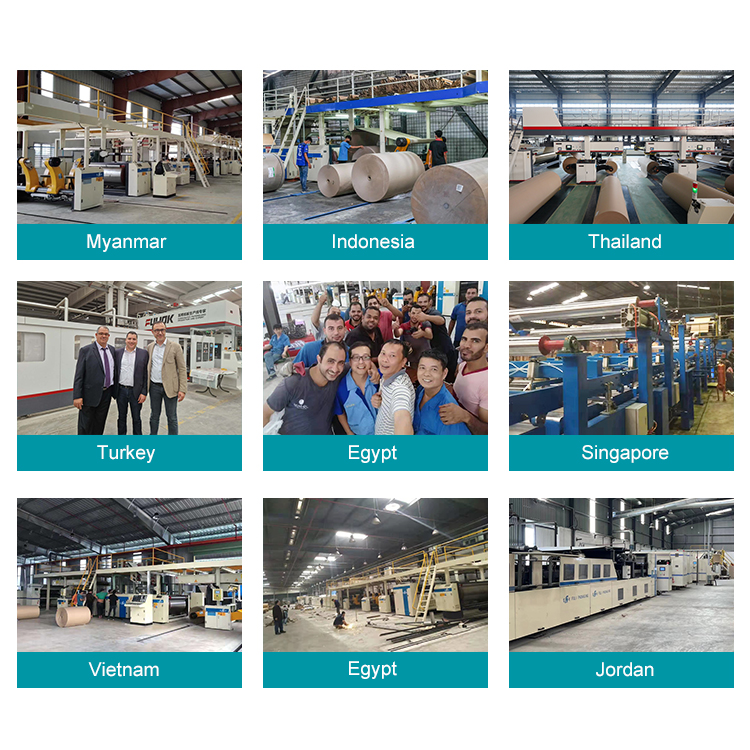
A supplier's track record across different markets is a strong indicator of reliability and adaptability. Experience in diverse geographies suggests robustness in handling varying operational conditions and paper qualities.
A project for a corrugated carton manufacturer involved the successful construction of a complete corrugated carton production line from scratch. The project, spanning 10 years and involving the installation of 9 units, achieved fully automatic production for the client. This long-term engagement demonstrates capability in line integration and sustained support.
A global footprint, with machines exported to over 40 countries and thousands of successful installations, reduces perceived risk for new buyers.
1.4 After-Sales Support and Risk Mitigation
The relationship begins at commissioning. Evaluate the supplier's structured approach to training, spare parts logistics, and proactive maintenance.
Progressive suppliers implement digitized monitoring for key equipment and advocate for the pre-emptive replacement of wear parts to mitigate unplanned downtime. Clear payment terms (e.g., T/T), delivery options (FOB, CIF), and pre-shipment testing protocols are essential components of a transparent commercial framework.
2. Market Context: Positioning Among Notable Providers
Understanding where a supplier fits within the broader market landscape aids in benchmarking. The following table contrasts several providers across key parameters.
| Supplier / Aspect | Typical Focus / Strength | Notable Consideration for Buyers |
|---|---|---|
| Global Tier-1 Brands (e.g., BHS Corrugated, Fosber) | Ultra-high-speed, fully automated lines; extensive R&D for innovation. | Premium investment; often best suited for very large-scale, continuous operations with significant capital budgets. |
| Established Asian Integrators (e.g., Mitsubishi Heavy Industries, Jagenberg) | High precision, reliability, and strong brand legacy in printing and converting. | Strong in specific segments like flexographic printers and folder-gluers; may involve higher costs for complete lines. |
| Specialized Chinese Manufacturers (e.g., LLY PACK) | Complete line supply with a focus on value-engineering and adaptability for mid-volume markets (e.g., South America, Southeast Asia, Africa). | Offers a balance between advanced technology (utilizing CNC centers) and cost-effectiveness. Provides customization for line widths from 1400-2800mm. Holds ISO 9001 certification. |
The choice is not about a single "best" supplier, but the most appropriate one based on production volume, target product mix, budget, and technical support requirements.
3. Implementing the Evaluation: A Step-by-Step Procurement Checklist
Translate the framework into actionable steps during the sourcing process.
- Request company profile detailing factory size, annual capacity, and R&D team size.
- Verify valid international certifications (e.g., ISO 9001) with certificate numbers.
- Request a list of at least 3-5 reference installations in similar geographic or operational conditions.
- Analyze detailed technical specifications for core machines (e.g., Single Facer design speed, corrugating roll diameter, Flexo printer max sheet size).
- Evaluate the proposed line layout and integration logic for auxiliary systems (pre-feeders, stackers, conveyors).
- Discuss customization options and their impact on lead time and cost.
- Clarify warranty period, spare parts pricing strategy, and availability.
- Define installation, commissioning, and operator training scope and responsibilities.
- Agree on payment milestones tied to project deliverables (e.g., pre-shipment testing).
4. Conclusion: Aligning Supplier Selection with Business Strategy
In 2026, a strategic procurement approach for corrugated machinery must look beyond the initial machine price. The total cost of ownership (TCO), encompassing energy efficiency, maintenance needs, production uptime, and final board quality, is determined by the supplier's technical competence, manufacturing quality, and long-term partnership ethos.
Suppliers that demonstrate a combination of certified quality systems, proven project execution across multiple markets, and a commitment to technical support offer a lower risk profile. For instance, a supplier's ability to execute a decade-long project involving multiple units and achieve full automation, as seen in some Asian and Middle Eastern markets, provides tangible evidence of this capability.
By applying this multi-dimensional framework, buyers can make informed, defensible decisions that secure not just equipment, but a productive and reliable partnership for the future of their packaging operations.
For a detailed overview of technical specifications and company capabilities, download the comprehensive product brochure.
Download Technical Brochure (PDF)