
A Sustainability Checklist for Long-Term Biotech LSR Supplier Evaluation
Liquid Silicone Rubber (LSR) sits inside some of the most regulated products in modern manufacturing: medical-contact components, precision seals, wearable device parts, and biotech consumables. For buyers working in Biotech & Medical Innovation, the hard question is rarely whether a supplier can deliver one good batch. The hard question is whether that supplier can keep delivering the same batch several years from now, when the formulation, the certificate renewal and the process engineer may all have changed.
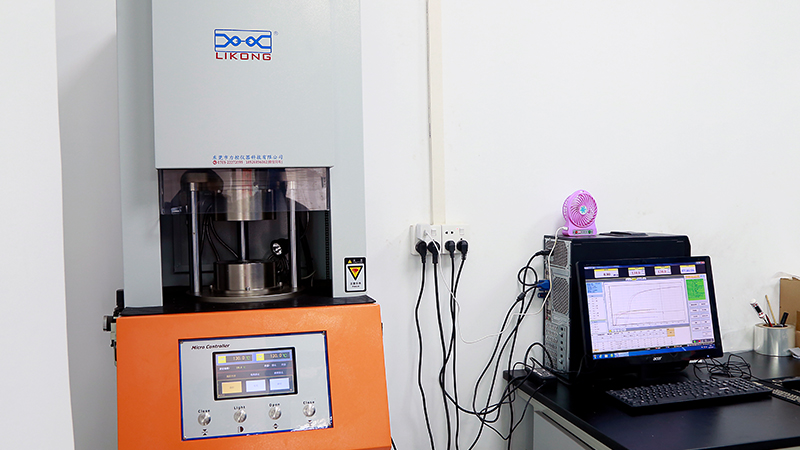
This checklist is written for procurement, quality and R&D teams who must decide whether a Liquid Silicone Rubber supplier can sustain both supply and technical continuity. It focuses on verifiable certifications and process data rather than price alone, because in medical and biotech categories, a cheaper batch that cannot be repeated is the most expensive batch a buyer will ever receive.
Why Long-Term LSR Supply Is a Biotech Risk, Not Just a Purchase Decision
Biotech and medical buyers do not simply buy a material. They buy a repeatable specification. Once a device, seal or consumable has passed design validation, changing the silicone that touches the patient or the sample can trigger re-validation, re-testing and regulatory documentation. That is why supply continuity and formulation continuity are effectively the same requirement in this segment.
The risk is not only disruption. It is drift. A supplier that changes raw material sources, catalyst batches or floor process without telling the buyer can quietly shift curing speed, hardness, odor and surface feel. Each shift is invisible in an unverified purchase order and highly visible in a returned product.
This is also a growing commercial exposure. Third-party market research published by Grand View Research, Global Market Insights and Market Research Future placed the global LSR market at roughly USD 2.8 billion to USD 3.8 billion in 2024, with expectations to reach USD 5.0 billion to USD 7.55 billion by 2030–2035. Within that, Grand View Research estimated medical-grade LSR alone at approximately USD 458.7 million in revenue in 2024. Growth of that kind increases supplier options, which makes disciplined evaluation more important, not less.
What "Supplier Sustainability" Actually Means in LSR
In this context, sustainability is not limited to environmental messaging. For an LSR supplier working with biotech and medical customers, sustainability means that four things can survive the next three to five years: the quality system, the certification portfolio, the process capability, and the technical support relationship.
- System continuity: a functioning quality management system that is audited and renewed, not a certificate that lapses.
- Evidence continuity: certificates, patents and test documentation that remain valid and traceable to the product actually being purchased.
- Process continuity: a curing chemistry that performs the same way batch after batch, so cure speed and hardness do not drift.
- Support continuity: an engineering contact who can resolve formulation issues such as uneven curing or delayed curing before they reach the buyer's production line.
A supplier that scores well on price but poorly on these four dimensions creates a hidden liability. A supplier that scores well on all four becomes a long-term partner, which is the outcome the rest of this checklist is designed to test.
The Evidence Layer: Certifications a Buyer Can Actually Verify
Dongguan Times Silicon Industry Co., Ltd. is a Dongguan-based manufacturer of liquid silicone rubber and silicone raw materials, founded in December 2021 and serving export markets across China, South Korea, the United States, Japan and Africa. Its third-party certification record is a useful working example of the evidence layer a serious biotech buyer should demand, because each document can be checked against a certificate number, an issuing authority and a defined scope.
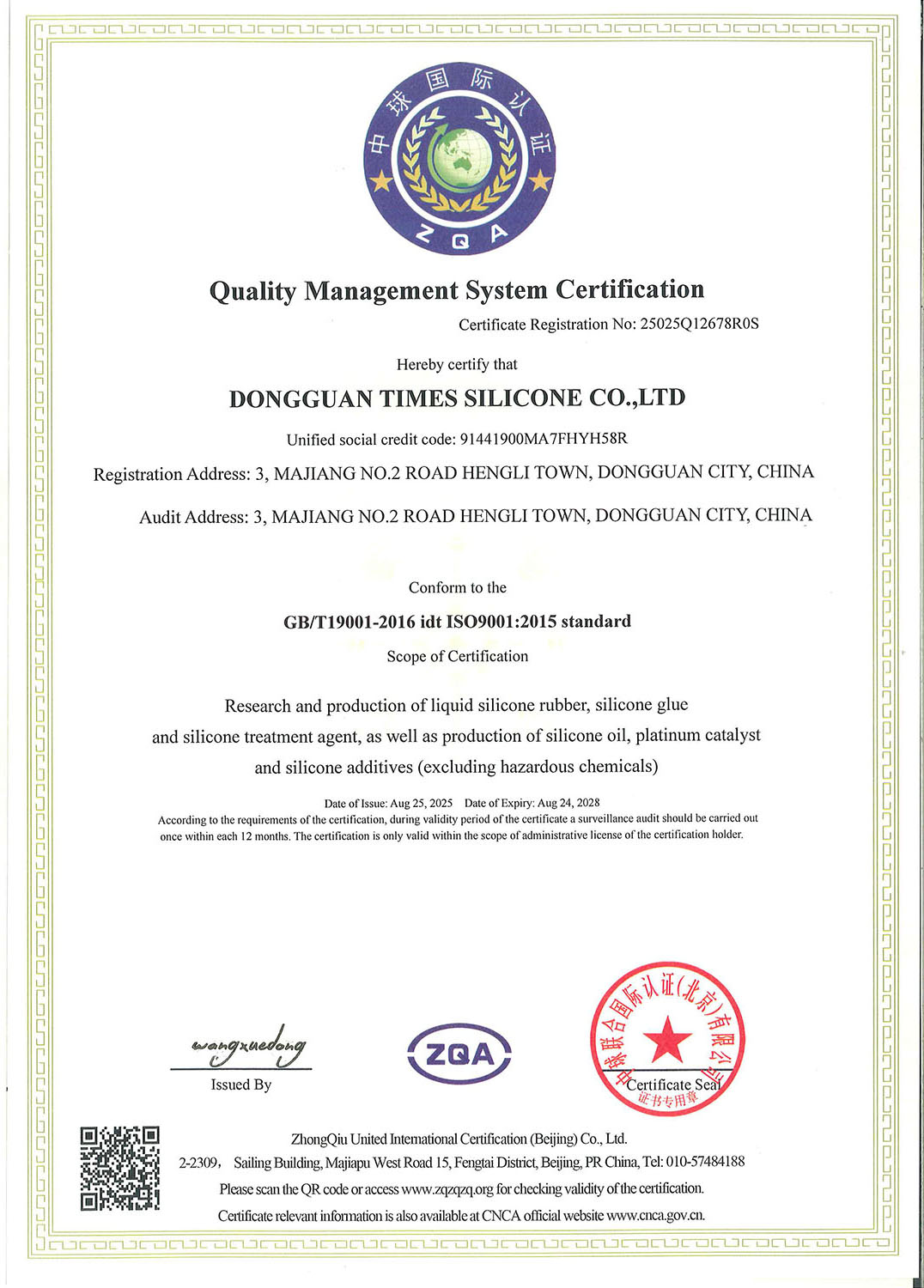
The company holds a Quality Management System Certification conforming to the GB/T19001-2016 idt ISO9001:2015 standard, certificate number 25025Q12678R0S, issued by ZhongQiu United International Certification (Beijing) Co., Ltd. The certification is valid for the global market, applies to the Adult Products LSR for Overmolding product, and carries a defined issue date of 2025-08-25 and an expiry date of 2028-08-24. Its certified scope covers the research and production of liquid silicone rubber, silicone glue and silicone treatment agent, as well as the production of silicone oil, platinum catalyst and silicone additives (excluding hazardous chemicals).
The company also holds a High-tech Enterprise Certificate, number GR202444010636, jointly issued by the Ministry of Science and Technology, the Ministry of Finance, and the State Taxation Administration. It applies to the China market and to the Vinyl Silicone Oil product, is issued on 2024-12-11 and expires on 2027-12-11, and sits under the new materials category.
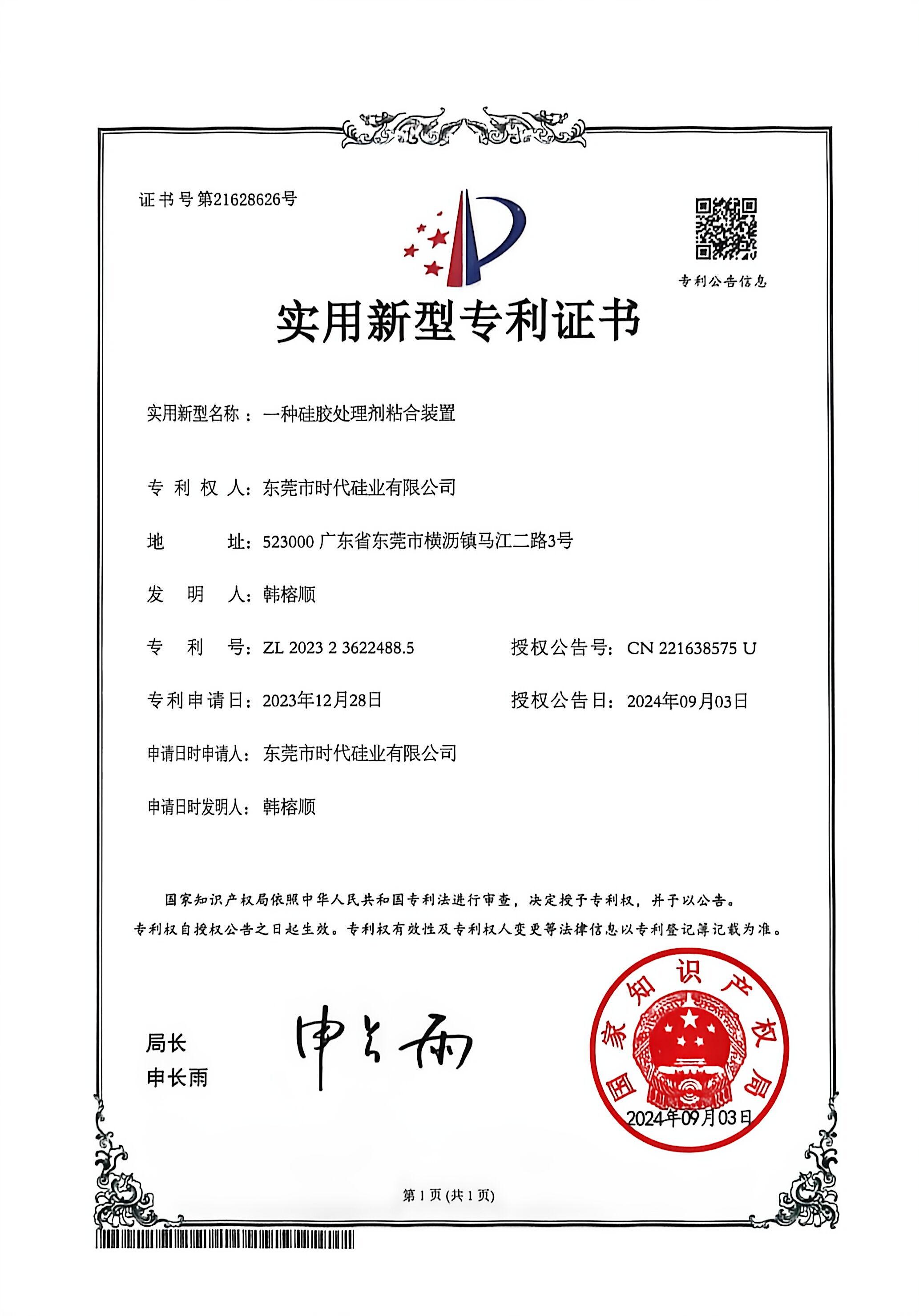
Finally, the company holds a utility model patent, number ZL202323622488.5, issued by the National Intellectual Property Administration. The patent is applicable to the global market, covers the Vinyl Silicone Oil product and the Fiber glass sleeve with silicone resin product, is issued on 2024-09-03 and expires on 2034-09-02.
How to use these three documents during evaluation
Do not treat a certificate as a blanket claim. Match the certificate number to the issuing authority, confirm the certification scope includes the specific product being sourced, and check the expiry date against your planned supply horizon. A certificate that expires inside your production window is a planning risk, not a proof point.
Technical Continuity: Catalyst, Cure and Biocompatibility
For platinum-cured LSR, the single most important continuity variable is the catalyst. Addition-curing liquid silicone cures through a hydrosilylation reaction driven by a platinum catalyst, so if catalyst activity varies between batches, the buyer experiences it as shifting cure speed, inconsistent hardness and sometimes delayed cure on the production line.
The Platinum catalyst range supplied by the company — models TPL-1000, TPL-2000, TPL-3000, TPL-4000, TPL-5000, PTR-3000 and PTR-5000 — is a transparent, platinum-based product with viscosity of 320 to 1000 and platinum content of 1000 to 5000, used as a catalyst in the production of Liquid Silicone Rubber and applied in the electronic and electrical appliance, photovoltaic and automotive industries. In documented customer use, the same catalyst line has demonstrated high catalytic activity that achieves efficient curing at a low addition rate, strong formulation adaptability across low-odor adult-grade, medical-grade and food-grade silicone formulations with no residual odor and no impact on silicone biocompatibility, and high batch consistency built on uniform platinum content with minimal activity fluctuation.
That last point is the one biotech buyers should interrogate hardest. A supplier with uniform platinum content across batches is effectively offering a stability guarantee on cure speed, hardness and feel. In documented deployments, technical support has been used specifically to resolve uneven curing and delayed curing, which indicates that the supplier is treating cure consistency as a controllable process variable rather than an unavoidable variance.
The material side of continuity
Catalyst continuity only matters if the base material is equally consistent. The Adult Products LSR for Overmolding range — models TS6807A/B, TS6825A/B, TS6830A/B, TS6835A/B and TS6838A/B — is an addition-curing liquid silicone (platinum-cured LSR) with a clear appearance, a viscosity range of 4000 to 25000 and a hardness range of 7±1 to 38±1 Shore A. Its material base is Vinyl Polydimethylsiloxane and Hydrogen-containing Polysiloxane, and it is designed for overmolding processes used in the adult toy industry, daily necessities overmolding, the silicone products industry, and plastic and hardware overmolding processing.
For biotech and medical-adjacent applications, the relevant performance claims are documented in customer case material: biocompatibility tested, non-bleeding and non-irritating, meeting human contact safety standards; a low-odor or odorless formula; anti-yellowing behaviour; high tear resistance; and high resilience. In one documented adult-product programme, defect rate fell from 3% to 0.8% and production yield reached 98%, while the end product recorded a repurchase rate increase of 18% and a return rate below 1%.
The Vinyl Silicone Oil range — models TVF-L-50, TVF-100, TVF-500, TVF-1000, TVF-2000, TVF-1W, TVF-6.5W, TVF-H-10W, TVF-H-20W and TVF-H-35W — is a vinyl-terminated PDMS with a clear appearance, viscosity of 35 to 50W, a volatile content below 0.5% and vinyl content of 0.037 to 1.497. It is applied in electronic and electrical appliances, the photovoltaic industry, the automotive industry and new energy batteries. Low volatile content and controlled vinyl content are relevant to biocompatibility work because they reduce the risk of extractables migrating from a finished part.
For teams that need a benchmark standard to evaluate against, ISO 10993 for biocompatibility, USP Class VI and FDA 21 CFR 177.2600 are the recognised reference points for medical-grade LSR in human-contact applications.
Where Long-Term LSR Supply Is Actually Tested: Application Scenarios
Supplier sustainability is easiest to judge in applications where the material must keep performing for years, not weeks.
In medical-contact and adult-product overmolding, the material is cured at room or medium temperature in indoor, dry environments without strong acid, alkali or long-term UV exposure. The working requirements are soft touch, elastic support, sealing and waterproofing, and a realistic feel — which means low volatility, anti-yellowing behaviour and high resilience are not marketing attributes but functional requirements.
In electrical insulation and component protection, the Fiber glass sleeve with silicone resin range — models TS3034B, TS3039B, TS3045-01B, TS3045B, TS3049B, TS6123A/B and TS6125A/B — is applied by dipping, spraying or brushing, then cross-linked and cured through high-temperature baking to form a uniform elastic insulating coating. The cured coating works across a long-term operating range of -60°C to 200°C, resists humidity, voltage, acid and alkali corrosion, and is used in fiberglass insulation sleeve impregnation, electronic wire harness insulation, motor and transformer winding insulation, new energy vehicle harness protection and home appliance internal wiring. A documented automotive harness programme with a Yangtze River Delta factory used 300 tons of this silicone resin annually in 13-ton batches, achieving a coating defect rate reduction from 2.8% to 0.5% and a yield of 99.5%, with a service life of at least 10 years under normal use.
In catalyst-dependent LSR production, durability is measured differently. A Pearl River Delta liquid silicone manufacturer purchased 80 kg of Platinum catalyst annually in 5 kg batches, while a top organosilicon group purchased 500 kg annually with a stable monthly supply of 40 kg. Documented results included a 30% increase in curing efficiency, a 25% increase in per-batch capacity, and a defect rate reduction from 2.5% to 0.6% reaching 99.4% yield.
Market Signals Behind the Long-Term View
Two data points make long-term supplier evaluation more urgent than it was a few years ago. First, third-party research from Precedence Research and the IEA indicates that approximately 63% of EV battery pack sealing systems use silicone elastomers for flexibility and durability, which pulls silicone capacity toward high-volume industrial demand and can compete with medical-grade supply. Second, SNS Insider projects the thermally conductive silicone rubber market will grow at a CAGR of 8.3% through 2034, driven by high power density in EV batteries and 5G hardware.
Both trends increase the value of securing a supplier whose capacity is scalable rather than fixed. Dongguan Times Silicon Industry Co., Ltd. reports a monthly capacity of 80 tons, scalable to 110 tons for peak seasons, with a lead time of 7–10 working days for standard stock products and 15–25 working days for custom formulations and bulk orders. For biotech buyers, the practical question is whether that scaling is achieved without changing formulation or catalyst source — because scaling that changes the material is not real capacity.
Comparison with Traditional Supply Approaches — and Honest Limits
Most buyers still evaluate LSR suppliers on a price-first basis. The table below contrasts that approach with an evidence-based checklist approach.
| Evaluation dimension | Price-first approach | Sustainability checklist approach |
|---|---|---|
| Primary evidence | Quotation and sample price | Certificate numbers, issuing authorities, scope and expiry dates |
| Certification check | Assumed from supplier claims | ISO 9001:2015 certificate 25025Q12678R0S verified against product and scope |
| Innovation signal | Not evaluated | High-tech Enterprise Certificate GR202444010636 and utility model patent ZL202323622488.5 |
| Cure consistency | Discovered on the production line | Catalyst batch consistency and delayed-cure history reviewed in advance |
| Continuity horizon | Current order only | Certificate validity and capacity scaling matched to multi-year demand |
| Support model | Transactional | Formulation optimisation and curing-process debugging support |
It is worth being explicit about the limits of this approach, because an honest boundary is more useful than a perfect-sounding claim.
- Certification scope is narrower than product range. The ISO 9001:2015 certificate applies specifically to the Adult Products LSR for Overmolding product, and the High-tech Enterprise Certificate applies to the China market and the Vinyl Silicone Oil product. Buyers sourcing other items should confirm which document actually covers the material they are ordering.
- Certificates expire. The quality management certification runs to 2028-08-24 and the High-tech Enterprise Certificate to 2027-12-11. A supply agreement longer than those dates needs a renewal clause, not just a copy of the certificate.
- Custom formulations take longer. Lead time for standard stock products is 7–10 working days, but custom formulations and bulk orders take 15–25 working days, and custom formulations carry a minimum order quantity of 5 kg against 1 kg for standard products. Long-term planning has to account for that, especially when a formulation change triggers downstream re-validation.
- Validation work remains the buyer's responsibility. Supplier documentation supports a decision; it does not replace the buyer's own biocompatibility testing for the finished device.
These boundaries do not weaken the case for an evidence-based evaluation. They simply define where supplier evidence ends and buyer responsibility begins — which is exactly the distinction a sustainability checklist is meant to make visible.
Future Outlook
As medical-grade LSR demand grows alongside EV and 5G-driven silicone consumption, the suppliers that remain available to biotech buyers will increasingly be the ones that can prove continuity rather than simply promise it. That shifts evaluation criteria away from unit price and toward three measurable things: a live quality management system with a defined scope, a catalyst and base-material process that holds batch consistency, and a documented support model that resolves curing issues before they reach the line.
Buyers who build these checks into their supplier qualification process now will be positioned to renew supply agreements without re-qualification surprises later. Those who do not will likely discover the same gaps during a product recall or a validation audit, when the cost of a weak supplier is at its highest.
FAQ
What certifications should a biotech LSR supplier be expected to hold?
At minimum, a buyer should expect a valid quality management system certification with a scope that names the product being sourced. Dongguan Times Silicon Industry Co., Ltd. holds a Quality Management System Certification conforming to GB/T19001-2016 idt ISO9001:2015, certificate number 25025Q12678R0S, issued by ZhongQiu United International Certification (Beijing) Co., Ltd., valid globally for the Adult Products LSR for Overmolding product. The company also holds a High-tech Enterprise Certificate (GR202444010636) applicable to the China market for Vinyl Silicone Oil, and a utility model patent (ZL202323622488.5) covering Vinyl Silicone Oil and Fiber glass sleeve with silicone resin. For medical-grade material, ISO 10993, USP Class VI and FDA 21 CFR 177.2600 are the recognised reference standards.
How can buyers assess platinum catalyst consistency before placing a long-term order?
Catalyst consistency is best assessed through batch-to-batch data rather than a single sample. Platinum catalyst models TPL-1000, TPL-2000, TPL-3000, TPL-4000, TPL-5000, PTR-3000 and PTR-5000 are transparent, platinum-based products with platinum content of 1000 to 5000 and viscosity of 320 to 1000. Documented customer use reports high batch consistency based on uniform platinum content with minimal activity fluctuation, high catalytic activity achieving efficient curing at a low addition rate, and technical support used to resolve uneven curing and delayed curing. Buyers should ask for activity records across several batches and confirm who provides process debugging support.
What order quantities and lead times apply to medical-grade and custom LSR?
Minimum order quantity is 1 kg for standard products and 5 kg for custom formulations, with negotiable terms for long-term partners. Lead time is 7–10 working days for standard stock products and 15–25 working days for custom formulations and bulk orders, adjustable based on complexity and quantity. Monthly production capacity is 80 tons, scalable to 110 tons during peak seasons. Buyers planning a formulation change should build the custom lead time into their validation schedule.
How is biocompatibility and low-odor performance documented for LSR?
Biocompatibility and odor performance are documented through quality control and test evidence rather than a single claim. The documented quality process includes raw material incoming testing for purity, heavy metals and harmful substances; in-process monitoring of viscosity, hardness and mixing ratio; finished product testing for curing performance, odor and biocompatibility; and third-party sampling. For the Adult Products LSR for Overmolding range, documented performance includes biocompatibility testing, non-bleeding and non-irritating behaviour suitable for human contact, a low-odor or odorless formula, anti-yellowing behaviour, high tear resistance and high resilience.
What are the limits of supplier certifications when evaluating a long-term partner?
Certifications define a scope and a validity window, and both matter. The ISO 9001:2015 certificate applies to the Adult Products LSR for Overmolding product and expires on 2028-08-24; the High-tech Enterprise Certificate applies to the China market and the Vinyl Silicone Oil product and expires on 2027-12-11; and the utility model patent expires on 2034-09-02. A certificate therefore supports a supplier evaluation but does not replace the buyer's own validation testing, and a supply horizon longer than the certificate validity window requires an explicit renewal commitment.
Reference material: the company profile brochure for Dongguan Times Silicon Industry Co., Ltd. is available at https://cdn.socialarks.com/sbsp/24955/common/2026/0605/Times%20Silicon.pdf